Members
The Weekly Brief
The best of SHOWSIGHT editorials, weekly wins, and breeder commentary — delivered to your inbox every Sunday morning.
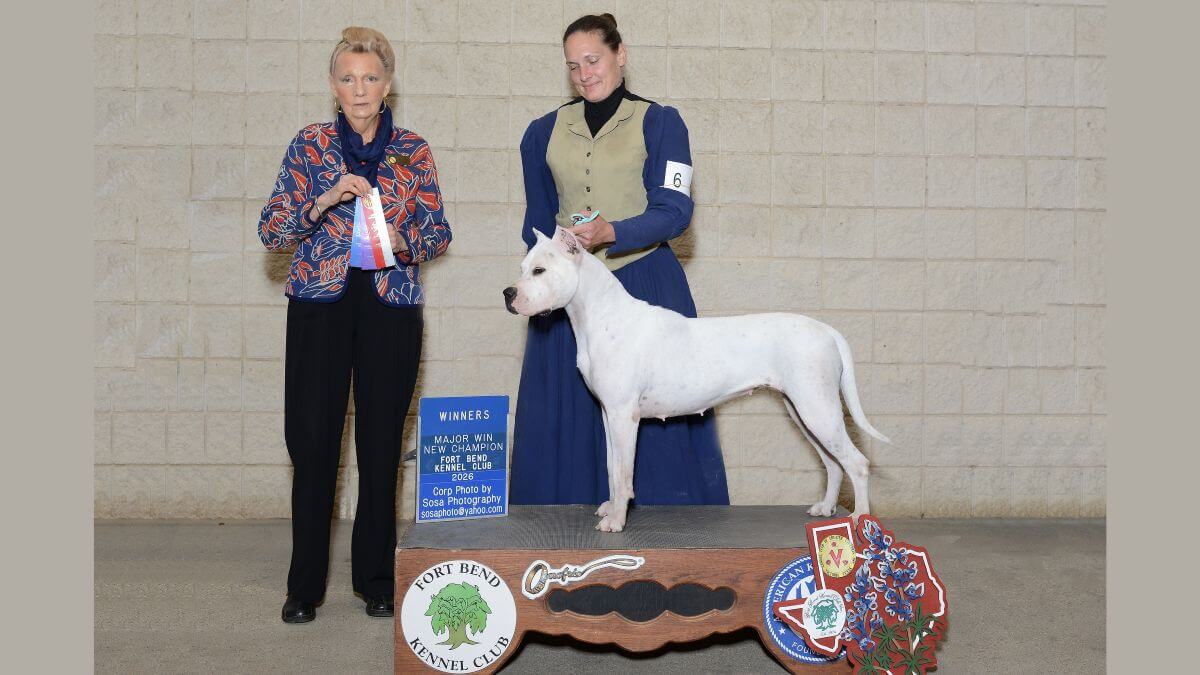
Rebecca Fletcher is the owner and founder of DoubleD Creek Ranch and Balanced Canine Services, a veteran-owned canine training, behavior, and breeding operation based in De Kalb, Texas. Her business provides private training, group classes, behavior modification, service dog training, board-and-train programs, and canine nutritional consulting. The ranch also serves as the home of her natural rearing Dogo Argentino breeding program.
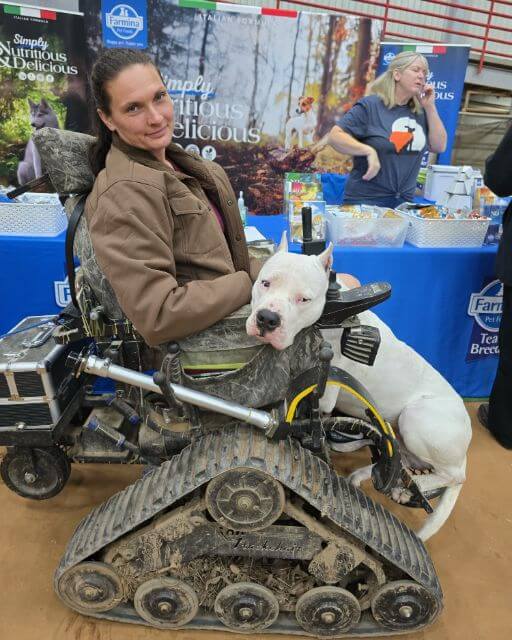
A retired United States Marine, Rebecca’s entry into professional dog training began with training her own service dog following a life-changing amputation. She subsequently completed an apprenticeship under an experienced service dog trainer and eventually established and operated her own training kennel before relocating to Texas. She currently has more than a decade of professional training experience and holds certifications as a CPDT-KA (Certified Professional Dog Trainer-Knowledge Assessed) and Certified Professional Canine Nutritionist.
Rebecca is widely recognized for her balanced training philosophy, emphasizing clear communication, relationship-building, and individualized programs tailored to each dog-and-owner team. Through her educational writing and public outreach, she addresses topics such as canine body language, socialization, behavior modification, balanced training methods, and responsible use of training tools.
In addition to her work as a trainer, Rebecca is an active preservation breeder and exhibitor of Dogos Argentinos under the Diavol Dogos kennel name. Her breeding philosophy incorporates natural rearing principles, with a strong emphasis on health, nutrition, working ability, temperament, and breed preservation. Her dogs participate in Conformation and Performance events as well as hunting activities.
Throughout her career, Rebecca has become an advocate for resilience, often sharing her personal journey of overcoming significant physical challenges while building a successful canine career. She frequently speaks about the importance of perseverance, grace, and the transformative role dogs can play in people’s lives.
Dédé Wilson: Rebecca, thank you so much for doing this interview with us. You came to my attention when I saw a video of you with one of your Dogos trialing in Rally. I am a Dogo fan, noticed your leg prosthetic, and was captivated by you and your dog team.
You have described dogs as playing a pivotal role in your own recovery and personal journey. Can you tell us about that experience and how it ultimately shaped your career?
Rebecca Fletcher: When I first retired, it was a hard adjustment. I was self-training my first Dogo as a service dog; he pushed me to go out when I did not want to. Knowing I was responsible for him helped me when I did not want to be alive anymore. I attribute my still being here to him. As you can imagine, I had a great deal to learn and significant growth to work through. I was angry, anxious, and learning to adapt to a world not built for me. Dogs are a mirror, and whatever you project onto them, they reflect onto you. You cannot walk into a kennel to start training dogs if you are angry and anxious; I learned self-reflection, I practiced grounding skills, and I worked to grow because my dogs were important and I needed to be the best version of me for them. Now as a service dog trainer, I use my ability to control my emotive state to train tasks related to anxiety.
Dédé Wilson: How did your background as a Marine influence your approach to dog training, business ownership, and competition?
Rebecca Fletcher: The Marines are known for the discipline they instill. As a Marine, I had no hair out of place. I learned body awareness and control, skills that are vital in dog training because dogs communicate with body language. A slight shift of weight can make or break you when dealing with an aggressive dog. As a Sergeant, I led Marines and I taught classes, so these skills aided me in teaching the other end of the leash—because we all know humans need more than dogs do. Navigating interactions with civilians was a learning curve compared to the more assertive style I needed when leading Marines.
Dédé Wilson: What first attracted you to the Dogo Argentino? For readers unfamiliar with the breed, what characteristics make the Dogo unique?
Rebecca Fletcher: Their uniquely striking appearance! The Dogo is a fierce big game “catch dog.” They are built to find and catch their own prey. Dr. Martinez developed the Breed Standard he wanted the Dogo to have and then built the dog to that Standard. Dogos can trot for miles, have enough endurance to sprint in for the catch, and still have even more to fight a large boar once they have a hold of them. Then they come home and, if you let them, they will live in your skin. Their love and devotion, in my opinion, is unmatched. I love this breed with all my being. I have trained many breeds, and find many intriguing, but none of them hold a candle to the Dogo Argentino for me. My Shiba Inu is a close second!
Dédé Wilson: How do you balance preserving breed type with maintaining health, temperament, and functional ability?
Rebecca Fletcher: For me, I have non-negotiables. The Dogo is a “head breed.” You should know a Dogo by the outline of the head. I will not compromise the head, therefore will not use any dogs in my program with incorrect head type.
My second is temperament. This breed has been normalized as same-sex aggressive, but these are hunting dogs. They should be able to be dropped in the woods with dogs they have not previously hunted with and have a singular focus… catch that hog. They should be of stable mind; you do not need a 100-pound dog with a 500-psi bite overreacting to the existence of other same-sex dogs in the vicinity. Temperament is an indication of a stable nervous system.
Each piece of our Breed Standard was specifically designed to make the Dogo a superior catch breed. Form and function are not separate. Sure, a poorly built dog may still do its job and do it well, but how much faster will their body break down? A Dogo feels no pain, so they will not stop just because it hurts. But that does not mean I should accept poor structure to have a strong hunter. All my dogs get tested on hogs; they all end up in the woods at some point.
Dédé Wilson: What role do Conformation and Performance events play in your breeding program?
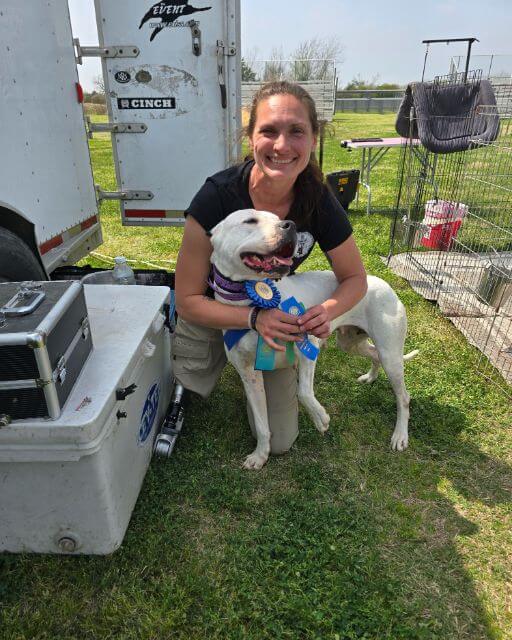
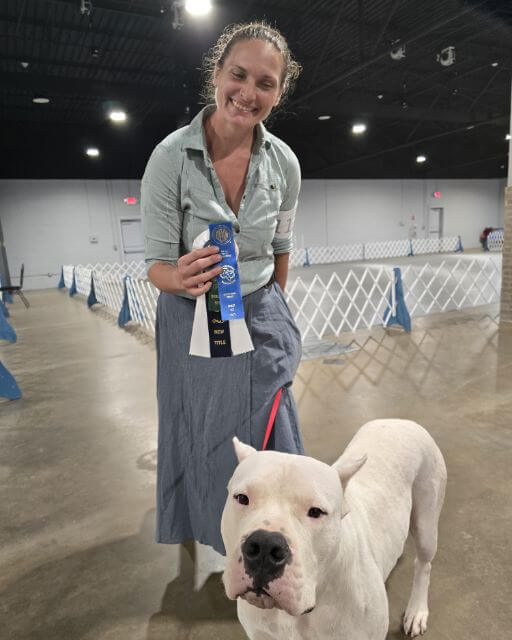
Rebecca Fletcher: It is important to demonstrate the versatility of my lines. Not everyone hunts, and that is okay, but dogs need a job; they need enrichment. And dogs can heal. So, showing that my dogs can go from the woods to the Conformation ring, to the Rally or Obedience ring, demonstrates the versatility, the biddability of my dogs. Furthermore, it shows a stable nervous system. Each of my dogs has their strengths and may not enjoy or excel at each facet, but they do it to please me and that is what I like to see in my dogs.
Dédé Wilson: What challenges currently face preservation breeders of Dogos Argentinos?
Rebecca Fletcher: Well, again, they are a catch dog, but the world is increasingly against “blood sports.” Even within the American Kennel Club (AKC) our dog’s purpose is not well received. People do not understand that we crop to prevent ear injury that could result in death. More often, people do not understand that dogs are still dogs, not humans; they require a job, a purpose. You cannot buy a breed of this caliber and expect it to lounge around on the couch without a job or purpose.
Dédé Wilson: Running a training facility, breeding program, and educational platform simultaneously is no small feat. How do you balance those many responsibilities?
Rebecca Fletcher: I focus on quality not quantity. I do not want to have a huge training facility that requires multiple trainers to manage. I want my clientele to feel that they got the best of me each time, that their dog in training was given the same time and consideration I give my own. To accomplish that I keep things small. I do not want several litters a year. If I breed a litter it is because I want a puppy from that breeding specifically, as it is a vital step in my breeding end goal. I stay focused on quality. I take time off for my health when I need it. I give myself grace when necessary. I let God lead me in my decisions for my business and personal life, no matter how big or small.
Dédé Wilson: You often speak about “giving yourself grace.” What does that phrase mean to you today? And how do you think it applies to your clients, or dog people in general?
Rebecca Fletcher: Grace is the unmerited gift of God’s love; it is the foundation that makes forgiveness possible. I have always had high expectations for myself; the Marine Corps amplified that and trained me as a warfighter. Early on, I spent many mornings at 0300 in the ER because of severe pain episodes. (Phantom limb pain is nerve pain; it is impacted by the nervous system.) As a Marine, you are supposed to push through no matter what; anything less than perfect is failure, right? I am slower now; I do things differently.
Most people can look at me and understand I do things slower, and they are patient with me. Early on, I was often less patient and less understanding towards myself than a stranger. That did not serve me; it would fuel frustration with myself, anger, and bitterness. I would often feel like a failure when I felt I could not control everything. I am a “control freak,” and as it turns out I am not in control; God is, and honestly, knowing that was a game changer. When things do not go as planned, it is not because I am a failure; God is in control and whatever the outcome… it will be okay.
We need to learn to love ourselves, and to forgive ourselves when things do not go as planned. If we can learn to do that for ourselves, we can certainly learn to do that for our dogs and others. The dog show world can be brutal (none of us are perfect), but it would certainly be a more welcoming community if more people learned to give grace and forgiveness.
Dédé Wilson: You emphasize communication between dogs and owners. What are some of the biggest communication mistakes you see people make with their dogs?
Rebecca Fletcher: You can inadvertently “train” your dog to behave in a way you do not want when you do not understand how dogs communicate or learn. People use verbal language a lot, and often, their body language contradicts the verbal in the eyes of a dog.
Another issue I often see is that people do not break behavior down into pieces. For example, I train the execution of “sit” first; until the dog demonstrates a comprehensive understanding of that, I do not train duration of sit. People often want to train a dog to sit and stay as one behavior. This can result in slow execution or misunderstanding of the behavior fully. You may get away with this on simple behaviors without distraction, but add in the pressure of distraction or more complicated behaviors and you will see the gaps in training.
Dédé Wilson: Your business is built around balanced training. How do you define balanced training, and why do you believe the term is so frequently misunderstood?
Rebecca Fletcher: For me, balanced training starts with positive reinforcement. If you do not know something and ask me to teach you, and the first time you get it wrong I smack you, you are not likely to enjoy learning.
Balanced training is commonly misunderstood by some, because they do not understand what positive (adding in) and negative (subtracting out) means. Rather instead, they associate positive with “good,” negative with “bad.” The quadrants of operant conditioning [positive reinforcement, negative reinforcement, positive punishment, negative punishment] are not inherently good or bad, rather they are a framework. They describe four separate ways the consequences of an action influence future behavior. Operant conditioning should not be used to cause pain or fear in training. Balanced training, in my opinion, builds its foundation on positive reinforcement, then applies the other three quadrants when and where they are needed.
Dédé Wilson: What about socialization? Many owners equate socialization with simply exposing puppies to many people and places. How do you define proper socialization? And, by the way, we rear with Puppy Culture as well (Jane is a great friend) and would love to hear how you have integrated these principles.
Rebecca Fletcher: I explain to my clients that you cannot control whether your dog will like other people/places/things; however, you can control how they respond around them. My goal is to make me the center of the dog’s universe; I am interesting and offer value through positive reinforcement. Once that is understood, I can add in distractions. The goal is not to make them enjoy but to accept and tolerate those distractions. If they enjoy it, great! If they do not, so be it.
I do not like every person, but I do not go around yelling at or punching people, because I have learned to accept and tolerate. It is also important that we, as the owner/advocate, do not flood our dogs with stimulation they are not ready for. If they indicate displacement or avoidance, listen to them.
Puppy Culture is a great framework in helping breeders utilize the most important learning period to build confidence in our pups. Genetics, of course, matters as a foundation, but pups are a blank slate. Teaching them manners, confidence, and problem solving at an early age sets them up for regulatory success. A dog that learns to work through problems or frustration with confidence is not going to have an overreaction when faced with something later that they do not understand.
Dédé Wilson: What do you wish every puppy buyer understood before bringing a new dog home?
Rebecca Fletcher: Getting a dog is a commitment, requiring money and time. Be sure to research the best breed for your life and family. Regardless of buying or adopting, do so responsibly and make an informed choice. Dogs are individuals that have individual nutritional and training needs; line up a trainer, a nutritionist, a vet, and a groomer.
Dédé Wilson: Can you share a particularly memorable behavior case that challenged you or changed your perspective as a trainer?
Rebecca Fletcher: I can think of two, and in both cases the dogs were candidates for behavioral euthanasia; however, I was determined to prevent that. Sadly, I was more determined than the owners. Ultimately, my hard work did not last because the owners had no follow-through. I have always required owners to participate; however, I now enforce it more forcefully and I am not afraid to “lose” business if the owner is not committed to the training.
Dédé Wilson: Service dogs played a major role in your own life. What qualities separate a good pet dog from a dog capable of successful service work?
Rebecca Fletcher: A service dog must be biddable, have stable nerves, handler focus, and a clean bill of health. Many people may read this and say, “That is my pet dog.” How will your dog react if a stranger accidentally kicks or steps on them? What about loud noises? Strangers petting them without proper introduction? Escalators, elevators…?
I once had a dog that was a good, biddable dog, a Labrador Retriever, but he became reactive. I did not originally train him, but I worked to fix him. He did great with me. I sent him home and did training with his handler. A month or so later he fell apart again because he could not handle the pressure of working long days, and when his handler was anxious, he joined in. I like to say a good service dog brings a fire extinguisher, not a can of gasoline!
Dédé Wilson: What advice would you give to individuals considering obtaining or owner-training a service dog?
Rebecca Fletcher: Do not try to use breeds whose original purpose is contradictory to what you need. Most dogs wash out, so pick a breed that is perfectly suited for the job. Find an ethical breeder or adopt, but do so with help from someone who understands how to select a dog for service work. Training takes time and money, and planning; even owner-trained dogs will need assistance at some point.
Dédé Wilson: You became a Certified Professional Canine Nutritionist after recognizing the connection between nutrition and behavior. What first led you down that path?
Rebecca Fletcher: I have for a long time understood that food impacts how we feel, especially for those of us with autoimmune issues. I know when I’ve consumed something that is working against my body. I began learning under Bronwyn Farley of Dolce’s Legacy, wanting to understand canine nutrition and how to heal using what God gave us. When you do not feel well, you are not likely to be your best behaviorally.
Well, I noticed one of my dogs would occasionally be more reactive. I was still kibble-feeding and rotated proteins weekly, so I was unable to identify a pattern. When I began feeding raw, I remember I was feeding white fish and this dog’s behavior became undeniably aggressive. I immediately made the connection, as one kibble recipe was bison and whitefish. I stopped feeding it to him, and he returned to normal and never again displayed such behavior. I now pay way more attention to my dog’s behavior with the knowledge that maybe a dietary change could impact it.
Dédé Wilson: Your breeding program incorporates natural rearing principles. Can you explain what natural rearing means to you?
Rebecca Fletcher: I do things differently than most. My dogs are raw fed from the start, using age-appropriate ratios and ingredients. I use nodoses starting at three weeks to build immunity to Parvo and Distemper rather than vaccines. I use natural deworming remedies, and natural flea and tick solutions. I do not use any harmful chemicals or toxins in or around my dogs. It is more work than just giving a pill to kill fleas or spraying pesticides, but for me, building longevity in my lines starts with healing generations of epigenetic damage from overuse of toxins.
My approach to breeding is also natural. I do not disagree with AI or C-section, but a dog that can only be bred AI or give birth via C-section indicates a lack of health in the reproductive side, and yes, that can be passed on. I do not jump to giving allopathic medications for every little thing. I keep a plethora of homeopathies and herbal remedies on hand; in fact, my friends often call me for alternative treatments for ailments. It was not an overnight change, rather one that has been developing for many years.
Dédé Wilson: The topic of natural rearing principles can sometimes be controversial. How do you navigate differing opinions while still advocating for the practices you believe in?
Rebecca Fletcher: I have learned that I am not for everybody. Some will hear me say, “I have an oil/tincture/herb for that” and think I am a crazy person. They may think my lack of using Parvo/Distemper vaccines is unethical or I am being cheap. The reality is that I invest way more money in quality raw food, and enough time, to count as a full-time job in sourcing, shopping, comparing, and prepping. I am upfront and transparent with people on what and why I am doing it. If you like it and want to learn more, I am happy to teach. If not, and you think I am crazy, no worries; come to me when you are ready. I cannot make you believe it. (Goodness knows I used to think people like me were crazy, too.) I can only use my platform to educate in hopes that a few will see/hear it and decide they too want to learn more.
Dédé Wilson: Are there nutritional or husbandry trends in the dog world that concern you?
Rebecca Fletcher: Absolutely! I see people standing by food brands despite the use of filler and poor-quality ingredients. I see people feeding the same food, same protein, day in and day out. This is an issue. Dogs are individuals with individual needs; each of my dogs handles
proteins differently.
We expect too much from vets; they are not, nor should they be, a one-stop shop for all things dog: nutrition, behavior, training, medical. Even as humans we have medical specialists. Dogs do too. I spend time learning and understanding vet med, but I am alas not a vet and rely on my vet for that information. I do not expect my vet to understand instincts and behavior of every dog breed, or the nutritional needs of every dog. Our vets have a difficult enough job; we do not need to put more on them.
As far as husbandry, I fall back on looking at why we have a decrease in longevity in our dogs. Our modern world has many conveniences that make things easier for this busy, fast-paced life we live, but what negative repercussions have those had on the health and longevity of our dogs?
Dédé Wilson: Are there areas of canine behavior or health where you believe the industry still has much to learn?
Rebecca Fletcher: Oh, of course! If we are not learning, we are dead. Dog behavior is not cookie cutter; we can always learn more. Behavior and health should not be looked at separately. We need to understand more about how they influence each other. Just consider sympathetic and parasympathetic nervous systems and how normal bodily functions cease to work when the sympathetic nervous system is in control. That is not sustainable and will negatively impact a dog’s health and behavior over time. I look at how I can heal the nervous system through nutrition, herbal remedies, and training.
Dédé Wilson: What professional goals remain on your horizon?
Rebecca Fletcher:I want to travel the country more and bring my methods and knowledge to others outside of my direct area and in person. The Internet is great, but talking to someone face to face, working hands-on, cannot be replaced. I also hope to inspire others living with disabilities to get involved with dogs and dog sports.
Dédé Wilson: If you could change one thing about today’s dog world, what would it be?
Rebecca Fletcher: One thing? Only one? It would have to be how quick to judge the people can be. Discernment is good, but people are often quick to judge others and not use the same standard they use to judge themselves or their close friends. That judgement often prevents us from taking an opportunity to help mentor others or even to learn from others. It is often self-serving. Nobody benefits from such harsh judgements towards each other.
Dédé Wilson: Finally, what do you hope your legacy in dogs will be?
Rebecca Fletcher: In my breeding, I hope to leave behind generations of dogs that exemplify breed type, excel at their intended purpose, and live way past the expected lifespan because I was crazy enough to heal their epigenetics though nutrition, herbs, tinctures, and homeopathies. In training, I hope to teach owners how to understand their dogs, how to work with their dogs, and how to grow and learn from their dogs... same as I did.
As a disabled person in dog sports, I hope to inspire other disabled people to get involved; that nothing can hold them back. They might just be differently-abled than someone else. Comparison is the thief of joy; never compare your ability, difficulty, or struggles to another.

Dog Show Community