
Members
Emma Schneidkraut, KPA CTP, CPDT-KA, CCUI, FDM
The Weekly Brief
The best of SHOWSIGHT editorials, weekly wins, and breeder commentary — delivered to your inbox every Sunday morning.
Photos by Nick Arba, Merle Dog Photography (except where noted)
Competitive Weight Pull is a growing all-breed sport with a focus on strength, teamwork, and resiliency. The sport’s origins are traced back to sled dog racers who competed to see whose team could break a sled free first after it had frozen into the snow. Organized canine Weight Pull emerged in the United States in the 1970s, and today the sport attracts dogs of many breeds and sizes.
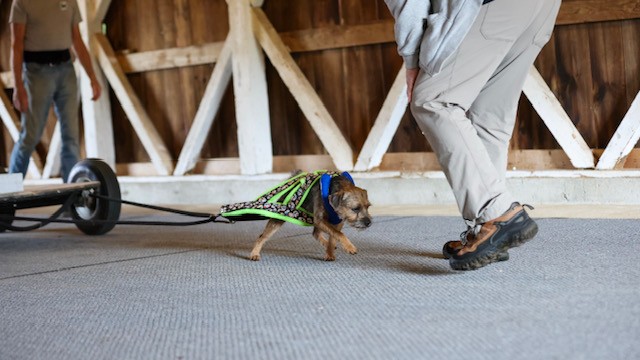
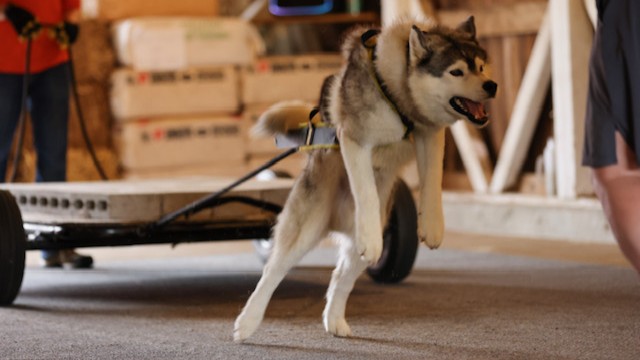
Among my regular cohort of New England Weight Pull competitors and friends, you see the breeds you would expect; Northern breeds, including Alaskan Malamutes and Siberian Huskies, and high-drive, muscular breeds, including Rottweilers, American Pit Bull Terriers, and Doberman Pinschers. Most exciting to me are the “off” breed dogs like the competitive senior Chihuahua, Gobo Fraggle, and the tenacious little Border Terrier, Walnut, on the smaller end. On the opposite end of the breed size spectrum, Benni, the Standard Parti Poodle, is always one of the last competitors pulling the most weight on a sagging cart.
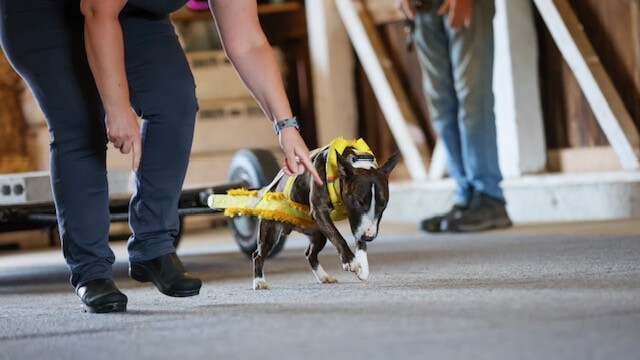
I have been competing in Weight Pull for nearly three years with my Miniature Bull Terrier, Cheese. He is a true competitor, regularly reaching the max allowed pull in UKC Weight Pull of 650 lbs., which is 25 times his body weight. Cheese has some big shoes (harnesses) to fill within his breed; the top-ranked Miniature Bull Terrier, owned by Paula Spangler, Truly (Evolution’s Equipoise is Truly Scrumptious), holds the W3PO record on rails, pulling 6,490 lbs., which is 231.78 times her body weight!
In Weight Pull, dogs wear a specially designed harness and pull a cart or sled progressively loaded with cinder blocks over a specific distance within a time limit, commonly 16 feet in 60 seconds. Rules vary by organization, including weight class ranges, scoring, and whether fouls are allowed. Winners are determined by the greatest total weight pulled, the greatest weight pulled relative to the dog’s body weight, and speed of pull. Because of this, you will often see smaller dogs rank high in trial because they are often speedy and reach higher weight percentages more quickly.
Competitions are held on one of these three (3) surfaces:
• Rails: The cart travels along a railed track.
• Wheels: A wheeled cart moves over a synthetic surface like carpet or a natural surface such as dirt.
• Snow: A skid sled travels over snow or prepared ice shavings.
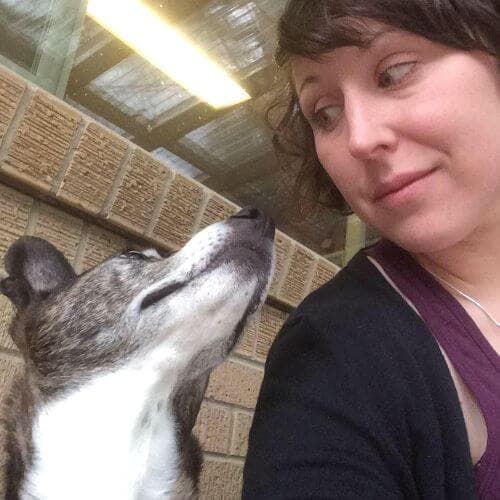
I spoke with Dani Cyr, one of my mentors, friend, and well-respected Weight Pull judge who welcomed me into the New England Weight Pull community.
Emma: Tell us about yourself and your work with dogs.
Dani: I work full-time as a veterinary technician, which I’ve done for 25 years, and I’ve been a hobby dog trainer for 20 years. I’m also a Certified Canine Conditioning Athlete Specialist. I coach group classes and design fitness programs for clients’ dogs.
Emma: What first drew you to weight pull?
Dani: A couple of decades ago, a program called Training Wheels introduced inner-city youth to activities they could do with their dogs as an alternative to dog fighting. I attended a seminar in Boston and was hooked.
At the time, I had a rescue girl and wanted to find activities that would help her become stronger physically and mentally. She was never a serious competitor, but we had so much fun traveling and camping. We made wonderful memories together.
Emma: How long have you been competing, organizing events, and judging?
Dani: I’ve been competing for 20 years. About 15 years ago, I began judging for a couple of smaller organizations and founded Dirigo Working Dogs to offer practices and events.
In 2012, we established our United Dog Sports UKC club, with Weight Pull among its activities. I became a UKC judge in 2017.
Emma: Which organizations have you worked with?
Dani: UKC, W3PO, APA, and UPF. I also compete in ADBA events, although I don’t judge for that organization.
Emma: Tell us about your own Weight Pull dogs.
Dani: My dogs have included Ryder, a mixed breed who competed lightly until age 11; Lojac, an American Pit Bull Terrier who came to the sport as a rescue later in life; and Panze, an American Bully who competed lightly until age 10.
There’s also Pistol, my retired 10-year-old American Pit Bull Terrier, along with Smith, who is 6, and Kevlar, who is 4.
Emma: What kinds of dogs can try Weight Pull?
Dani: I believe dogs of many breeds can participate when they are physically sound and properly trained. Mental grit matters as well as physical strength. You’ll see plenty of Bully breeds and Northern breeds, but many other breeds can be competitive, too.
Emma: What benefits does the sport offer dogs and their people?
Dani: For dogs, it’s resistance training using a harness designed to distribute the load across the body. It can help develop muscle and conditioning while giving the dog something to focus on.
It can also provide an outlet for dogs who aren’t comfortable participating in social activities with other dogs. I find that it builds confidence in the dog and trust in the handler.
For people, it’s a team activity and an outlet for those who enjoy competition. You meet a community of people who love their dogs and the sport. Personally, I find early-morning drag work with my dogs cathartic.
Emma: What else would you like newcomers to understand?
Dani: Preparation matters. As with Agility, Flyball, or Coursing, dogs should be properly prepared for the activity they’re doing. The training is where the magic happens.
Even if you never compete, drag work can offer benefits when introduced and practiced appropriately. Finding a safe place to train can be one of the biggest challenges.
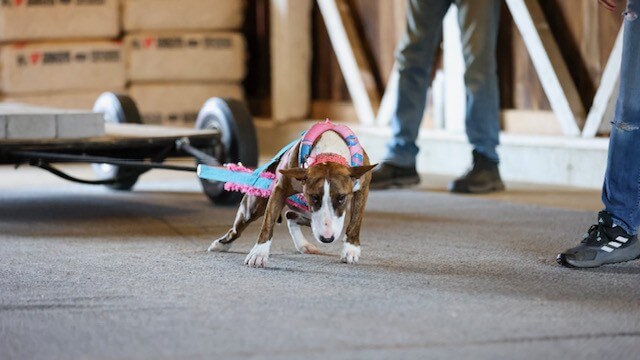
Dani’s emphasis on preparation is a useful starting point for anyone curious about Weight Pull. Before buying equipment or asking your dog to pull, watch an event and connect with an experienced instructor or club.
Attending a competition lets you see the equipment, observe how handlers work with their dogs, and ask questions about training. Weight Pull groups on Facebook can also help you find local events and experienced participants.
These are the primary Weight Pull organizations:
American Pulling Alliance (APA)
International Weight Pull Association (IWPA)
Iron Dog Sports Association (IDSA)
North American Weight Pull Association (NAWA)
United Pulling Federation (UPF)
World Wide Weight Pull Organization (W3PO)
Registries that offer Weight Pull events include the United Kennel Club (UKC), Global Canine Registry (GCR), American Dog Breeders Association (ADBA), and All American Dog Registry International (AADRI).
Check the organization’s current rules before entering. Competition requirements and scoring can differ.
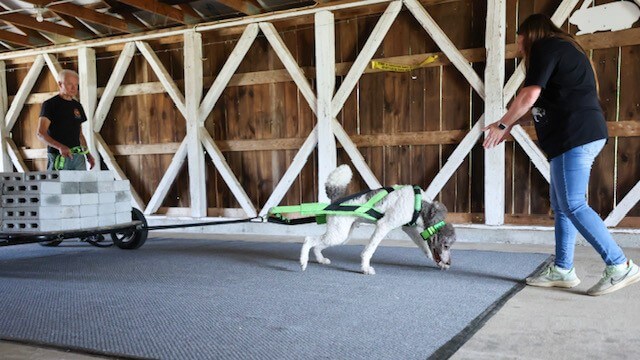
It is very important to have the proper equipment to get started - a weight pull harness, or freight harness, is specifically designed to evenly distribute the load down the dog's body and allow them to safely carry large loads behind them. The harnesses fit and construction matter. Harnesses designed for walking, running, joring, or other activities are no suitable for competitive Weight Pull. An experienced instructor can help you choose appropriate equipment and assess its fit. It’s recommended to get a custom-made harness for your dog, although some makers offer standard starter sizes.
Harness makers to explore:
It is important to start your dog off safely and correctly so that they become comfortable with wearing a harness, dragging weights, chains, and pulling carts. Weight Pull is a relationship-based dog sport, great for bonding, conditioning, and having fun with your dog. Dogs compete only with verbal encouragement from their handlers, and you are not allowed to touch or bait your dog to pull the weight in competition.
Competitors spend months—and often years—developing their dogs’ skills and conditioning. Brown Dog Designs and the ADBA offer introductory training resources, but hands-on guidance can help you put that information into practice.
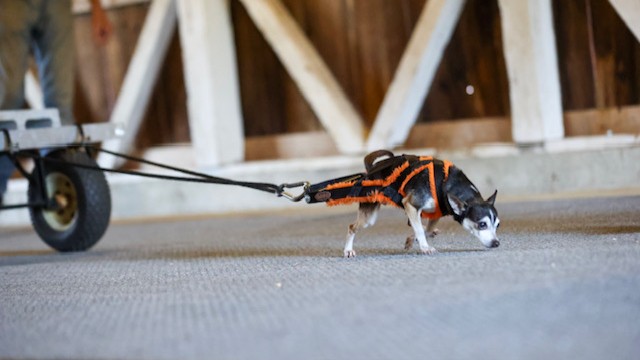
I have competed in many sports, and Weight Pull is by far one of the most welcoming communities. All competitors, even those at the highest levels, understand that from day to day and competition to competition their dog may or may not pull, but the bond between handlers and their dogs is undeniable.
The days that Cheese does not pull or does not pull at his heaviest, we still have a blast! Other noticeable benefits, both anecdotal and measurable, are that Cheese’s participation in Weight Pull has improved his overall physical condition (observed by his chiropractor); he has fewer injuries, his speed has increased in Fast CAT, and his body awareness is much improved in Agility and Disc Dog, which is huge for a breed of dog that notoriously has little to no self-preservation skills.
If you are looking for a new outlet for you and your dog, Weight Pull may be just the thing whether you are pursuing competition, a bonding experience, new training challenges, physical conditioning, or just another way to have fun with your dog.