01/Overview
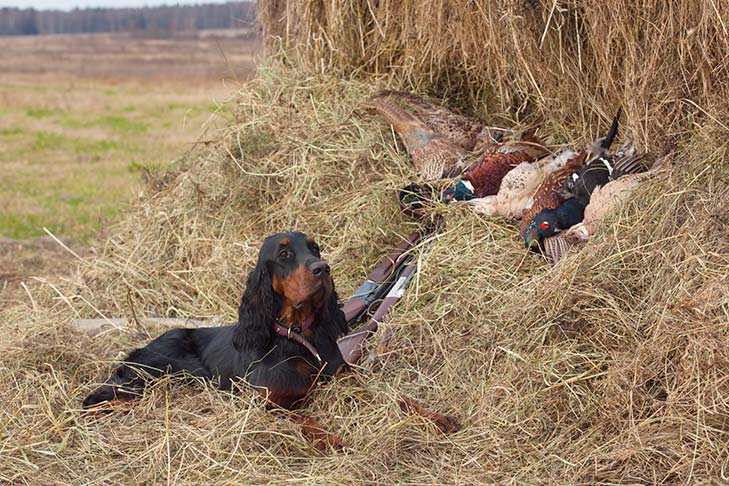
Gordon Setters were initially bred as bird dogs, for hunting birds like pheasant and quail. Although the hunting instinct remains strong in the breed, Gordons are equally at home as companion dogs, obedience and agility competitors, and show dogs. Gordon Setters are alert and lively, pleasant, and exceedingly loyal. They tend to be devoted to members of their household but are not overly friendly to strangers. As a general rule, Gordons tend to tolerate attention from people they do not know rather than seeking such attention. Gordons are highly intelligent dogs, as quick to spot an advantage as to spot game.
Highlights
02/History
Literature tells us that the Setter was in existence as early as the 1500s or early 1600s. The name “Setter” was coined because the dog would locate a bird and “sit” or lay down, showing the hunter where the bird is and the hunter would throw a net over the dog and bird.
The major differences between the Setter breeds is the terrain in which it hunts. The Gordon, being heavy-boned and square, suggests strength and stamina rather than speed over the craggy terrain of Scotland.
Alexander Gordon, 4th Duke of Gordon, established his kennel of Black and Tan Setters at Gordon Castle, which was situated near Fochabers, not far from the River Spey and a few miles from the coast of Moray. The exact date when this occurred is not known.
These first Setters looked more like the field English Setters. The Duke crossed the Setters with the flat-coated black and tan Collie. These dogs were good for hunting and herding. Other breeders used Bloodhounds, black Pointers, and solid black Setters.
The First documented import of Gordon Setters to the US was in 1842 when George Blunt of New York brought Rake and Rachael. Rachael was given to Daniel Webster.
03/Appearance
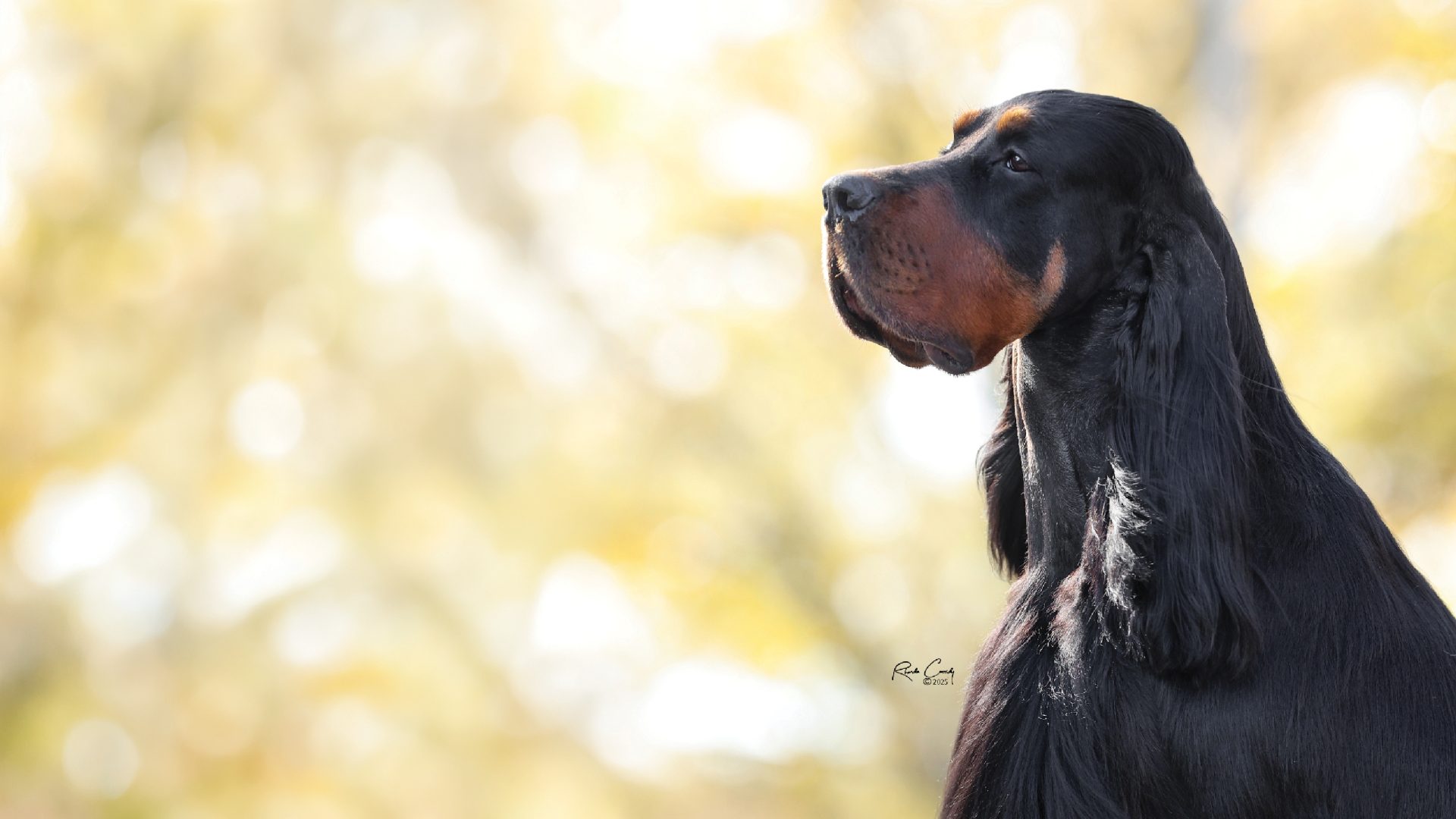
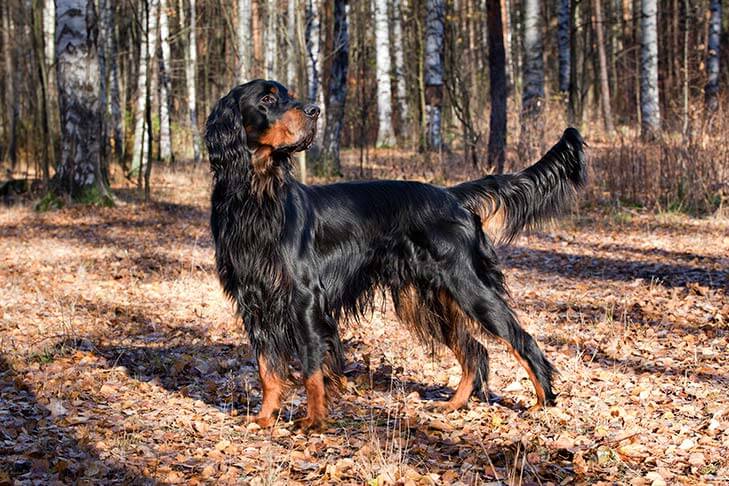
The Gordon Setter is a good-sized, sturdily built, black and tan dog, well-muscled, with plenty of bone and substance. The Gordon is active, upstanding and stylish, appearing capable of doing a full day’s work in the field. He has a strong, rather short back, with well-sprung ribs and a short tail. The head is fairly heavy and finely chiseled. His bearing is intelligent, noble, and dignified, showing no signs of shyness or viciousness. Clear colors and a straight or slightly waved coat are correct. He suggests strength and stamina rather than extreme speed. Symmetry and quality are most essential. A dog well balanced in all points is preferable to one with outstanding good qualities and defects. A smooth, free movement, with high head carriage, is typical. On a scale of 100 points, Size and General Appearance are worth 15 points.
Males stand 24 to 27 inches tall at the shoulder, while females; females measure 23 to 26 inches in height. Weight for males is 55 to 80 pounds, and 45 to 70 pounds for females.
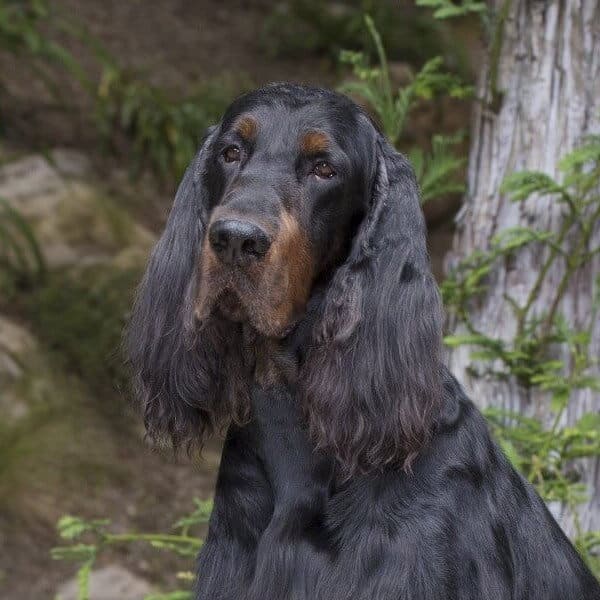
The distance from the forechest to the back of the thigh is approximately equal the height from the ground to the withers. The Gordon Setter has plenty of bone and substance. Animals that appear to be over or under the prescribed weight limits are to be judged on the basis of conformation and condition. Extremely thin or fat dogs are discouraged on the basis that under or overweight hampers the true working ability of the Gordon Setter. The weight-to-height ratio makes him heavier than other Setters.
Texture: Soft and shining, straight or slightly waved, but not curly, with long hair on ears, under stomach and on chest, on back of the fore and hind legs, and on the tail. The feather which starts near the root of the tail is slightly waved or straight, having a triangular appearance, growing shorter uniformly toward the end. Heavily coated dogs require grooming beyond brushing and bathing. Hair beneath and between the toes should be trimmed. On a scale of 100 points, coat is worth eight points.
Colors
• Black with Tan Markings, either of rich chestnut or mahogany color. Black penciling is allowed on the toes. The borderline between black and tan colors is clearly defined. There are no tan hairs mixed in the black.
Markings
• Rich Chestnut
• Rich Mahogany
04/Consider
Gordon Setters are wonderful family dogs and personal companions. Many Gordons are great talkers. They can develop quite a vocabulary with various tones to express themselves. Constant wagging of the tail seems to be part of their style as well. Gordon Setters thrive when they share both hearth and field with their owners. They do not enjoy being part of a kennel string. Gordon Setters do shed, so if you are looking for a breed that does not, this is not a breed for you.
Interaction With Family
The level of affection a breed typically shows towards family members and familiar individuals.
Good With Other Dogs
The innate friendliness of a dog towards other dogs can depend on its breed.
Good With Young Children
The degree to which a breed will typically be patient with young children.
Amount Of Shedding
How much hair a breed typically leaves behind on clothes, furniture and floors.
Frequency Of Grooming
How often a breed needs brushing, bathing or a professional trim to stay in condition.
Amount Of Drooling
How prone a breed is to drool — worth knowing before you keep a towel by the door.
Openness To Strangers
How openly a breed tends to greet new people, visitors and strangers.
Protective Nature
How likely a breed is to alert you to — and stand between you and — anything unfamiliar.
Playfulness Level
How enthusiastic a breed stays about games and play well past puppyhood.
Trainability Level
How readily a breed takes direction and works with you rather than around you.
Barking Level
How much a breed uses its voice, and how readily.
Energy Level
How much get-up-and-go a breed brings to an average day.
Health
Gordon Setters are basically healthy dogs. Still, as with many other breeds, Gordons are subject to a few health concerns. Screening is available for many of these conditions. The Gordon Setter Club of America participates in the OFA CHIC program and believes in health testing and research. Lifespan: Gordon Setters can live into their late teens, but most live 12-14 years.
Alert, gay, interested, and confident, the Gordon Setter is fearless and willing, intelligent, and capable. He is loyal and affectionate, and strong-minded enough to stand the rigors of training. He is noble and dignified, showing no signs of shyness or viciousness. On a scale of 100 points, temperament is worth 10 points.
Exercise Expectations
Grooming Expectations
Gordon Setters are great family dogs. They are devoted to the members of their household, and often have a “favorite.” Gordons are not blindly obedient and can come across as stubborn. Training must be an integral part of Gordon Setter ownership. Gordons are happy, they can be vocal, and they are usually very sweet.
05/Puppies
There is nothing cuter than a Gordon Setter puppy. They can wrap you around their paw in no time flat.
To build the foundation for a well-trained adult, the Gordon Setter puppy must be trained with gentle consistency from the time it is very young. The Gordon puppy should be vaccinated according to your veterinarian’s protocol. After vaccination, the puppy should be exposed to other dogs, children, and everyday things they may encounter.
06/Activities
Gordon Setters are seen in a variety of organized events, including:
With proper training, a Gordon can pretty much do it all!
Gallery
07/Standards
The Gordon Setter is recognized by the world's leading registries and kennel organizations, which categorize the breed into a specific Group based on its unique characteristics. This breed is recognized worldwide under the following Group designations:
The ideal Gordon Setter is described by a Breed Standard that is approved by each of the world’s leading registries and kennel organizations. The Breed Standards for this breed may be found in the following links:
08/Clubs
09/Rescue
10/Facts
Breed Recognition
In 1862, dog show classes were for English, Irish, and Black and Tan Setters. The British Kennel Club made them an official breed in 1872 as the black and tan.
Name Change
In 1924, The Kennel Club of England changed their name to Gordon Setter. They thought there was a connection to the Castle Gordon Setters. AKC changed to the present name in 1892.
First Import
The first documented import was in 1842 when George Blunt of New York brought Rake and Rachael to the US. Rake was curly coated, white with a black saddle and tan points. Rachael was black and tan.
Famous Friend
Rachael was given to Daniel Webster.
Lifelong Involvement
Charles T. Inglee had a lifelong involvement in Gordons. He revived the Gordon in 1920 by importing from Norway, Denmark, and Sweden. He kept very good records of his litters. When he retired in 1935, he had 300 litters and 40 champions.
(Courtesy of the Gordon Setter Club of America Illustrated Standard)
11/FAQ
Gordon Setters are bred to run and find birds. Even if your dog will never be used as a hunting companion, it will still need a lot of exercise. Sitting in the backyard does not count as exercise.
Official Standard for the Gordon Setter
General Appearance: The Gordon Setter is a good-sized, sturdily built, black and tan dog, well muscled, with plenty of bone and substance, but active, upstanding and stylish, appearing capable of doing a full day's work in the field. He has a strong, rather short back, with well sprung ribs and a short tail. The head is fairly heavy and finely chiseled. His bearing is intelligent, noble, and dignified, showing no signs of shyness or viciousness. Clear colors and straight or slightly waved coat are correct. He suggests strength and stamina rather than extreme speed. Symmetry and quality are most essential. A dog well balanced in all points is preferable to one with outstanding good qualities and defects. A smooth, free movement, with high head carriage, is typical.
Size, Proportion, Substance: Size-Shoulder height for males, 24 to 27 inches; females, 23 to 26 inches. Weight for males, 55 to 80 pounds; females, 45 to 70 pounds. Animals that appear to be over or under the prescribed weight limits are to be judged on the basis of conformation and condition. Extremely thin or fat dogs are discouraged on the basis that under or overweight hampers the true working ability of the Gordon Setter. The weight-to-height ratio makes him heavier than other Setters. Proportion The distance from the forechest to the back of the thigh is approximately equal the height from the ground to the withers. The Gordon Setter has plenty of bone and substance.
Head: Head deep, rather than broad, with plenty of brain room. Eyes of fair size, neither too deep-set nor too bulging, dark brown, bright and wise. The shape is oval rather than round. The lids are tight. Ears set low on the head approximately on line with the eyes, fairly large and thin, well folded and carried close to the head. Skull nicely rounded, good-sized, broadest between the ears. Below and above the eyes is lean and the cheeks as narrow as the leanness of the head allows. The head should have a clearly indicated stop. Muzzle fairly long and not pointed, either as seen from above or from the side. The flews are not pendulous. The muzzle is the same length as the skull from occiput to stop and the top of the muzzle is parallel to the line of the skull extended. Nose broad, with open nostrils and black in color. The lip line from the nose to the flews shows a sharp, well-defined, square contour. Teeth strong and white, meeting in front in a scissors bite, with the upper incisors slightly forward of the lower incisors. A level bite is not a fault. Pitted teeth from distemper or allied infections are not penalized.
Neck, Topline, Body: Neck long, lean, arched to the head, and without throatiness. Topline moderately sloping. Body short from shoulder to hips. Chest deep and not too broad in front; the ribs well sprung, leaving plenty of lung room. The chest reaches to the elbows. A pronounced forechest is in evidence. Loins short and broad and not arched. Croup nearly flat, with only a slight slope to the tailhead. Tail short and not reaching below the hocks, carried horizontal or nearly so, not docked, thick at the root and finishing in a fine point. The placement of the tail is important for correct carriage. When the angle of the tail bends too sharply at the first coccygeal bone, the tail will be carried too gaily or will droop. The tail placement is judged in relationship to the structure of the croup.
Forequarters: Shoulders fine at the points, and laying well back. The tops of the shoulder blades are close together. When viewed from behind, the neck appears to fit into the shoulders in smooth, flat lines that gradually widen from neck to shoulder. The angle formed by the shoulder blade and upper arm bone is approximately 90 degrees when the dog is standing so that the foreleg is perpendicular to the ground. Forelegs big-boned, straight and not bowed, with elbows free and not turned in or out. Pasterns are strong, short and nearly vertical with a slight spring. Dewclaws may be removed. Feet catlike in shape, formed by close-knit, well arched toes with plenty of hair between; with full toe pads and deep heel cushions. Feet are not turned in or out.
Hindquarters: The hind legs from hip to hock are long, flat and muscular; from hock to heel, short and strong. The stifle and hock joints are well bent and not turned either in or out. When the dog is standing with the rear pastern perpendicular to the ground, the thighbone hangs downward parallel to an imaginary line drawn upward from the hock. Feet as in front.
Coat: Soft and shining, straight or slightly waved, but not curly, with long hair on ears, under stomach and on chest, on back of the fore and hind legs, and on the tail. The feather which starts near the root of the tail is slightly waved or straight, having a triangular appearance, growing shorter uniformly toward the end.
Color and Markings: Black with tan markings, either of rich chestnut or mahogany color. Black penciling is allowed on the toes. The borderline between black and tan colors is clearly defined. There are not any tan hairs mixed in the black. The tan markings are located as follows: (1) Two clear spots over the eyes and not over three-quarters of an inch in diameter; (2) On the sides of the muzzle. The tan does not reach to the top of the muzzle, but resembles a stripe around the end of the muzzle from one side to the other; (3) On the throat; (4) Two large clear spots on the chest; (5) On the inside of the hind legs showing down the front of the stifle and broadening out to the outside of the hind legs from the hock to the toes. It must not completely eliminate the black on the back of the hind legs; (6) On the forelegs from the carpus, or a little above, downward to the toes; (7) Around the vent; (8) A white spot on the chest is allowed, but the smaller the better. Disqualification - Predominantly tan, red or buff dogs are ineligible for showing and undesirable for breeding.
Gait: A bold, strong, driving free-swinging gait. The head is carried up and the tail "flags" constantly while the dog is in motion. When viewed from the front, the forefeet move up and down in straight lines so that the shoulder, elbow and pastern joints are approximately in line. When viewed from the rear, the hock, stifle and hip joints are approximately in line. Thus the dog moves in a straight pattern forward without throwing the feet in or out. When viewed from the side, the forefeet are seen to lift up and reach forward to compensate for the driving hindquarters. The hindquarters reach well forward and stretch far back, enabling the stride to be long and the drive powerful. The overall appearance of the moving dog is one of smooth-flowing, well balanced rhythm, in which the action is pleasing to the eye, effortless, economical and harmonious.
Temperament: The Gordon Setter is alert, gay, interested, and confident. He is fearless and willing, intelligent and capable. He is loyal and affectionate, and strong-minded enough to stand the rigors of training.
Disqualification: Predominantly tan, red or buff dogs.
Scale of Points To be used as a guide when judging the Gordon Setter: Head and neck (include ears and eyes) 10 Body 15 Shoulders, forelegs, forefeet 10 Hind legs and feet 10 Tail 5 Coat 8 Color and markings 5 Temperament 10 Size, general appearance 15 Gait 12 Total 100
Approved October 7, 2002
Effective November 27, 2002

Meet the Breeders
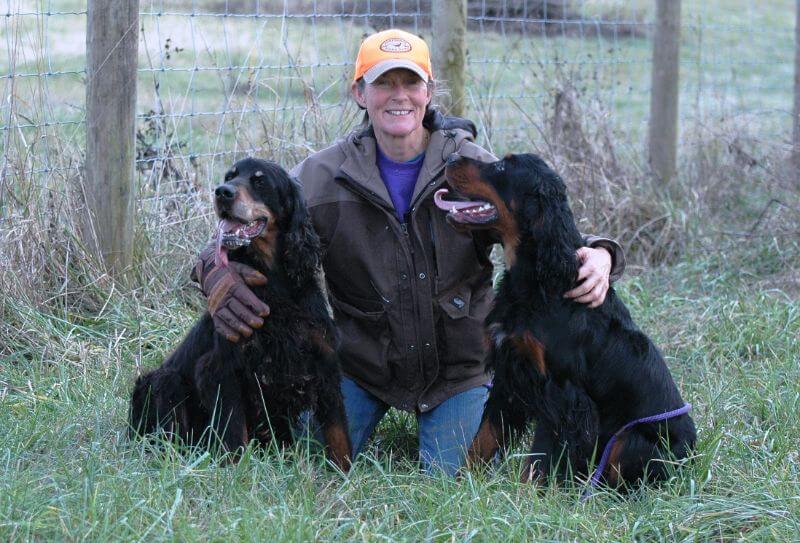
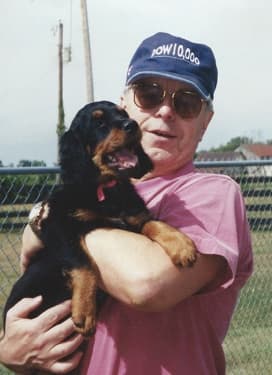
Rhonda Cornum is the breeder behind Munroc Farm Kennel. Read about the kennel’s beginnings, breeding philosophy, puppies, and more!
Meet the Breeders
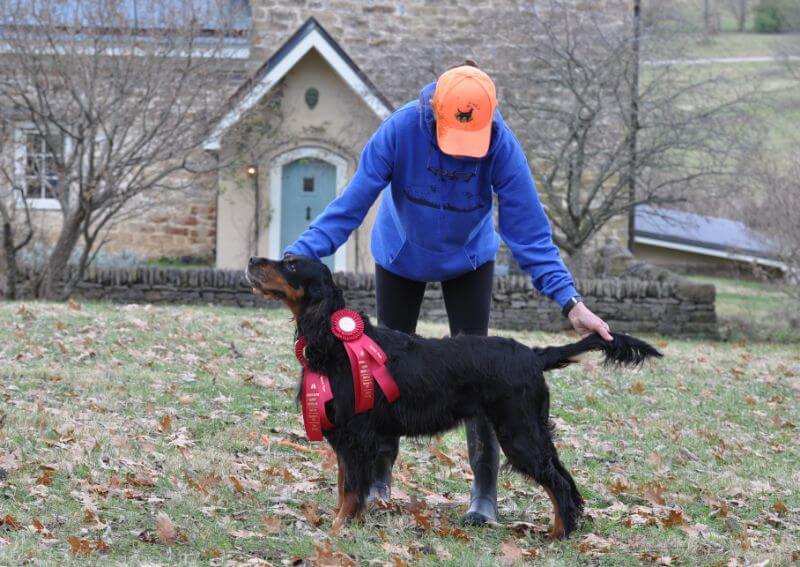
Rhonda Cornum is the breeder behind Munroc Farm Gordon Setters. Read about the kennel’s beginnings, champions dogs, puppies, photos & more!
The tail is an important part of the Gordon Setter’s general appearance. Read and learn more about the correct tail set and carriage.

All About Judging
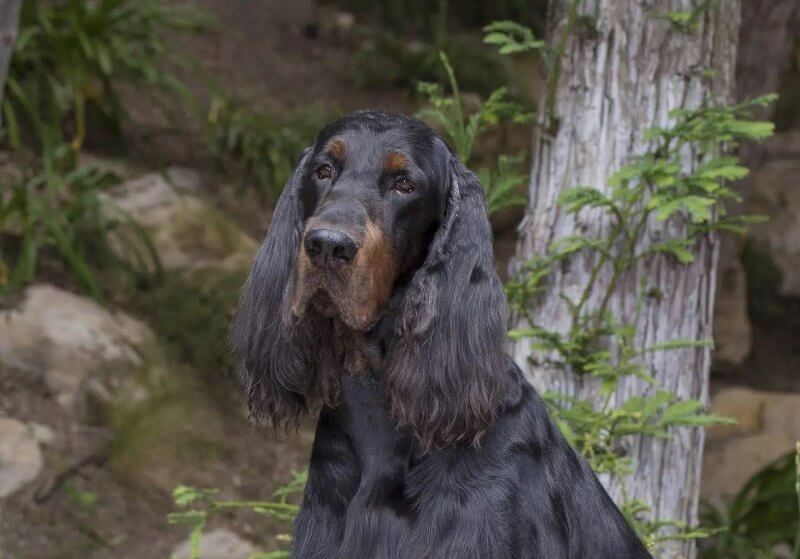
Complete overview of characteristics to look for when judging the Gordon Setter dog breed. By Gary L. Andersen, AKC Judge and JEC at GSCA.

Meet the Owner Handlers
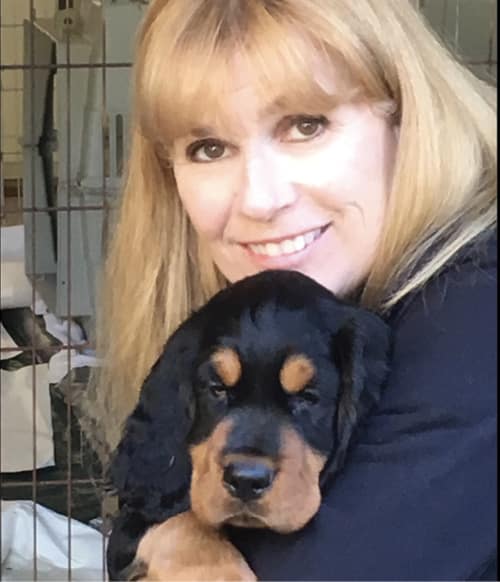
Pat Cordray | Gordon Setter. I have been showing dogs since 1974 when I first started showing my six-month-old Irish Setter puppy that I had bred—we were both total novices!
Dog Sports
For as long as anyone can remember, the motto of the Gordon Setter Club of America Inc. has been “Beauty, Brains and Bird Sense.”
The tail is short and not reaching below the hocks, carried horizontal or nearly so, not docked, thick at the root and finishing in a fine point. The placement of the tail is important for correct carriage. When the angle of the tail bends too sharply at the first coccygeal bone, the tail will be carried too gaily or will droop. The tail placement is judged in relationship to the structure of the croup.
A Note About Color: The Gordon Setter is black with Tan Markings, either of rich chestnut or mahogany color. Black penciling is allowed on the toes. The borderline between black and tan colors is clearly defined. There are no tan hairs mixed in the black. The tan markings are located as follows: (1) Two clear spots over the eyes and not over three-quarters of an inch in diameter; (2) On the sides of the muzzle. The tan does not reach to the top of the muzzle from one side to the other; (3) On the throat; (4) Two large clear spots on the chest; (5) on the inside of the hind legs showing down the front of the stifle and broadening out to the outside of the hind legs from hock to the toes. It must not completely eliminate the black on the back of the hind legs; (6) On the forelegs from the carpus, or a little above, downward to the toes; (7) Around the vent; (8) A white spot on the chest is allowed, but the smaller the better. Disqualification: Predominantly tan, red or buff dogs are ineligible for showing and undesirable for breeding. On a scale of 100 points, color and markings are worth five points.
Coat Type
Double
The structure of the coat this breed carries.
Coat Length
Medium
How long the breed's coat grows when kept in condition.
Adaptability Level
How easily a breed copes with changes in home, routine, noise and weather.
Mental Stimulation Needs
How much a breed needs a job, a puzzle or training to stay content.
Gordon Setters should be fed a high-quality diet with balanced nutritional levels. Gordons do best with twice a day feedings. Dogs should not be allowed to be over or underweight.
There is no denying a Gordon would prefer to stay a “puppy” forever, but with proper techniques, a young Gordon can be trained without breaking his spirit. Gordons are highly intelligent dogs, as quick to spot an advantage as to spot game, and basic obedience training will make your Gordon a better companion and a better canine citizen. Although Gordons are bright, they are not blindly obedient and may seem stubborn. Firmness and consistency are the keys to handling Gordons; harsh treatment is NEVER necessary. Obedience classes, ranging from puppy kindergarten to advanced competition, are available in most areas through local kennel clubs and/or professional training organizations.