Members
Discover the history, popularity, and uniqueness of the French Bulldog breed. Is it the right companion for you? Learn more here.
The Weekly Brief
The best of SHOWSIGHT editorials, weekly wins, and breeder commentary — delivered to your inbox every Sunday morning.
That’s the dog of the hour I am talking about, the number one in popularity within AKC and number one in so many hearts. But is it the breed for everyone? And with so many ads on every social media platform that exists, how can you even begin to start the search for the perfect companion?
In the mid 1800s, the lace makers in Nottingham wanted to create a smaller version of the English Bulldog. These craftsmen then moved to France, bringing with them their beloved dogs that would become the French Bulldog. Even though originating in England, the breed has always kept the name French Bulldog. They were said to have been crossed with several breeds to develop what became the Frenchie, including some terriers and even Pugs.
Fast forward to around 1890, and on any given night in the chic city of Paris you could find French Bulldogs as the companions to the sex workers of the area. Many postcards were seen depicting scantily clad mistresses with their Frenchies alongside.
In the early 20th century, there was a period when Frenchies showed up in paintings by many a famous artist. Aristocrats found the breed to have high social status and to be incredibly chic. You will find many works of art from this period depicting what had evolved into what we know today as the modern French Bulldog. You will find not only paintings but sculptures, porcelains, and even works of this beloved breed from the House of Fabergé in St. Petersburg, Russia.

After three countries and two continents, the breed was on its next journey to the United States. It had been recorded that a French Bulldog had gone down on the Titanic. Unfortunately, he did not survive, but that did not stop others with their fascination for the breed. The first exhibition of the breed at Westminster Kennel Club occurred in 1896. The following year, the French Bulldog Club of America was formed and the first Breed Standard was written, with the bat ear being the only acceptable ear.
People often ask, “When did they become so popular, and how or why?” We started seeing celebrities with them both on and off screen, and in advertising, and it seemed everywhere you looked, especially in big cities, there was a Frenchie. So, “why?” is the big question to what seems their sudden rise in population. Well, that might be for many reasons.
One, French Bulldogs are incredibly silly and very entertaining. There’s not a dull moment when you own a Frenchie. You can pick them up and take them just about anywhere. They do not require a lot of room, especially for exercise, so they fit into city life very well. With their short coat, very little grooming is needed. They are very versatile; you will find them competing not only in Conformation shows but they have become popular in Agility, Obedience, and Fast CAT, and as Service Dogs and Therapy Dogs. They can be stubborn, so a handler might have to work slightly harder with this breed. They are thinkers and, many times, I think they are smarter than they let on.

With a price that some would consider to be on the high side for a pet, we have seen people jump into the breed with money signs in front of them. Talk with any preservation breeder… it is not always an easy road. Health testing, show expenses, stud fees, C-sections, and raising a happy and healthy litter, not to mention the time involved, leaves little room for so-called profit.
Now we come to those who exploit this fame and will deviate from the Standard to have their dogs be considered “rare.” So, we are seeing exotic colors, patterns, and coats. With the “rare” label, some equate a call for exorbitant prices to follow. An increase in thefts of the dogs has also been seen, as criminals have found another way to cash in!
The parent club, the French Bulldog Club of America, has a webpage that has valuable information dealing with all aspects of the French Bulldog. Please visit it at: www.frenchbulldogclub.org. It does not matter if you are a breeder, handler, or judge, novice or experienced, the information provided is a stepping stone into the world of the Frenchie.
The hallmark of the breed is its unique silhouette; a topline that has a slight rise above the loin. It is never flat or high in the rear. It is, in my opinion, the hardest part of the dog to breed correctly.
Back to the conformation of the breed. Our original Breed Standard was written in 1897, and if you ask what a Standard is, it is a blueprint that one follows to breed dogs as close to it as one can. It is also what an AKC judge uses to make decisions as to awarding wins, by judging each dog against this Standard.
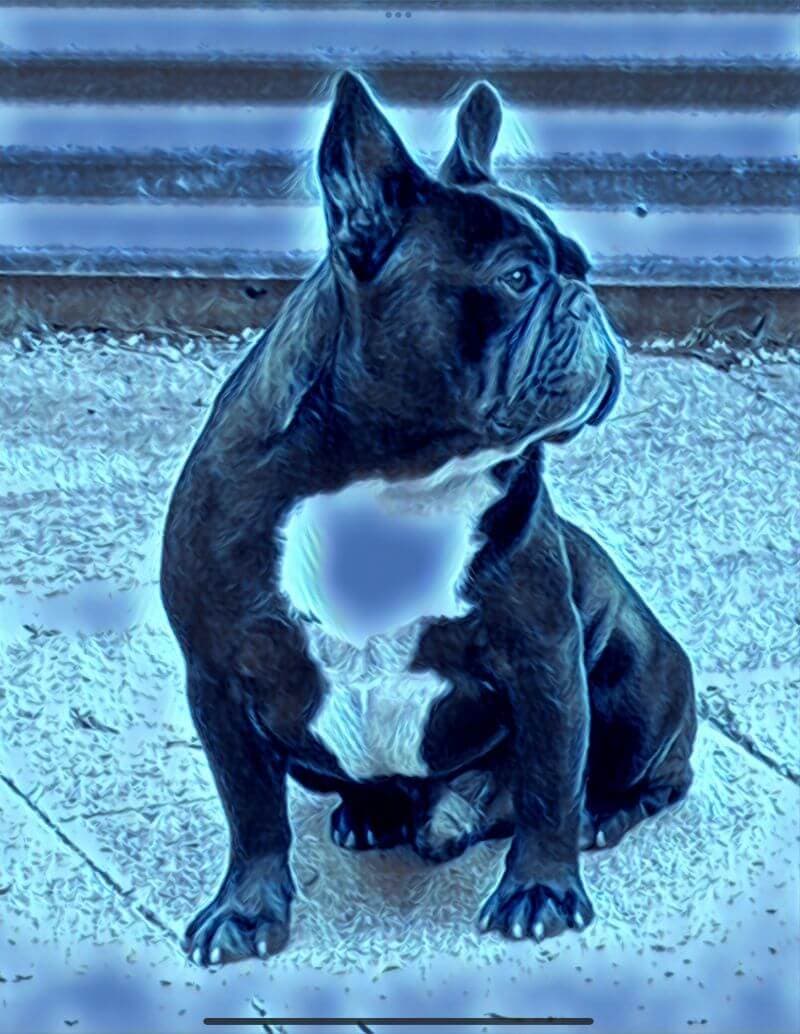
The hallmark of the breed is its unique silhouette; a topline that has a slight rise above the loin. It is never flat or high in the rear. It is, in my opinion, the hardest part of the dog to breed correctly. I describe it as a smooth symphony of “S” curves, where you will see the “S” curve at the topline, from the neck down to the onset of the tail, and at the underline of the dog. But with so much variety seen in the ring, it can be a challenge when one is judging. In the silhouette, you can see just about everything that makes a Frenchie unique. From the front, you will find the square head, bat ears, and broad underjaw, which is upturned, teeth or tongue not showing, and a soft expression that will melt your heart at first glance.
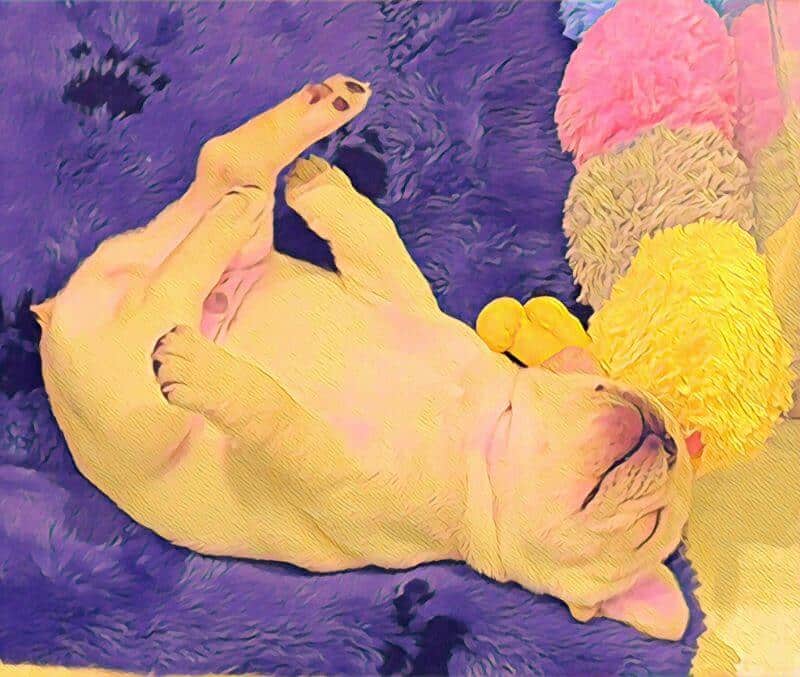
Frenchies do have a unique movement, as they are broader in their front assemblies and more narrow in their rear assemblies. Pear-shaped is one way to describe the shape. The gait is a four-tracking foot pattern, with the front track wider than the rear track.
Frenchies wear many hats, and this is a testament to their growing popularity. With that said, they are not the dog for everyone.
The French Bulldog Breed Standard calls for three acceptable colors: white, cream, fawn (ranging from light fawn to red fawn), with markings and patterns such as the following: brindle, piebald, black mask, black shading, and white markings. The coat is short and smooth. As stated before, with popularity comes the so-called rare varieties which, in fact, are not part of the Standard. Preservation breeders use the AKC Standard as a blueprint to follow as a guideline, as well as health test their Frenchies to produce not only beautiful but healthy and loving dogs that have worked their way to the very top.
French Bulldogs can be incredibly challenging for a judge on any given day, since you can find a great deal of variation. Remember, both as a judge or breeder, we need to remember that type and silhouette, bat ears, and a large, square head are the essence of our breed. No topline, no Frenchie! I will say it again: No Topline, No Frenchie!!
It is not uncommon to see Frenchies not only winning Groups at AKC competition events but also winning Bests in Show at many shows around the country. They are unique in so many fashions, and I would say this is why they have made their way into the number one place in AKC registrations, and into the hearts of so many.
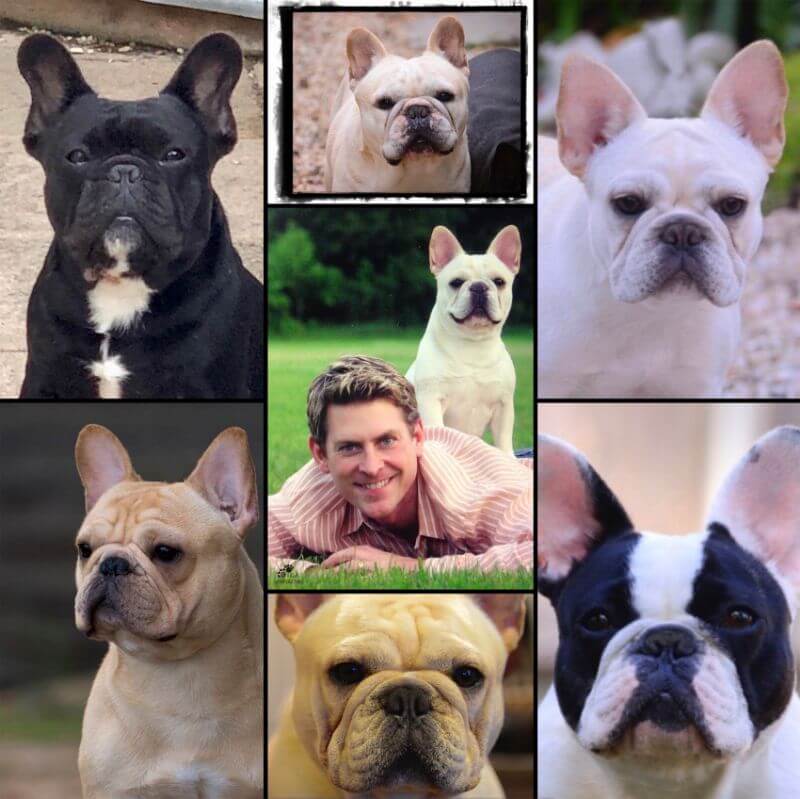
Frenchies wear many hats, and this is a testament to their growing popularity. With that said, they are not the dog for everyone. They do not swim, and with their short faces they can face challenges in some extreme environments. If you are looking for a dog that will run marathons and hike all day, this might not be the breed for you. Educate yourself and do your homework. A French Bulldog is a long-time commitment!

Dog Show Candids