Members
The Weekly Brief
The best of SHOWSIGHT editorials, weekly wins, and breeder commentary — delivered to your inbox every Sunday morning.
How power, exclusion, and relational aggression operate within dog show culture.
My writings regarding dog show culture are largely observational, and my observations are drilled down through scientific inquiry regarding human behavior to explain their occurrence. If you have not read my last piece on relational aggression in dog show culture (“Silent Bullies! Relational Aggression in Dog Shows,” SHOWSIGHT January 2026) you should probably go back and read it before you read this piece, since this article delineates how relational aggression is applied in different areas of dog show culture.
I am sure the title of this article resonates for most of us, as we can recall a bratty child in our youth bullying other kids they did not wish to play with. Sadly, the bratty child could care less about the feelings of others, or the downstream psychological harm they are doing. Like the bratty child, the bratty adult uses these tactics to protect their ranking in a social hierarchy, control a group dynamic, or remove a competitive threat. Ironically, while dog show culture has become a “safe haven” for marginalized subgroups who rage-on in their social media posts about inclusion and equity, many of the same people vilify and victimize others who do not fit into their social group or threaten the power they have gleaned through their perceived or desired ownership of the ball.
Sadly, I am writing this due to my own personal experiences as a person who showed dogs as a youth in the 1980s, and for a brief period in the late 1990s, returning in 2017 once my children were grown. Returning to the sport, I came back with fresh eyes, scientific knowledge, and the expectation that the sport was “about the dog.” I was lucky; my mother bred Standard Poodles, and I was mentored by both the Poodle and the Terrier communities under the grooming tents in the Northeastern US. (I often pay homage to Wendell Sammett, Peter Green, and Anne Rodgers Clark for their time and teaching.) When I returned in 2017 and won my first Breed, a friend asked me if I was going to compete in the Owner-Handled Group. I have to confess, I had no idea what she was talking about. I showed in Owner-Handled just once, after losing a bet with my co-breeder, and I decided it wasn’t really my thing.
Returning to dog shows, I retraced some of my parents’ footsteps in the attempt to fully immerse myself in the sport that I learned to love as a child. I believed that it was important to join my breed’s national club, and I wanted to join a regional specialty club that my parents belonged to at the time it was founded. When I was young, dog shows were a happy place where I felt engaged and included, even if it meant playing everyone’s most-willing “bucket bitch.” I played this role and was paid back with coaching, knowledge, and friendship. When I asked one of the well-known breeders to sponsor me for my breed club, I discovered that she never put my application through to the board. I did not confront this person or ask for an explanation; I went to someone else I knew for a long time, and they put it through and I became a member.
While waiting to go into the Group at a regional specialty show, a wonderful older woman, who was a founder of the club, stopped me and said, “You must be Les Nelinson’s son.” (I guess I look like my dad.) She knew my parents back when the club was founded, and we laughed about some of my parents’ innocent, silly but well-intentioned behaviors. My mother was not very skilled in social situations, so I was forced to be the intermediary in many cases. The woman told me that I needed to become a member, and I was happy to rejoin a club that my parents watched come into existence. When I applied for membership, however, I was blocked, most likely by one of the board members who held a grudge against my co-breeder that dates to an incident that occurred in 1967 between himself and her grandfather. In 1967, I was three years old and my co-breeder had not been born, but this individual, who is “an important member” of dog show culture, a former handler, and a judge, should be the arbiter of who should be allowed to participate?
While my journey in dog show culture makes for a unique personal interest story, what I am describing is discussed by social psychologists as the “Lucifer Effect,” a psychological concept describing how ordinary, morally grounded people can be corrupted to commit cruel or evil acts. These cruel acts are cultivated through the use of relational aggression to target and remove those who either don’t fit cleanly into the social hierarchy or pose a threat to the power that a person or a group holds in a particular environment. We are all familiar with the metaphor, “one bad apple,” but Philip Zimbardo, whose work is critical to our understanding of systemic abuses of power, points out that it is usually not about one apple. It is about a social environment that has become corrupted: the bad barrel. Zimbardo suggests that we shouldn’t just look for “bad apples” (corrupt individuals) but rather examine the “bad barrel” (the environment, situation, or social system) that enables and forces individuals to act out of character. Sadly, if you have not figured it out, dog shows have become a bad barrel.
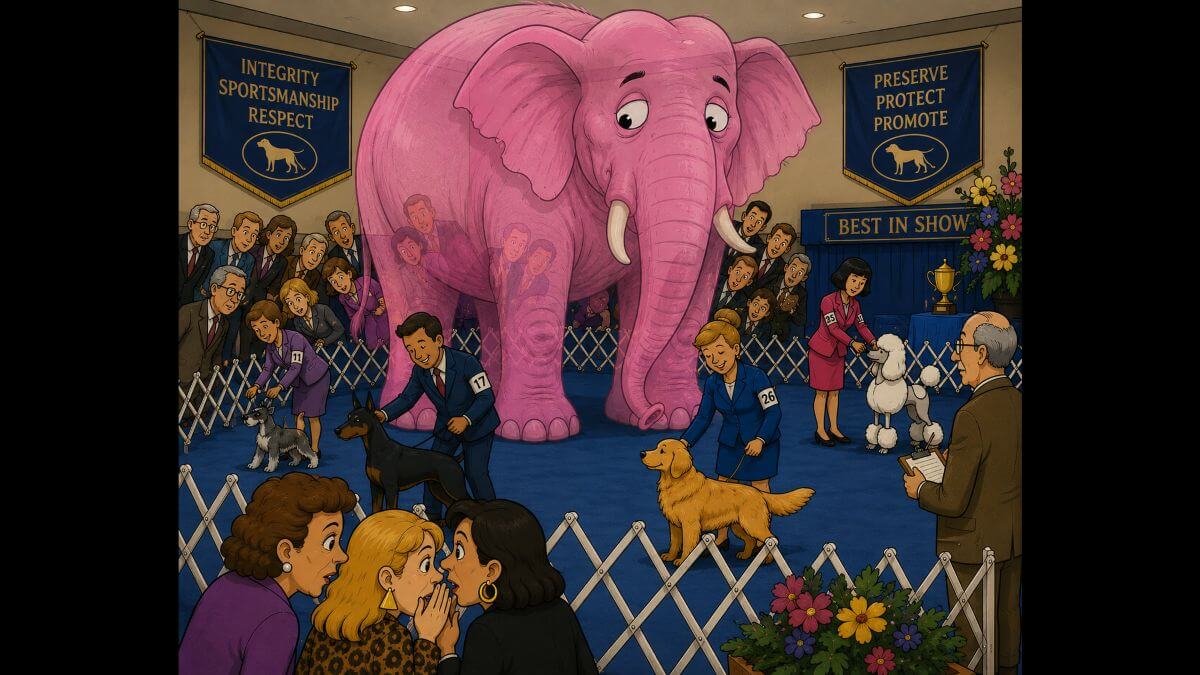
Many of my friends have experienced relational aggression that has been projected into organized hostilities within their national breed clubs, all-breed clubs, and with individuals in dog show culture. I wish I could say that this is a rare problem—but it’s not. One of the big changes in the culture of dog shows is that it has moved away from being a breeder community that sought to preserve and improve their respective breeds to become an alternative and insular social environment. In a way, it is sort of like high school, but instead of jocks, stoners, and geeks, you have judges, handlers, breeders, and NOHS people. And within each group there is an “in” group and an “out” group. The latter group is often slandered, gossiped about, and derided. Which group you belong to, and who you are friends with, really matters. Scary. I graduated from high school in 1982, but the behaviors that made high school a torture for me have followed me here.
Further exacerbating the problem is that dog shows have become a social media phenomenon. If you didn’t post it on Facebook, it didn’t really happen. On social media there are hundreds of dog show-relevant groups, specialist groups where people can hang with their friends, post their often-inappropriate thoughts about judges, or gossip about anyone and everyone in dog show culture. Within these groups is often where “inversion,” or the targeting of individuals with false or exaggerated narratives, begins and spreads. One of my friends was sent a post about herself from a “secret breed group” where they disparaged her and her dogs terribly. Sadly, she has become a target because she holds the moral and ethical high ground in a breed that is struggling with health issues and diminishing registration numbers. Like myself, she will tell you that it’s fine if you don’t like her, but don’t make up lies and slander her! Another friend, who is the most highly rewarded breeder, owner, handler of all-time in her breed, has members of her breed club actively trying to sabotage her in an attempt to derail her winning program. She was targeted at her national specialty, and some of the deliberate actions were so egregious that she left the national and drove overnight to show at a different show. (She had double-entered because she had a feeling that something creepy was happening behind her back.) To her credit, her dog won Best in Show. I guess you can talk all you want, but the cream will rise to the top. It might appear that she came out on top, but in truth, she was emotionally injured, sad, physically exhausted, confused, and angry, trying to understand why the people in her breed were so awful to her.
I must take a second to make an important statement that needs little clarification: There is nothing you can achieve at a dog show that validates the abuse of others! If you rant on social media about people in the government abusing power, why are you acting like them? All it does is prove that you are immoral, unethical, and self-centered, and that you are trying to control the environment to eliminate people who you perceive as threats.
The older members of this community will recall the story of Olympic figure skater Tonya Harding. In 1994, she orchestrated an assault with her ex-husband, Shane, who struck another competitor, Nancy Kerrigan, on the knee with a baton to remove her from competition. Any rational person could see that the action was not appropriate, but you don’t need a baton to injure a person. Physical abuse can even seem less harmful than psychological abuse, since the bruises heal faster. In dog show culture, I have seen many neophyte competitors run off by the relative “stake holders” of their breed, who refused to offer a helping hand and some mentoring to help the newbies become part of the community. With the AKC registration crisis and declining dog show entries, we really need everybody if the sport is to survive.
If dog shows are to survive, they need to be a diverse, inclusive, and equitable environment where the dogs that are being exhibited are what matters. We need to get back to a time when it was about breeders doing the difficult work of preserving and improving their breeds. To do this, we need to encourage others to learn as much as they can so that they can be the future success stories, breeding and exhibiting dogs that matter to their breed and to dog show culture.
The sad conclusion to this article is that it is unlikely that the abusers in our environment will stop being abusers. The violators succeed at driving people away from dog shows, and they keep people from becoming helpful members of clubs while diminishing the value of dog show culture for everyone. And while the AKC has created a new Code of Sportsmanship and Civility, the problem runs so deeply through the fabric of dog show culture that they would need to create an enforcement branch just to deal with the complaints and prevent people from taking their ball and going somewhere else to play.
Link to AKC Code of Sportsmanship and Civility: https://images.akc.org/pdf/AKC_code_of_sportsmanship.pdf
Link to my article on relational aggression: https://showsightmagazine.com/the-silent-bullies-relational-aggression-in-dog-shows/
If you are interested in discussions of this type, please join the Dog Show Psychology Facebook group: https://www.facebook.com/groups/dogshowpsychology

Dog Show Community