Members
Learn how to judge the Redbone Coonhound, focusing on their square build, striking red coat, and traits vital to their hunting abilities.
The Weekly Brief
The best of SHOWSIGHT editorials, weekly wins, and breeder commentary — delivered to your inbox every Sunday morning.
This article was originally published in Showsight Magazine, April 2011 issue.
Imagine the dark of the night surrounds you. It’s late, and you’ve just decided tonight is going to be a great night! You see, you just cut your hound, Red, loose to do what he does best—tree a coon. This is the first image that should enter your mind when you see a Redbone Coonhound in your ring. Redbones can travel numerous miles while hunting night after night. When judging the breed, it’s important to emphasize whether they look capable of doing their job in the woods. Size is crucial, with the standard calling for males at 22-27 inches and females at 21-26 inches, mid-range preferred. Height is important, but remember the two words scattered throughout our standard: proportioned and square. Regardless of height, a Redbone should be as tall as it is long. These are medium-sized hounds that should never be overdone.
Now back to the dark night—it seems silent at first, but then you hear it: the long bawl of your Redbone, letting you know he’s aggressively on the trail of his game. Red has picked up an older track, but he’s working it out, keeping you updated with every sound. Finally, you hear it—the chase has ended. Old Red barks a locate, signaling he’s run the coon up a tree and is settling into a chop at its base.
As a hunter, the hard part comes next—making your way to the tree and your hound. You can’t help but think Red has likely covered triple the ground you have, navigating terrain far tougher than you imagined. You’re thankful Red’s feet are tight and cat-paw-like because flat feet wouldn’t hold up out here. Climbing over a barb-wire fence, relief floods you, knowing your dog isn’t too tall, has a level topline, and a tail set mid-croup. If his tail carried beyond his ischium, you’d be patching it tonight.
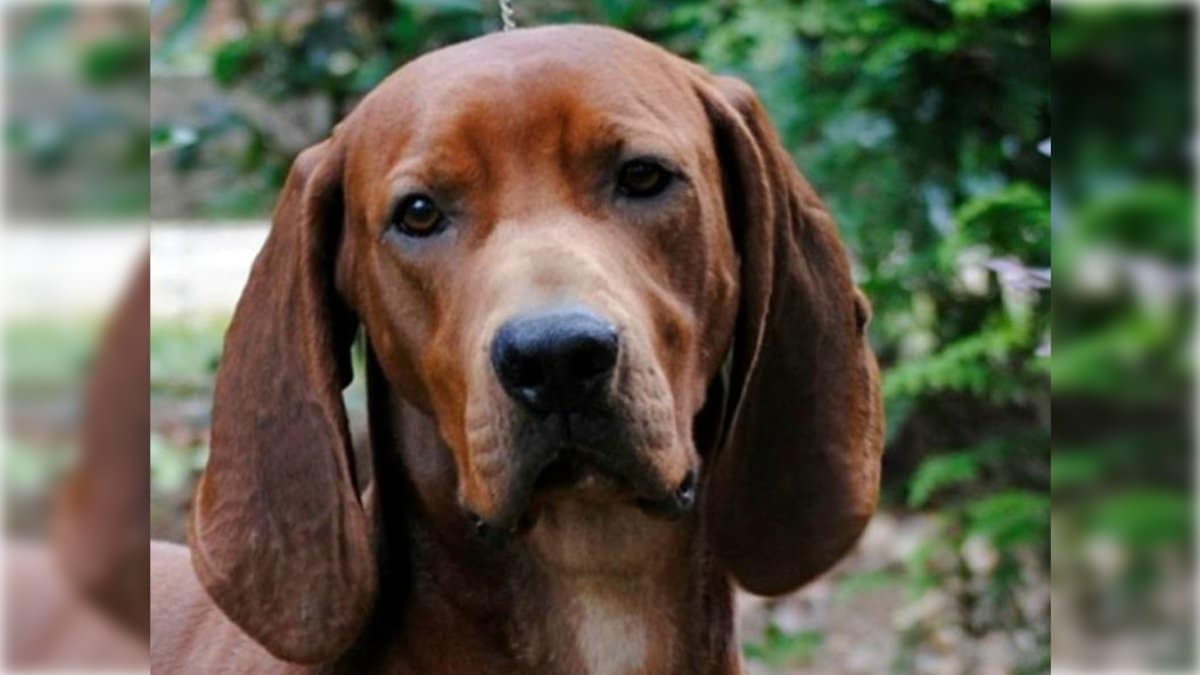
Over the hill, you hear a stream bubbling, with Red still calling out in the distance. You think, “Red is one heck of a coondog,” his large black nose and open nostrils working hard, his long ears sweeping scent toward his nose, and his bright, round eyes focused on the trail. Built with a 90-degree shoulder and rear, Red’s structure gives him the reach and drive to push through tough woods night after night.
Watching your step, you notice Red’s rear paw prints nearly replace his front ones—a sign of efficient movement. After covering the distance, you finally close in. Red is still at the tree, barking with every breath. Your flashlight reveals Red stretched out against the tree, belly rubbing against it, front feet gripping the bark where the coon climbed. His deep red coat glistens, muscles rippling as his head throws back with each bark. It’s an intense, remarkable scene.
After spotting the coon in the tree, it’s time to leash Red and head out. Petting him, Red gazes at you with a pleading expression, knowing he’s done his job well. As the excitement fades, he mellows, walking proudly beside you, content with making you proud.
When judging Redbones, remember they should possess a striking red coat and move effortlessly in the ring with a nonchalant, laid-back demeanor unless hunting. They should be moderate in size, square in proportion, and equal in height to length, with medium bone. The head should feature a skull equal in length to the muzzle, ears reaching the nose or beyond, and a slight skin fold below the jaw. The topline must be level, the chest reaching the elbow, and the tail carried correctly—not gay or past the ischium. Feet should be tight and cat-like, with shoulders and rear angles at 90 degrees.
Ultimately, Redbones should be square in all aspects, from head to body. In Group, ask yourself: Is this Redbone square, with a level topline, medium size, good feet, and a pleasing look? Those closest to the breed standard should excel, as correct conformation is key to their hunting ability.

All About Judging