Members

The Weekly Brief
The best of SHOWSIGHT editorials, weekly wins, and breeder commentary — delivered to your inbox every Sunday morning.
The 2026 FCI World Congress for Show Judges in Bologna, Italy, on June 2, 2026 was a grueling day of over eight hours with tiny coffee breaks and barely enough lunch time to get through the buffet line. It might have been better spread out in a two-day event, though goodness knows, with the pace of life today and the cost of travel, it was a miracle to get together over two hundred dog show judges in one place. So it’s a good thing that the organizer, Claudio De Giuliani, packed into his day as many quality speakers as he could manage.
Two of the speakers really bowled over everyone in the room. Gopi Krishnan of Malaysia spoke on the topic, “Qualifications: Evaluation, Responsibility, and Perception of Judging.” This is a tricky subject which can easily sound like a textbook reading, a schoolteacher beratement, or a holier-than-thou sermon, and there were moments when the other speakers fell into these traps at one time or another—but not Gopi. The sheer force of his charm and humor, and the clarity of his ideas, set off occasional crackles of spontaneous clapping, cheering, and at the end, a standing ovation. The only other standing ovation was earned by Louis Donald who gave us a sneak peek into his new volume on the Herding Group. His visuals were “off the charts,” his energy and focus reminding us why we began this whole dog thing to begin with. He was contagious.
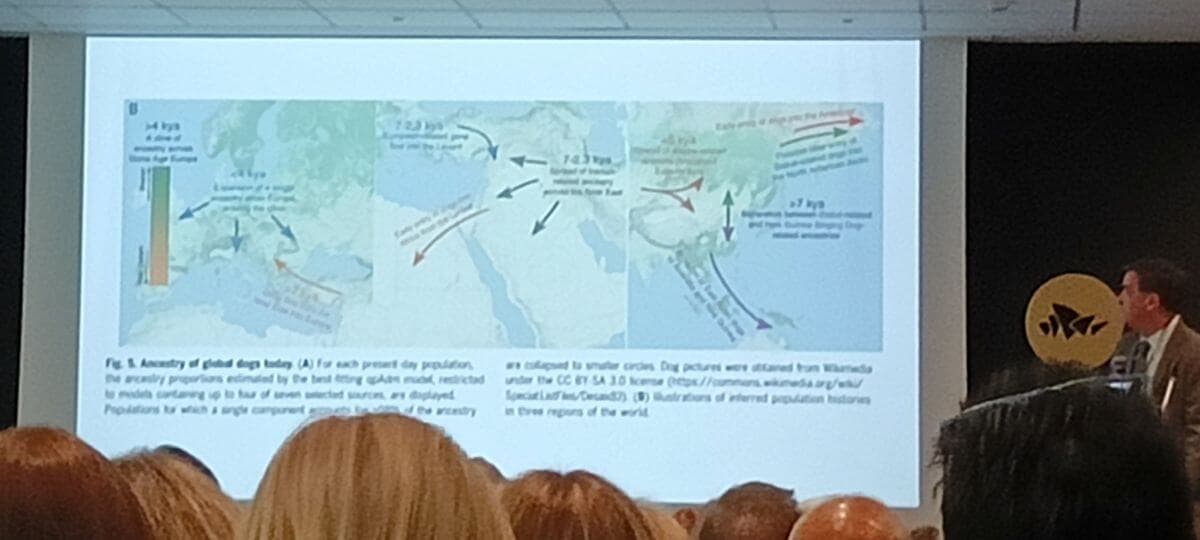
The biggest surprises were Lemo Nikša of Croatia who bent his topic, “Animal Welfare and Ethical Judging,” enough to comprise the origins and development of dogs, clearly his favorite subject. His erudite knowledge and love of this topic made us wish he could have been given another slot of time to continue. The even bigger surprise was the presentation prior to Niska, listed as the representatives of Royal Canin. Expectations were admittedly low as Elodie Morel and Casey Knox took the podium, with presentiments of a droning shpiel on nutrition, blended with a eulogy of the company and slide after slide of statistics and nauseating honey-toned images of children holding puppies. Instead, I was fully drawn in by the initiatives the company has undertaken, completely independent of their core mission to sell dog food. Their research answered some major questions such as how families find their puppies, what distinguishes a low-quality breedership from a high-quality one, the dynamics of abandoned animals in various countries, and a synthesis of what they term “the pet eco system” internationally. The company seems truly committed to pet health and to working closely with organizations such as the FCI to improve pet welfare.

The event was well worth attending, though inevitably, there were some slow moments and people tended to get restless toward the end. But overall, the high points prevailed. It was the perfect way to get together an international group of dog show judges and get us all talking about the esoteric and complex subject that dominates our lives after, or should we say, usually after, the priorities of work and family. Claudio De Giuliani posted his own reflections of the event, picking up on a single word which had been used that day—bias—which he defined as: “A term widely used in cognitive science, it is a systematic tendency, often unconscious, that influences the way we perceive, interpret, and evaluate information, moving us away from complete objectivity.” He goes on to make several interesting comments which led him to the question: “How much of what we consider ‘correct’ truly derives from the Standard itself, and how much is influenced by our education, our cynological culture, and our visual background?” And he concludes: “(Bias) is an interpretive lens through which the Standard is read and which is often unconsciously regarded as ‘the correct interpretation.’” His (dual language) post in social media then analyzes aspects of this phenomenon and finally addresses the inevitable question: “How can bias be countered?” for which he provides a well-articulated answer, concluding the discussion with his private observation:
Perhaps the perfect judge is not the one who is free from bias, but the one who recognizes its existence and constantly strives to minimize its influence.
I am amazed that this was only the Fourth World Congress organized in conjunction with the FCI World Dog Show, and I hope there will be more such opportunities to gather together colleagues who are dedicated to deepening the knowledge they have already accumulated and widening their horizons with the viewpoints of like-minded international colleagues. It is so rare to find an opportunity to discuss cynology with such a varied roomful of people raising the conversation above the local or even the national level of issues, politics, and acquaintances. It might be the closest we get to a real experience in my favorite place, the Ivory Tower!
All About Judging