Members
Dr. Wenny Wang Bauman
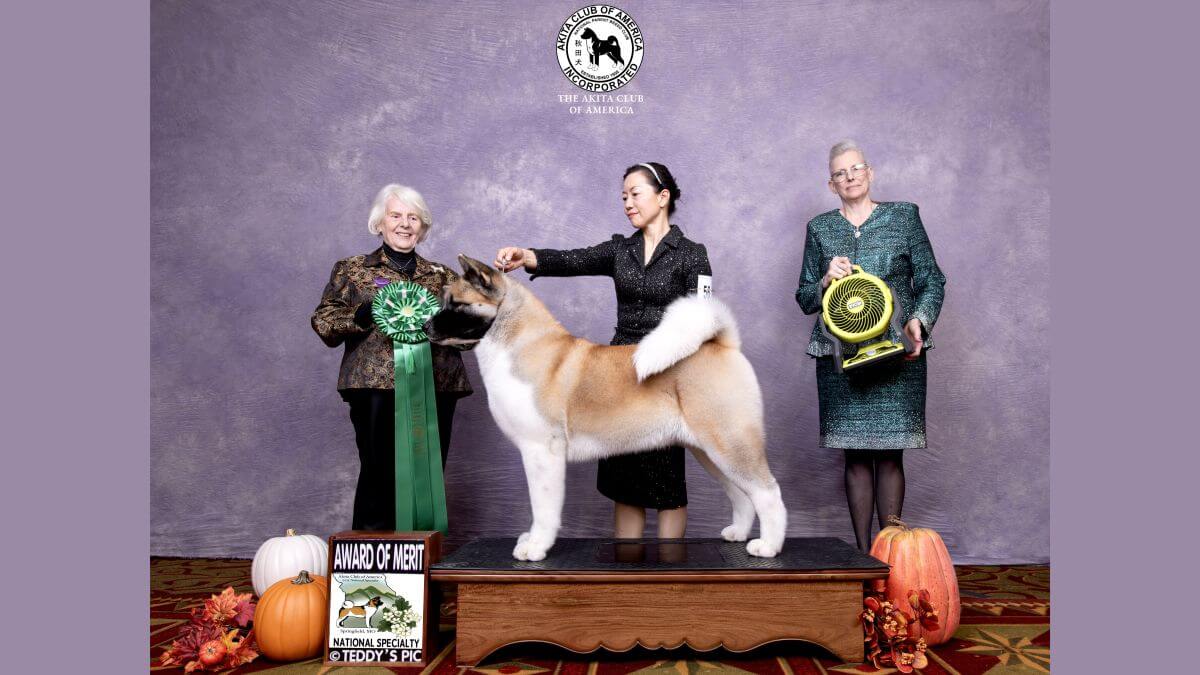
(A version of this article appeared in the March 2026 issue of Akita Annual (UK).)
Many say that the sport is dying, so is the breed. However, my mentor once said to me, “Excellence never dies. Excellent breeders never go extinct.”
In order to become an excellent breeder, I believe one ought to study those excellent breeders in the past and at present. Study how they selected their foundation, and developed their lines from it. Study their breeding choices, priorities, puppy selection methods. Study their highs and lows, career-defining litters, and how they propagated their breeding program from there. Study their networking with other breeders, exhibitors, and handlers, etc.
Without a solid understanding of the Breed Standard first and foremost, none of these would be possible.
For new Akita breeders, nothing could be better than learning the comprehensive perspectives and in-depth interpretations from the true legends in the breed. My favorite reads include The World of the Akita [1] by the breed pioneer, and hall of fame breeder, Barbara J. Andrews [1] and The Akita Today [2] by the esteemed breeders and judges, David & Jenny Killilea (Redwitch Akitas). The initial read helped me break down the Standard into component pieces of each breed characteristic.
As I have gained experience and knowledge in both breeding and exhibiting, I have gone back re-reading them many times to advance my understanding of the Standard.
Every time I went back, I learned something new. If you see yourself as one of the preservation breeders, you need to understand first and foremost the breed “Type” you wish to preserve. As many new breeders tend to mistake the breed type for a few individual features such as head and substance.
The Weekly Brief
The best of SHOWSIGHT editorials, weekly wins, and breeder commentary — delivered to your inbox every Sunday morning.
I think the definition of “Type” is spot on in Solving the Mysteries of Breed Type [3] by Richard Beauchamp. After considering many breeds and identifying their defining qualities, Mr. Beauchamp concludes that there are five elements that determine breed type:
Silhouette: “I’m frequently asked what is the very first thing I look at, even before considering individual features. The answer is simple: Silhouette.” [1]
Head: “The Standard delineates certain parameters that the good Akita head must fit within. Beyond that I believe, every breeder and fancier has his or her own idea of what ideal head type is. I personally prefer a clean, chiseled but powerful head that is not greatly exaggerated in any one of its points,” said Dr. Sophia Kaluzniacki, DVM. [4]
Gait: “As in many parts of the Akita Standard, the word moderate appears again, and this is a crucial word in describing movement. This breed should not have the reach and drive seen in the German Shepherd Dog, nor should it be so short-stepping as to appear terrier-like, but the moderate gait should always be brisk and powerful,” said Dave and Jenny Kilillea. [2]
Coat: “The Akita should carry a superb double coat. The undercoat is short, soft, and dense, almost wool-like. The outer coat is straight and harsh and stands off the body, protecting the dog from extreme cold and also providing a water-proof jacket. The guard-hair is hard and glossy and stands out through the underlying double coat,” according to Dave and Jenny Kilillea. [2]
Breed Character: If it were necessary to describe the Akita in one word, dignity would suffice for it is this concept that the breed embodies. Whether in a proud stance or in no-nonsense movement, the breed’s dignified presence is its most distinct quality. Each element described in the Breed Standard is designed to contribute to this impression. We like to say, “An Akita owns the ground he stands on,” stresses Sylvia Thomas of Chihensen Akitas). [5]
After reading many books, articles, and Breeder interviews, if asked to select a few key words that could sum up the breed characteristics in the Standard, I would say:
Thick: Think thick. Thick is heavy bone and much substance. Thick is large and broad head forming a blunt triangle. Thick is broad and full muzzle with a powerful underjaw. Thick is small ears in relation to the head, with thick leather that doesn’t tear easily in a fight and less prone to frostbite in the frigid climate. Thick is comparatively short and well-muscled neck. Thick is broad chest with well-sprung ribs. Thick is strong muscular hindquarters with well-developed thighs. Thick is “cat-like” feet made for speed and agility.
Moderate: Think moderate. Moderate is a well-defined stop but not abrupt. Moderate is a large head in balance with the body and tail. Moderate is moderate shoulder layback, which means the shoulder blade will slope at an angle of approximately 50 degrees. Moderate is moderate tuck up. Moderate is pasterns slightly inclining forward sloping 15 degrees from vertical. Moderate is moderate bend of stifle with well let-down hocks. Moderate is moderate side gait that is powerful and efficient but not restricted.
Dignified: Think dignified. Dignified are small ears, wide at the base carried strongly erect. Dignified is large head, clean and dry with no wrinkles. Dignified are small, deep-set, and dark eyes with tight rims. Dignified is large and full tail, set high and carried over back with proper length. Dignified are fully webbed feet with a tight grip.
Among the Breeders of all breeds, there have always been trends of certain degree of exaggeration. For Akitas in the past few years, I have observed a few:
“The bigger the better,” (head size, height, and/or substance).
“The smaller the better,” (eyes and/or ears).
“The shorter the better,” (hocks and/or back).
Once such trend(s) overwrite the Breed Standard and become dominant in the beliefs of the Breeders, the overall balance may be compromised. Certain exaggerations have even become some Breeders’ trademarks, which are proudly produced and preached generation after generation. I believe four elements contribute to the overall balance of Akitas:
Proportions: First, the ratio of the length of the body to the height (10 to 9 in males and 11 to 9 in bitches). Note the measurement landmark for the length is the prosternum, not point of shoulder like OES (Old English Sheepdogs). This is important as the sternum may or may not protrude beyond the point of the shoulder. “The outline should be almost square in the male Akita, bitches only a fraction longer,” said B. J. Andrews [6]. The dogs’ lack of prosternum may appear to be shorter in body length while those with forward-placed forequarters may appear to be longer. Second, the leg-to-body ratio. Third, the ratio of the length of shoulder blade to upper arm. Most believe that the ideal shoulders should have an upper arm that is equal in length to the shoulder blade. Last, the proportions of the head which are described as “a symphony of triangles.” [1]
Angulations: In a balanced dog, the angle of the articulation of the shoulder blade (scapula) to the upper arm (humerus) at the point of the shoulder equals the angle of the articulation of the pelvis (hip) to the upper thigh (femur) at the hip joint. [7] The incomparable Pat Trotter said, “The laws of nature applied to athleticism require these four bones to be in correct balance in both length and set-on (angulation) if the animal is to function properly.” [8] Another angulation that is often neglected by new breeders is the angulation of the croup. Akita’s tail should always set high corresponding to a relatively flat croup. This allows the thrust to be transmitted forward along the back. For low tail set caused by steep croup, the angle of drive is too high, which causes the back to rise during movement and restricts rear swing of the hindquarter.
Gait: Three words are used in the Standard to describe Akita’s gait: brisk, powerful, and moderate. Akita’s gait is a remarkable mix of aesthetics and functionality. Balanced and moderate reach and drive with proper foot timing. The motion is effortless, efficient, and ground-covering. An unbalanced Akita in motion will display lateral and/or vertical instability. For instance, the rolling motion of the front from side to side is one form of lateral instability and is most often seen in a dog with a shortened upper arm.
Temperament: “Temperament is best described in the Akita’s movement: purposeful with a no-nonsense approach to life, remaining dignified throughout. Character, without doubt, is reserved, silent and dominant and, while the breed does not go looking for trouble, any serious challenge would be met with instant retaliation. To make a comparison, this has to be a thoroughbred stallion in miniature,” say David and Jenny Killilea. [2] Perfectly said!
As you learn the Breed Standard and absolutely believe in every single word of it, the world presented to you all of sudden appears to be much simpler, quieter, and more explicit.
By “simpler,” you make all the decisions based on the Standard which will always guide you and protect you.
That is, select your mentors who not only have a wealth of knowledge of the Standard but also an extraordinary line rich and consistent in quality. Select your handlers who excel at presenting each of his/her Akitas closest to the Standard. Select your future partners: Breeders and Exhibitors who share similar ethics and beliefs. Decide which bitches are worthy to be bred and to which stud dogs for possibly improving your breeding program. Make smart plans on which entries to put in against certain competitions for better chance of winning.
By “quieter,” when you see the pictures of a flashy puppy on social media which everybody praises, when you watch a top-winning Akita moving around the ring with a large cheering crowd, nothing will distract you from applying the Breed Standard and only the Standard to evaluate their true quality.
By “explicit,” when you evaluate your breeding stock every few months, nobody knows better than yourself when it comes to their virtues and flaws. It does not matter who has the most impressive winning record, you know your best dog and best bitch. And you know just the puppy who may have the potential of becoming something even better, and why.
When you lay out your breeding plans for the next 5-10 years, you have a road map for certain improvements to be implanted and certain faults to be removed through certain combinations. If any particular combination fails, you have a plan B, plan C, and plan D, which may carry similar genetic patterns. And you know which puppy to keep out of each particular combination for your breeding program to converge following your vision, even though he or she may not appear to be the best one in this litter.
“Without standards, there can be no improvement.” Taiichi Ohno (the Father of the Toyota Production System)
[1] The World of The Akita by B. J. Andrews.
[2] The Akita Today by David and Jenny Killilea.
[3] Solving the Mysteries of Breed Type by Richard Beauchamp.
[4] Breeder Forum: Head Type, by B. J. Andrews of O’BJ Akitas, Beverly Vics of Tobe Kennels, Liz Harrell of Akita Tani Kennels, Dr. Sophia Kaluzniacki DVM of Tamarlane Akitas. Akita World, June 1986.
[5] SHOWSIGHT Breed Magazine: Akita, https://digital.showsightmagazine.com/view/253568/.
[6] Judging the Akita - The Akita Breed Standard: Head to Tail by B. J. Andrews, The Judges Place.
[7] Balance in the Canine by Stephanie Hedgepath, SHOWSIGHT October 2022.
[8] Born to Win, Breed to Succeed by Pat Trotter.
[9] Construction and Movement in The Dog by Dr. Karen Hedberg BVSC 2008.

Dog Show Candids