Members
Randy Colson
The Weekly Brief
The best of SHOWSIGHT editorials, weekly wins, and breeder commentary — delivered to your inbox every Sunday morning.
I didn’t set out to become a dog-show person. I’m a union electrician, a guy who works with his hands and believes that if something is worth doing, you learn to do it right. I grew up in Georgia around family, horses, work, and dogs. My grandmother showed a Yorkshire Terrier, and her example stayed with me: Give what you care about everything you’ve got.
Years later, standing beside a Bloodhound in a show ring, I began to understand how much of her had followed me there.
My black Labrador Retriever, Violet, changed the direction of my life. Through her, I discovered search work and what a dog can do when you understand its purpose. She became my partner. Her nose wasn’t just an interesting feature; it was a working instrument. That relationship led me toward search and rescue and, eventually, Bloodhounds.
The Bloodhound’s face gets your attention. The ears, wrinkles, and loose skin are hard to ignore. But the real hook is the nose. This is a dog created to work, and the more I learned, the more I understood that showing one in the ring could be part of preserving that purpose. Structure affects how a dog moves. Temperament affects how it lives and works. Health affects whether it can do either.
There was a lot more going on than ribbons.
Earl is a Bloodhound I love dearly. He also taught me that loving a dog and deciding whether to breed that dog are two different questions.
His temperament wasn’t what I wanted to reproduce, and there were things about his eye and head that didn’t fit the direction I believed I needed to go. It would have been easy to tell myself he was close enough. But “close enough” isn’t good enough when you’re making decisions about the future of a breed.
I neutered Earl, and he stayed my dog. He didn’t lose his value because he wasn’t the right breeding prospect. He taught me that stewardship sometimes means making a decision you don’t want to make.
Earl also earned his first—and only—AKC point in Perry, Georgia. I was proud of him. Instead of the good sportsmanship I’d hoped for, somebody reacted poorly to his win. I won’t name the person; that isn’t the point. I remember sitting in my truck afterward wondering what the hell I was doing there. I could accept losing. I was getting tired of people.
Earl didn’t know anyone was upset. He didn’t know about points or reputations. He was just Earl. I could let that moment push me out, or I could remember why I’d come: the dogs. Other owner-handlers saw that I was discouraged and told me, “Don’t quit. Hang in there. Keep learning.” Their kindness mattered as much as the other person’s behavior. One bad experience didn’t get to define the whole community.
When I started showing Bloodhounds, I thought I was learning how to handle a dog. I was learning how to see one.
At first, you notice the ribbons, the big kennels, and the people who seem to know everybody. Then you start studying feet, toplines, shoulders, and rear assemblies. You watch a dog move from the side, the front, and behind. You read the Breed Standard again, and then again. One day you realize you’re looking at the dog instead of the ribbon.
None of that means I always know what I’m doing. At noisy shows, I’ve missed what a judge said and spent the next few seconds trying to figure out what to do without looking completely lost. Nobody hands you an owner’s manual at your first show. If they did, it would probably be six hundred pages long, and someone would tell you that you were holding it wrong.
I learned by watching, asking questions, and occasionally making an ass of myself. I’d rather be embarrassed while learning than too proud to admit I don’t know something.
I wasn’t raised in a professional kennel. I began as an owner-handler with a Bloodhound, a lead, a lot of questions, and enough stubbornness to keep showing up. Then came Duchess Amelia Rose.
Rose was young, and she made me look more carefully. I watched her movement from every angle. I studied her structure, learned what I loved about her, and stayed honest about what I would still like to improve.
In Ocala, Florida, over the Fourth of July weekend, Rose finished her Championship. There was no Hollywood moment. It was better: I stood there with my dog, realizing how far we’d come. I’d driven the miles, paid the entries, groomed her, studied the Standard, made mistakes, and gone to the next show. I was proud as hell. For a moment, I wasn’t thinking about rankings or anybody else’s opinion. I looked at Rose and thought, “Damn. We actually did this.”
The Championship closed one chapter. Rose is still young, and she’s still teaching me.
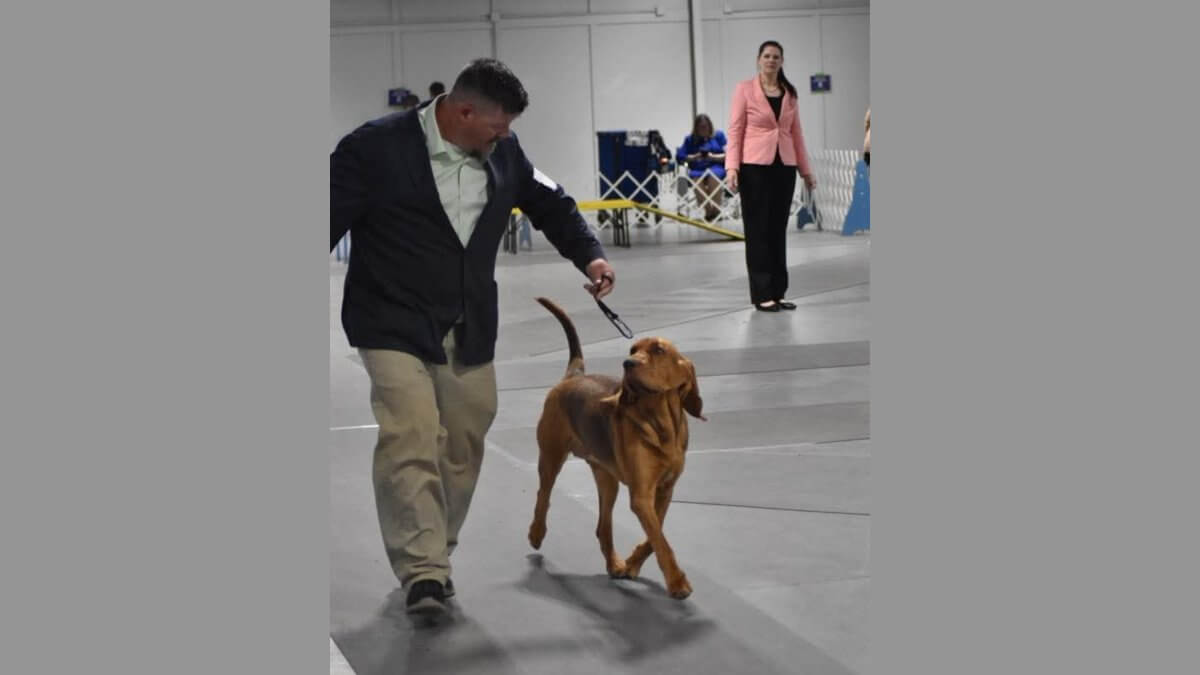
With a dog that lacks balance, you work harder to place the feet, manage the topline, and make everything come together. Then you put a balanced Bloodhound on the lead and feel the difference. The dog carries itself. The front and rear work together. You don’t have to fight to make it look like what it is; you let it move.
My job isn’t to manufacture balance with a lead. It’s to present what’s already there. You can flatter a dog standing still. Four feet moving tells you more.
The Bloodhound was created to work a trail. I want a dog that can put its nose down for hours, cover ground efficiently, and still has something left when the work is done. That’s why feet, bone, movement, temperament, and health matter together. A beautiful outline isn’t enough if the whole dog can’t do its job.
We also have to be careful about what we call “normal.” A feature doesn’t become correct just because it wins or appears often. If exaggeration becomes what people expect, breeders may select for it and judges may reward it. The written Standard can stay the same while the unwritten one in the ring drifts.
I’m not saying every winning dog has a problem, or every judge follows a fashion. I’m saying we should keep asking whether what we see helps the Bloodhound do what it was created to do. I don’t want to choose between a beautiful Bloodhound and a working Bloodhound. I want the whole dog.
A ribbon can’t track a missing person. A photograph can’t tell you whether a dog would still be working at the end of a long day. The Standard should help protect that future, not merely describe an appearance.
Dog shows have friendships, familiar faces, established kennels, and reputations. Sometimes it feels as though a person’s name enters the ring before the dog does. That doesn’t mean every win is political. It means people are involved, and I had to learn about that without becoming cynical.
I come from the electrical trade. I don’t care what brand is stamped on a machine; I want to know whether it works. In the ring, I want to look at the feet, the topline, and the movement rather than the name on the lead. A famous kennel doesn’t give a dog better structure, and a handler’s reputation shouldn’t add an inch to its reach.
I like winning. Of course I do. But I don’t want my whole identity to be about chasing points. A ribbon ends up in a box. What you learn can help you make a better breeding decision, explain the breed to a newcomer, or understand your own dog more honestly.
That last part can be hard. If you see every fault in everybody else’s dog but none in yours, you aren’t studying the breed; you’re defending your ego. I want to know why Earl wasn’t right for my breeding program and what I would improve in Rose. I want to hear what somebody else sees without taking it personally. Some of my best lessons have come from people who disagreed with me.
I think our sport could use more spectators who leave a show understanding something they didn’t know when they arrived. We can’t expect people to appreciate what they don’t understand.
When I started, I knew I liked a Bloodhound’s big head, ears, and wrinkles. I didn’t know much about how the front and rear should work together. Somebody had to help me see beyond that first impression. Now I can explain why a breed has a Standard and why the parts of a Bloodhound must work together.
Showing costs money: entries, gas, hotels, and time off work. Sometimes you make the long drive and find there aren’t enough dogs entered for much competition. But a spectator doesn’t have to pay those costs to fall in love with a breed. The person outside the ring might become an owner, a breeder, a rescue volunteer, or someone who teaches a child why that dog is built that way.
The future of dog shows depends on more than getting people through the gate. We need to give them a reason to stay. Answer questions. Explain what they’re seeing. Welcome the person who doesn’t yet know the difference between a good topline and a pretty face. Other owner-handlers did that for me when I needed them.
We inherited the Bloodhound; we didn’t create it. Every generation gets to decide what it will pass on. That calls for honesty about health, temperament, structure, and purpose—and the humility to keep learning. We shouldn’t breed simply because we can, or let trends replace the Standard.
Violet taught me purpose. Earl taught me honesty. Rose taught me to look closer. My grandmother taught me to take pride in doing something well, and the Bloodhound community taught me that there’s always more to learn.
I once thought my goal was to win. Then I thought it was to produce the perfect Bloodhound. Neither is entirely within my control. I can study, listen, admit when I’m wrong, make hard decisions and help someone coming behind me. I hope that when my time with this breed is over, somebody can say I cared about the Bloodhound. That’s enough for me.
When the gate opens, I’ll stop talking. I’ll watch the feet and the movement, and let the dog do the talking.
Owner Handler