Members
Lynda Kieres of TopperLyn Kennels shares her journey breeding Epagneul Bretons & Schipperkes, focusing on conformation and health.
The Weekly Brief
The best of SHOWSIGHT editorials, weekly wins, and breeder commentary — delivered to your inbox every Sunday morning.
Lynda Kieres
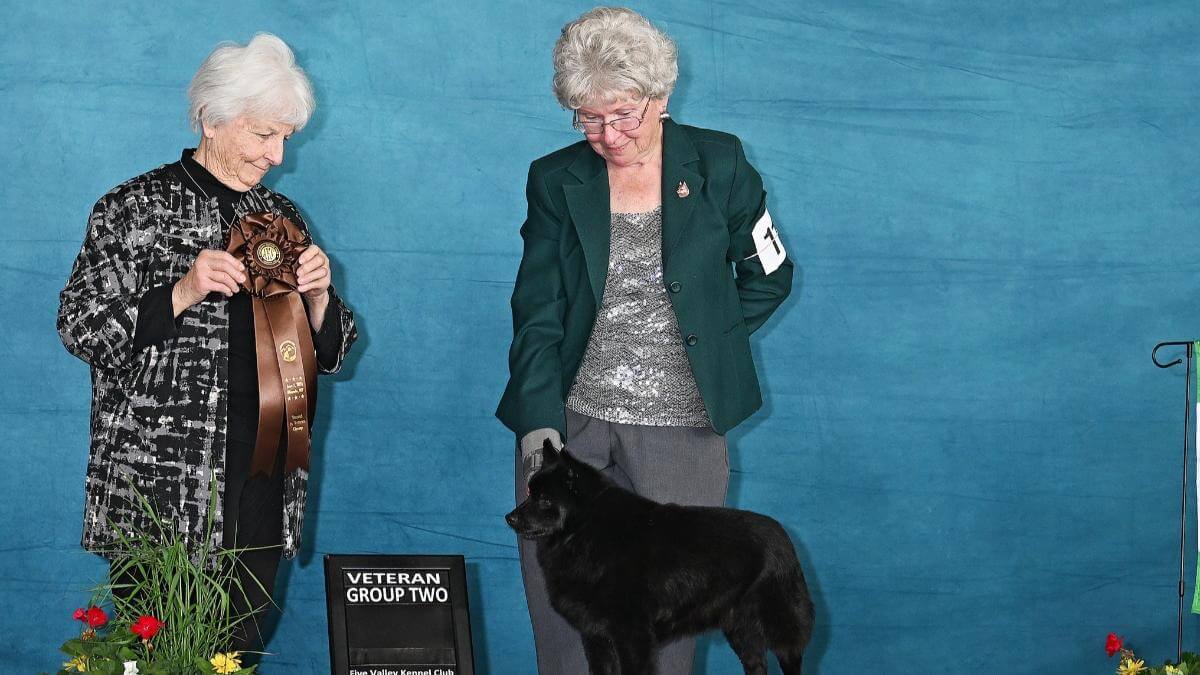
1. I live in the beautiful Bitterroot Valley in Western Montana. I’ve been “in dogs” since the early 1970s. My first breed was the Brittany. In 1998, my son and I added Epagneul Breton (commonly called “French Brittanies”). I’ve bred these dogs just over 25 years and am proud to say we played a strong role in establishing the breed in the US. In 2010, I decided I wanted a smaller dog that I could show in AKC. The end result was a Schipperke, “Huckleberry” (GCH CH Delamer A Fish Tale). Huckleberry and I have shared many adventures over the years. He recently turned 15 and I’m happy to say he still loves to show and gets out occasionally in Veteran Classes. I bred my first litter of Schipperkes in 2017. My kennel name is TopperLyn, which is the prefix for both Epagneul Breton and Schipperkes.
2. I have always subscribed to the philosophy that “breeding the best to the best is just good enough.” First and foremost in importance is conformation to the Breed Standard and Form = Function! Whether a dog is coursing across a field in search of game or working all day guarding a canal boat, if the dog is not put together correctly it won’t be able to hold up and do its job. Second is health. We screen every dog for all known health issues. Any dog we consider for breeding must pass these health screenings first. Health goes hand in hand with conformation. Third is temperament. Although the Schipperke was bred to be a guard dog, in today’s world, disposition is particularly important in order to do the many dog sports, from Obedience and Agility to FastCat, Conformation showing, and especially as a family companion, and frequently, a Service Dog. (Show dogs and Performance dogs are first and foremost family companions.)
3. We don’t breed for pet homes. When we make the decision to breed a pair, our standards are that we breed first for ourselves. Our goal is to produce a succession of excellent dogs to carry on our breeding program. Producing a great dog is amazing; producing a whole line of excellent dogs is everything. Each generation should be as good as or better than the previous. Second are prospective show and/or performance clients. In that case we typically have a waiting list. We will occasionally place a puppy in a “pet home,” often as a service dog/companion. Those are on a case by case basis.
4. Of course, we take advantage of all the new technologies in DNA testing and try to keep abreast of new developments. We are fortunate to have an excellent repro vet who supports our breeding program in all aspects, from health testing to reproduction
and whelping.
5. I can’t really say what the overall opinion is locally about purebred dogs, but I do know there has been a noticeable shift in the opinions of newer veterinarians—particularly in spay/neuter policies. They provide zero support in reproduction and think every dog should be spayed or neutered. That’s why I appreciate my repro vet as much as I do.
6. I’ve seen both good and bad trends in the sport. Competition in the show ring is what it is and you have to be willing to accept that. Even Owner-Handled competition is more and more at a high level. Any time you walk in the ring you have to be prepared to “play with the big dogs.” But, that being said, every time a judge recognizes your dog, your heart swells with pride. And even if you don’t come out the big winner you always take the best dog home.
7. Overall, there are far more activities available to dog owners today and I’m happy to say I see a lot of “show dogs” having the opportunity to do the “fun stuff” too. I think that is important for their mental health as well as physical.

Meet the Breeders