Members
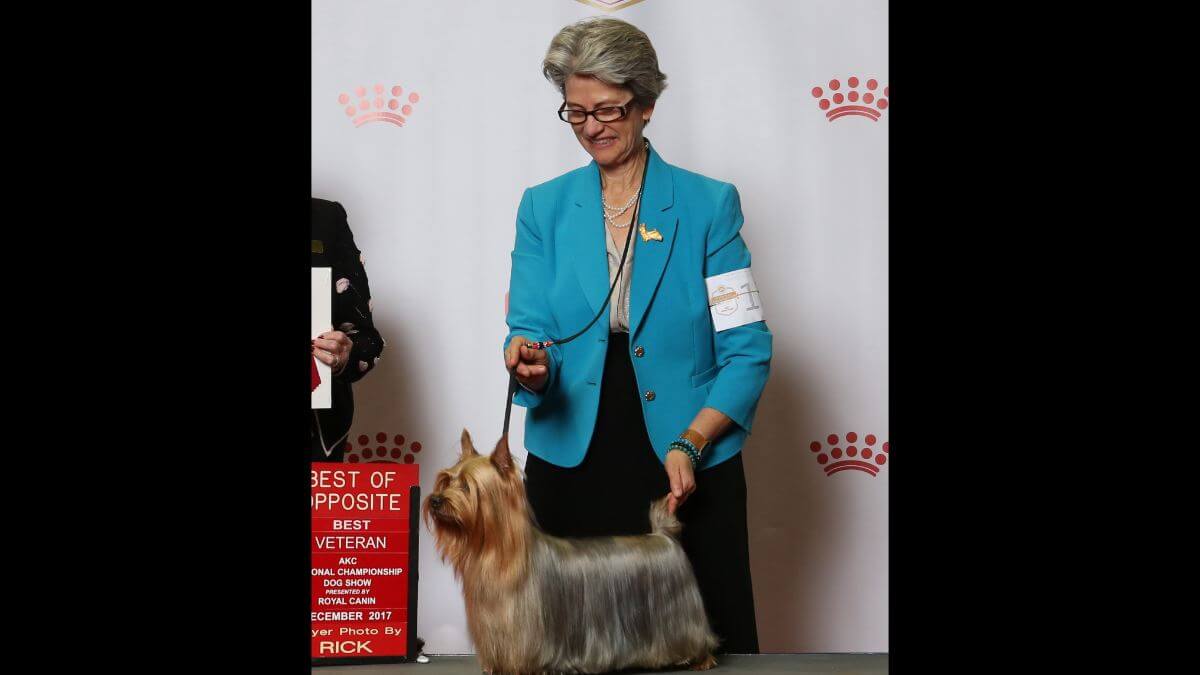
Sandy Mesmer of Tessier shares her insights on Silky Terriers, show puppy selection, breed trends, and the dog show community.
The Weekly Brief
The best of SHOWSIGHT editorials, weekly wins, and breeder commentary — delivered to your inbox every Sunday morning.
Sandy Mesmer
1. I live in Clearwater, Florida, and have been in Silky Terriers for 44 years, since 1980. Tessier is an AKC Platinum Breeder of Merit and we have had the No. 1 Silky for the past two years.
2. I look at puppies when they are newborn, but our breed looks like black and tan potatoes until about three weeks old—so it’s hard! My partner, Karen Huey, is better at this and says it has to do with everything on the puppy being smooth. Hmmm. I really start sorting when the babies learn how to stand. I put them on the table and look at them in the grooming mirror. I also use “puppy music” (an app with all sorts of noises) to see which puppy is worried and who wants to bark at the external speaker. I also have toys like our Funky Chicken, which dances. When I turn Funky on in the pen, some puppies hide but then slowly gain courage.
Others try to take him down right away. At about seven weeks, I play “let’s go.” I go outside, put a puppy down, and invite him to “let’s go.” Then I walk away. Some follow me cheerfully, others want to explore independently, some freeze in place—I can really see the difference in temperaments. But the best tool I use to sort out litters is my good camera. Over several weeks, we all go and hang out in the backyard and I take tons of photos. It’s fascinating how puppies can be average in person but really shine on camera. Then I take what I see on film and confirm—or disprove—on the table.
3. No, the breed is not in good condition overall. OurAKC numbers have slid badly since 2000 when we were ranked 61st. Now we are 114th. That’s a crash, even keeping in mind the larger amount of AKC registered breeds we now have. Silkys are a low entry breed and the number of breeders has crashed as well. The breed is genetically healthy as of right now, but this will not continue if our numbers dip too low. There are good dogs being shown, just not enough of them. I hear people disengaging from the breed rather than doubling down to help in any way they can. That’s distressing to me.
4. The number of shows is fine, and the judging is okay. There have always been a couple handfuls of truly outstanding judges, a moderate number of decent judges, and a couple of stinkers. (Note to self: don’t show to the stinkers.) The tendency is that you give people you know and like an extra look; that’s human nature, not politics. Good judges fight that tendency. I have loads of respect for most judges. They are careful and dedicated, and do a job that is much more physically demanding than you would think. I remember a retired pro handler friend telling me that after her first weekend of judging it took her several days and many hot baths to recover.
5. Is social media good or harmful? It’s both. On the positive side, social media allows a level of instant communication, unheard of 15 years ago, and it has democratized communication. Everyone has a platform where they can speak up. On the negative side, it gives us a feeling of communication with anonymity, in other words, we can say whatever we like with no consequences. My rule is this: If I wouldn’t tell it to my Grandmother, I shouldn’t post it.
6. Not only specifically to my breed, but in general, we need more breeders breeding. We need more people stepping up to see how they can help. “Ask not what the Fancy can do for you, ask what you can do for the Fancy.” We need more people showing up with their good dogs to compete. It’s easy to “Debby Down” on everything that is wrong, but the trend is reversible. We just need to have a positive attitude and do it.
7. I find more judges trying to be kind to exhibitors than they did 30 years ago.

Meet the Breeders