Members

The Weekly Brief
The best of SHOWSIGHT editorials, weekly wins, and breeder commentary — delivered to your inbox every Sunday morning.
The Scenario: The day ends. Ribbons are handed out. Chairs fold, grooming areas pack up, and another dog show weekend wraps up. What happens next often determines far more about your future than what happened during the judging. Some exhibitors leave excited on their magic carpet. Others leave disappointed. Most start thinking about what happened in the ring. For many exhibitors, the weekend ends when they load the last crate into the car. For the exhibitors who continue to improve year after year, however, the learning is just beginning.
One of the greatest misconceptions in our sport is that experience automatically leads to improvement. It doesn’t. We’ve all known people who have shown dogs for twenty or thirty years yet continue making the same mistakes. Time alone doesn’t make us better.
Learning does. The difference is the clarity of the feedback you receive and how you use it.
Every time you walk into the ring, you receive feedback. Sometimes it comes in the form of a blue ribbon. Sometimes it comes in the form of a handshake and a quiet walk back to your setup. Either way, the ring is teaching you something.
The question is: “Are you paying attention?”
One of the concepts I teach is that every result in the ring can be understood by evaluating three variables:
Those three factors are constantly interacting: the quality and preparation of your dog; the judge’s interpretation of the Breed Standard and priorities on that particular day; and your ability to present your dog to its greatest advantage.
When exhibitors focus on only one of those variables, they miss valuable information.
When they honestly evaluate all three elements of quality, engagement, and results, they begin creating what I call:
The first challenge is separating emotion from information, which isn’t always easy.
Dog shows are emotional. We invest countless hours grooming, training, and traveling. It’s natural to feel disappointed after a loss, or excited after a big win. However, emotion has a way of distorting feedback.
Likewise, winning doesn’t always mean we did everything right.
A ribbon confirms the result on that day. It doesn’t eliminate opportunities to become better.
The exhibitors who improve the fastest learn to become investigators rather than advocates. Instead of proving they were right, they became curious about what actually happened.
They begin with the dog.
Did my dog move as well as he does at home? Did he maintain his attitude throughout the class? Was he physically fit enough to finish strong? Did he show confidence? Was he carrying the correct weight and maintaining the correct muscle tone?
These questions aren’t criticisms. They’re opportunities. Self-reflection is an essential tool for successful outcomes in competitions. What follows next is perhaps the most difficult evaluation of all: YOU!
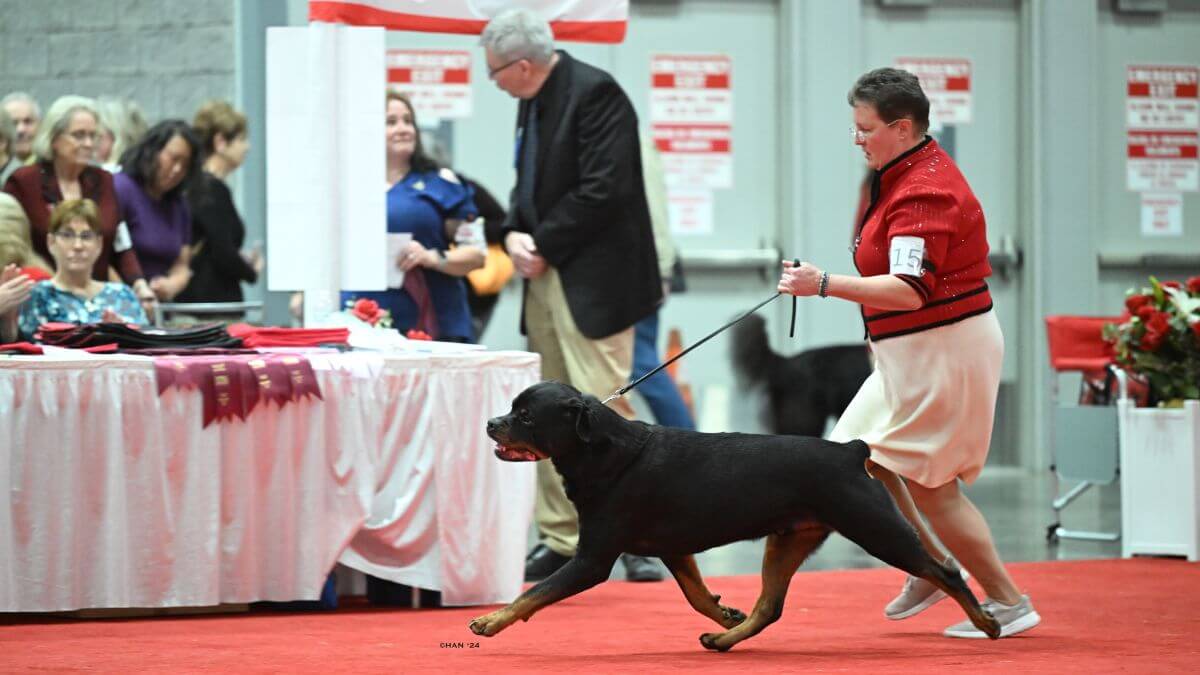
As judges, we often see exhibitors so intently focused on stacking or gaiting that they stop watching what’s happening around them, which is exactly what separates sub-par exhibitors from those who create stellar performances. Professionals have 1,000 eyes in their heads and know everything that is going on, not only in their own ring but also in every ring at the show. Timing is never out of sync. Opportunities are always seized. Sometimes confidence disappears the moment something unexpected occurs with owner handlers, but the professional will make it appear intentional.
To develop your own ring savvy, ask yourself the following difficult questions.
Did I enter the ring prepared? Even most beginners know that they should watch the judge before going into the ring. A ring bag with essential cooling and heating items, plastic bags, various personal items, and a battery-powered fan are all important to have ringside. The basics, at the very least, include having the right armband number and wearing it right-side up!
Did I pay attention to the judge’s instructions and where in space s/he was in relation to where my dog was at all times? There is an intricate dance with the judge in the ring that depends on your awareness of where you place yourself in relation to the judge and where your dog is looking and standing. While judging, there have been countless times when exhibitors have run their dogs into me because they didn’t realize they had gone too far on the down-and-back.
Plus, there have been numerous times when exhibitors put their heads right in front of their dog’s face for the bite exam, and their hands when baiting their dog. Did you move at the proper speed for your breed and your individual dog? Did you stay calm when things didn’t go exactly as planned? Did you truly present him/her in peak condition?
One of the healthiest habits an exhibitor can develop is critiquing their own performance after every show, regardless of the outcome. One of the biggest obstacles to improvement is confirmation bias. We naturally look for evidence that supports what we already believe.
“My dog should have won.”
“I always lose because…”
“The judge never…”
Those conclusions may protect our ego, but they rarely improve our dogs.
Curiosity is far more valuable than certainty. There are many more questions we can ask ourselves; this is just the beginning.
Finally, evaluate the judge. Notice I didn’t say criticize the judge. There is an enormous difference. This is part of your process to becoming a top-quality handler.
Every judge brings years of study and experience to the center of the ring. While every decision should be based on the Breed Standard, judges may value different virtues when evaluating otherwise worthy exhibits.
Was breed type consistently rewarded?
When you watched the judge, what characteristics were rewarded consistently throughout the day? Become a student of judging by learning the most important characteristics of your breed, and then take careful observation of which judges consistently reward those virtues.
Was movement especially important? Read the Breed Standard and learn basic anatomy to figure out where movement fits into breed type. For example, the Saint Bernard Breed Standard doesn’t even mention gait, whereas the Alaskan Malamute is expected to have no structural faults that would interfere with its function as a drafting dog. The Border Collie, on the other hand, moves with its head lower than most livestock herding breeds. Alternatively, the Havanese should show the pads when moving toward the judge.
There are many aspects of a breed to consider; these are just a few examples of judges’ priorities in the ring. These observations help you understand the day’s results without considering every loss as a personal injustice.
So, what does this look like in practice?
I encourage exhibitors to create a simple routine after every show.
Following each show, write down these three points:
What worked?
What needs improvement?
What will I do before my next show?
Those three questions become the beginning of your Dog Show Mentor Personal Improvement Journal™.
Over time, patterns begin to appear.
Assess whether your dog consistently loses focus during long classes. Evaluate whether your down-and-back needs work. Perhaps conditioning slips after several weekends on the road. Or maybe you discover that your biggest improvements have come from changes you never would have noticed had you relied solely on memory. Documenting by handwriting in a journal is known to be one of the most impactful ways to create positive change. This creates a cycle of intentional improvement.
SHOW -> REFLECT -> ADJUST -> PRACTICE -> SHOW AGAIN
Show your dog.
Reflect honestly by assessing these main feedback elements: The Dog. The Judge. YOU!
Adjust one or two specific areas instead of trying to change everything.
The Right Practice: Adjustments should be made until they become habits. The Right Habits. Five minutes a day.
Now, show again.
Over time, the exhibitors who implement this process become remarkably resilient. They don’t define themselves by a single weekend, a single judge, or even a single season, because a quality handler develops one lesson at a time.
I’ve often said that dog shows are about much more than ribbons. They teach patience, humility, resilience, observation, and continuous improvement. Those lessons don’t just make us better exhibitors. They make us better students of our dogs and, perhaps, better people as well.
The next time you leave the ring, resist the temptation to ask only whether you won.
Ask what the ring taught you, because in the end…
Winning tells you where you are. Feedback shows you the roadmap ahead. The Dog. The Judge. YOU!TM helps you decide which road to take.

Owner Handler