01/Overview
The Briard is a charming purebred known for its courage, loyalty, and high spirit. Hailing from France, this ancient shepherd's dog has been a unique choice for people looking for a lively canine companion. The breed's keen sense of duty and protective nature make it an excellent choice as a guardian, while its loving disposition makes it a cherished member of the family.
Highlights
02/History
The Briard is a breed steeped in history, tracing its origin to the French countryside. Renowned for its impeccable herding and guarding abilities, the breed has been present in the country for centuries, serving as the shepherd's loyal companion.
Many tales and lore surround the Briard, each contributing to the breed's rich historical tapestry. There's even mention of the breed in literature from the 8th century, underlining its longstanding presence in France. Emperor Charlemagne, as well as Napoleon, are believed to have had Briards.
Primarily used for guarding and herding sheep, the Briard's keen senses, intelligence, and undying loyalty made it an invaluable asset. The dogs' unique ability to herd and protect livestock from predators, particularly wolves, established them as a staple in French pastoral life.
The breed's role underwent a transformation during the World Wars. Owing to its intelligence, determination, and acute sense of hearing, the Briard was employed by the military for various tasks, including detecting wounded soldiers and carrying supplies. This service further underscored the breed's adaptability and valor.
It was only in the late 19th and early 20th centuries that the Briard began to be recognized as more than just a working dog. The breed gained prominence at dog shows, and the dogs' distinctive characteristics began to attract the attention of enthusiasts outside France.
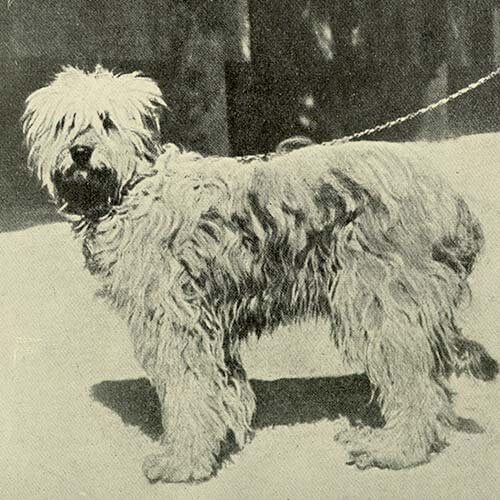
The American Kennel Club (AKC) officially recognized the Briard in 1928, cementing its status in North America as a breed of distinction. Additionally, other major canine organizations, including the FCI and The Royal Kennel Club (UK), extended recognition, propelling the breed to global notoriety.
While the Briard may not always be found working sheep in the French countryside today, its herding instincts remain strong. Modern-day Briards serve as companions, show dogs, and even Therapy Dogs, proving that their versatility and charm transcend time and purpose.
03/Appearance
Adult male Briards typically stand between 23 and 27 inches tall at the shoulder, while mature females are slightly smaller, measuring around 22 to 25.5 inches.
Weight varies based on the overall size and build of the individual dog. Generally, adult Briards can weigh between 55 and 100 pounds.
Skull: Broad and slightly rounded, the Briard's skull conveys its strength. It is well-proportioned with the rest of the body, with a prominent occiput and a well-marked stop. The forehead is very slightly rounded.
Expression: One of the breed's most captivating features is its expression, which is both confident and kind. Even when its eyes are obscured by its flowing coat, one can sense the dog's alertness and keen observance.
Eyes: Dark and set well apart, the eyes are large and oval in shape. They possess a lively, intelligent gaze that speaks of curiosity and an alert nature.
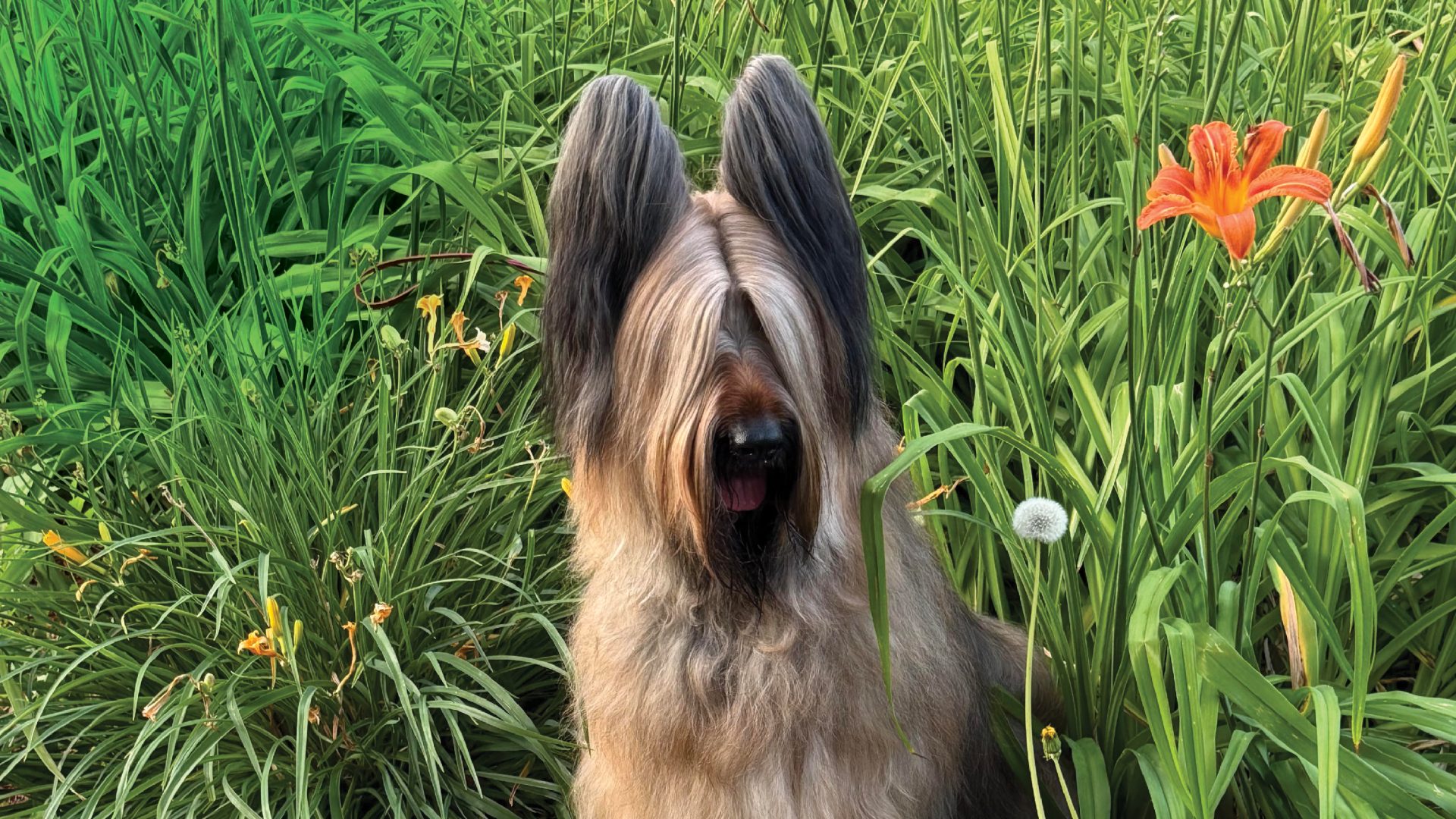
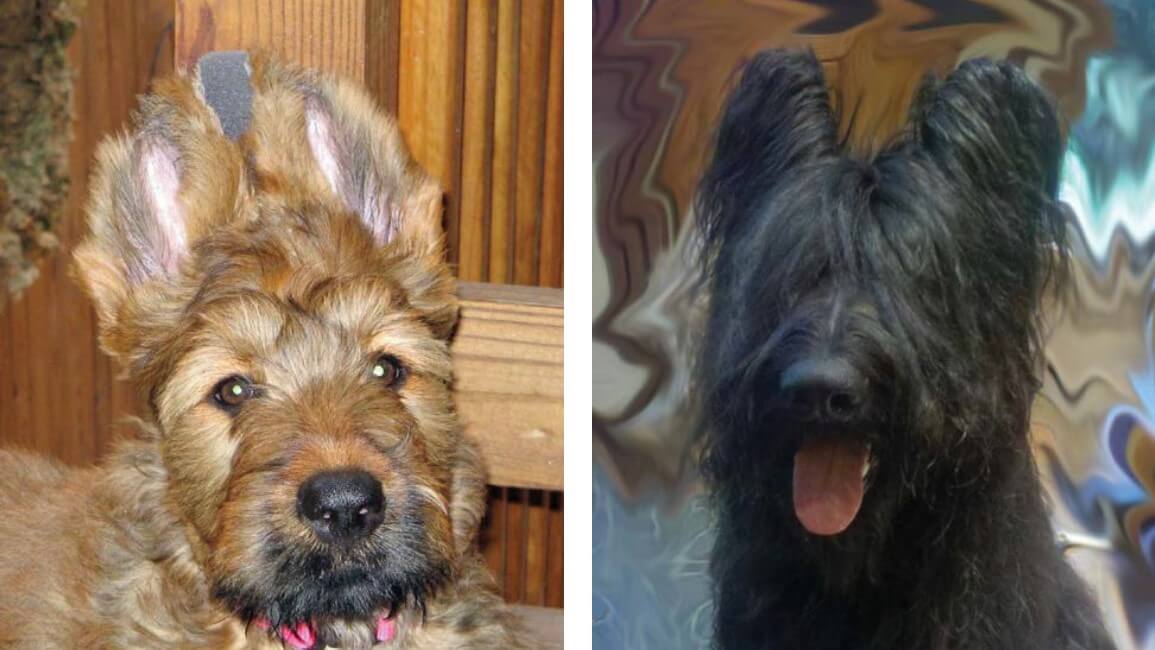
Ears: Set high and covered in hair, the ears may be natural or cropped. Natural ears do not lie flat against the head. When cropped, the ears stand upright and parallel to each other. When alert, the ears perk up and face forward, adding to the breed's inquisitive expression.
Muzzle: Strong and ending in a slight square shape, the muzzle is of equal length to the skull, giving a balanced appearance to the head.
Nose: Prominent and always black in color, the nose adds much character to the appearance of the head.
Bite: The Briard possesses a strong jaw with a scissors bite, where the upper incisors closely overlap the lower incisors. This ensures a usefulness when working livestock.
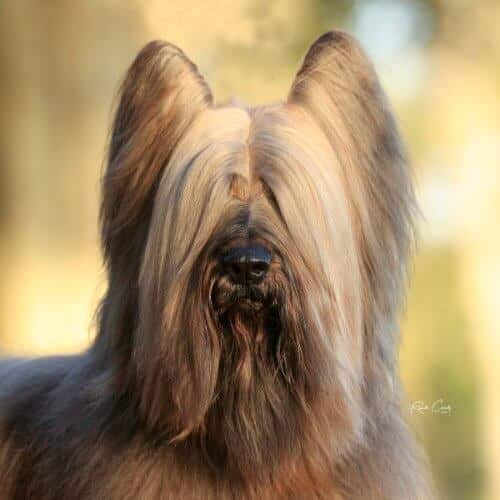
The Briard presents a harmonious balance in its proportions. The body may be slightly longer than it is tall; however, the overall silhouette is square but not cobby. The breed is not merely a fluffy facade; beneath its luxurious coat lies a robust framework of strength and agility that showcases the Briard's herding ancestry and its capacity for strenuous work.
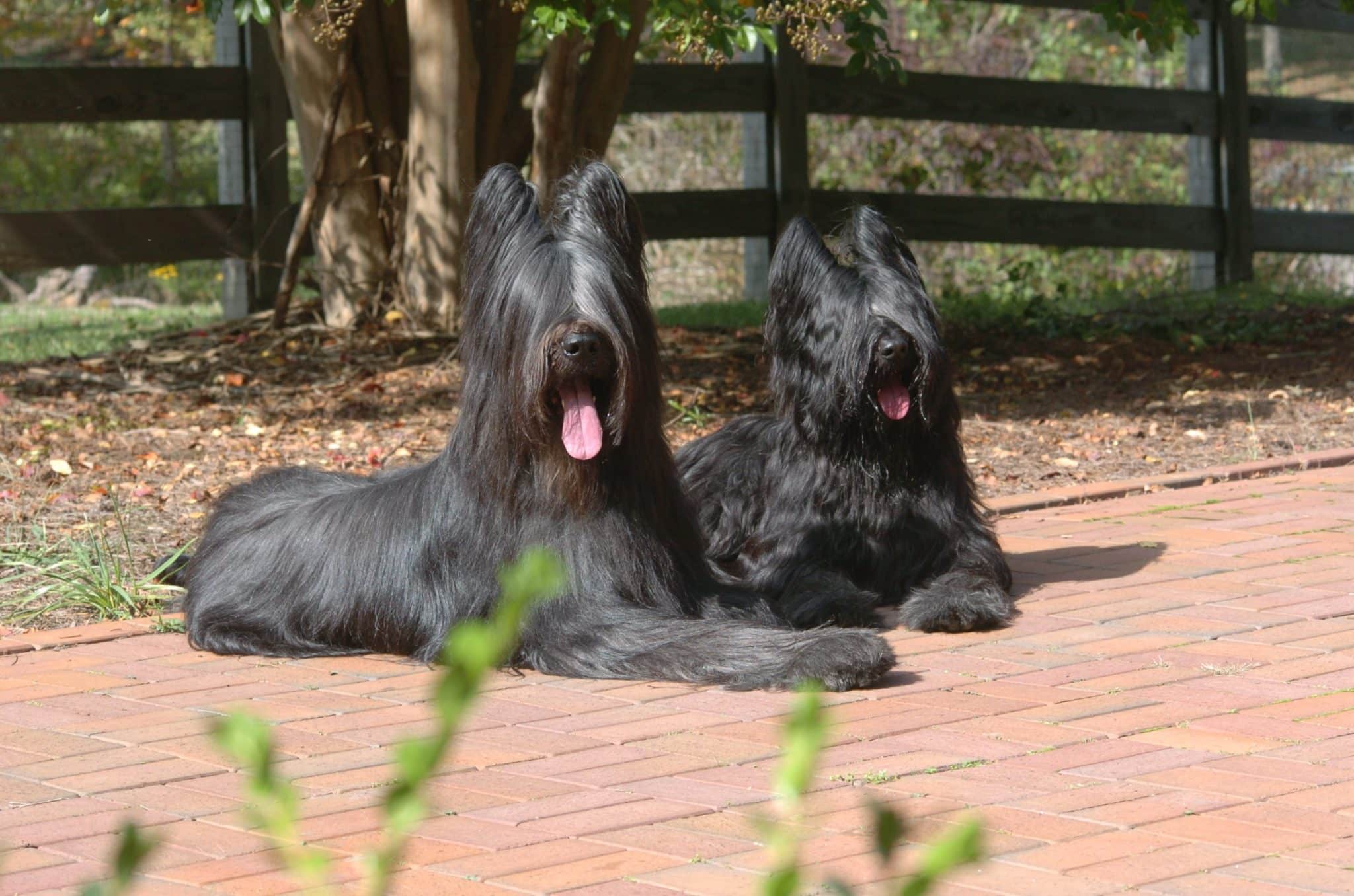
Texture: The Briard boasts a harsh double coat that is both long and wavy. The outer coat is coarse and dry, ensuring it is resistant to the elements, while the undercoat remains soft and dense. The head is covered in long hair, parting naturally along the centerline of the face. The coat is hard and dry but has a good sheen. The hair lies flat, falling in slightly wavy locks, and has a texture that not only gives the Briard its distinctive appearance, it also provides a rasping sound when touched.
Markings: White Markings
Standard Colors
04/Consider
The Briard is more than just striking in appearance. Owning one of these distinctive dogs comes with the joy of sharing life with a loyal and spirited companion. However, potential Briard owners should be aware of certain breed-specific considerations.
Interaction With Family
The level of affection a breed typically shows towards family members and familiar individuals.
Good With Other Dogs
The innate friendliness of a dog towards other dogs can depend on its breed.
Good With Young Children
The degree to which a breed will typically be patient with young children.
Amount Of Shedding
How much hair a breed typically leaves behind on clothes, furniture and floors.
Frequency Of Grooming
How often a breed needs brushing, bathing or a professional trim to stay in condition.
Amount Of Drooling
How prone a breed is to drool — worth knowing before you keep a towel by the door.
Openness To Strangers
How openly a breed tends to greet new people, visitors and strangers.
Protective Nature
How likely a breed is to alert you to — and stand between you and — anything unfamiliar.
Playfulness Level
How enthusiastic a breed stays about games and play well past puppyhood.
Trainability Level
How readily a breed takes direction and works with you rather than around you.
Barking Level
How much a breed uses its voice, and how readily.
Energy Level
How much get-up-and-go a breed brings to an average day.
Health
The Briard is typically a robust and healthy dog, blessed with a sturdy constitution. However, like all breeds and mixed breeds, it can be susceptible to some health issues. Prospective owners should be aware of these and work closely with a trusted breeder and veterinarian to ensure the dog maintains optimal health throughout its life. Lifespan: The lifespan of a Briard is typically around 12 years, but with proper care and exercise, regular check-ups, and a balanced diet, many can thrive beyond this average.
When considering bringing a Briard into the home, it's essential to understand the breed's personality traits. The Briard is an intelligent and spirited breed, known for its loyalty and keen protective instincts.
For novice owners, the Briard can be a bit of a challenge due to its strong-willed nature. However, with consistent training and early socialization, these dogs can become obedient and well-adjusted family members. Their sensitivity level is relatively high; Briards often form deep bonds with their families and can be quite intuitive about their owner's feelings and needs.
Being alone is not the Briard's favorite pastime. Given the herding background of these dogs, they prefer to be involved in family activities and can become distressed if left isolated for extended periods. This also ties into their relationship with other dogs. Briards can get along well with other dogs, especially if they've been introduced and socialized from a young age.
Their protective instincts extend to their relationship with young children. Briards are generally patient and gentle with kids, making them suitable companions for families. However, due to their herding instincts, they might attempt to "herd" young children, so supervision is recommended during interactions.
When it comes to strangers, the Briard's initial reaction might be one of caution. These herding dogs are naturally protective and may take some time to warm up to unfamiliar faces. But with proper introductions and positive experiences, they can be quite sociable.
Exercise Expectations
The Briard's exercise needs are relatively high, reflecting their working background. A simple walk around the block might not suffice for these energetic dogs. They thrive on activities that engage both their minds and bodies. Hence, long walks, hikes, play sessions, and even Agility or Herding Trials can be beneficial and enjoyable for them. In terms of energy level, the Briard is notably spirited. These dopgs possess an inherent drive to work and play, making them ideal companions for active families or individuals. Their enthusiasm, paired with their intelligence, also means they excel in dog sports and training sessions where they can channel their energy productively. The Briard’s playfulness is evident in its interactions, be it with other dogs or with its human family members. These dogs love engaging in games of fetch, tug-of-war, or even interactive toys. However, it's essential to ensure that play sessions are controlled, especially if there are smaller animals or young children around, due to the Briard's herding instincts. Intensity is another hallmark of the Briard's exercise regimen. While these dogs are always up for rigorous activities, it's crucial to monitor them, especially in extreme weather conditions, ensuring they don't overexert themselves.
Living with a Briard is a rewarding experience that comes with its own set of considerations due to the breed's distinctive traits. As a herding breed with a rich history, the Briard brings a mix of energy, intelligence, and affection into a household.
For urban dwellers considering a Briard, it's crucial to understand that while these dogs can adapt to apartment living, they require ample space every day to move and play. The dog’s size and energy level make a spacious environment more conducive to its well-being. If living in a confined space, it becomes even more critical to ensure the Briard gets its daily dose of exercise and mental stimulation.
Climate can play a role in the comfort of a Briard. With its thick double coat, these dogs are naturally well-equipped for colder weather. They can frolic in the snow and handle lower temperatures quite well. However, the same coat can make them more sensitive to extreme heat. During hotter months, it's important to provide them with a cool, shaded environment and avoid intense physical activity during peak hours of sunshine.
While Briards are loyal and protective, making them excellent watchdogs, their herding instincts might sometimes manifest in the home environment. They could attempt to "herd" family members, especially young children, by nipping at their heels or circling around them. It's essential to train them early on to manage these instincts and to always ensure safe interactions.
Socialization is paramount for a Briard. Introducing this breed to various environments, people, and other animals from a young age can help in molding a well-rounded and confident adult dog. The breed’s protective nature means these dogs can be wary of strangers, so positive experiences with various individuals can help with curbing any undue apprehension.
05/Puppies
The introduction of a Briard puppy into a household is a moment filled with excitement and anticipation. These little bundles of energy bring immense joy and, with their curious eyes and playful antics, can quickly become the center of attention. However, caring for a Briard puppy, as with any young dog, demands dedication, understanding, and a commitment to their well-being.
From the moment a Briard puppy steps into its new home, it's vital to create an environment conducive to its growth and development. Establishing a routine early on helps the puppy adjust and understand what's expected. This includes regular feeding times, potty breaks, and play sessions.
Nutrition plays a pivotal role during this growth phase. A balanced diet, specially formulated for puppies, provides them with the essential nutrients required for their development. Consulting with a veterinarian can help to guide the right dietary choices and quantities, ensuring the puppy thrives and builds a strong foundation for adulthood.
Socialization, as with adult Briards, is paramount during the puppy phase. Exposing puppies to various sounds, sights, people, and other animals helps in building confidence and reduces the chances of them becoming overly cautious or aggressive in unfamiliar situations.
Training should begin early, capitalizing on the breed's keen intelligence and eagerness to learn. Simple commands, housebreaking, and leash training are some of the basics to start with. Given their herding instincts, early training can also help to curb behaviors like nipping or excessive chasing.
Physical health is crucial, of course, but so is mental well-being. Briard puppies are curious and eager to explore, so providing them with toys, puzzles, and interactive games can help to stimulate their minds. Puppies that are actively engaged are less likely to develop undesirable behaviors out of boredom.
Lastly, while Briard puppies are naturally playful and energetic, it's essential to be certain they don't overexert themselves. Their bones and joints are still developing, and excessive or rough play can lead to injuries.
06/Activities
The Briard's rich heritage as a working and herding breed means that they're not just content lounging around. They have a deep-seated need for activity, both mentally and physically. As such, these dogs thrive in environments where they can channel their energy and intelligence into constructive outlets.
Herding Trials: Given their historical role as herders, Briards excel in Herding Trials. These events simulate the tasks a herding dog would typically undertake, requiring them to move livestock in specific patterns or within specified areas. A Briard's natural instincts, combined with training, make this breed a formidable competitor in these trials.
Agility: Agility Trials, filled with jumps, tunnels, and weave poles, provide an excellent platform for Briards to showcase their dexterity and intelligence. Training for Agility strengthens their problem-solving skills and offers a robust physical workout.
Obedience: The breed's keen intelligence and desire to please their owners make Briards strong contenders in Obedience Trials. These events test a dog's discipline and training, requiring them to follow specific commands and perform certain tasks alongside their human partners.
Rally: Rally offers a mix of Obedience and Agility. In this low-pressure sport, dogs and their handlers navigate a course with different stations, each requiring a specific task or command. The continuous flow and varied directives cater to the Briard's intelligence and adaptability.
Tracking: Tapping into their innate sense of smell and focus, Tracking events require Briards to follow a scent trail and locate specific items or individuals. The breed’s determination and concentration shine in these activities.
Flyball: This relay race activity witnesses teams of dogs racing against each other, jumping over hurdles and triggering a spring-loaded mechanism to release a tennis ball. The Briard's energy and enthusiasm make Flyball a thrilling sport for these dogs.
Disc Dog: In Disc Dog, competitors are judged on their ability to catch a thrown disc at various distances. Briards, with their agility and keen eye, can excel at this sport, making it a fun and interactive event for both dog and owner.
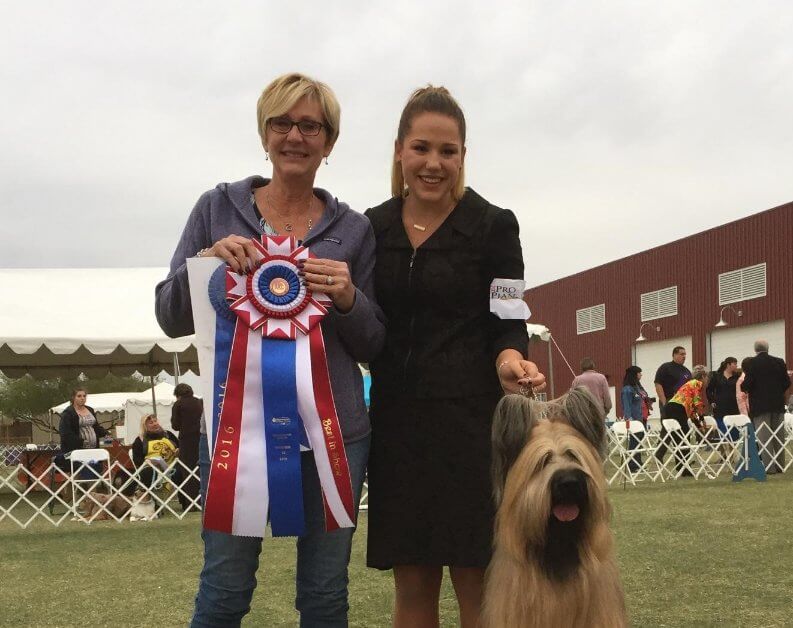
Conformation Shows: A staple in the world of purebred dogs, Conformation Shows assess a dog's physical attributes and temperament against its Breed Standard. Briards, with their majestic coats and striking appearance, often make a mark in these high-stakes events.
The Briard is a versatile breed, making it suitable for a wide range of activities. Engaging the Briard in these activities not only showcases its many talents, it also provides the mental stimulation and physical exercise that this breed craves.
Gallery
07/Standards
The Briard is recognized by the world's leading registries and kennel organizations, which categorize the breed into a specific Group based on its unique characteristics. This breed is recognized worldwide under the following Group designations:
The ideal Briard is described by a Breed Standard that is approved by each of the world’s leading registries and kennel organizations. The Breed Standards for this breed may be found in the following links:
08/Clubs
Several dedicated organizations across the globe champion the Briard, offering invaluable resources, expertise, and community connections for those interested in learning more about the breed.In the United States, the primary organization dedicated to the breed is the Briard Club of America (BCA). Established in 1928, the BCA has been a steadfast advocate for the Briard, working closely with the American Kennel Club. The club’s members are deeply involved in organizing events, producing educational resources and orchestrating rescue efforts for the breed.In Canada, the Canadian Briard Club stands as a beacon for Briard enthusiasts. Collaborating with the Canadian Kennel Club, the CBC has made significant strides in promoting, protecting, and bettering the Briard, ensuring it continues to thrive in Canadian households and on Canadian farms.In the United Kingdom, the Briard Association takes the helm in representing the breed. This esteemed organization holds a close association with The Royal Kennel Club and is integral in hosting breed-specific events, educational initiatives, and upholding the highest standards for the preservation of the Briard.For those passionate about the Briard, getting involved with these organizations can prove immensely beneficial. They not only provide a gateway to understanding the breed deeper but also open doors to a community that shares an unwavering love for the Briard.
09/Rescue
The commitment to ensuring every Briard has a loving home extends beyond breeders and enthusiasts. Rescue groups play a pivotal role in this endeavor, offering Briards that may have faced hardships or abandonment a second chance at a fulfilling life.In the United States, there's a concerted effort by organizations such as the Briard Rescue and Haven to rehabilitate and rehome Briards. They take in Briards in need, provide them with necessary medical care, training, and most importantly, love until they find their forever homes.For those considering bringing a Briard into their lives, adopting from a rescue group can be a heartwarming option. Not only does it give a Briard another chance at happiness, but it also opens up a space for another dog in need. While breed-specific rescue groups are a wonderful resource, it's also worth noting that many dog rescue organizations and local shelters could also have a Briard looking for a home.
10/Facts
Historical Significance
The Briard has been woven into French history for centuries, with images of the breed found on tapestries from the 8th century.
Presidential Preference
Thomas Jefferson, the third President of the United States, had a particular fondness for Briards. He is believed to have owned one, further showcasing the breed's appeal.
Military Service
The Briard's sharp senses and unwavering loyalty were put to the test during the World Wars, where they served as sentinels, messengers, and even search and rescue dogs.
Herding Instinct
The Briard's herding instinct is so pronounced that they often display it even without training. This can be observed in household settings, where they might subtly try to "herd" their human family members or other pets.
Unique Footwear
One of the distinguishing features of the Briard is the breed’s "double dewclaws" on the hind legs. These extra toes are not just for show – historically, they provided better grip and stability on uneven terrain while herding.
Celebrity Status
The Briard has graced the silver screen on more than one occasion. The breed’s striking appearance and expressive demeanor have made this dog a favorite choice for movies and television shows.
Guardian by Nature
Even though they're cherished as companion animals today, Briards have a deeply ingrained protective instinct. Their keen sense of hearing, coupled with a natural wariness of strangers, makes them effective watchdogs.
11/FAQ
While no dog breed is truly hypoallergenic, Briards are often considered to be among the breeds that are less likely to trigger a person’s allergies. Their wavy coats can help to trap dander, preventing it from becoming airborne. However, to ensure there’s no reaction, individuals with severe allergies should spend time with a Briard before deciding to bring one home.
Official Standard of the Briard
General Appearance: A dog of handsome form. Vigorous and alert, powerful without coarseness, strong in bone and muscle, exhibiting the strength and agility required of the herding dog. Dogs lacking these qualities, however concealed by the coat, are to be penalized.
Size, Proportions: Size - males 23 to 27 inches at the withers; bitches 22 to 25½ inches at the withers. Disqualification - all dogs or bitches under the minimum. Proportions - the Briard is not cobby in build. In males the length of the body, measured from the point of the shoulder to the point of the buttock, is equal to or slightly more than his height at the withers. The female may be a little longer.
Head: The head of a Briard always gives the impression of length, having sufficient width without being cumbersome. The correct length of a good head, measured from the occiput to the tip of the nose, is about forty percent (40%) of the height of the dog at the withers. There is no objection to a slightly longer head, especially if the animal tends to a longer body line. Viewed from above, from the front or in profile, the fully-coated silhouette gives the impression of two rectangular forms, equal in length but differing in height and width, blending together rather abruptly. The larger rectangle is the skull and the other forms the muzzle. The head joins the neck in a right angle and is held proudly alert. The head is sculptured in clean lines, without jowls or excess flesh on the sides, or under the eyes or temples. Expression - the gaze is frank, questioning and confident. Eyes - the eyes set well apart with the inner corners and outer corners on the same level. Large, well opened and calm, they must never be narrow or slanted. The color must be black or black-brown with very dark pigmentation of the rim of the eyelids, whatever the color of the coat. Disqualification - yellow eyes or spotted eyes. Ears - the ears should be attached high, have thick leather and be firm at the base. Low-set ears cause the head to appear to be too arched. The length of the natural ear should be equal to or slightly less than one-half the length of the head, always straight and covered with long hair. The natural ear must not lie flat against the head and, when alert, the ears are lifted slightly, giving a square look to the top of the skull. The ears when cropped should be carried upright and parallel, emphasizing the parallel lines of the head; when alert, they should face forward, well open with long hair falling over the opening. The cropped ear should be long, broad at the base, tapering gradually to a rounded tip. Skull - the width of the head, as measured across the skull, is slightly less than the length of the skull from the occiput to the stop. Although not clearly visible on the fully-coated head, the occiput is prominent and the forehead is very slightly rounded. Muzzle - the muzzle with mustache and beard is somewhat wide and terminates in a right angle. The muzzle must not be narrow or pointed. Planes - the topline of the muzzle is parallel to the topline of the skull, and the junction of the two forms a well-marked stop, which is midway between the occiput and the tip of the nose, and on a level with the eyes. Nose - square rather than round, always black with nostrils well opened. Disqualification - any color other than black. Lips - the lips are of medium thickness, firm of line and fitted neatly, without folds or flews at the corners. The lips are black. Bite, Teeth - strong, white and adapting perfectly in a scissors bite.
Neck, Topline and Body: Neck - strong and well constructed. The neck is in the shape of a truncated cone, clearing the shoulders well. It is strongly muscled and has good length. Topline - the Briard is constructed with a very slight incline, downward from the prominent withers to the back which is straight, to the broad loin and the croup which is slightly inclined. The croup is well muscled and slightly sloped to give a well-rounded finish. The topline is strong, never swayed nor roached. Body - the chest is broad and deep with moderately curved ribs, egg-shaped in form, the ribs not too rounded. The breastbone is moderately advanced in front, descending smoothly to the level of the elbows and shaped to give good depth to the chest. The abdomen is moderately drawn up but still presents good volume. Tail - uncut, well feathered, forming a crook at the extremity, carried low and not deviating to the right or to the left. In repose, the bone of the tail descends to the point of the hock, terminating in the crook, similar in shape to the printed "J" when viewed from the dog's right side. In action, the tail is raised in a harmonious curve, never going above the level of the back, except for the terminal crook. Disqualification - tail non-existent or cut.
Forequarters: Shoulder blades are long and sloping forming a 45-degree angle with the horizontal, firmly attached by strong muscles and blending smoothly with the withers. Legs the legs are powerfully muscled with strong bone. The forelegs are vertical when viewed from the side except the pasterns are very slightly inclined. Viewed from the front or rear, the legs are straight and parallel to the median line of the body, never turned inward or outward. The distance between the front legs is equal to the distance between the rear legs. The construction of the legs is of utmost importance, determining the dog's ability to work and his resistance to fatigue. Dewclaws - dewclaws on the forelegs may or may not be removed. Feet - strong and rounded, being slightly oval in shape. The feet travel straight forward in the line of movement. The toes are strong, well arched and compact. The pads are well developed, compact and elastic, covered with strong tissue. The nails are always black and hard.
Hindquarters: The hindquarters are powerful, providing flexible, almost tireless movement. The pelvis slopes at a 30-degree angle from the horizontal and forms a right angle with the upper leg bone. Legs viewed from the side, the legs are well angulated with the metatarsus slightly inclined, the hock making an angle of 135 degrees. Dewclaws two dewclaws are required on each rear leg, placed low on the leg, giving a wide base to the foot. Occasionally the nail may break off completely. The dog shall not be penalized for the missing nail so long as the digit itself is present. Ideally the dewclaws form additional functioning toes. Disqualification - anything less than two dewclaws on each rear leg. Feet - if the rear toes turn out very slightly when the hocks and metatarsus are parallel, then the position of the feet is correct.
Coat: The outer coat is coarse, hard and dry (making a dry rasping sound between the fingers). It lies down flat, falling naturally in long, slightly waving locks, having the sheen of good health. On the shoulders the length of the hair is generally six inches or more. The undercoat is fine and tight on all the body. The head is well covered with hair which lies down, forming a natural part in the center. The eyebrows do not lie flat but, instead, arch up and out in a curve that lightly veils the eyes. The hair is never so abundant that it masks the form of the head or completely covers the eyes.
Color: All uniform colors are permitted except white. The colors are black, various shades of gray and various shades of tawny. The deeper shades of each color are preferred. Combinations of two of these colors are permitted, provided there are no marked spots and the transition from one color to another takes place gradually and symmetrically. The only permissible white: white hairs scattered throughout the coat and/or a white spot on the chest not to exceed one inch in diameter at the root of the hair. Disqualification - white coat, spotted coat, white spot on chest exceeding one inch in diameter
Gait: The well-constructed Briard is a marvel of supple power. His movement has been described as "quicksilver", permitting him to make abrupt turns, springing starts and sudden stops required of the sheepherding dog. His gait is supple and light, almost like that of a large feline. The gait gives the impression that the dog glides along without touching the ground. Strong, flexible movement is essential to the sheepdog. He is above all a trotter, single-tracking, occasionally galloping and he frequently needs to change his speed to accomplish his work. His conformation is harmoniously balanced and strong to sustain him in the long day's work. Dogs with clumsy or inelegant gait must be penalized.
Temperament: He is a dog of heart, with spirit and initiative, wise and fearless with no trace of timidity. Intelligent, easily trained, faithful, gentle, and obedient, the Briard possesses an excellent memory and an ardent desire to please his master. He retains a high degree of his ancestral instinct to guard home and master. Although he is reserved with strangers, he is loving and loyal to those he knows. Some will display a certain independence.
Disqualifications: All dogs or bitches under the minimum size limits. Yellow eyes or spotted eyes. Nose any color other than black. Tail non-existent or cut. Less than two dewclaws on each rear leg. White coat. Spotted coat. White spot on chest exceeding one inch in diameter.
Approved February 8, 1975
Reformatted January 12, 1992
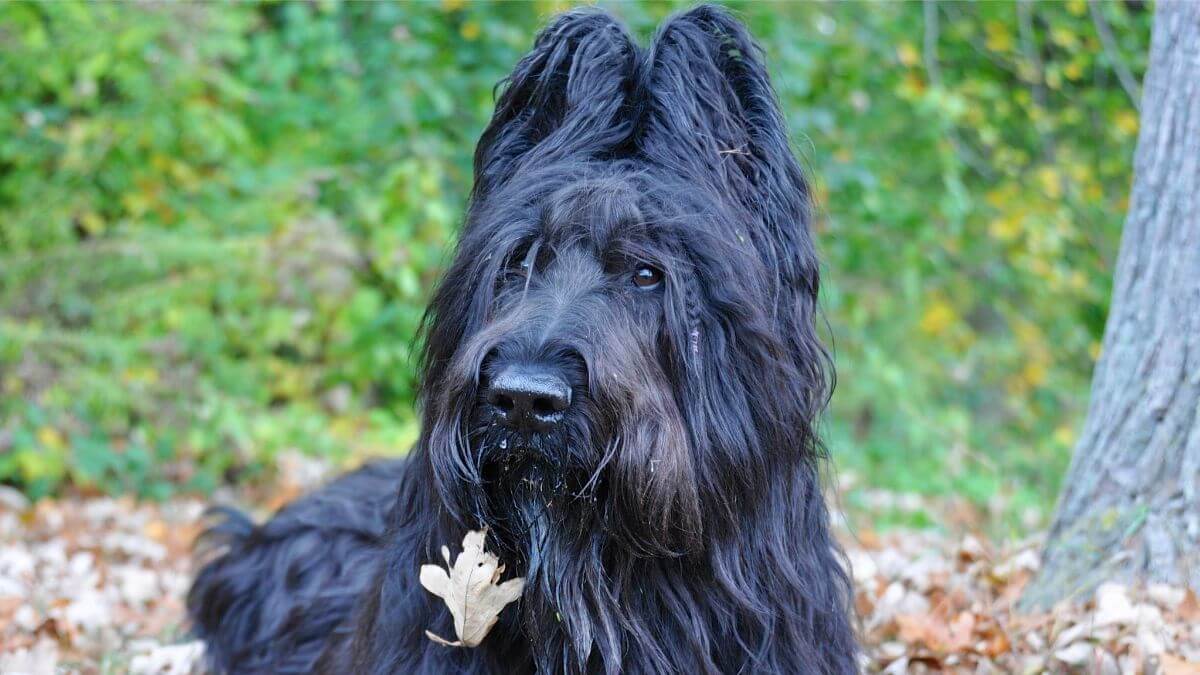
Briard Temperament: Discover the complex charm of the Briard breed—intensely affectionate yet discerning, with unique socialization needs.
All About Judging
Learn how to judge the Briard, focusing on key features, movement, and grooming standards to appreciate this elegant and intelligent breed.
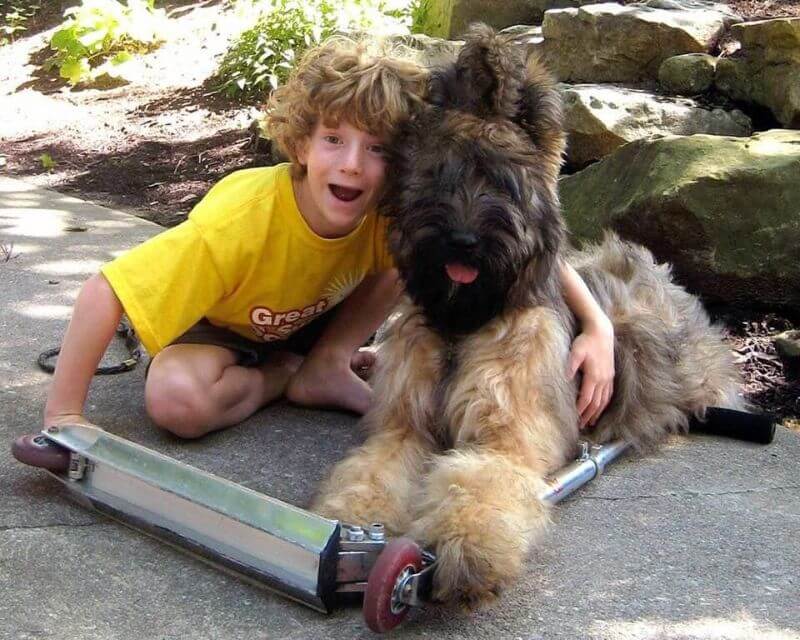
Unlock your dog’s full potential with socialization! Build confidence, friendliness, & sociability for a happier, well-adjusted pet.
Meet the Breeders
Interview with Herding Group Breeders Gina & KayCee Klang – I live in Thousand Palms, California, about two hours east of Los Angeles and 10

Meet the Breeders
Owner Handler’s Sharon Onorato Utych & James Utych: We became involved in the sport when we got our first Cavalier King Charles Spaniel.

All About Judging
The Briard is handsome, alert and powerful without coarseness. He must possess the structural integrity and mental versatility necessary to
The Briard's tail is long and feathered, reaching at least to the hocks. It often has a distinctive “J”-shaped hook at the end, sometimes referred to as a "crook." When the Briard is in motion or alert, the tail is lifted, showcasing its flowing and luxurious hair, but it doesn't curl over the back. When relaxed, the tail hangs down.
The tail of the Briard is not docked, thus maintaining its natural length and shape. The long and expressive tail not only adds to the breed's aesthetic appeal, it also provides balance and aids in communication, making it an essential aspect of the Briard's anatomy and ability to express itself.
A Note About Color: All uniform colors are acceptable, the deeper the shade the better. White is not an acceptable color; however, a small white spot on the chest and/or white hairs scattered throughout the coat are not uncommon in a good Briard.
Coat Type
Double, Wavy
The structure of the coat this breed carries.
Coat Length
Long
How long the breed's coat grows when kept in condition.
Adaptability Level
How easily a breed copes with changes in home, routine, noise and weather.
Mental Stimulation Needs
How much a breed needs a job, a puzzle or training to stay content.
Providing the right nutrition is paramount for the overall well-being and longevity of a Briard. Being an active and sizable breed, the dietary needs of this herder can be different from other dogs.
For Briard puppies, it's essential to provide a balanced diet that supports their growth phase. Puppies have unique nutritional needs, and it's crucial to choose a high-quality puppy food that ensures they get all the necessary vitamins and minerals for strong bone and muscle development. Typically, Briard puppies should be fed more frequently, about 3-4 times a day, transitioning to two times as they approach adulthood.
An adult Briard, depending on its weight and activity level, might require about 2.5 to 3 cups of high-quality dog food daily, split into two meals. It's essential to note that the exact amount can vary based on individual metabolism, age, and exercise intensity. Overfeeding can lead to obesity, a growing concern among many dog owners. Hence, it's advisable to monitor the Briard's weight and adjust food portions accordingly.
When considering the type of food for a Briard, whether commercial or home-cooked, it’s important to be sure it is high in protein and contains balanced fats. Given the breed's lush coat, foods rich in Omega-3 and Omega-6 fatty acids can help to maintain its sheen and strength.
Always ensure fresh water is available for your Briard. And while treats can be a good training aid, remember to give them in moderation to prevent weight gain and potential nutritional imbalances.
Lastly, consulting with a veterinarian or a pet nutritionist can provide tailored advice, ensuring that the Briard's dietary needs are adequately met throughout its life stages.
Training a Briard is a journey of understanding and cooperation. These dogs, with their sharp intelligence and eagerness to learn, can quickly grasp commands and tricks. This intelligence, however, has a flip side; they can easily get bored if not mentally stimulated. So, in addition to physical activities, it's essential to engage them with puzzles and interactive toys to channel their intellectual energy positively.
Briards possess an independent nature owing to their herding background, which means they might occasionally test boundaries. It's crucial to establish a bond of trust and leadership early on in their training. Positive reinforcement techniques work best with this breed, as the dog’s sensitive nature might not respond well to harsh methods.
A noteworthy trait of the Briard is its moderate tendency to bark. While these dogs aren't excessive barkers by nature, they will vocalize if they sense something amiss in their surroundings. Through consistent training, they can be taught commands like "quiet" or "enough" to control their vocalizations.
The Briard’s herding lineage also brings with it certain behaviors, such as a potential to roam or chase. For instance, if a Briard senses something interesting beyond its usual territory, the dog might be inclined to investigate. A robust recall command and ensuring the immediate environment is secure can help to manage this wandering nature. Similarly, the breed’s instinct to chase, especially smaller animals or moving objects, can be redirected through training and early socialization.
Grooming Expectations
The Briard's coat, while beautiful, requires consistent maintenance to ensure it remains tangle-free and healthy. Regular brushing, at least a few times a week, is essential to prevent mats and knots from forming, particularly in areas prone to tangles such as behind the ears, under the legs, and around the collar area. These sessions can also serve as a bonding time between the dog and the owner, making it a pleasurable experience for both. Shedding is a natural process, and while Briards are not heavy shedders, they do lose hair, especially during seasonal changes. Regular grooming can help with managing and reducing the amount of hair around the house. While the coat is a primary focus in grooming, other aspects of Briard care should not be overlooked. The ears should be checked and cleaned regularly to prevent infections, and the nails should be trimmed to avoid overgrowth that can cause discomfort or lead to injuries. Dental hygiene is also paramount; brushing the Briard’s teeth or providing dental chews can help with keeping oral issues at bay. Briards are known for their "griffon-like" beard, which can sometimes get messy, especially after meals. A quick wipe or occasional wash can help to keep this area of the coat clean. Bathing a Briard doesn't need to be a frequent affair; doing so when they get particularly dirty or start to have an odor is usually sufficient. However, post-bath, it's vital to dry the coat thoroughly to prevent any moisture-related skin issues.