Members
01/Overview
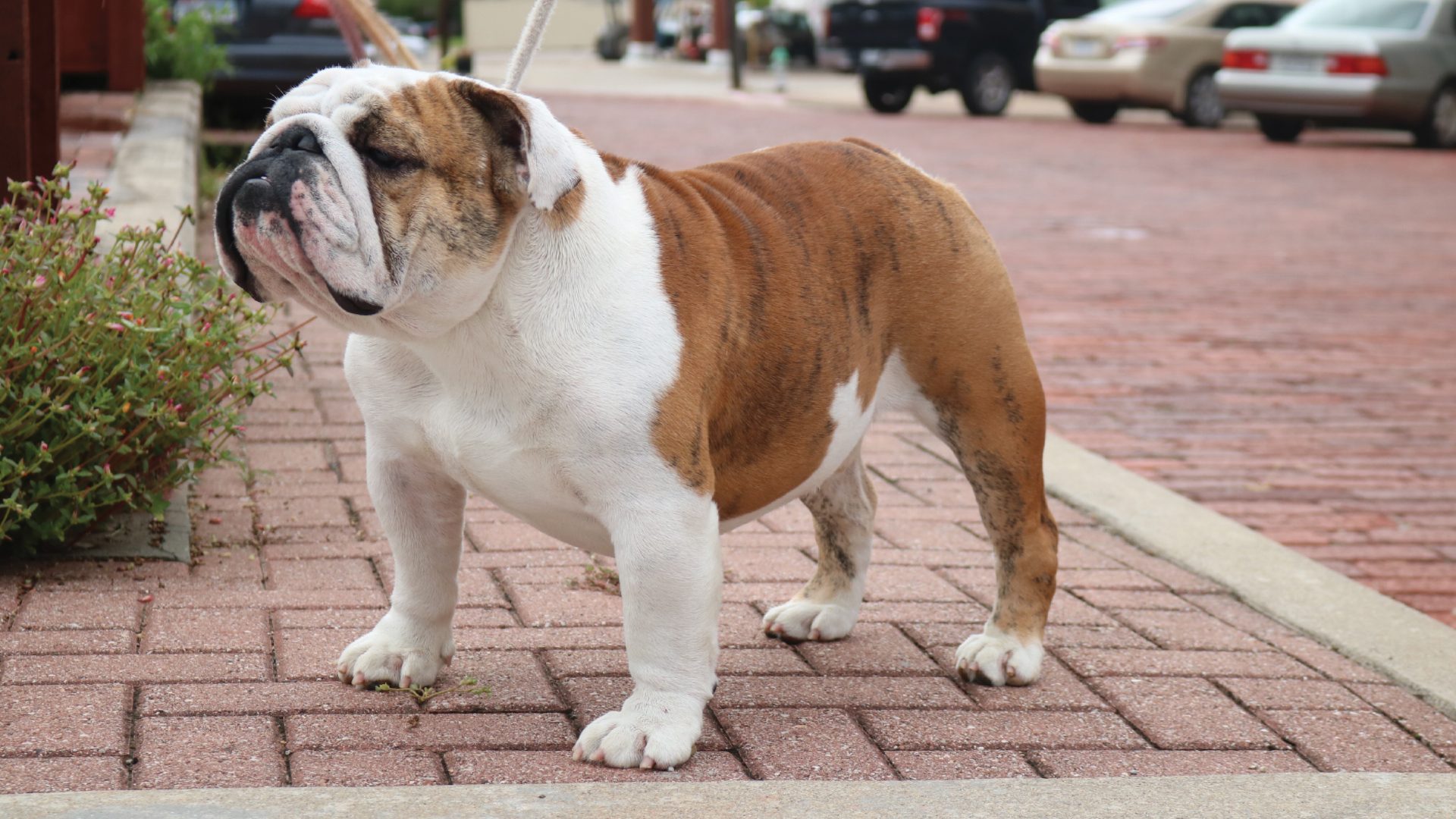
The Bulldog, sometimes referred to as the English or British Bulldog, is a popular purebred whose origins date back to the 13th century. Equable in nature and extraordinary in appearance, the breed has been developed from its bull-baiting roots to become a universally kind and courageous companion today. Its unique physical characteristics, such as a wrinkled face, undershot jaw, and rolling gait, suggest its historic purpose as well as its surprising agility, and its determined demeanor makes it a dog that simply cannot be ignored. The Bulldog develops a deep connection with each member of the household, making it a great choice as a courageous, and comical, companion.
Highlights
02/History
The modern Bulldog is quite different from its ancestors, which were descended from ancient mastiff-type canines and developed entirely in England. The breed was first mentioned by name in 1500, illustrating a man with two Bulldogges, indicating the breed's early existence. Back then, the dogs were actively involved in the violent sport of bull-baiting, where the dogs would aggressively grip the bull's nose and vigorously shake it for sport.
Early Bulldogs were bigger and heavier than current breed, having been intentionally bred to excel at this rigorous pastime. They would crawl on their bellies to avoid the bull's horns. Then, they'd use their powerful jaws to latch securely around the bull's snout, refusing to let go. The dogs' short, flat noses allowed them to breathe while maintaining their grasp, and their pain tolerance allowed them to withstand the grueling combat.
The road to recovery for the Bulldog was not without difficulties. The first Bulldog breed club was created in 1864, but it folded after only three years. The perseverance of Bulldog enthusiasts, however, triumphed, and in 1890, the Bulldog Club of America was created, setting a new standard for the breed. A Breed Standard was revised and adapted several times before finally becoming accepted in 1896.
The Bulldog's popularity grew rapidly in the United States, eventually leading to the breed's recognition by the American Kennel Club in 1890. Bulldogs have been popular as companion dogs ever since, achieving new heights in the 1940s and '50s, and again in the 2010s and '20s.
03/Appearance
Mature Bulldogs typically stand between 12 and 16 inches tall at the shoulder, although adult females are generally shorter than the males.
Adult males typically weigh around 50 pounds, while mature females average around 40 pounds in weight.
Skull: The skull of the Bulldog is very large and its circumference should measure at least the height of the dog at the shoulders, as measured in front of the ears. When viewed from the front, it should appear very high from the corner of the lower jaw to the peak of the skull, and it should appear quite broad and square, with well-rounded cheeks. When viewed from the side, the head has a well-defined stop and should appear very high and very short from the tip of the nose to the occiput.
Expression: The expression is rather formidable in a way that belies the breed’s gentle and friendly disposition.
Eyes: The eyes should be set low on a skull, as far from the ears as possible. They should be in front of the head and set wide apart. Their shape is round and their size is moderate, neither sunken nor bulging, with a very dark color. The eyelids should cover the whites of the eyes, and blue, green, or parti-colored eye(s) are unacceptable in the breed.
Ears: Bulldog ears are relatively small-to-medium in size when compared to the overall size of the head. They are set high and folded inward at the back lower edge, with the upper front edge curving over, outward, and backward to reveal the inside of the ears. These “rose ears” are an essential characteristic of the breed, and prick, button, tulip-shaped, or fly-away ears are unacceptable.
Muzzle: Bulldogs have a short and broad muzzle. This "brachycephalic" configuration presents a muzzle that has “lay-back” and is short in length as compared to its width. The skin on the muzzle forms wrinkles and folds, particularly around the nose and the sides of the head.
Nose: A broad and flat nose is part of the breed’s brachycephalic facial structure. This contributes to the Bulldog’s characteristic look. The nose is large, broad, and tipped back deeply between the eyes. The nostrils should be large and wide, and the color of the nose should be black.
Bite: The Bulldog has massive, broad, and square jaws with an undershot bite. This configuration is due to a lower jaw which projects considerably in front of the upper jaw in an upward sweep.
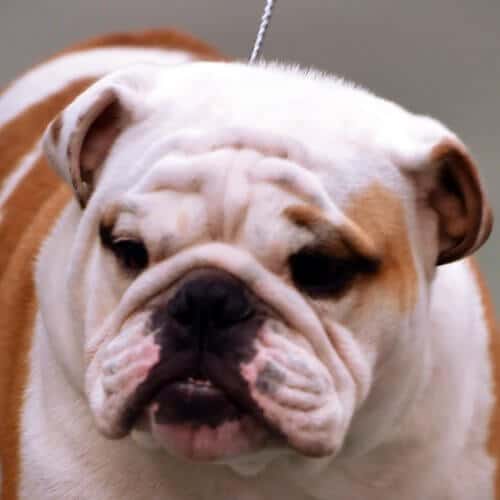
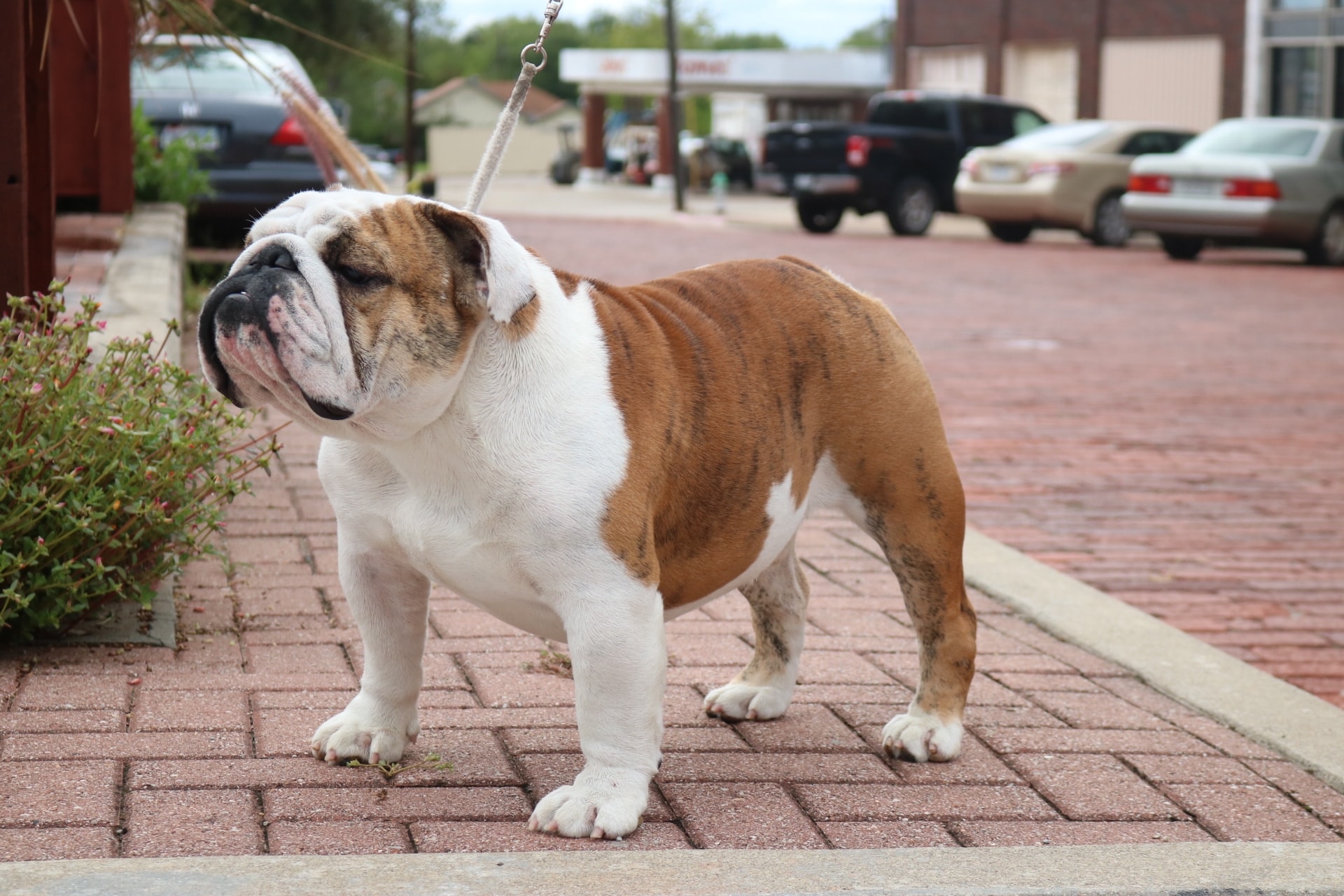
The Bulldog is unforgettable, with a compact construction that differs from that of all other dog breeds. It has a deep and capacious body, well let-down between the shoulders and forelegs, giving a broad, low, and short-legged appearance overall. There is a fullness to the brisket and well-rounded ribs, and a comparatively narrow loin that contributes to the breed’s pear shape when seen from above. Despite the breed’s somewhat disparate parts and pieces, proportion and symmetry should never be compromised and no feature should be too prominent or obscure.
Texture: The single coat of the Bulldog is straight, short, flat, and fine in texture, with a smooth and glossy appearance. It is close-fitting on skin that is soft and loose, especially on the head, neck, and shoulders.
Standard Colors
04/Consider
The Bulldog is typically gentle, affectionate, and good with families, making the breed an excellent choice as a companion in a variety of homes. These dogs are known for their loyalty and protective nature.; however, they can be a bit lazy and enjoy lounging around the house. They're also known for their unique appearance, and their unusual faces can lead to respiratory issues. Bulldogs are social creatures that require regular interaction with their people. They can be prone to separation anxiety, so it's important to ensure they're not left alone for extended periods.
Interaction With Family
The level of affection a breed typically shows towards family members and familiar individuals.
Good With Other Dogs
The innate friendliness of a dog towards other dogs can depend on its breed.
Good With Young Children
The degree to which a breed will typically be patient with young children.
Amount Of Shedding
How much hair a breed typically leaves behind on clothes, furniture and floors.
Frequency Of Grooming
How often a breed needs brushing, bathing or a professional trim to stay in condition.
Amount Of Drooling
How prone a breed is to drool, worth knowing before you keep a towel by the door.
Openness To Strangers
How openly a breed tends to greet new people, visitors and strangers.
Protective Nature
How likely a breed is to alert you to anything unfamiliar, and stand between you and it.
Playfulness Level
How enthusiastic a breed stays about games and play well past puppyhood.
Trainability Level
How readily a breed takes direction and works with you rather than around you.
Barking Level
How much a breed uses its voice, and how readily.
Energy Level
How much get-up-and-go a breed brings to an average day.
Health
The Bulldog can be prone to certain health issues, including hip dysplasia, skin fold infections, eye problems, and respiratory difficulties due to the shape of the breed's muzzle. Responsible breeding practices and regular veterinary check-ups are vital for maintaining the health of the breed and welfare of every Bulldog. The average lifespan of the Bulldog is 8 to 10 years, but with good breeding practices, proper care, a balanced diet, and regular check-ups, many can thrive beyond these years.
One of the most striking aspects of the Bulldog’s personality is its loyalty and devotion to its family. These dogs form a deep connection with their owners and their loyalty knows no bounds. Whether it's a quiet evening at home or an adventurous family gathering, Bulldogs will enjoy it, offering everyone a heavy dose of love and companionship.
The Bulldog’s extraordinary appearance may extrude strength, but the breed's true nature is remarkably gentle. These dogs are known for their enthusiasm and affection, and they can sense the emotions of their owners and provide comfort and solace when needed. Their gentle nature makes them excellent family companions, including families with young children.
The breed's characteristic inner strength contributes to its usefulness as a family companion. Bulldogs have a natural instinct to watch over their loved ones, and this protective instinct, combined with their loyalty, reinforces the strong bond that's shared between Bulldogs and their people.
Despite the Bulldog's often laid-back demeanor, these dogs have a playful side. They enjoy games, toys, and playtime with their family members, and their lively nature can bring joy and laughter to the household. Bulldogs, it should be noted, typically make excellent playmates for children.
Another aspect of the Bulldog’s personality is its determination. This trait has strong historical roots, as the ancestors of today's dogs were originally bred for bull-baiting and showed outstanding courage in the face of danger. While modern Bulldogs are not involved in such activities, their resilience remains. However, this can sometimes be translated as stubbornness which can make training an interesting, if occasionally frustrating, challenge.
Exercise Expectations
To keep a Bulldog at a healthy weight, regular exercise is necessary. A low-impact regimen will also aid digestion and support overall cardiovascular health. Since the breed typically walking, a daily stroll is an easy way to keep the Bulldog active and engaged. Depending on the dog's age and fitness level, 20 to 30 minutes of walking per day should be enough. Exercise is not only about physical fitness but also mental stimulation. Bulldogs benefit from activities that challenge their minds, preventing boredom and the destructive behaviors it encourages. Puzzle toys that dispense treats or require problem-solving can keep their minds active and engaged. It's important to consider a few safety precautions when exercising the Bulldog. The breed can be susceptible to overheating, so avoiding strenuous exercise during hot weather is crucial. These dogs can also be prone to joint issues, so excessive running or jumping, especially during their growth stages, should be avoided. Regular exercise is a fundamental aspect of responsible Bulldog ownership. It not only maintains the dog's physical health, it also keeps the mind active and strengthens the bond between dog and owner. Incorporating a variety of activities into a fitness routine, keeping safety in mind, will ensure that the Bulldog enjoys a healthy and fulfilling life.
The Bulldog is an incredibly affectionate and loyal companion. These dogs form strong bonds with their owners and thrive on social interactions. Whether lounging on the couch, going for a walk, or just spending time together, Bulldogs are always by their owner’s side. The breed's unwavering love and devotion make them wonderful additions to almost any household.
Bulldogs are famous for their amusing and quirky personalities. Their wrinkled faces, distinctive underbite, and expressive eyes often create comical and endearing expressions. With their charming antics, including their snoring, playful nature, and the way they tilt their heads when curious, they have a way of making anyone smile.
The Bulldog is not known for its high energy levels. This breed typically prefers a relaxed and low-energy lifestyle, making it a great companion for people who enjoy a more sedentary pace of life. While Bulldogs do enjoy playtime and short walks, they are content with long naps and quality time spent at home with their families.
The breed is not a heavy shedder and its short coat doesn't require frequent brushing. However, special attention should be given to the Bulldog's facial wrinkles and skin folds to prevent irritation and infection. In poorly bred dogs, the flat face can lead to breathing difficulties and overheating, especially in hot weather. Bulldogs may also be prone to certain health issues, including skin problems and joint concerns. Regular vet visits and a balanced diet are crucial for the well-being of every dog.
Bulldogs are prone to respond poorly to extreme temperatures. Due to their short muzzles, they are likely to overheat in hot weather and can also be sensitive to extreme cold. It's essential, therefore, to always provide for the Bulldog's comfort at home and outdoors, and to monitor its welfare when temperatures are extreme.
05/Puppies
Bulldog puppies are undeniably adorable, but they do require special care and attention during their early stages of life. It is important to remember that each Bulldog puppy is unique, with individual personalities and needs that vary. It's important, therefore, to tailor care and training to the pup's specific requirements.
Health care is a critical aspect of Bulldog puppy care. Since this breed can be prone to specific health concerns, including brachycephalic obstructive airway syndrome (BOAS) and joint issues, regular veterinary check-ups are necessary to monitor the growing pup's health and address any potential issues early on.
Socialization is key to raising a well-adjusted Bulldog puppy. Early exposure to various people, pets, and environments helps the youngster to become confident and sociable as an adult. It's essential to introduce the puppy to different experiences gradually, making sure it is responding comfortably. This can help to prevent fear or aggression issues as it grows.
Feeding the young Bulldog is another crucial aspect of puppy care. A high-quality food, appropriate for the puppy's age and size, is essential for ensuring proper growth and development. It's also important to monitor weight gain, to be certain the pup is growing at a healthy rate, and to avoid overfeeding, as Bulldogs can be prone to obesity.
Training the Bulldog puppy requires patience and consistency. This breed can be a bit stubborn, so positive reinforcement methods work best. Basic training should begin early to establish good behavioral habits and create a strong bond between the puppy and its caretaker. Crate training can also be beneficial for housebreaking and for providing a safe space for the puppy to call its own.
06/Activities
While Bulldogs are not typically known for their athleticism, they can still participate in various dog sports that are adapted to their physical capabilities and temperament. Engaging in these activities can help to keep this breed mentally and physically stimulated while strengthening the bond between each owner and their furry friend.
Obedience: Teaching a Bulldog basic obedience commands like sit, stay, and come is a great way to provide mental stimulation and improve overall behavior. With patience and consistency in training, Bulldogs can excel in this low-impact sport.
Agility: Modified Agility courses designed for Bulldogs can be a fun way to engage their minds and bodies. While they may not be as agile as some other breeds, they can still navigate tunnels, jumps, and weave poles at a comfortable pace.
Scent Work: Bulldogs have a surprisingly strong sense of smell, so hiding treats or toys for them to find can be a fun and rewarding activity that can be enjoyed indoors or outdoors.
Canine Freestyle: Canine Freestyle is a choreographed dance routine performed by dogs and their handlers. Bulldogs can participate in freestyle activities that are not too physically demanding.
Tug-of-War: Most Bulldogs enjoy games of tug-of-war. It's a good way to strengthen their bodies and engage in interactive play .
Weight Pulling: Some Bulldogs are eager to participate in weight-pulling activities. These events can be adapted for the breed and are a good way to provide both physical and mental stimulation.
Therapy Dog: Bulldogs can make excellent Therapy Dogs. They have a gentle and affectionate nature that can be comforting to people in hospitals, nursing homes, and other settings where dogs can be a welcomed distraction.
Gallery
07/Standards
The Bulldog is recognized by the world's leading registries and kennel organizations, which categorize the breed into a specific Group based on its unique characteristics. This breed is recognized worldwide under the following Group designations:
The ideal Bulldog is described by a Breed Standard that is approved by each of the world’s leading registries and kennel organizations. The Breed Standards for this breed may be found in the following links:
08/Clubs
Bulldog clubs are organizations dedicated to the promotion, preservation, and welfare of the Bulldog as a unique breed. These clubs often serve as valuable resources for breed enthusiasts, providing information, support, and opportunities to engage with fellow Bulldog owners and breeders.The Bulldog Club of America (BCA) is the oldest and one of the most recognized Bulldog clubs in the United States. Founded in 1890, the BCA is dedicated to preserving and promoting the well-being of all Bulldogs. The club's members provide educational resources and information on breed standards, and organize various social and competitive events, including the National Specialty show.The Bulldog Club of Canada (BCC) is an club dedicated to the promotion, preservation, and welfare of Bulldogs in Canada. It serves as a resource for Bulldog enthusiasts and owners across the country, providing information, support, and opportunities for engagement with supporters of the breed.
09/Rescue
Bulldog rescue groups are organizations dedicated to rescuing and rehoming dogs in need. The groups' volunteers work tirelessly to provide a second chance for Bulldogs that may have been abandoned, surrendered, or even found as strays. They also focus on educating the public about the breed and advocating for responsible dog ownership.Bulldog Club of America Rescue Network (BCARN) is affiliated with the Bulldog Club of America and operates a network of Bulldog rescue groups across the United States.Bulldog Club of Canada has a rescue program that provides rescuing and rehoming of Bulldogs all over Canada. The volunteers’ efforts not only provide relief to dogs in distress, they also offer potential adopters an avenue to join a community of people who share a love for the breed.
10/Facts
Origins in Bull-Baiting
Bulldogs were originally bred for bull-baiting in England in the 16th century. They were known for their strength, determination, and tenacity when taking on bulls in this brutal sport.
Temperament
Despite their historical reputation for aggression, Bulldogs today are known for their gentle and affectionate nature. They are sometimes referred to as "sweet sourmugs" and make great family companions.
Laziness
Bulldogs are not known for their high energy levels. They are considered one of the laziest dog breeds and are usually content with lounging around the house.
Short Lifespan
Unfortunately, Bulldogs have a relatively short lifespan compared to many other breeds, with an average life expectancy of around 8 to 10 years. Their health issues, including respiratory and joint problems, can contribute to their shorter lives.
The Mascot of Various Institutions
Bulldogs are frequently chosen as mascots for various sports teams and institutions, such as Yale University and the United States Marine Corps.
British Symbolism
Bulldogs are often associated with British culture and are considered a symbol of England. They are sometimes called "British Bulldogs."
Excellent with Children
Bulldogs are known for their patience and gentleness, making them excellent family dogs, particularly in households with children. They are always caring towards their human family members and can even be protective if needed.
Pop Culture References
Bulldogs have made their way into various aspects of pop culture, appearing in movies, advertisements, and even as mascots for well-known brands like Churchill Insurance.
Movie Star
Adam Sandler was the proud owner of "Meatball," a Bulldog that appeared in the film Little Nicky.
11/FAQ
Bulldogs typically have a lifespan of about 8 to 10 years. Some may live longer with excellent care, provided they're given a proper diet, regular exercise, and timely veterinary checkups. Their lifespan is typically somewhat shorter compared to other breeds of similar size.
Official Standard of the Bulldog
General Appearance: The perfect Bulldog must be of medium size and smooth coat; with heavy, thick-set, low-swung body, massive short-faced head, wide shoulders and sturdy limbs. The general appearance and attitude should suggest great stability, vigor and strength. The disposition should be equable and kind, resolute and courageous (not vicious or aggressive), and demeanor should be pacific and dignified. These attributes should be countenanced by the expression and behavior.
Size, Proportion, Symmetry: Size - The size for mature dogs is about 50 pounds; for mature bitches about 40 pounds. Proportion - The circumference of the skull in front of the ears should measure at least the height of the dog at the shoulders. Symmetry - The "points" should be well distributed and bear good relation one to the other, no feature being in such prominence from either excess or lack of quality that the animal appears deformed or ill-proportioned. Influence of Sex - In comparison of specimens of different sex, due allowance should be made in favor of the bitches, which do not bear the characteristics of the breed to the same degree of perfection and grandeur as do the dogs.
Head: Eyes and Eyelids - The eyes, seen from the front, should be situated low down in the skull, as far from the ears as possible, and their corners should be in a straight line at right angles with the stop. They should be quite in front of the head, as wide apart as possible, provided their outer corners are within the outline of the cheeks when viewed from the front. They should be quite round in form, of moderate size, neither sunken nor bulging, and in color should be very dark. Blue or green eye(s) or parti-colored eye(s) are a disqualification. The lids should cover the white of the eyeball, when the dog is looking directly forward, and the lid should show no “haw.” Ears – The ears should be set high in the head, the front inner edge of each ear joining the outline of the skull at the top back corner of skull, so as to place them as wide apart, and as high, and as far from the eyes as possible. In size they should be small and thin. The shape termed “rose ear” is the most desirable. The rose ear folds inward at its back lower edge, the upper front edge curving over, outward and backward, showing part of the inside of the burr. (The ears should not be carried erect or prick-eared or buttoned and should never be cropped.) Skull – The skull should be very large, and in circumference, in front of the ears, should measure at least the height of the dog at the shoulders. Viewed from the front, it should appear very high from the corner of the lower jaw to the apex of the skull, and also very broad and square. Viewed at the side, the head should appear very high, and very short from the point of the nose to occiput. The forehead should be flat (not rounded or domed), neither too prominent nor overhanging the face. Cheeks – The cheeks should be well rounded, protruding sideways and outward beyond the eyes. Stop – The temples or frontal bones should be very well defined, broad, square and high, causing a hollow or groove between the eyes. This indentation, or stop, should be both broad and deep and extend up the middle of the forehead, dividing the head vertically, being traceable to the top of the skull. Face and Muzzle – The face, measured from the front of the cheekbone to the tip of the nose, should be extremely short, the muzzle being very short, broad, turned upward and very deep from the corner of the eye to the corner of the mouth. Nose – The nose should be large, broad and black, its tip set back deeply between the eyes. The distance from bottom of stop, between the eyes, to the tip of nose should be as short as possible and not exceed the length from the tip of nose to the edge of underlip. The nostrils should be wide, large and black, with a well-defined line between them. Any nose other than black is objectionable and a brown or liver-colored nose shall disqualify. Lips – The chops or “flews” should be thick, broad, pendant and very deep, completely overhanging the lower jaw at each side. They join the underlip in front and almost or quite cover the teeth, which should be scarcely noticeable when the mouth is closed. Bite – Jaws – The jaws should be massive, very broad, square and “undershot,” the lower jaw projecting considerably in front of the upper jaw and turning up. Teeth – The teeth should be large and strong, with the canine teeth or tusks wide apart, and the six small teeth in front, between the canines, in an even, level row.
Neck, Topline, Body: Neck - The neck should be short, very thick, deep and strong and well arched at the back. Topline - There should be a slight fall in the back, close behind the shoulders (its lowest part), whence the spine should rise to the loins (the top of which should be higher than the top of the shoulders), thence curving again more suddenly to the tail, forming an arch (a very distinctive feature of the breed), termed "roach back" or, more correctly, "wheel-back." Body - The brisket and body should be very capacious, with full sides, well-rounded ribs and very deep from the shoulders down to its lowest part, where it joins the chest. It should be well let down between the shoulders and forelegs, giving the dog a broad, low, short-legged appearance. Chest - The chest should be very broad, deep and full. Underline - The body should be well ribbed up behind with the belly tucked up and not rotund. Back and Loin - The back should be short and strong, very broad at the shoulders and comparatively narrow at the loins. Tail - The tail may be either straight or "screwed" (but never curved or curly), and in any case must be short, hung low, with decided downward carriage, thick root and fine tip. If straight, the tail should be cylindrical and of uniform taper. If "screwed," the bends or kinks should be well defined, and they may be abrupt and even knotty, but no portion of the member should be elevated above the base or root.
Forequarters: Shoulders - The shoulders should be muscular, very heavy, widespread and slanting outward, giving stability and great power. Forelegs - The forelegs should be short, very stout, straight and muscular, set wide apart, with well developed calves, presenting a bowed outline, but the bones of the legs should not be curved or bandy, nor the feet brought too close together. Elbows - The elbows should be low and stand well out and loose from the body. Feet - The feet should be moderate in size, compact and firmly set. Toes compact, well split up, with high knuckles and very short stubby nails. The front feet may be straight or slightly outturned.
Hindquarters: Legs - The hind legs should be strong and muscular and longer than the forelegs, so as to elevate the loins above the shoulders. Hocks should be slightly bent and well let down, so as to give length and strength from the loins to hock. The lower leg should be short, straight and strong, with the stifles turned slightly outward and away from the body. The hocks are thereby made to approach each other, and the hind feet to turn outward. Feet - The feet should be moderate in size, compact and firmly set. Toes compact, well split up, with high knuckles and short stubby nails. The hind feet should be pointed well outward.
Coat and Skin: Coat - The coat should be straight, short, flat, close, of fine texture, smooth and glossy. (No fringe, feather or curl.) Skin - The skin should be soft and loose, especially at the head, neck and shoulders. Wrinkles and Dewlap - The head and face should be covered with heavy wrinkles, and at the throat, from jaw to chest, there should be two loose pendulous folds, forming the dewlap.
Color of Coat: The color of coat should be uniform, pure of its kind and brilliant. Colors are red, white, fawn, fallow, or any combination of the foregoing. Patterns and markings may include brindle, piebald, ticking, black masks, black tipping, and a minimal amount of solid black in piebalds. All other colors or markings are a disqualification. The merle pattern is a disqualification.
Gait: The style and carriage are peculiar, his gait being a loose-jointed, shuffling, sidewise motion, giving the characteristic "roll." The action must, however, be unrestrained, free and vigorous.
Temperament: The disposition should be equable and kind, resolute and courageous (not vicious or aggressive), and demeanor should be pacific and dignified. These attributes should be countenanced by the expression and behavior.
Scale of Points
General Properties
Proportion and symmetry 5
Attitude 3
Expression 2
Gait 3
Size 3
Coat 2
Color of coat 4 22
Head
Skull 5
Cheeks 2
Stop 4
Eyes and eyelids 3
Ears 5
Wrinkle 5
Nose 6
Chops 2
Jaws 5
Teeth 2 39
Body, Legs, etc.
Neck 3
Dewlap 2
Shoulders 5
Chest 3
Ribs 3
Brisket 2
Belly 2
Back 5
Forelegs and elbows 4
Hind Legs 3
Feet 3
Tail 4 39
Total 100
Disqualification: Blue or green eye(s) or parti-colored eye(s). Brown or liver-colored nose. Colors or markings not defined in the standard. The merle pattern.
Approved July 12, 201
Effective August 31, 2016

All About Judging
The AKC Bulldog breed standard was penned by the Bulldog Club of America (BCA) in 1890 and has survived with only two changes.
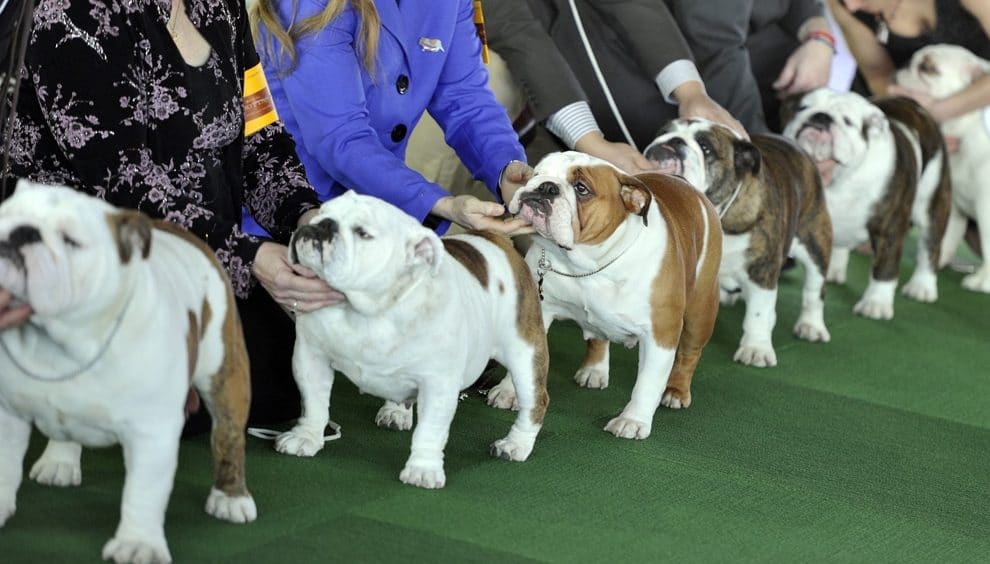

Kennel Clubs & Registries
The Bulldog Club of America (BCA), the Parent Club for Bulldogs in the US, was founded in 1896. The official BCA/AKC standard was written in 1896 and is still in use, with only a format change
The Bulldog can have one of two different types of tail. Some have a tail that is straight, whereas others have a “screwed” tail. Straight tails are uniform in shape and taper towards the end. Screwed tails have well-defined bends and kinks, although these should never be elevated above the root of the tail. In either case, the tail is typically thick at the base, short, and hung low, with a decidedly downward carriage.
Standard Markings
A Note About Color: The Bulldog is a colorful breed, with a variety of colors and markings that make every individual a unique character. Whatever the dog’s coloration, colors are uniform, pure, and brilliant. Patterns and markings include brindle, piebald, ticking, black masks, and black tipping. All other colors and markings are unacceptable in the breed.
Coat Type
Smooth
The structure of the coat this breed carries.
Coat Length
Short
How long the breed's coat grows when kept in condition.
Adaptability Level
How easily a breed copes with changes in home, routine, noise and weather.
Mental Stimulation Needs
How much a breed needs a job, a puzzle or training to stay content.
Feeding and nutrition are foundational components of responsible Bulldog care. The Bulldog, with its unique appearance and characteristics, requires special dietary considerations to ensure its health and well-being. They are a brachycephalic breed, characterized by their snouts and facial structures. These physical traits affect their feeding habits and digestion so the diet should be formed according to that.
The Bulldog should do well on high-quality dog food, whether commercially manufactured or home-prepared under the supervision and consent of your veterinarian. Bulldogs need an adequate amount of protein to maintain muscle health. They are prone to obesity, so it's crucial to monitor their fat intake.
Bulldogs may act like they're always hungry, but owners should resist the temptation to overfeed. Portion sizes should be followed by labels on the dog food packaging considering the Bulldog's age, weight, and activity level. Bulldogs can be prone to bloat or gastric torsion, a potentially life-threatening condition. To help prevent this, a slow feeder bowl can slow down their eating pace.
Obesity exacerbates respiratory difficulties in Bulldogs due to their brachycephalic structure. Maintaining a healthy weight can alleviate some of these issues. Keeping an eye on them to see whether they are gaining weight is important. Obesity can reduce a dog's lifetime and put him at risk for additional health problems.
To train a Bulldog effectively, it is essential to understand the breed's characteristics and temperament. Bulldogs are known for their loyalty, and they tend to be gentle, affectionate, and good-natured. However, they can also be strong-willed and possess a stubborn streak, so training can be challenging sometimes.
It is important to note that the typical Bulldog does not respond well to harsh training methods or punishment. Positive reinforcement works best and involves rewarding desirable behaviors with treats, praise, or affection, while ignoring poor behavior. Bulldogs respond well to this approach, as they are generally eager to please and want to do well.
Consistency and patience are paramount while training the Bulldog. The breed is not known as a quick learner, so it's important to remain persistent and patient throughout the process. Consistency also extends to the use of positive commands and social cues.
Socialization is another crucial aspect of Bulldog training. Early and continued exposure to a variety of environments, people, and other animals can reduce the risk of fear or aggression in unfamiliar situations. It also helps the Bulldog puppy develop into a well-rounded and confident adult.
Grooming Expectations
The Bulldog is not a heavy shedder, but regular brushing helps to keep any loose hair in check. Brushing should be done at least once a week to keep the coat healthy and reduce shedding. Since the breed has a short coat, a soft-bristle brush or grooming mitt will sufficiently do the job. One of the most iconic features of the Bulldog is the breed's wrinkled skin. These wrinkles require special attention to prevent irritation and skin infections. Gently cleaning and drying the folds using a soft cloth or baby wipe, ensuring the areas are completely dry, prevents any moisture-related skin issues from becoming a problem. Bulldogs do not require frequent baths, since overbathing can strip the skin of its natural oils. Since some individuals can be prone to ear infections, the ears should be cleaned weekly to prevent infection. Excessive eye discharge and tear staining can also become a problem if these areas are not gently cleaned with a damp cloth and allowed to dry. The Bulldog’s nails, if not naturally worn down through activity, will need periodic trimming. It's essential to ensure the nails aren't allowed to get too long, as overly long nails can lead to discomfort and even injury.