Members
01/Overview
The Chow Chow is one of the world’s oldest dog breeds. Although its exact origins are disputed, the dog that is often simply called the “Chow” has long been admired by people of distinction. Emperors, royals, and celebrities have all championed the striking good looks, independent spirit, and innate dignity of this ancient Oriental purebred. Rather aloof in personality and character, the Chow possesses several distinguishing features that have made it an undeniable favorite for centuries. The breed’s aristocratic bearing, dignified manners, and lordly scowl are just a few of its many laudable qualities. Add a lion’s mane, deep-set eyes, a blue-black tongue, and a stiff-legged gait and you have a unique canine that is as original as it is memorable.
Highlights
02/History
The story of the Chow Chow begins thousands of years ago in ancient China. Although the breed’s exact origins are unknown, ancient artifacts suggest the Chow was already established during the Han Dynasty (206 B.C.E. to 22 C.E.). Some scholars have suggested the ancestors of the modern breed accompanied Barbarians who invaded China from the West in the 11th Century B.C.E. Others have proffered the breed’s ancestors hail from the Arctic Circle, traveling through Siberia and Mongolia before arriving in China.
One Chinese emperor during the T’ang Dynasty (7th Century C.E.) is reported to have kept 2,500 “chow dogs” to accompany his army of hunters. Hunting, in fact, is one of the breed’s original functions, along with herding, drafting, and personal protection. One theory suggests the Rough- and Smooth-coated dogs were treated differently throughout the Chow’s early history. Though both varieties were bred for their working abilities, the Rough dogs were utilized for their fur, whereas the Smooth dogs were kept for their meat. The Chinese word chou is slang for “edible.”
The Chow Chow first traveled to the West in the late 18th century. When the breed arrived in England, the press referred to the breed as “the wild dog of China.” Perhaps owing to this reputation, those Eastern dogs eventually found favor in royal circles. When Queen Victoria acquired a Chow in 1865, the breed quickly became a favorite among all strata of society. Thirty years later, the English Chow Chow Club was formed just as dog shows were growing in popularity.
Mr. and Ms. Charles E. Proctor imported many Chow Chows to their Blue Dragon Kennels in the United States. “Chinese Drum” was bred by Mr. H. Sawtell and became the first of his breed to receive an American championship. This dog also became the first American-bred Chow to sire a champion; “Night of Asia.” In 1906, the AKC Breed Standard was approved and the Chow Chow Club of America was formed.
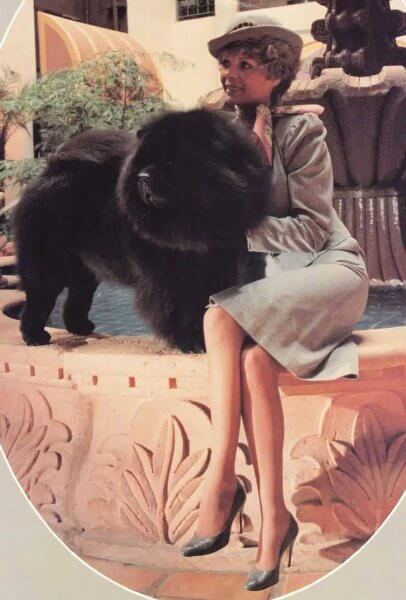
For well over a century, the modern Chow Chow has enjoyed considerable support among people from all walks of life—in both the East and the West. In the 1920s, the breed found favor among the glitterati of Hollywood, although the Chow’s popularity has ebbed and flowed with the changing times ever since. In 1986, the breed soared to prominence when 43,026 individual registrations were made with the American Kennel Club. Today, the breed is less popular as a companion but is still highly regarded by a discerning few for its many exceptional qualities.
03/Appearance
An adult Chow Chow stands between 17 and 20 inches tall at the shoulder; the breed’s overall proportions are more important than its size.
Weight varies based on size, but the Chow generally weighs between 45 and 70 pounds at maturity.
Skull: The Chow Chow's head is large in proportion to the size of the dog and is carried proudly. The topskull is broad and flat from side to side as well as from front to back. Correct bone structure is more important than loose skin and excessive coat.
Expression: The breed’s signature scowling expression is created by a padded button of skin above both eyes, a frowning brow, a distinct furrow between the eyes, and correctly shaped and placed eyes and ears. The overall look is dignified, sober, and even snobbish.
Eyes: Dark brown in color with black rims, the eyes are moderately sized, almond-shaped, and obliquely placed. They are deeply set and spaced wide apart on the head.
Ears: The ears are small and triangular in shape, with a slight rounding at the tip. They have a moderately thick leather and are carried stiffly erect, with a slight forward tilt.
Muzzle: The muzzle is short when compared to the topskull’s length, but never less than one-third the head’s overall length. It is broad and square in appearance owing to a depth and width that are equal.
Nose: Ideally, the nose is large with well-opened nostrils. Color and pigment vary depending on the color of the coat.
Bite: The Chow Chow possesses a strong complement of teeth that are even and meet in a scissors bite.
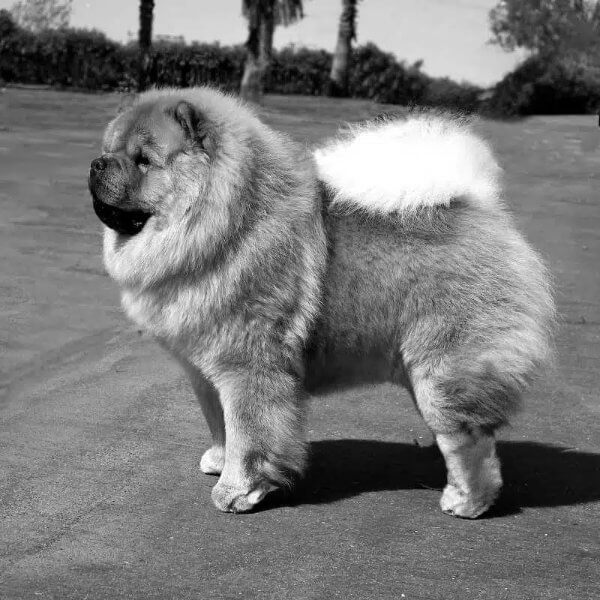
The Chow Chow is a medium-sized breed with heavy bone and strong muscling. It has a close-coupled, square silhouette in profile. The distance from the forechest to the point of buttocks is equal to the height at the highest point of the withers. The Chow presents a picture of balanced proportions, with the distance from the tip of the elbow to the ground half the height at the withers. The male Chow should be masculine in appearance, while the female should have less overall substance.
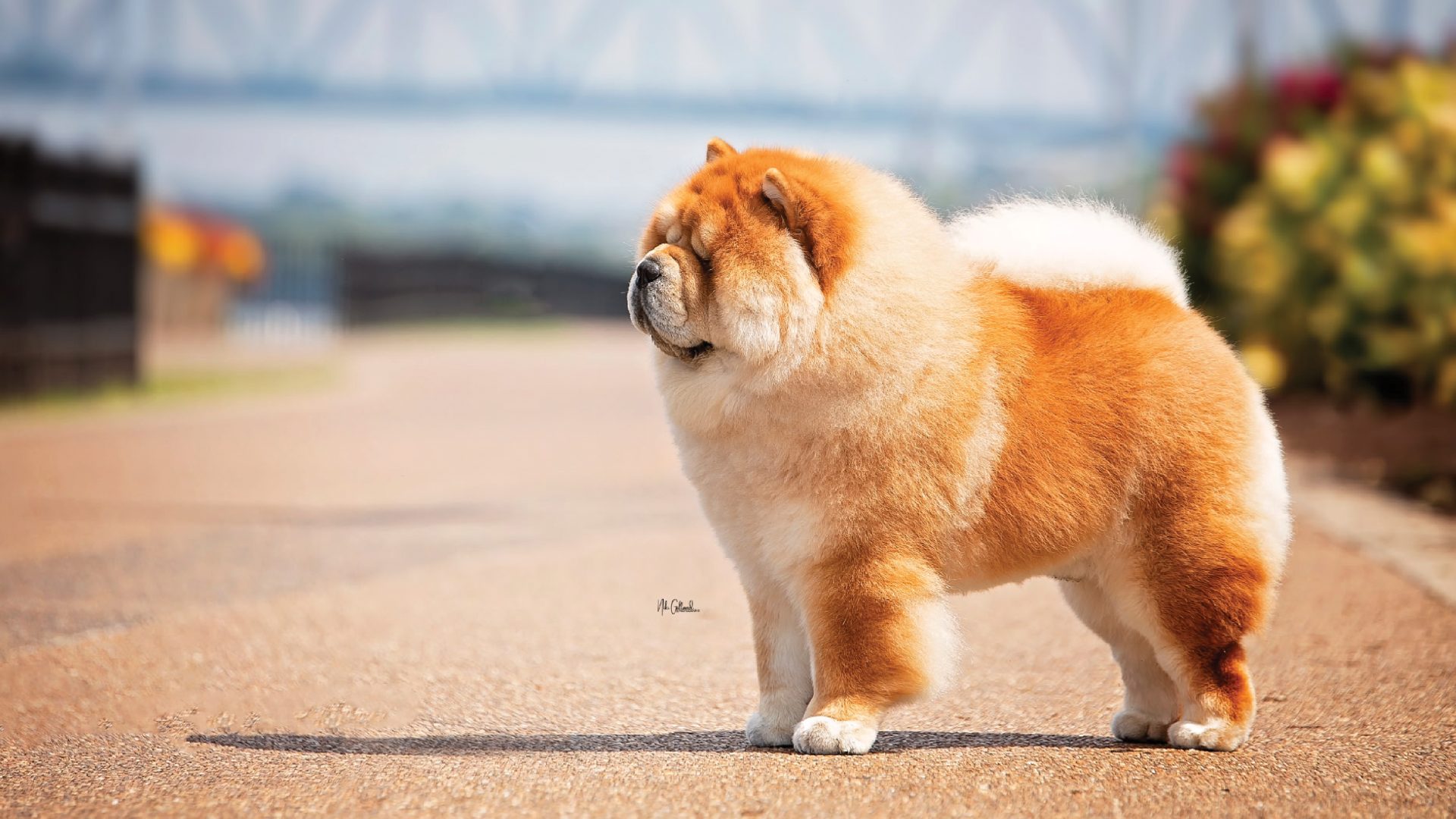
Texture: The Chow Chow’s coat may be either Rough or Smooth. In the Rough variety, the undercoat is soft, thick, and woolly. The outer coat is abundant, dense, and straight, with coarse hair that stands off the body. The coat’s length will vary from dog to dog, but its thickness, texture, and condition are more important than its length. Around the head and neck there is a profuse ruff that frames the head. In the Smooth variety, the undercoat is similar, but the outer coat is hard, dense, and smooth, without the quantity, length, and distribution of the Rough variety. No trimming or shaping should be necessary except on the feet and below the hock. Puppy coats are typically soft, thick, and woolly overall.
The coat of the Chow is solid in color, without any markings.
Standard Colors
04/Consider
Choosing a Chow Chow as a companion requires a commitment that is as fearless and forthright as the breed itself. Although the breed has strong instincts and a sturdy frame, ownership does not come without its fair share of responsibilities.
Interaction With Family
The level of affection a breed typically shows towards family members and familiar individuals.
Good With Other Dogs
The innate friendliness of a dog towards other dogs can depend on its breed.
Good With Young Children
The degree to which a breed will typically be patient with young children.
Amount Of Shedding
How much hair a breed typically leaves behind on clothes, furniture and floors.
Frequency Of Grooming
How often a breed needs brushing, bathing or a professional trim to stay in condition.
Amount Of Drooling
How prone a breed is to drool — worth knowing before you keep a towel by the door.
Openness To Strangers
How openly a breed tends to greet new people, visitors and strangers.
Protective Nature
How likely a breed is to alert you to — and stand between you and — anything unfamiliar.
Playfulness Level
How enthusiastic a breed stays about games and play well past puppyhood.
Trainability Level
How readily a breed takes direction and works with you rather than around you.
Barking Level
How much a breed uses its voice, and how readily.
Energy Level
How much get-up-and-go a breed brings to an average day.
Health
The Chow Chow, while typically robust, is not without a few considerations that prospective owners should be aware of before committing to one of these aloof and intelligent dogs. The average lifespan of a Chow Chow ranges from 8 to 12 years, but with regular health exams, a balanced diet, and moderate exercise, many can thrive well into the upper range.
The ancient and alluring Chow Chow is an aristocratic canine with a real independent streak. These dogs are typically aloof with strangers, but their loyalty to their owners knows no bounds. Chows are extremely devoted and form deep bonds with their family members. Because the breed is so strong, with an equally strong will, ownership requires both firmness and fairness.
Sometimes described as cat-like, the Chow Chow is among the cleanest of dog breeds. Chows tend to be as fastidious as felines, keeping themselves in fine form by avoiding mud and muck. Unlike many hunting and herding breeds, a Chow can be content just walking down a city street several times a day.
The Chow Chow’s intelligence, independence, and aloofness can make this breed a challenge for people who are new to dog ownership. Although the breed’s strong spirit is celebrated by experienced breeders, it can be a bit much for the novice owner. In the right hands, however, this loyal, protective, and quiet canine can make for a low-maintenance companion that yields very high returns.
Exercise Expectations
Grooming Expectations
Living with a Chow Chow is a unique experience, shaped by the breed's history, temperament, and physical attributes. As much as these dogs are cherished for their Teddy Bear looks, prospective owners should be well-versed in the specific needs of the breed before taking on the responsibility of caring for one of these loyal guardians.
The Chow’s independent nature is often misconstrued as stubbornness. However, this strong and striking breed is simply self-confident in most situations and doesn’t need to be reassured all the time. The breed is not emotionally dependent on people in the way other breeds can be. A Chow chooses to enter into a relationship; it doesn’t wait for an invitation.
When it comes to accommodations, Chow Chows are adaptable. Apartment living can suit these dogs just fine, provided they’re given regular walks throughout the day. With more room to roam, most Chows will only choose to stick close to their favorite person to be aware of what’s going on.
05/Puppies
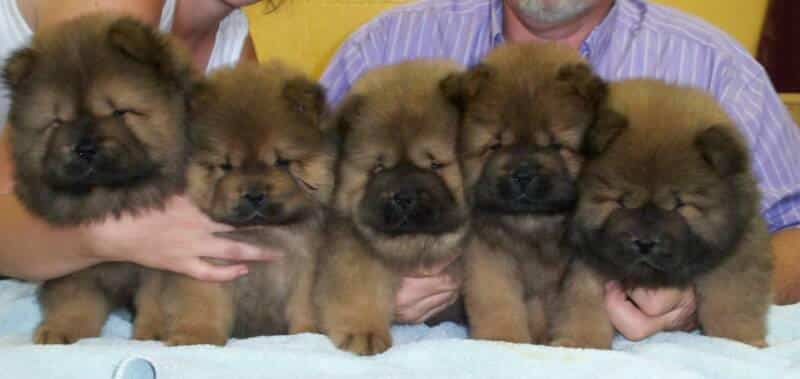
The arrival of a litter of Chow Chow puppies can be an exciting experience for any preservation breeder. With their fluffy coats and playful antics, it’s easy to spend hours watching them interact with each other and their mother. Chow puppies are bundles of energy, eager to explore their surroundings and bond with members of their human families.
Caring for a Chow Chow puppy involves a variety of considerations. It's a good idea to consult with the puppy’s breeder when it comes to feeding during the first year. A balanced diet that’s formulated for puppies is essential to ensure proper bone and muscle development. When it comes to housebreaking, the breed’s inherent cleanliness typically makes the process a snap.
Exercise is also a vital aspect of puppy care, but it should be approached with caution. Over-exercising a young Chow can put undue stress on developing joints and growth plates, leading to potential health issues later on. Short, controlled play sessions and leisurely walks are best until the pup reaches maturity.
A Chow Chow puppy thrives on human companionship and should be included in daily family activities. It’s important, however, that all indoor and outdoor spaces are puppy-proofed to avoid accidents and escapes. Socialization is important too, for mitigating the breed’s protective nature, and regular veterinary check-ups are vital for monitoring growth and ensuring the pup is developing as it should.
06/Activities
The Chow Chow is more than just a tough-looking Teddy bear. These dogs can enjoy participation in dog sports just as much as the next breed, although training should consider the breed’s independence as well as its intelligence.
Obedience: Participation in Obedience Trials tests a dog's ability to follow commands and signals. They can provide an excellent opportunity for Chows to demonstrate their intelligence and their willingness to work closely with their handlers.
Rally Obedience: A sport which combines elements of Obedience and Agility, Rally-O offers Chow Chows an opportunity to showcase their versatility and cooperative spirit.
Agility: This fast-paced sport channels the Chow's agility and intelligence. Navigating obstacle courses provides mental and physical challenges that support the dog and handler’s teamwork.
AKC Canine Good Citizen (CGC): This certification program is designed to reward Chow Chows that can demonstrate good manners. It is a two-part program that emphasizes responsible pet ownership as well as good behavior.
AKC Trick Dog: The AKC Trick Dog program has five levels, Novice, Intermediate, Advanced, Performer, and Elite Performer, to acknowledge Chows that can perform a variety of entertaining tricks on command.
Barn Hunt: In these events, dogs use their sense of smell to locate and signal the presence of a rat (safely enclosed in a protective tube) hidden in a course made of hay bales. It's an exciting way for Chow Chows to engage their ancient hunting instincts.
Conformation Shows: Chow Chows often participate in Conformation Shows, where they are judged against the Breed Standard. Dog shows celebrate the breed's physical attributes and temperament, and they promote responsible breeding practices.
Tracking: Due to the breed’s legacy as a hunter, Chows can excel at Tracking events. In this sport, several levels of difficulty allow dogs to follow pre-plotted scent trails over various terrain and obstacles.
Engaging a Chow Chow in various activities and organized sports not only highlights a Chow’s many talents, it also satisfies the dog’s desire to share the experiences with its favorite person.
Gallery
07/Standards
The Chow Chow is recognized by the world’s leading registries and kennel organizations, which categorize the breed into a specific Group based on its unique characteristics. This breed is recognized worldwide under the following Group designations:
08/Clubs
Purebred dogs are supported by members of breed clubs who dedicate their efforts for the betterment and preservation of a specific breed. For the Chow Chow, national clubs in various countries play a pivotal role in maintaining the Breed Standards, organizing events, and disseminating information about the breed to club members and potential owners alike.In the United States, The Chow Chow Club, Inc. is the AKC-recognized “parent club” for the breed in America. Founded in 1906, the club and its members remain committed to the breed, promoting responsible breeding practices, upholding the organization’s by-laws, and organizing National Specialty shows and other social and competitive events.In Canada, the Chow Chow Club of Canada, Inc. takes the lead in serving the needs of the breed. Like its American counterpart, this association is dedicated to the welfare of the Chow, fostering education and hosting events that celebrate the unique characteristics of these extraordinary dogs.In the United Kingdom, the Chow Chow Club is the breed’s parent club. Established in 1895, the association not only offers a platform for breeders and owners to connect and compete, it also actively champions the betterment of the breed’s health and welfare throughout the British Isles.Membership or affiliation with these clubs can offer Chow Chow enthusiasts access to a wealth of knowledge, regional and national events, and a community that shares a common love for this ancient Oriental breed.
09/Rescue
Rescue groups play an invaluable role in supporting the needs of individual dogs, providing shelter, care, and new beginnings for any Chow Chow in need. Rescue organizations and their volunteers are dedicated to the rehabilitation and rehoming of these dignified and deserving companions.In the United States, the CCCI Welfare is a committee of members appointed by The Chow Chow Club, Inc. The group focuses on the well-being of the purebred Chow as a pet in today’s society. The committee establishes a central point of contact for people seeking an abandoned or unwanted Chow, maintains a directory of volunteers, and provides information, resources, and support to veterinarians, animal shelters, and others who care for homeless Chows.For those in the United Kingdom, Chow Chow Rescue Service and Scottish Chow Rescue offer support, rehoming services, and education for individuals looking to adopt one of these powerful protectors. Acquiring a rescued Chow can be a rewarding experience, as it provides a loving home to a loyal dog in need.
10/Facts
Ancient Origins
Several theories surround the origins of the Chow Chow as a distinct breed. Some claim the dogs arrived in China with Tartar hordes in the 11th Century B.C.E. Others suggest the breed is derived from crosses of the Samoyed and the Tibetan Mastiff.
Name that Dog
One theory suggests the breed’s name is derived from the Chinese slang term for “edible: chou. Another claims that since the hulls of ships heading to England from China were called “chow chow” holds, the dogs were given this name upon their arrival in the West.
A Stilted Gait
One of the Chow’s unique characteristics is the breed’s rather short and stilted gait. This “signature move” is the result of moderate angles of the rear legs which produce a pendulum-like movement and a slight bounce of the rump.
A Blue-Black Tongue
Unlike nearly every other breed of dog, the Chow doesn’t have a pink tongue. Instead, the breed’s “licker” (as well as its lips, palate, and gums) is typically blue-black in color. Only the Chinese Shar-Pei shares this unusual feature.
Lion-Like
The profuse ruff of hair that surrounds the head and neck of the Chow Chow bears a striking resemblance to a lion’s mane. Both canine and feline share a dignified demeanor as well as a signature hairstyle.
Cat-atonic
This breed is typically independent and aloof, just like most domestic cats. They also like to keep themselves clean like a cat, maintaining a tidy appearance and avoiding most dirty endeavors.
Lone Wolves
Chow Chows are not the social butterflies of the dog world. In fact, most prefer the company of their favorite person and other family members. In public, they usually display an aloof dignity and a quiet demeanor.
Popularity
The Chow has experienced several waves of popularity since it arrived in the West more than a century ago. In the late 20th century, the breed was among the top five breeds registered with the American Kennel Club.
Famous Friends
The Chow Chow has enjoyed support from a number of public figures through the years. Queen Victoria, Sigmund Freud, Walt Disney, and Martha Stewart have all enjoyed the company of one or more of these all-purpose, always delightful companions.
11/FAQ
Yes, Chow Chows shed. The breed’s thick, double coat sheds regularly, especially during the spring and fall. During these seasons, it’s necessary to brush the coat thoroughly to the skin to prevent uncomfortable matts from forming.
Official Standard of the Chow Chow
General Appearance - Characteristics - An ancient breed of northern Chinese origin, this all-purpose dog of China was used for hunting, herding, pulling and protection of the home. While primarily a companion today, his working origin must always be remembered when assessing true Chow type. A powerful, sturdy, squarely built, upstanding dog of Arctic type, medium in size with strong muscular development and heavy bone. The body is compact, short coupled, broad and deep, the tail set high and carried closely to the back, the whole supported by four straight, strong, sound legs. Viewed from the side, the hind legs have little apparent angulation and the hock joint and metatarsals are directly beneath the hip joint. It is this structure which produces the characteristic shorter, stilted gait unique to the breed. The large head with broad, flat skull and short, broad and deep muzzle is proudly carried and accentuated by a ruff. Elegance and substance must be combined into a well balanced whole, never so massive as to outweigh his ability to be active, alert and agile. Clothed in a smooth or an offstanding rough double coat, the Chow is a masterpiece of beauty, dignity and naturalness. Essential to true Chow type are his unique blue-black tongue, scowling expression and stilted gait.
Size, Proportions, Substance: Size - The average height of adult specimens is 17 to 20 inches at the withers but in every case consideration of overall proportions and type should take precedence over size. Proportions - Square in profile and close coupled. Distance from forechest to point of buttocks equals height at the highest points of the withers. Serious Fault - Profile other than square. Distance from tip of elbow to ground is half the height at the withers. Floor of chest level with tips of elbows. Width viewed from the front and rear is the same and must be broad. It is these proportions that are essential to true Chow type. In judging puppies, no allowance should be made for their failure to conform to these proportions. Substance - Medium in size with strong muscular development and heavy bone. Equally objectionable are snipy, fine boned specimens and overdone, ponderous, cloddy specimens. In comparing specimens of different sex, due allowance must be made in favor of the bitches who may not have as much head or substance as do the males. There is an impression of femininity in bitches as compared to an impression of masculinity in dogs.
Head: Proudly carried, large in proportion to the size of the dog but never so exaggerated as to make the dog seem top-heavy or to result in a low carriage. Expression essentially scowling, dignified, lordly, discerning, sober and snobbish, one of independence. The scowl is achieved by a marked brow with a padded button of skin just above the inner, upper corner of each eye; by sufficient play of skin to form frowning brows and a distinct furrow between the eyes beginning at the base of the muzzle and extending up the forehead; by the correct eye shape and placement and by the correct ear shape, carriage and placement. Excessive loose skin is not desirable. Wrinkles on the muzzle do not contribute to expression and are not required. Eyes dark brown, deep set and placed wide apart and obliquely, of moderate size, almond in shape. The correct placement and shape should create an Oriental appearance. The eye rims black with lids which neither turn in nor droop and the pupils of the eyes clearly visible. Serious Faults Entropion or ectropion, or pupils wholly or partially obscured by loose skin. Ears small, moderately thick, triangular in shape with a slight rounding at the tip, carried stiffly erect but with a slight forward tilt. Placed wide apart with the inner corner on top of the skull. An ear which flops as the dog moves is very undesirable. Disqualifying Fault - Drop ear or ears. A drop ear is one which breaks at any point from its base to its tip or which is not carried stiffly erect but lies parallel to the top of the skull. Skull - The top skull is broad and flat from side to side and front to back. Coat and loose skin cannot substitute for the correct bone structure. Viewed in profile, the toplines of the muzzle and skull are approximately parallel, joined by a moderate stop. The padding of the brows may make the stop appear steeper than it is. The muzzle is short in comparison to the length of the top skull but never less than one-third of the head length. The muzzle is broad and well filled out under the eyes, its width and depth are equal and both dimensions should appear to be the same from its base to its tip. This square appearance is achieved by correct bone structure plus padding of the muzzle and full cushioned lips. The muzzle should never be so padded or cushioned as to make it appear other than square in shape. The upper lips completely cover the lower lips when the mouth is closed but should not be pendulous. Nose – Large, broad and black in color with well opened nostrils. Disqualifying fault – Nose spotted or distinctly other color than black, except in blue Chows which may have solid blue or slate noses and cream Chows which may have a range of nose colors. Reds, Blacks and Cinnamons must have a solid black nose. Blue chows may have a solid blue or slate nose. Cream chows may have a range of nose color, from dark black/brown solid pigment, fading to pinkish pigment, with or without darker nose rim pigment at the outer edge, as puppies or adults; all of which are equally correct. Mouth and Tongue - Edges of the lips black, tissues of the mouth mostly black, gums preferably black. A solid black mouth is ideal. The top surface and edges of the tongue a solid blue-black, the darker the better. Disqualifying Fault - The top surface or edges of the tongue red or pink or with one or more spots of red or pink. Teeth strong and even with a scissors bite.
Neck, Topline, Body: Neck strong, full, well muscled, nicely arched and of sufficient length to carry the head proudly above the topline when standing at attention. Topline - straight, strong and level from the withers to the root of the tail. Body - short, compact, close coupled, strongly muscled, broad, deep and well let down in the flank. The body, back, coupling and croup must all be short to give the required square build. Chest broad, deep and muscular, never narrow or slab-sided. The ribs close together and well sprung, not barrel. The spring of the front ribs is somewhat narrowed at their lower ends to permit the shoulder and upper arm to fit smoothly against the chest wall. The floor of the chest is broad and deep extending down to the tips of the elbows. The point of sternum slightly in front of the shoulder points. Serious Faults - Labored or abdominal breathing (not to include normal panting), narrow or slab-sided chest. Loin well muscled, strong, short, broad and deep. Croup short and broad with powerful rump and thigh muscles giving a level croup. Tail - set high and carried closely to the back at all times, following the line of the spine at the start.
Forequarters: Shoulders strong, well muscled, the tips of the shoulder blades moderately close together; the spine of the shoulder forms an angle approximately 55 degrees with the horizontal and forms an angle with the upper arm approximately 110 degrees. Length of upper arm never less than length of shoulder blade. Elbow joints set well back alongside the chest wall, elbows turning neither in nor out. Forelegs perfectly straight from elbow to foot with heavy bone which must be in proportion to the rest of the dog. Viewed from the front, the forelegs are parallel and widely spaced commensurate with the broad chest. Pasterns short and upright. Wrists shall not knuckle over. The dewclaws may be removed. Feet round, compact, catlike, standing well upon the thick toe pads.
Hindquarters: The rear assembly broad, powerful, and well muscled in the hips and thighs, heavy in bone with rear and front bone approximately equal. Viewed from the rear, the legs are straight, parallel and widely spaced commensurate with the broad pelvis. Stifle Joint shows little angulation, is well knit and stable, points straight forward and the bones of the joint should be clean and sharp. Hock Joint well let down and appears almost straight. The hock joint must be strong, well knit and firm, never bowing or breaking forward or to either side. The hock joint and metatarsals lie in a straight line below the hip joint. Serious Faults - Unsound stifle or hock joints. Metatarsals short and perpendicular to the ground. The dewclaws may be removed. Feet same as front.
Coat: There are two types of coat; rough and smooth. Both are double coated. Rough - In the rough coat, the outer coat is abundant, dense, straight and offstanding, rather coarse in texture; the undercoat soft, thick and wooly. Puppy coat soft, thick and wooly overall. The coat forms a profuse ruff around the head and neck, framing the head. The coat and ruff generally longer in dogs than in bitches. Tail well feathered. The coat length varies markedly on different Chows and thickness, texture and condition should be given greater emphasis than length. Obvious trimming or shaping is undesirable. Trimming of the whiskers, feet and metatarsals optional. Smooth - The smooth coated Chow is judged by the same standard as the rough coated Chow except that references to the quantity and distribution of the outer coat are not applicable to the smooth coated Chow, which has a hard, dense, smooth outer coat with a definite undercoat. There should be no obvious ruff or feathering on the legs or tail.
Color: Clear colored, solid or solid with lighter shadings in the ruff, tail and featherings. There are five colors in the Chow: red (light golden to deep mahogany), black, blue, cinnamon (light fawn to deep cinnamon) and cream. Acceptable colors to be judged on an equal basis.
Gait: Proper movement is the crucial test of proper conformation and soundness. It must be sound, straight moving, agile, brief, quick, and powerful, never lumbering. The rear gait shorter and stilted because of the straighter rear assembly. It is from the side that the unique stilted action is most easily assessed. The rear leg moves up and forward from the hip in a straight, stilted pendulum-like line with a slight bounce in the rump, the legs extend neither far forward nor far backward. The hind foot has a strong thrust which transfers power to the body in an almost straight line due to the minimal rear leg angulation. To transmit this power efficiently to the front assembly, the coupling must be short and there should be no roll through the midsection. Viewed from the rear, the line of bone from hip joint to pad remains straight as the dog moves. As the speed increases the hind legs incline slightly inward. The stifle joints must point in the line of travel, not outward resulting in a bowlegged appearance nor hitching in under the dog. Viewed from the front, the line of bone from shoulder joint to pad remains straight as the dog moves. As the speed increases, the forelegs do not move in exact parallel planes, rather, incline slightly inward. The front legs must not swing out in semicircles nor mince or show any evidence of hackney action. The front and rear assemblies must be in dynamic equilibrium. Somewhat lacking in speed, the Chow has excellent endurance because the sound, straight rear leg provides direct, usable power efficiently.
Temperament: Keen intelligence, an independent spirit and innate dignity give the Chow an aura of aloofness. It is a Chow’s nature to be reserved and discerning with strangers. Displays of aggression or timidity are unacceptable. Because of its deep set eyes the Chow has limited peripheral vision and is best approached from the front.
Summary: Faults shall be penalized in proportion to their deviation from the standard. In judging the Chow, the overall picture is of primary consideration. Exaggeration of any characteristic at the expense of balance or soundness shall be severely penalized. Type should include general appearance, temperament, the harmony of all parts, and soundness especially as seen when the dog is in motion. There should be proper emphasis on movement which is the final test of the Chow's conformation, balance and soundness.
Disqualifications:
Drop ear or ears. A drop ear is one which breaks at any point from its base to its tip or which is not carried stiffly erect but lies parallel to the top of the skull.
Nose spotted or distinctly other color than black, except in blue Chows which may have solid blue or slate noses and cream Chows which may have a range of nose colors.
The top surface or edges of the tongue red or pink or with one or more spots of red or pink.
Approved May 11, 2020
Effective July 29, 2020
The tail of the Chow Chow is set high and follows the line of the spine at its insertion. It is aways carried closely to the back, whether the dog is alert or relaxed.
A Note About Color: The coat of the Chow Chow may be one of five clear colors, either solid-colored or solid with lighter shadings on the ruff, tail, and feathering. So-called “rare” colors like Brindle, Chocolate, Merle, and Piebald are not acceptable and are an indication of a cross with another breed. Red dogs can have lighter shadings of red. Black and Blue dogs can have gray shading and may even show a reddish tinge due to sun exposure. Cinnamon dogs can have lighter shadings. Cream dogs can vary in color from nearly white to a very pale red. Red dogs have a black nose, lips, and gums, with a dark palate and a dark blue tongue. Black dogs have a black nose and lips, a blue-black palate and gums, and a dark blue tongue. Blue dogs have a dark gray nose, blue-gray lips and gums, and a medium-to-dark blue palate and tongue. Cinnamon dogs have a dark gray nose, blue-gray lips and gums, and a medium-blue tongue. Cream dogs have a pinkish nose, black lips, and a dark blue palate and tongue.
Coat Type
Smooth, Rough, Double
The structure of the coat this breed carries.
Coat Length
Medium
How long the breed's coat grows when kept in condition.
Adaptability Level
How easily a breed copes with changes in home, routine, noise and weather.
Mental Stimulation Needs
How much a breed needs a job, a puzzle or training to stay content.
Proper nutrition is essential for the Chow Chow’s vitality and longevity. A balanced and nutritious diet is the foundation of good health, so it's important to feed a high-quality commercial dog food or a well-balanced homemade diet. Protein, fat, and carbohydrates are all important for maintaining health, both inside and out.
A healthy weight is crucial for the Chow's overall well-being. Because the breed can have a hearty appetite leading to obesity, overfeeding should be avoided. Portion sizes should be based on the dog's age, activity level, and overall health.
The thick coat of the Chow Chow means the breed can be susceptible to overheating. Fresh water should always be readily available, especially after meals and following any strenuous physical activity. In warmer climates, it is particularly crucial to provide clean drinking water and a cool place to rest after mealtimes.
Training an independent Chow Chow is a commitment that brings enormous rewards and plenty of responsibilities. Although the breed has a strong protective instinct, requiring puppies to be socialized from an early age, these dogs also form extremely strong bonds with their owners. This unshakable connection makes every training session a rewarding experience.
The Chow’s inherent independence requires patience and consistency on the part of the dog’s trainer. These dogs respond best to positive reinforcement techniques, so using treats, praise, and play as a reward can make each training session an enjoyable experience. Conversely, harsh methods can damage the bond that’s shared between dog and trainer, leading to a variety of unfortunate behavioral issues.
Because Chow Chows form strong bonds with their owners, separation anxiety can become a problem for dogs that are left alone for extended periods. Since this breed thrives on companionship, the Chow is happiest when it spends time at home, on the job, or on the street with its favorite person. Every shared moment offers opportunities to reinforce the bond that is achieved through training.