01/Overview
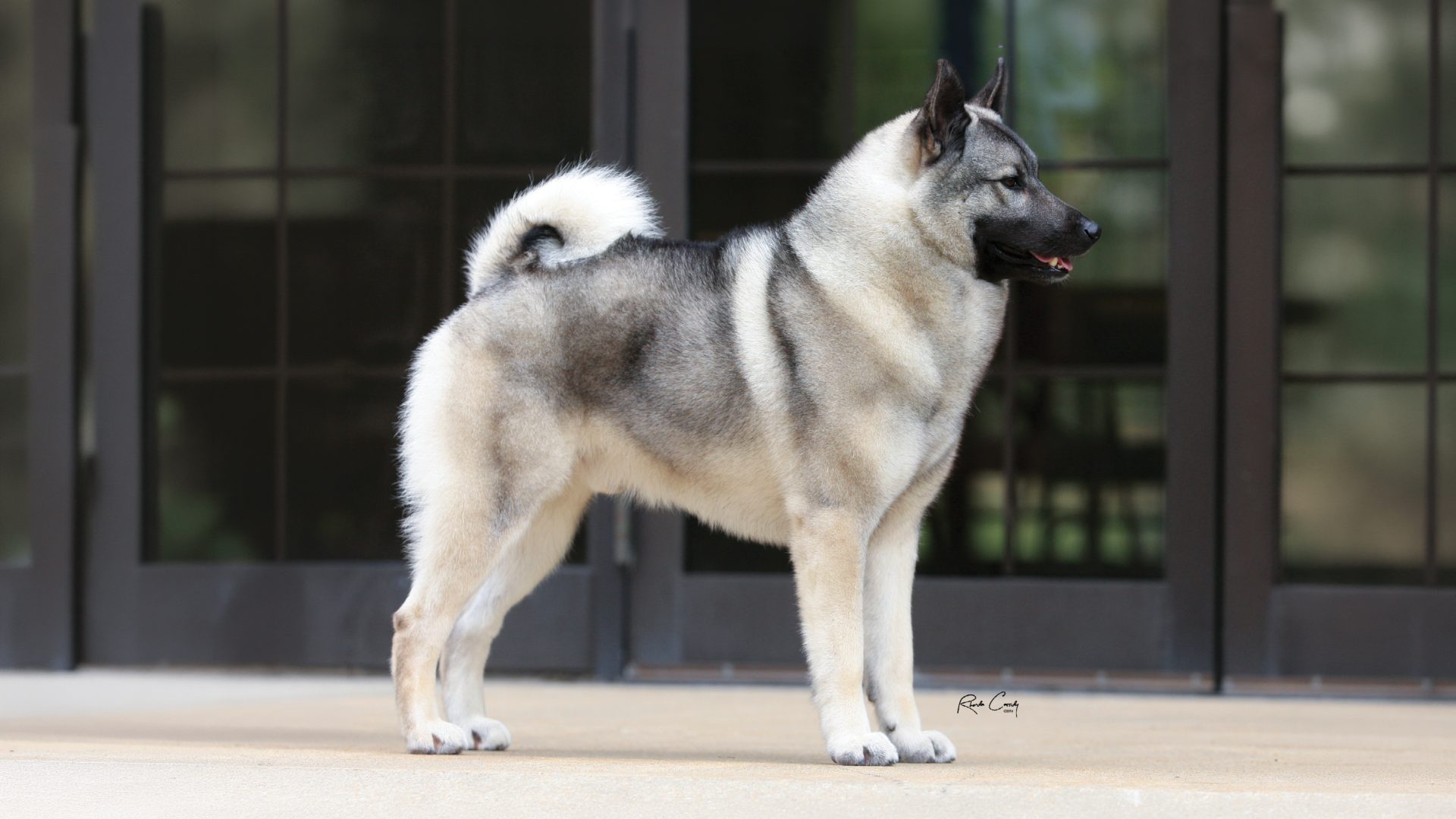
The Norwegian Elkhound, or simply Elkhound, stands among Europe's oldest breeds of dog. This spitz-type canine is known for its rather wolf-like appearance and robust build. The breed’s name is somewhat of a misnomer, however, as the Elkhound was never intended to hunt elk. Even today, they are not considered a genuine hound. In Norwegian, “elg” means moose and “hund” means dog. So, the Elkhound is really a “moose dog.” Whatever its name, the breed can make for a wonderful watchdog and a beloved family companion.
Highlights
02/History
The beautiful and rocky regions of Norway are home to the Norwegian Elkhound. The breed dates from about a millennium ago to a time when the Vikings used a sizeable and comparable dog for hunting and protection. Archaeologists have discovered skeletons of dogs that closely resemble the Elkhound in size and shape among artifacts from a primitive culture, suggesting that the breed may date back as far as 5,000 BCE. Although its exact history is lost in time, there is no doubt that the breed is inextricably linked to the area's early human civilizations.
Norwegian Elkhounds are categorized as hounds despite having a very different appearance from the scenthounds and sighthounds that originated in warmer climates. The Elkhound has been used to protect herds, flocks, and homes as well as for hunting large animals such as bears and moose. The breed's usefulness as hunter was due to its ability to track down prey by following its scent and then keep it at bay by barking until the hunter arrived.
Following the first dog exhibition organized by the Norwegian Hunters Association in 1877, the Norwegian Elkhound gained popularity as a breed. Local breeders soon started working to establish a written Breed Standard, maintain breed data, and develop the Elkhound as a competitive contender in the Conformation arena. In addition to being an excellent family companion, the modern breed excels in a wide range of canine sports and occupations, including Tracking, Guarding, Herding, Sledding, Agility, Obedience, Flyball, and Canine Freestyle. Norwegian Elkhounds are still employed as hunting dogs too, just as they were in the past.
03/Appearance
Mature male Norwegian Elkhounds typically stand around 20.5 inches at the shoulder, while females usually measure around 19.5 inches.
Norwegian Elkhound males typically weigh around 55 pounds, with females averaging about 48 pounds in weight.
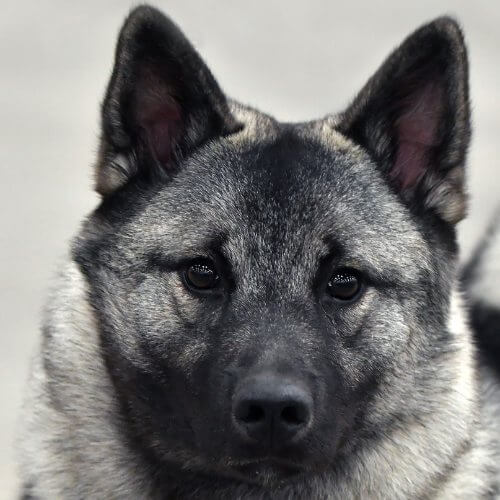
The Norwegian Elkhound is a typical spitz breed that displays a square profile and compact build, medium in both size and substance. A muscular neck, straight topline, and short body contribute to the breed’s strength and are collectively considered essential characteristics of the breed. The Elkhound's size allows the dog to do its job perfectly, and its construction allows for movement that is light and effortless.
Texture: The undercoat is soft, dense, and wooly, while the outer coat is coarse and straight. The Norwegian Elkhound’s coat is typical of most Northern dog breeds, with thick, protective guard hairs and a soft, dense undercoat for insulation. This double coat is weather-resistant by virtue of it being thick, hard, and smooth-lying. On the head, ears, and fronts of the legs, the coat is short and even, but it is longer on the back of the neck, buttocks, and underside of the tail.
Markings: Variations Shadings
Standard Colors
04/Consider
When considering a Norwegian Elkhound for the home, it’s important to understand the breed’s characteristics, needs, and temperament. By being highly adaptable and affectionate, this breed can be a great choice for both experienced pet owners and novices, the most important consideration is providing plenty of exercises to fulfill the breed's high-energy needs. The Elkhound is an intelligent, bold, energetic, and protective breed and makes an ideal guardian. Before acquiring the breed, however, it's essential to consider the fact that the Elkhound is known for barking and is not a great choice for apartment living.
Interaction With Family
The level of affection a breed typically shows towards family members and familiar individuals.
Good With Other Dogs
The innate friendliness of a dog towards other dogs can depend on its breed.
Good With Young Children
The degree to which a breed will typically be patient with young children.
Amount Of Shedding
How much hair a breed typically leaves behind on clothes, furniture and floors.
Frequency Of Grooming
How often a breed needs brushing, bathing or a professional trim to stay in condition.
Amount Of Drooling
How prone a breed is to drool — worth knowing before you keep a towel by the door.
Openness To Strangers
How openly a breed tends to greet new people, visitors and strangers.
Protective Nature
How likely a breed is to alert you to — and stand between you and — anything unfamiliar.
Playfulness Level
How enthusiastic a breed stays about games and play well past puppyhood.
Trainability Level
How readily a breed takes direction and works with you rather than around you.
Barking Level
How much a breed uses its voice, and how readily.
Energy Level
How much get-up-and-go a breed brings to an average day.
Health
The Norwegian Elkhound is typically healthy, however, the breed is prone to some health issues, as are all breeds and mixed breeds. Of course, not all Elkhounds will get any or all of these diseases, but it is essential to be aware of them. And it is important to remember that regular veterinary check-ups and a balanced diet can go a long way toward ensuring the well-being and longevity of any dog. Lifespan: The average lifespan of a Norwegian Elkhound ranges between 12 and 15 years, but with proper care, regular exercise, and a balanced diet, many can thrive beyond these years.
The Norwegian Elkhound traces its roots back to ancient times when the dogs were shipmates of the Vikings. Today, this tough and tenacious breed can make a wonderful companion to people from all walks of life. It is a highly extroverted character and loves to be around the action. As is typical of active and independent breeds, it should be noted, this one can be a challenge to train.
Elkhounds are highly devoted to the family and are generally protective, and sometimes, even possessive. Yet, these characteristics make for a wonderful guardian. These dogs are loyal and devoted, but many have the need to be the center of attention most of the time.
Barking is one of the more notable characteristics of the Norwegian Elkhound. The breed can provide a level of security and is a natural watchdog, especially since it enjoy making vocalizations. It is not, however, an inherently aggressive dog. Any excessive barking can often be quieted through training, although it is best to avoid keeping this breed in an apartment.
The Elkhound loves to play a lot, but usually not with toys. Chasing balls (but not bringing them back) is one of its favorite activities. The breed is naturally adventurous and needs plenty of space to run around. So, all exercise should take place outdoors. Otherwise, most of the household belongings could get tossed and turned.
Overall, the Norwegian Elkhound is a loving dog that makes a fantastic family member in the right setting. These Nordic originals are naturally suspicious of strangers and make excellent watchdogs, but they thrive on attention and are typically great with kids. In fact, a more devoted canine companion might be pretty hard to find.
Grooming Expectations
The Norwegian Elkhound's coat is short and thick, with an undercoat that's dense, wooly, and soft. The breed is always found in its natural state, with no trimming needed. Many Elkhounds can be prone to skin problems when they are trimmed or even shaved, and a haircut typically damages the guard hairs and causes them to grow improperly. Elkhounds are a naturally clean breed in terms of their coat, which tends to expel debris on its own. Weekly brushing is needed when the dog isn't shedding its coat, but daily brushing is often required during shedding seasons. Luckily, Norwegian Elkhounds don’t typically have a doggy odor, so bathing is not required too frequently. Instead, it should be necessary only when the dog has rolled in something stinky. In that case, bathing should be done with a high-quality shampoo to protect the skin and coat. Beyond coat care, other grooming tasks include brushing the Elkhound's teeth two to three times a week to remove tartar build-up and bacteria. To prevent gum disease and bad breath, it is better to do the daily brushing if possible. Trimming the nails should be done once or twice a month if the dog doesn’t wear them down naturally, and ears should be also checked and cleaned weekly.
Living with a Norwegian Elkhound is a rewarding experience considering the breed’s protectiveness, adaptability, and most importantly, its wonderful sense of adventure. The breed is highly adaptable and enjoys accompanying its family on any kind of outdoor adventure. Elkhounds love cold weather and definitely enjoy playing in the snow; however, swimming can also be a good option for fulfilling their high-energy needs.
Training is essential for an Elkhound, although it can be a challenge due to the breed's often stubborn and dominant nature. It is important, therefore, to be firm and consistent when training and to reinforce that the dog is not the one in charge. Conversely, the breed is highly affectionate towards its family members and usually makes an outgoing, if protective, companion.
Since the Elkhound is a highly vocal breed, these dogs can bark at anything and everything, even if there's nothing to bark at! And although it is not a good choice for an apartment dog, an Elkhound can live in a smaller space without barking excessively if it is given enough time outdoors and plenty of mental stimulation.
Despite the breed's wolf-like appearance, the Norwegian Elkhound is far from intimidating. On the contrary, most Elkhounds are known to be friendly and sweet. When they are not active, their favorite activity is to cuddle with their owner. Most are great around children of all ages, although interactions with kids and dogs should always be supervised.
The Norwegian Elkhound tends to be a highly protective dog, so it is important to socialize puppies when they're young and introduce them to as many people as possible as they mature. Introducing the Elkhound to other dogs is also important, since the breed is not always polite during these introductions.
05/Puppies
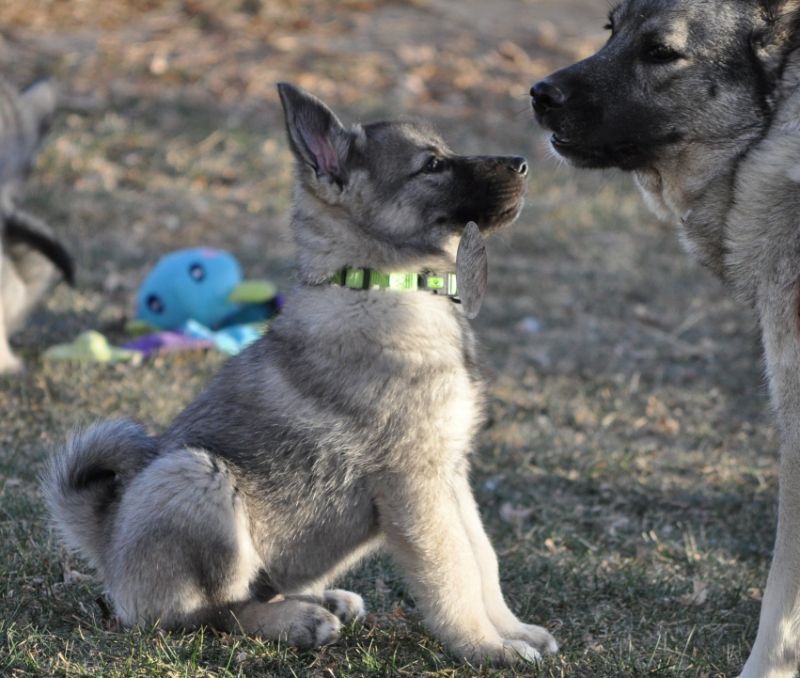
Norwegian Elkhound puppies bring joy and happiness to most any home with their energy, playfulness, and friendliness. However, the stubborn side of the breed shows at a young age and requires a lot of patience and responsibility for their caretakers. Still, raising these puppies is always a fun journey - no matter what.
When bringing a Norwegian Elkhound puppy home, it can be easy to think that it’s a shy and calm breed. However, once the puppy has adapted to its surroundings and meets its own people, a whole new story begins. The Elkhound puppy is, indeed, active, curious, playful, and most of all, stubborn.
Nutrition is one of the first things to think about. A puppy grows quickly and its diet should keep up with its growth. A high-quality puppy food that is rich in critical nutrients and designed specifically for medium and large breed puppies is needed. The amount and frequency of meals can be guided by the feeding guidelines published on pet food packaging or by a veterinarian's advice.
Socialization is the second important aspect of a puppy's life. With the Elkhound being a protective breed and not necessarily good with other dogs, it is of great importance to start introducing the new puppy to different dogs and people. New introductions help to shape a pup's temperament and its behavior as an adult.
Training should begin as soon as possible, taking advantage of a puppy's adaptable nature. While the Elkhound puppy is intelligent, the breed's stubbornness can make training difficult at times. Positive reinforcement strategies, such as using treats, praise, and toys, are the most effective.
Because of its curious temperament, the Norwegian Elkhound puppy will want to explore every corner and crevice of its new home. The living space must therefore be puppy-proofed. In the early weeks and months, it is critical to maintain a healthy environment that is free of dangerous substances and choking hazards.
06/Activities
Norwegian Elkhound owners understand that their dogs are high-energy canines that require a lot of exercise to keep them from climbing the walls. Aside from daily walks, it is critical to engage these dogs in a variety of activities.
Gallery
07/Standards
The Norwegian Elkhound is recognized by the world's leading registries and kennel organizations, which categorize the breed into a specific Group based on its unique characteristics. This breed is recognized worldwide under the following Group designations:
The ideal Norwegian Elkhound is described by a Breed Standard that is approved by each of the world’s leading registries and kennel organizations. The Breed Standards for this breed may be found in the following links:
08/Clubs
09/Rescue
10/Facts
Wolf-Like Appearance
With their thick, silver-gray coat, upright ears, and curled tail, they have a distinctly wolf-like appearance.
Age
According to records, the Norwegian Elkhound could have appeared as early as 5,000 B.C. Archaeologists have discovered bones similar to the Norwegian Elkhound in the same locations where Viking remnants and weapons have been discovered. This would make them one of the world's oldest dog breeds.
Name
The Norwegian Elkhound was given the name "Norsk Elghund," which translates to "moose dog." The name is misleading, however, since Europeans refer to moose as elk, while moose and elk are different animals in North America.
Cold-Weather
Because of their thick double coat and sturdy frame, Norwegian Elkhounds are well-suited to colder climates.
Worker
Norwegian Elkhounds are versatile. They have been employed to hunt a wide range of animals in America, from birds to mountain lions. They make excellent Service Dogs for persons with disabilities due to the breed's innate intelligence. Its ability to track can make the Elkhound ideal for Search and Rescue teams as well.
11/FAQ
Yes, Norwegian Elkhounds are known to shed a significant amount. They have a dense, double coat that sheds throughout the year, with increased shedding during seasonal changes. Regular grooming can help to manage the shedding, but potential owners should be prepared for a considerable amount of hair in their homes.
Official Standard of the Norwegian Elkhound
General Appearance: The Norwegian Elkhound is a hardy gray hunting dog. In appearance, a typical northern dog of medium size and substance, square in profile, close coupled and balanced in proportions. The head is broad with prick ears, and the tail is tightly curled and carried over the back. The distinctive gray coat is dense and smooth lying. As a hunter, the Norwegian Elkhound has the courage, agility and stamina to hold moose and other big game at bay by barking and dodging attack, and the endurance to track for long hours in all weather over rough and varied terrain.
Size, Proportion, Substance: Height at the withers for dogs is 20½ inches, for bitches 19½ inches. Weight for dogs about 55 pounds, for bitches about 48 pounds. Square in profile and close coupled. Distance from brisket to ground appears to be half the height at the withers. Distance from forechest to rump equals the height at the withers. Bone is substantial, without being coarse.
Head: Head broad at the ears, wedge shaped, strong and dry (without loose skin). Expression keen, alert, indicating a dog with great courage. Eyes very dark brown, medium in size, oval, not protruding. Ears set high, firm and erect, yet very mobile. Comparatively small; slightly taller than their width at the base with pointed (not rounded) tips. When the dog is alert, the orifices turn forward and the outer edges are vertical. When relaxed or showing affection, the ears go back, and the dog should not be penalized for doing this during the judge's examination. Viewed from the side, the forehead and back of the skull are only slightly arched; the stop not large, yet clearly defined. The muzzle is thickest at the base and, seen from above or from the side, tapers evenly without being pointed. The bridge of the nose is straight, parallel to and about the same length as the skull. Lips are tightly closed and teeth meet in a scissors bite.
Neck, Topline, Body: Neck of medium length, muscular, well set up with a slight arch and with no loose skin on the throat. Topline - The back is straight and strong from its high point at the withers to the root of the tail. The body is short and close-coupled with the rib cage accounting for most of its length. Chest deep and moderately broad; brisket level with points of elbows; and ribs well sprung. Loin short and wide with very little tuck-up. Tail set high, tightly curled, and carried over the centerline of the back. It is thickly and closely haired, without brush, natural and untrimmed.
Forequarters: Shoulders sloping with elbows closely set on. Legs well under body and medium in length; substantial, but not coarse, in bone. Seen from the front, the legs appear straight and parallel. Single dewclaws are normally present. Feet-Paws comparatively small, slightly oval with tightly closed toes and thick pads. Pasterns are strong and only slightly bent. Feet turn neither in nor out.
Hindquarters: Moderate angulation at stifle and hock. Thighs are broad and well muscled. Seen from behind, legs are straight, strong and without dewclaws. Feet as in front.
Coat: Thick, hard, weather resisting and smooth lying; made up of soft, dense, woolly undercoat and coarse, straight covering hairs. Short and even on head, ears, and front of legs; longest on back of neck, buttocks and underside of tail. The coat is not altered by trimming, clipping or artificial treatment. Trimming of whiskers is optional. In the show ring, presentation in a natural, unaltered condition is essential.
Color: Gray, medium preferred, variations in shade determined by the length of black tips and quantity of guard hairs. Undercoat is clear light silver as are legs, stomach, buttocks, and underside of tail. The gray body color is darkest on the saddle, lighter on the chest, mane and distinctive harness mark (a band of longer guard hairs from shoulder to elbow). The muzzle, ears and tail tip are black. The black of the muzzle shades to lighter gray over the forehead and skull. Yellow or brown shading, white patches, indistinct or irregular markings, "sooty" coloring on the lower legs and light circles around the eyes are undesirable. Any overall color other than gray as described above, such as red, brown, solid black, white or other solid color, disqualifies.
Gait: Normal for an active dog constructed for agility and endurance. At a trot the stride is even and effortless; the back remains level. As the speed of the trot increases, front and rear legs converge equally in straight lines toward a centerline beneath the body, so that the pads appear to follow in the same tracks (single track). Front and rear quarters are well balanced in angulation and muscular development.
Temperament: In temperament, the Norwegian Elkhound is bold and energetic, an effective guardian yet normally friendly, with great dignity and independence of character.
Summary: The Norwegian Elkhound is a square and athletic member of the northern dog family. His unique coloring, weather resistant coat and stable disposition make him an ideal multipurpose dog at work or at play.
Disqualifications: An overall color other than gray.
Approved December 13, 1988
Effective February 1, 1989

Meet the Breeders
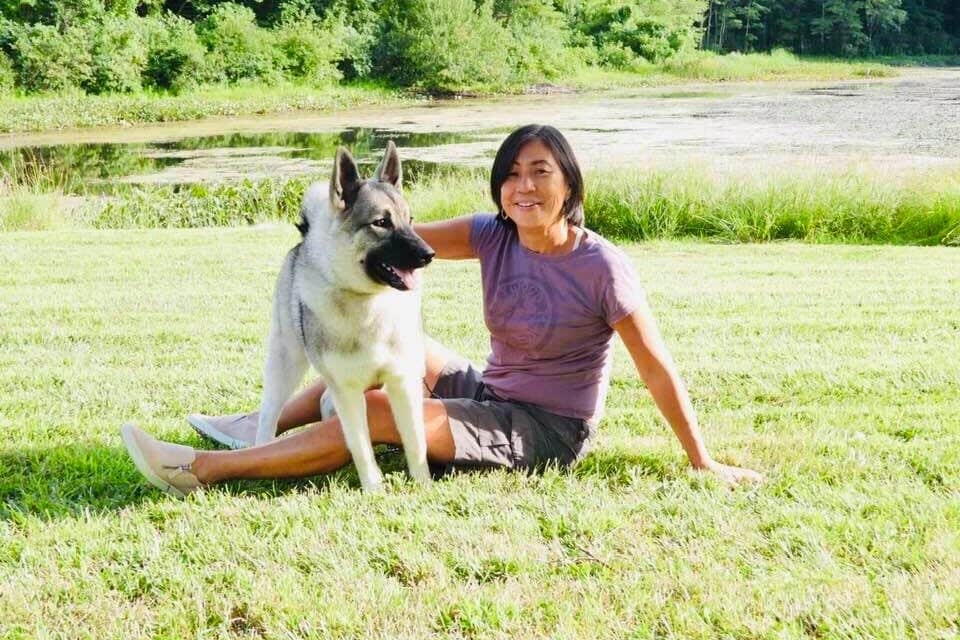
Kathi Molloy is the breeder behind Highpoint Norwegian Elkhounds. Read about the kennel’s beginnings, the dogs, the puppies, and more!
Meet the Breeders
Robin Rhoden is the breeder behind the Aspen Norwegian Elkhounds. Read about the kennel’s beginnings, the puppies, and much more!
American Kennel Club (AKC)
Interview with 2022 AKC Hound Group Honoree, Margaret “Maggie” K. Mott and Sally P. Simmonds of Kamgaard Norwegian Elkhounds.
The Tail of a Norwegian Elkhound is always set high, tightly curled, and carried over the centerline of the back, making for a slightly different appearance than many of its Northern cousins. The tail is thick and closely haired, without the “brush” found on similar spitz breeds. The tail is always left natural and is never trimmed.
A Note About Color: Although generally gray in color, the Norwegian Elkhound's coat displays variations in shade due to the length and quantity of the guard hair's black tips. The body is darkest on the back (saddle) and lighter on the chest, mane, and from the shoulder to the elbow (harness). The muzzle, ears, and tip of the tail are black, and black hairs on the muzzle fade to lighter gray on the forehead and skull. “Sooty” coloration, irregular markings, white patches, and yellow or brown shading are not acceptable in the breed. Likewise, red, brown, white, solid black or any other solid color are unacceptable.
Coat Type
Double
The structure of the coat this breed carries.
Coat Length
Medium
How long the breed's coat grows when kept in condition.
Adaptability Level
How easily a breed copes with changes in home, routine, noise and weather.
Mental Stimulation Needs
How much a breed needs a job, a puzzle or training to stay content.
The Norwegian Elkhound should thrive on high-quality food, whether purchased commercially or prepared at home with a veterinarian's supervision. The diet should be high in protein, moderate in fat, and low in carbohydrates, and it can sometimes be best to feed a raw food diet. Elkhounds can be “food hounds,” so it is important to supervise what the dog eats.
The diet should be tailored to the age of the dog (puppy, adult, or senior), as well as its size, build, metabolism, and activity level. Highly active dogs will need more food than those that are less active.
When it comes to feeding an Elkhound puppy, a nutrient-rich diet that promotes steady growth and development is crucial. A pup's dietary requirements will change as it reaches adulthood, when the recommended amount of food will be 2 to 2.5 cups per day.
Better quality food will nourish a dog best, so less food will be needed. Meals should be measured and split it into two servings per day rather than one. Also, it's important to never leave food out all day and avoid feeding human food.
It is essential to monitor a Norwegian Elkhound's weight to avoid overfeeding. The main indication that a dog is overweight is a rolling motion of its back or sides when the dog trots.
Another important consideration is to always have fresh water readily available for the Norwegian Elkhound. Hydration is just as crucial as nutrition, and this is especially so for such an active breed.
The Norwegian Elkhound is an independent and stubborn breed that can occasionally make training a bit difficult. The journey of training one of these beautiful hounds requires patience, consistency, and an understanding of the breed's true nature.
Elkhounds are intelligent, so they can easily pick up commands. On the other hand, they want something in return for the obedience work. Treats can be a good reward, but so is the owner's praise. Once the Elkhound gets attached to its favorite person, the bond is inseparable.
This Elkhound is naturally dominant, so it needs a firm handler for training. Owners of this breed should represent the pack leader as it is the only way for the dog to follow commands and take the training seriously. Otherwise, training can be difficult and the Elkhound will want to take the lead.
The Norwegian Elkhound should be provided with plenty of outdoor space. With its hunting heritage, the breed is highly adventurous and enjoys running and chasing whatever it perceives as prey. Some have even been known to catch game on their own. Elkhounds prefer a winter climate with lots of snow, but if this is not possible, most can happily exercise in warmer environments provided there's a change-up to their daily routine.
In general, a Norwegian Elkhound's daily activity should be vigorous. This breed can become irritable if it does not get enough mental and/or physical exercise. And when walking this breed, it's best to have the dog heel beside or behind the handler, never in front, to reaffirm the owner's position of authority.