Members
01/Overview
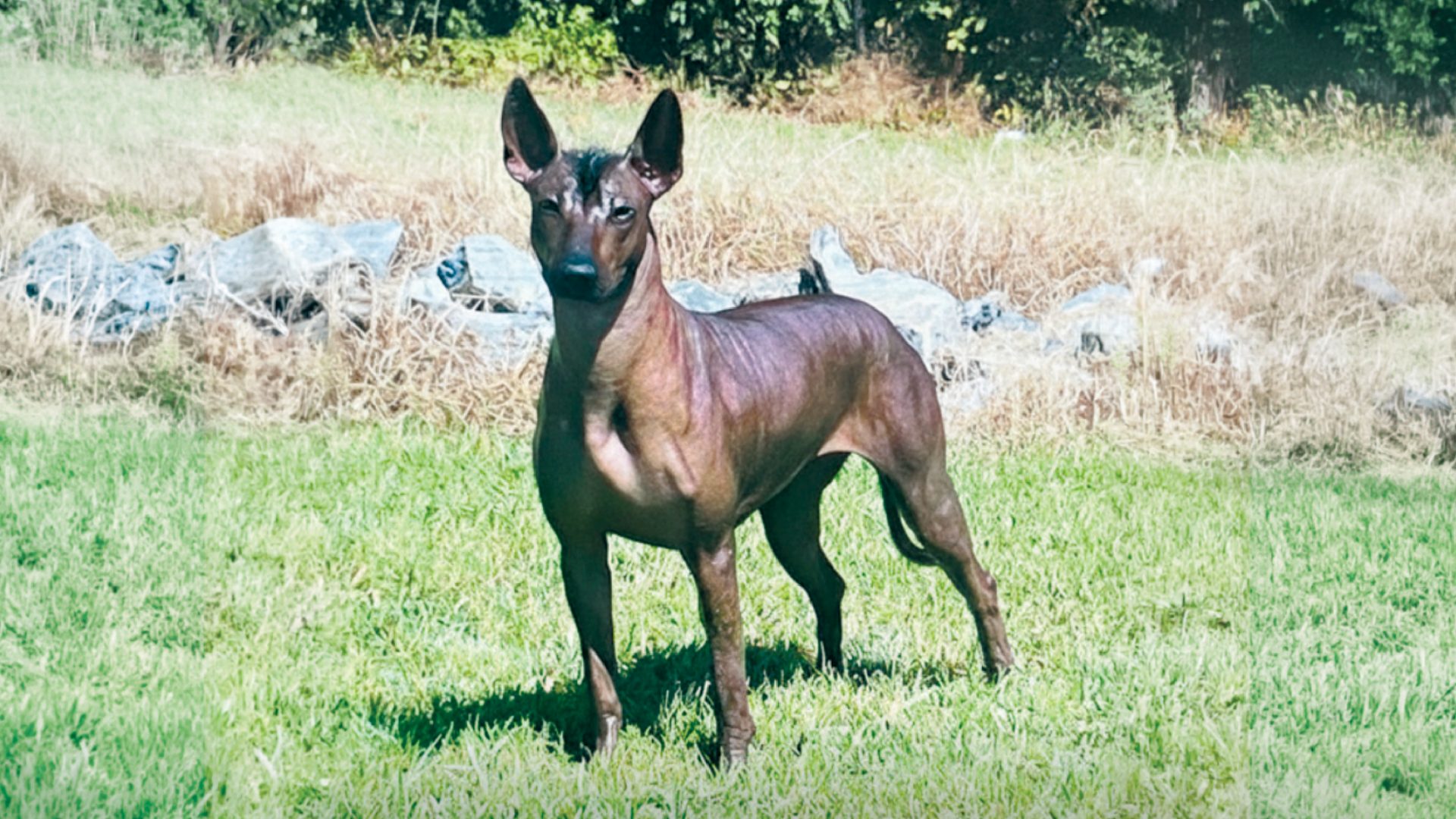
The Xoloitzcuintli comes in three sizes (Standard, Miniature, and Toy) and two varieties (Hairless and Coated). The Standard is a guardian of the home and family. The Miniature is an ideal size to play with the children, yet small enough to fit comfortably in a family home. The Toy is the perfect size for apartment life and those wanting a lapdog. Xolos may be suitable for people with allergies, but as there are no hypoallergenic dogs this must be considered on a case-by-case basis. The hairless Xolo skin is thick, protective, and resistant to injury. Incomplete dentition is common. The coated variety has a short, sleek, tight-fitting coat and should have full dentition.
Highlights
02/History
The name Xoloitzcuintli (show-low-eats-queent-lee) is derived from the name of the Aztec god Xolotl and Itzcuintli, the Aztec word for dog. Archaeological evidence has been found in the tombs of the Colima, Mayan, Toltec, Zapoteca, and Aztec cultures dating the breed to over 3500 years ago. Indigenous peoples revered the Xolo and believed the breed to have mystical healing abilities. Long regarded as guardians and protectors, the indigenous peoples believed that the Xolo would safeguard the home from evil spirits as well as intruders. In ancient times, Xolos were often sacrificed and then buried with their owners to act as guide to the soul on its journey to the underworld.
In 1887, the American Kennel Club studbook included the “Mexican Hairless,” but due to insufficient numbers it was dropped in 1959. Interest was minimal in the late 1940s when first shown in Mexico. Fearing the Xolo would become extinct, the Federación Canófila Mexicana (FCM) launched the “Xolo Expedition of 1954,” led by Norman Pelham Wright bringing back stock to form the foundation of Mexico’s breed revival program. The breed was first registered in Mexico in 1955. A committee headed by Wright authored the first official Breed Standard which was adopted on May 1, 1956. Now the Official Dog of Mexico, an FCI breed, and recognized by the AKC in 2011.
03/Appearance
The Xoloitzcuintli is an ancient, natural breed, molded by evolution rather than selective breeding. A Xolo is moderate in all aspects of type and conformation, never extreme or overdone. Today, the breed serves as a guard and companion. The Xolo possesses a clean, graceful outline, equally combining elegance and strength. There are two varieties, Hairless and Coated, identical except for coat and dentition. In the Hairless variety, the principal characteristic is the total or almost total absence of hair. The Coated variety is covered by a short, flat coat. In conformation, all three sizes are lean, sturdy, well-muscled with a spacious ribcage, and with moderate bone. The Xolo outline is rectangular, and the distance from the elbow to the ground is equal to, or slightly greater than, the distance from the withers to the elbow. Typical Xolo temperament is calm, tranquil, aloof, and attentive.
The Xoloitzcuintli comes in three sizes (Standard, Miniature, and Toy).
The Standard variety measures 18-23 inches tall at the shoulder. The miniature measures 14-18 inches tall, and the Toy measures 10-14 inches. Height at the withers is not to be under ten inches or over 24 inches. Dogs less than 10 inches or over 24 inches are disqualified from competition at Conformation dog shows. There is no specified weight range for the Xolo. Since the Xolo comes in three sizes, the weight for the breed can span from 12 to 70 lbs. Size ranges for Males and Females are the same.
Skull: Wedge-shaped, when seen from above, wide and strong, gradually tapering to the muzzle. Excessively wide or narrow heads are a fault. Skull and muzzle planes are parallel. The stop is not pronounced.
Muzzle: Longer than the skull, straight when viewed in profile. The lower jaw is strong and well developed, free from throatiness.
Nose: Dark on dark-colored dogs, lighter on light-colored dogs. Lips are thin and tight.
Expression: Thoughtful and intelligent, vivacious, conveying the noble and faithful character of the breed. Will show distinctive brow wrinkles when at attention.
Eyes: Almond-shaped, medium in size, neither sunken nor protruding. The color varies from yellow to black, the darker being preferred, but lighter color is acceptable. Both eyes must be of the same color. The eye rims may be less pigmented on light-colored dogs. Light or spotted eye rims are tolerated but not preferred.
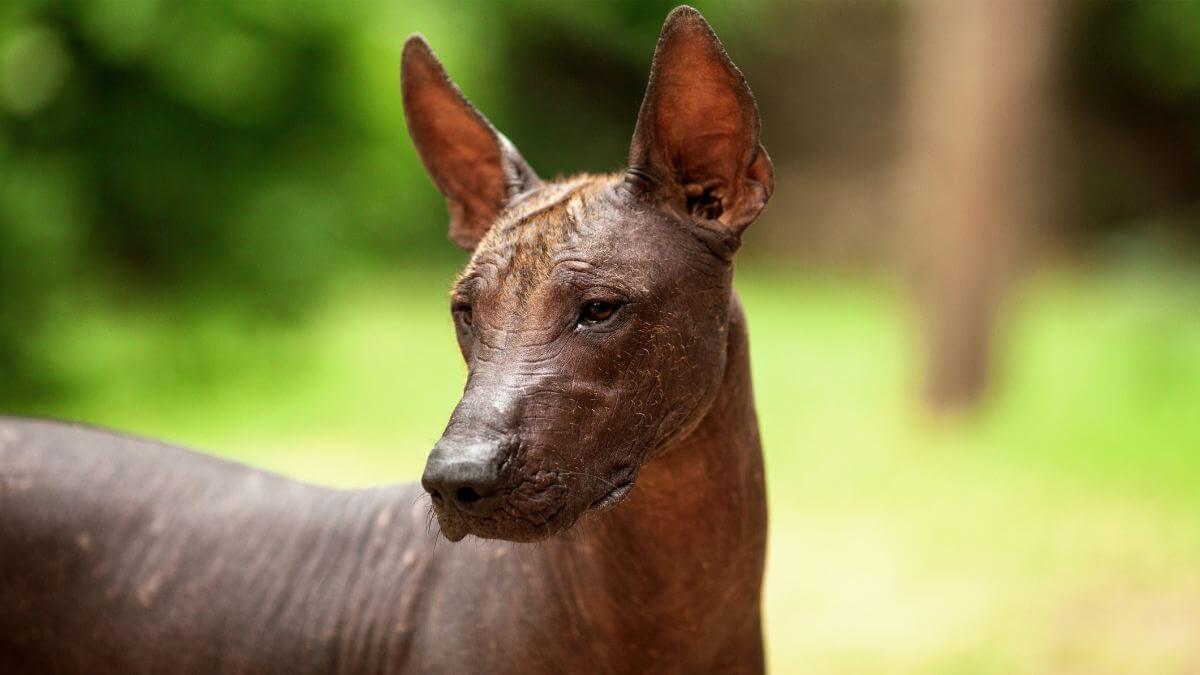
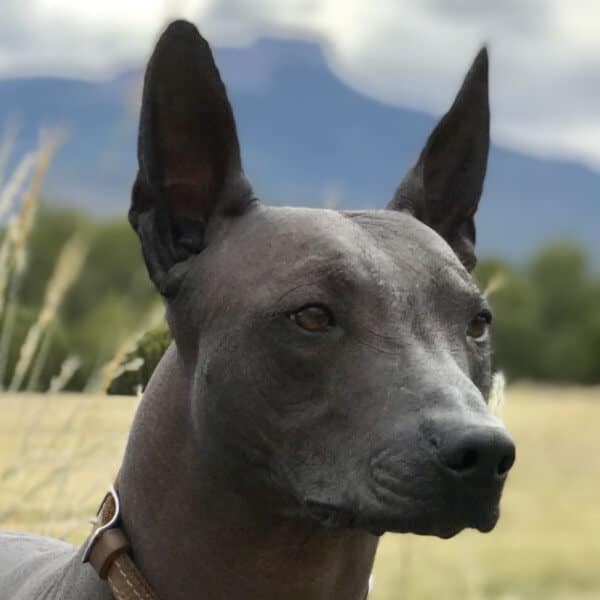
Ears: Large, elegant, and expressive, a thin delicate texture, tapering to a rounded tip. Ears are set high and carried strongly erect when alert. Ears not standing erect by one year of age are a fault. The Xolo should never exhibit ear fringe. Cropping is prohibited.
Bite: Scissors bite. In the Hairless variety, the absence of premolars is acceptable. A complete set of incisors is preferred but lack thereof is not to be penalized. In the Coated variety, complete dentition is required.
The body of the Xoloitzcuintli is slightly longer than the height, in a 9/10 ratio measured from the point of the shoulder to the end of the rump. Medium, oval-shaped bone is desirable. All three sizes exhibit moderately balanced proportions, and appear strong, sturdy, and well-covered with smooth, flat muscle, but never coarse, heavy, or over-muscled.
Texture: The principal characteristic of the hairless variety is the absence of hair; however, a small amount of short, coarse hair is permitted on the top of the head, the feet, and the last third of the tail to the tip. The absence of hair in those areas is not to be penalized. Hair on any other areas is a serious fault. The skin is tough, protective, smooth, and close-fitting. Moderate head wrinkles are permitted, but loose or wrinkled skin on the body is a fault. The coated variety is completely covered with a short, smooth, close-fitting coat. Long, soft, or wavy hair is a serious fault in either variety.
A Note About Grooming: The grooming needs of a Xoloitxcuintli are low, but like all dogs the Xolo will need proper care of skin, coat, teeth, and nails, the latter which grow fast on the Hairless variety. The nails do need to be either filed or cut, although some Xolos may be able to wear their nails down if they get enough running on a hard surface. The teeth need to be cleaned—either by regular brushing at home or periodic dental cleaning by a vet. Hairless dogs need regular bathing, and the application of moisturizing lotions will keep the skin in good condition. Xolos darken and tan with exposure to the sun. Xolos may suffer from adolescent acne as they mature, although keeping the dog and their surroundings clean, and not picking eruptions, will help that stage pass with a limited amount of distress for all concerned. The Xolo’s skin can be likened to a hide—resilient and tough enough to withstand scrapes and scratches with no damage.
04/Consider
Xolos are active, inquisitive, and destructive as puppies. They are a primitive breed, and require intense socializing as they mature. Xolos tend to be guard dogs, so you can never take them for granted. They require consistent training; you must be able to provide enough room and exercise, especially for young dogs, or they will keep themselves busy by destroying your belongings. The first year in a young Xolo’s life can be a rough one for both puppy and owner. This breed has a natural adaptation, with a hide instead of skin as in other hairless breeds. The correct Xoloitzcuintli does NOT need sunscreen, or clothing for protection. The hide matures throughout the first year of the dog’s life—during which time some Xolos go through adolescent acne as the skin and the oil glands grow at different speeds. Sometimes the skin may appear to break out with blackheads; young pups may acquire the equivalent of cradle cap (a waxy buildup on parts of their body). At times, the pups produce too much oil and take on a musty smell. A new owner must be ready, willing, and able to deal with these outbreaks. For the right person Xolos make a wonderful addition to their family.
Interaction With Family
The level of affection a breed typically shows towards family members and familiar individuals.
Good With Other Dogs
The innate friendliness of a dog towards other dogs can depend on its breed.
Good With Young Children
The degree to which a breed will typically be patient with young children.
Amount Of Shedding
How much hair a breed typically leaves behind on clothes, furniture and floors.
Frequency Of Grooming
How often a breed needs brushing, bathing or a professional trim to stay in condition.
Amount Of Drooling
How prone a breed is to drool, worth knowing before you keep a towel by the door.
Openness To Strangers
How openly a breed tends to greet new people, visitors and strangers.
Protective Nature
How likely a breed is to alert you to anything unfamiliar, and stand between you and it.
Playfulness Level
How enthusiastic a breed stays about games and play well past puppyhood.
Trainability Level
How readily a breed takes direction and works with you rather than around you.
Barking Level
How much a breed uses its voice, and how readily.
Energy Level
How much get-up-and-go a breed brings to an average day.
Health
This is a robust and healthy breed that evolved in the primitive jungles of Colima, Mexico. Because they are a hardy, primitive breed, they don’t yet have some of the health problems common in more domesticated breeds. The average lifespan of a Xolo is 13-16 years (approximately).
All three sizes exhibit the typical temperament of a working breed. They are often reserved and wary of strangers, but should never be timid or aggressive. Xolos generally bond strongly with their owners, and while friendly, will not be as affectionate with strangers. They are intelligent problem-solvers and often seem to have a sense of humor.
Exercise Expectations
Living with a Xoloitzcuintli is a unique and rewarding experience. These loyal and affectionate dogs form strong bonds with their families and thrive on companionship. Their calm demeanor at home makes them excellent indoor pets, content to relax alongside you, but they also have bursts of playful energy that require daily exercise. Xolos are intelligent and curious, so mental stimulation is key to keeping them happy. They are generally low-maintenance, though their unique skin requires regular care, especially in Hairless varieties. With the right balance of attention, training, and care, a Xoloitzcuintli can be a loving and devoted companion.
05/Puppies
The puppies don’t look much like their parents when they’re born—they have shorter faces, wrinkly skin, dropped ears, and seem a bit on the short-legged side. As they grow, their faces elongate, and their skin smooths out, revealing their distinctive appearance. Their ears gradually stand upright, and their legs lengthen, giving them the elegant posture typical of their breed. Despite their early awkwardness, these puppies quickly begin to show the traits that make them so special.
Raising a Xoloitzcuintli puppy requires clear, consistent training and extensive socialization. Structured social outings and interactions with new people, including children, are crucial for their development. Enrolling your Xolo in group puppy classes and basic manners training can be highly beneficial. Their natural curiosity and playful nature make early exposure to diverse situations the perfect time for fostering positive experiences.
06/Activities
Participating in Conformation shows is a rewarding way to bond with your Xoloitzcuintli. Due to the breed’s naturally cautious nature around strangers, it’s essential to provide them with ample practice to feel comfortable during a judge's hands-on examination. Enrolling in a Conformation handling class is crucial to ensure they are well-prepared and confident in the ring.
Xolos are highly active and excel in a variety of dog sports. Their love for running and strong prey drive make them particularly suited for fast-paced activities like Fast CAT, Lure Coursing, and Agility. They also perform admirably in Obedience, Rally, Scentwork, and even Dock Diving, showcasing their versatility and enthusiasm for physical and mental challenges.
Gallery
07/Standards
The Xoloitzcuintli is recognized by the world's leading registries and kennel organizations, which categorize the breed into a specific Group based on its unique characteristics. This breed is recognized worldwide under the following Group designations:
The ideal Xoloitzcuintli is described by a Breed Standard that is approved by each of the world’s leading registries and kennel organizations. The Breed Standards for this breed may be found in the following links:
08/Clubs
Xoloitzcuintli Club of America: Formed on October 26, 1986, and incorporated in New York State on June 14, 1989, membership in this parent club is comprised of Xoloitzcuintli owners, breeders, handlers, and friends.
The Xoloitzcuintle Club UK: Formed on October 26, 1986, and incorporated in New York State on June 14, 1989, membership in this parent club is comprised of Xoloitzcuintli owners, breeders, handlers, and friends.
09/Rescue
Michelle Thangtamsatid (m.thangta@gmail.com) may be contacted for assistance with Xolo rescue in the US.
10/Facts
Breed Recognition
The breed was first recognized by the Mexican Kennel Club (FCM) on May 1st, 1956; prior to that the breed was only known to the secluded Indian tribes in the remote parts of Mexico and Central America.
Noble Support
The Archduchess Felix of Austria, better known as the Countess Lascelles de Premio Real, was the driving force behind the 1955 expedition led by Norman Pelham Wright into the Colima jungle in order to find the dogs and reintroduce them via an organized breeding program.
Official Status
The Xoloitzcuintli has now been designated as the Official Dog of Mexico and is recognized by all FCI countries, as well as the US and Canada.
Old Moniker
The Kennel Club of Great Britain registers and allows Xolos to be shown, but they are still known as “Mexican Hairless.”
A Fútbol Favorite
The Tijuana Xoloitzcuintle soccer team (with Xolos as team mascots) proudly display a beautiful Xolo head on their logo (bred by the world-famous Caliente Kennel). On December 2, 2012, the Xolos (as they are known) became champions of the Liga MX, the top level of the Mexican football league system. The success of the team has done more to promote the Xolo in the public eye than all of the years of work done by the parent club in both countries.
As with most primitive breeds, the Xolo’s intelligence allows them to interact with people in a near-human type of friendship.
Xolos tend to bond strongly with one family member, although they will connect with and love the whole family—including other pets.
11/FAQ
Xolo owners are frequently stopped and find themselves explaining not just the breed, but teaching people how to pronounce the name!
Written by
Xoloitzcuintli Club of America
Founded in 1986, the Xoloitzcuintli Club of America is the AKC-recognized official parent club.
Official Standard of the Xoloitzcuintli
General Appearance: The Xolo is an ancient, natural breed, molded by evolution rather than selective breeding. A Xolo is moderate in all aspects of type and conformation, never extreme or overdone. Today the breed serves as a guard and companion. The Xolo possesses a clean, graceful outline, equally combining elegance and strength. There are two varieties, hairless and coated, identical except for coat and dentition. In the hairless variety, the principal characteristic is the total or almost total absence of hair. The coated variety is covered by a short, flat coat. In conformation, all three sizes are lean, sturdy, well muscled with a spacious ribcage, and moderate bone. The Xolo outline is rectangular, and the distance from the elbow to ground is equal to, or slightly greater than, the distance from the withers to the elbow. Typical Xolo temperament is calm, tranquil, aloof and attentive.
Size, Proportion, Substance: Height is measured at the highest point of the withers. Toy - Height at withers at least 10, and up to and including 14 inches. Miniature - Height at withers over 14 inches, and up to and including 18 inches. Standard - Height at withers over 18 inches, and up to and including 23 inches. Dogs less than 10 inches, or over 24 inches are disqualified. The body is slightly longer than height, in a 9/10 ratio measured from the point of the shoulder blade to the end of the rump. Medium, oval shaped bone is desirable. All three sizes exhibit moderately balanced proportions, and appear strong, sturdy, and well covered with smooth, flat muscle, but never coarse, heavy or over-muscled.
Head: Expression - Thoughtful and intelligent, vivacious, conveying the noble and faithful character of the breed, will show distinctive brow wrinkles when at attention. Eyes are almond shaped, medium size, neither sunken nor protruding. The color varies from yellow to black, the darker being preferred, but lighter color is acceptable. Both eyes must be of the same color. The eye rims may be less pigmented on light colored dogs. Light or spotted eye rims are tolerated but not preferred. Ears - Large, elegant and expressive, a thin delicate texture, tapering to a rounded tip. Ears are set high and carried strongly erect when alert. Ears not standing erect by one year of age are a fault. The Xolo should never exhibit ear fringe. Cropping is prohibited. Skull is wedge shaped, when seen from above, wide and strong, gradually tapering to the muzzle. Excessively wide or narrow heads are a fault. Skull and muzzle planes are parallel. Stop is not pronounced. Muzzle is longer than skull, straight when viewed in profile. The lower jaw is strong and well developed, free from throatiness. Nose is dark on dark colored dogs, lighter on light colored dogs. Lips are thin and tight. Bite - Scissors bite. In the hairless variety, the absence of premolars is acceptable. Complete set of incisors preferred but lack thereof is not to be penalized. In the coated variety, complete dentition is required.
Neck, Topline, Body: Neck is long, elegant, slightly arched, blending smoothly into the shoulders. In dogs less than one year of age, wrinkled skin may be present. In adults, the skin on the neck is smooth and dry, without wrinkles. Topline is level with slight arch over loin. Body is well developed. The brisket should reach to point of elbow. The ribcage is deep and oval, of good length, with sufficient ribspring to produce a rounded shape, but never barrel shaped. The loin is muscular, with a smooth underline showing a slight tuck up. Back is level and firm. Croup is well muscled, slightly rounded, and broad. It should not be flat or steeply angled. Tail is set low, continuing smoothly off the angle of the croup, long and fine, reaching to the hock. When the dog is moving, the tail is carried in a graceful curve, but not over the back. It is held down in a relaxed position when the dog is at rest. A short or curled tail is a serious fault.
Forequarters: Shoulders are covered with smooth muscle, long and sloping. Shoulder blades are flat and well laid back. Upper Arm (humerus) is equal or slightly longer than scapula, angled to place the forelegs well under the body. Elbows are firm and tight, allowing for reach but not so loose to as to allow for elbowing out, nor so tight as to create toeing in or out. Legs are long, straight, and parallel, when viewed from all sides, set well under the body to allow a long stride. Pasterns are flexible, strong and straight, turning neither in nor out. Feet are harefeet, webbed, with well-arched toes. Thin soft pads, splayed feet or rounded feet are a serious fault. Toenails are to be dark on dark colored dogs, light on light colored dogs. Dewclaws may be removed.
Hindquarters: The Xolo possesses moderate rear angulation, in balance with the forequarters. The bones of the first and second thigh are approximately equal in length, and the combined angle should place the front edge of the back paw directly under the rearmost point of the pelvis with the hock perpendicular. Legs are straight and well muscled. Stifle is moderately bent. Hocks are short, sturdy and straight, turning neither in nor out. Dewclaws may be removed. Feet are the same as the front feet.
Coat: The principal characteristic of the hairless variety is the absence of hair, however a small amount of short, coarse hair is permitted on the top of the head, the feet, and the last third of the tail to the tip. The absence of hair in those areas is not to be penalized. Hair on any other areas is a serious fault. Hair may be any color. The skin is tough, protective, smooth and close fitting. Moderate head wrinkles are permitted but loose or wrinkled skin on the body is a fault. The coated variety is completely covered with a short, smooth, close fitting coat. Long, soft or wavy hair is a serious fault in either variety.
Color: A dark, uniform color is preferred, ranging from black, gray black, slate, to red, liver or bronze, although white spots and markings are permitted.
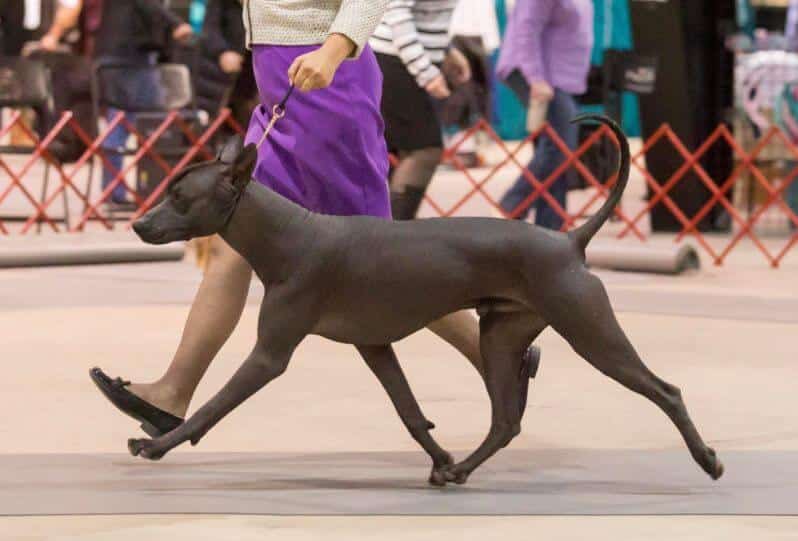
Gait: The movement is a free and effortless at a fast trot, with good reach and drive. Legs will converge towards a centerline of gravity as speed increases.
Temperament: Typical Xolo temperament is calm, tranquil, aloof and attentive.
Disqualifications: Xolos under ten or over 24 inches in height, measured at the highest point of the withers. Cropped ears.
Approved June 20, 2004
Effective January 1, 2009
Dogs in the Media


Meet the Judges
Edna González reflects on judging Non-Sporting breeds at Westminster 2026, sharing insights on her assignments and overall impressions.
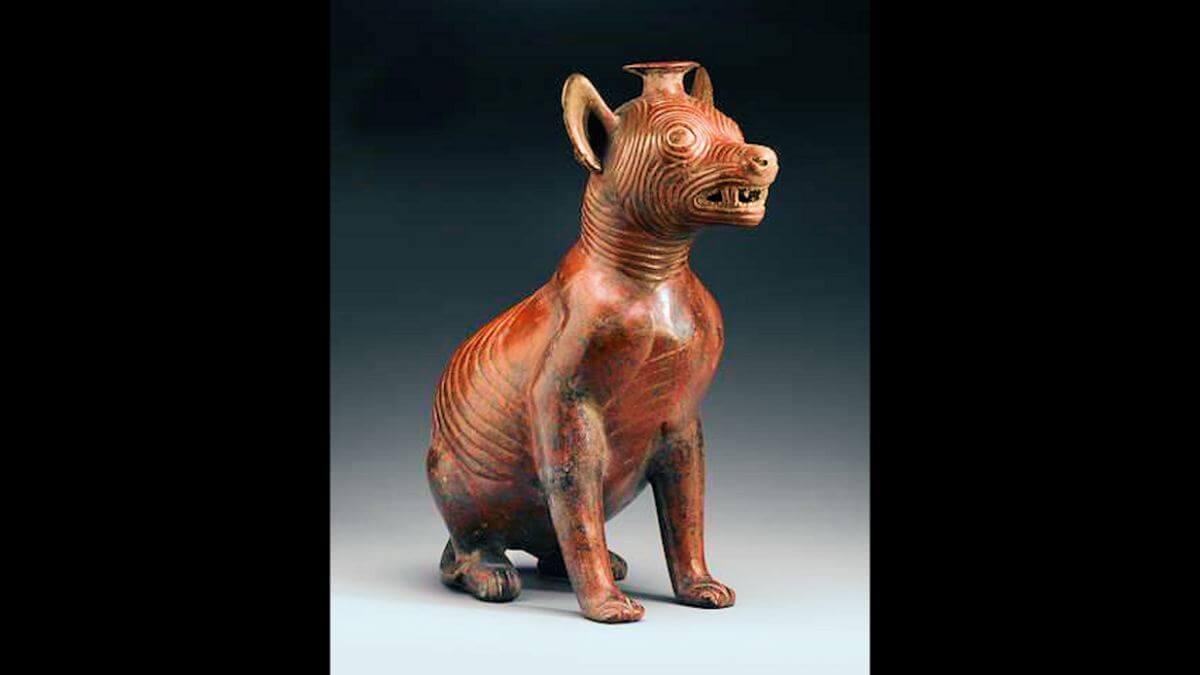
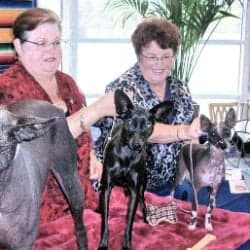
Explore the ancient origins of the Xoloitzcuintli, Mexico’s sacred hairless dog, revered for its loyalty, healing, and mystical powers.
Dog Shows
Learn to evaluate the Xoloitzcuintli: a primitive breed of balance, moderation, and versatility, with rich cultural history.

Meet the Owner Handlers
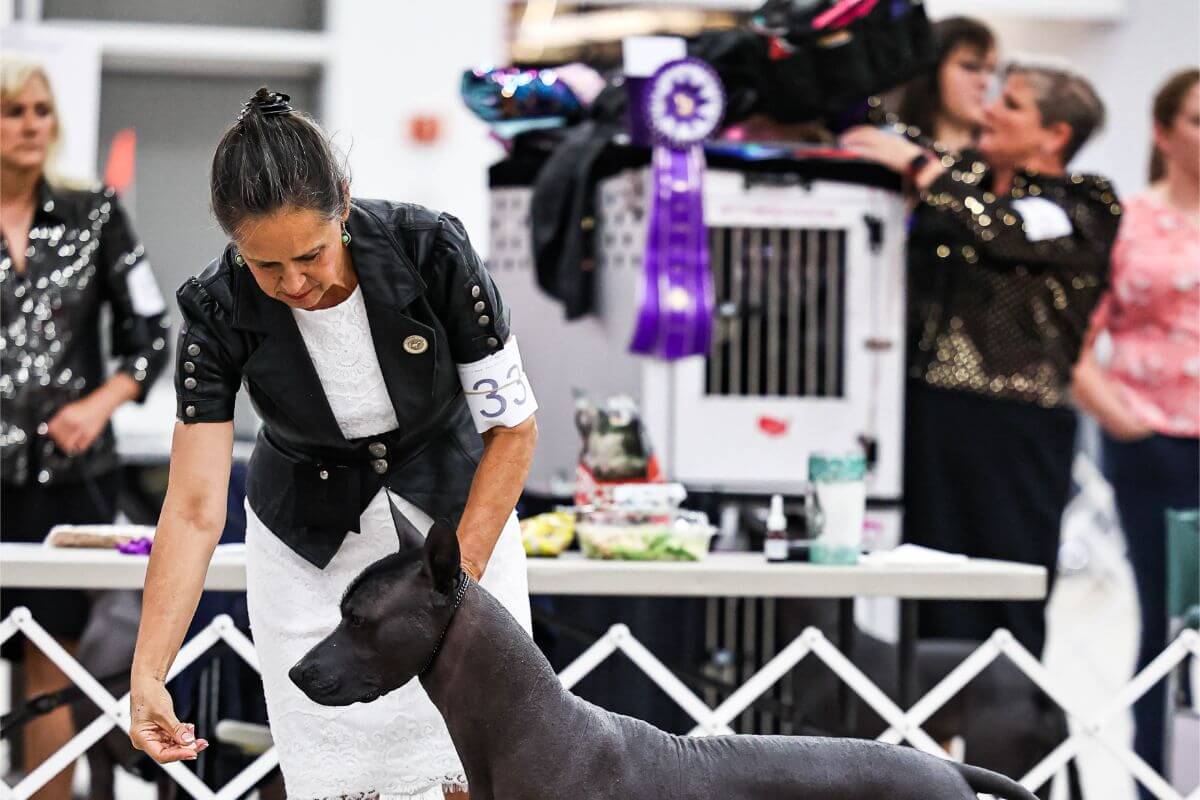
Insights from an Owner Handler, Teresa M. Vilá. Teresa shares her opinions on various topics about dog handling in the modern show ring.
Meet the Breeders
Interview with Non-Sporting Group Breeder Teresa M Vilá – Our kennel name is Ahuilaca, which means “playful and mischievous” in the Nahuatl

Meet the Breeders
Breeder Interview with Richard Yenchesky by Allan Reznik – I grew up in Wisconsin and I attended my first dog show when I was 15. I can still
Neck: Long, elegant, slightly arched, blending smoothly into the shoulders. In dogs less than one year of age, wrinkled skin may be present. In adults, the skin on the neck is smooth and dry, without wrinkles.
Topline: Level with a slight arch over the loin.
Body: Well developed. The brisket should reach to the point of elbow. The ribcage is deep and oval, of good length, with sufficient rib spring to produce a rounded shape, but never barrel-shaped. The loin is muscular, with a smooth underline showing a slight tuck up. The back is level and firm. The croup is well muscled, slightly rounded, and broad. It should not be flat or steeply angled.
Tail: Set low, continuing smoothly off the angle of the croup, long and fine, reaching to the hock. When the dog is moving, the tail is carried in a graceful curve, but not over the back. It is held down in a relaxed position when the dog is at rest. A short or curled tail is a serious fault.
Forequarters: Shoulders are covered with smooth muscle, long and sloping. Shoulder blades are flat and well-laid-back. The upper Arm (humerus) is equal or slightly longer than the scapula, angled to place the forelegs well under the body. The elbows are firm and tight, allowing for reach but not so loose so as to allow for elbowing out, nor so tight as to create toeing in or out. Legs are long, straight, and parallel, when viewed from all sides, set well under the body to allow a long stride. Pasterns are flexible, strong and straight, turning neither in nor out. Feet are hare feet, webbed, with well-arched toes. Thin, soft pads, splayed feet, or rounded feet are serious faults. Toenails are to be dark on dark-colored dogs, light on light-colored dogs. Dewclaws may be removed.
Hindquarters: The Xolo possesses moderate rear angulation, in balance with the forequarters. The bones of the first and second thigh are approximately equal in length, and the combined angle should place the front edge of the back foot directly under the rearmost point of the pelvis, with the hock perpendicular. Legs are straight and well-muscled. Stifles are moderately bent. Hocks are short, sturdy, and straight, turning neither in nor out. Dewclaws may be removed. The rear feet are the same as the front feet.
Gait: The movement is free and effortless at a fast trot, with good reach and drive. Legs will converge towards a centerline of gravity as speed increases.
Standard Colors
Standard Markings
A Note About Color: A dark, uniform color is preferred, ranging from black gray black, or slate to red, liver, or bronze, although white spots and markings are permitted. The hair may be any color.
Coat Type
Hairless, Smooth
The structure of the coat this breed carries.
Coat Length
Short
How long the breed's coat grows when kept in condition.
Adaptability Level
How easily a breed copes with changes in home, routine, noise and weather.
Mental Stimulation Needs
How much a breed needs a job, a puzzle or training to stay content.
Proper feeding and nutrition are crucial for maintaining the health and vitality of a Xoloitzcuintli. Given their active nature, Xolos benefit from a balanced diet rich in high-quality proteins, healthy fats, and essential vitamins and minerals. Feeding should be tailored to their size, age, and activity level, with portion control to prevent obesity—a common concern in small and Toy breeds. Fresh water should always be available, and treats should be given in moderation to avoid unnecessary weight gain. Some Xolos may have food sensitivities, so selecting a diet free from common allergens, like grains or certain proteins, might be beneficial. Regular consultations with a veterinarian can help to ensure that your Xolo is receiving the appropriate nutrients for their specific needs, promoting overall well-being and longevity.
Xoloitzcuintli are highly intelligent and quick learners, but their independent nature can make training a challenge. They require patience and creativity to keep them engaged and motivated. Positive reinforcement is essential, as they respond best to rewards and encouragement rather than harsh corrections. These sensitive dogs can become discouraged if scolded, so it’s important to maintain a calm and supportive approach. Consistency and short, varied training sessions will help to capture their attention and ensure success, making training a rewarding experience for both you and your Xolo.
Grooming Expectations