Members
The Weekly Brief
The best of SHOWSIGHT editorials, weekly wins, and breeder commentary — delivered to your inbox every Sunday morning.
The Fell and Moorland Working Terrier Club (F&MWTC) in England is a dog club like no other. It was formed in 1966 and based on a cooperative effort to come together to rescue terriers that were trapped during work. The club can and does provide the logistics and manpower to dig out these dogs, often trapped for days underground. That’s a noble purpose and it has been accomplished numerous times during the club’s existence.
That primary purpose requires both monetary and ideological support, and the club is regularly active in its efforts to preserve and protect “old strains” of working terriers and lurchers. The rationale is simple. If a particular conformation persists over the years, it has proven success in underground terrier work and stands less chance of finding itself in harm’s way. If that sounds a bit like our current trend for preservation breeding, we are on the same track.
The F&MWTC raises funds to support its work through terrier and lurcher shows. Almost every one of the 164 recognized fox hunts in England (and many of those in America) holds a spring terrier trial which always contains conformation classes. These are informal affairs, held after hunting comes to a close in early spring. There are no formal entries, no record keeping, practically no written rules, and no need at all for an event committee. There is, however, always a single champion terrier and frequently a champion lurcher. Recently, the F&MWTC started to keep track of the “conformation” champions at the spring shows, and at the beginning of summer it holds a “Best of the Best” competition open only to dogs that have won the championship at eligible qualifying shows.
Now, terrier men and women are a diverse sort. You can’t really conjure up a “typical” participant except that they all share a passion for working their dogs to ground or coursing across the halcyon fields. No matter that hunting has been restricted to trail hunting and coursing to “Simulated Coursing,” which Americans reference as Lure Coursing. There are, however, exceptions to the law which allow for true terrier work to continue. Professional gamekeepers and their dogs, for example, may continue to dig menacing fox or other predators. Rat hunting too, is both legal and necessary work for terriers, and so, even while observing the law to the letter, real terrier work continues.
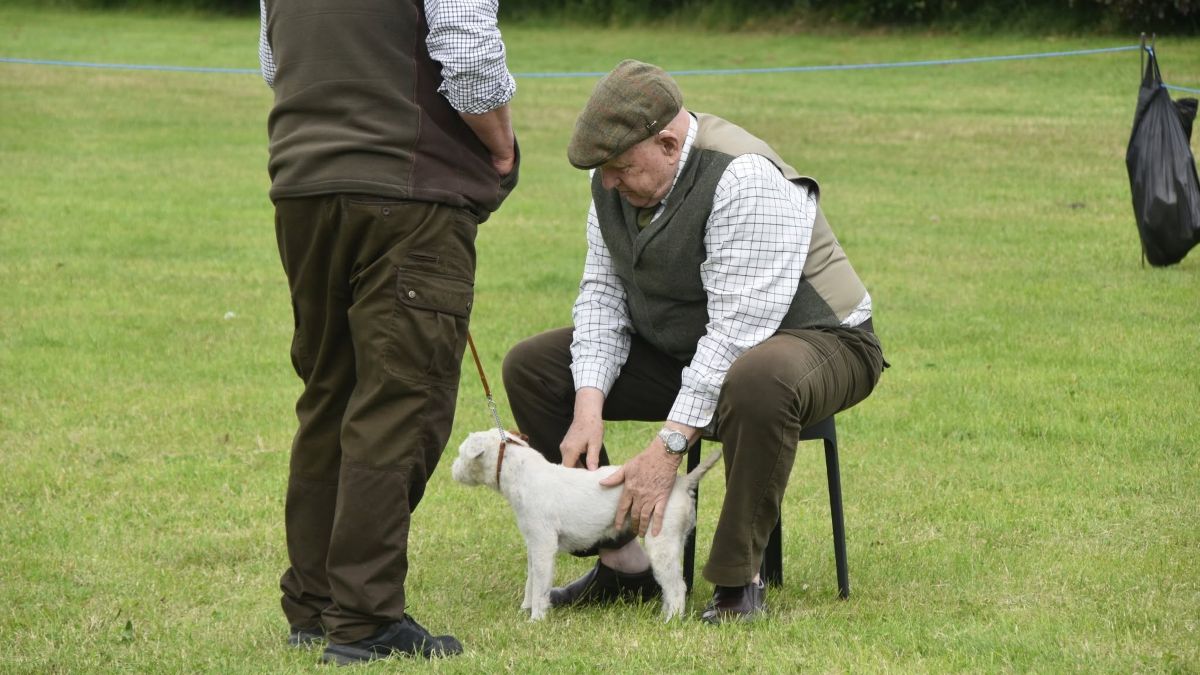
Conformation classes at Terrier Trials are traditionally judged with the dogs on the ground (where any good terrier belongs). Spanning is almost mandatory, and an individual dog may be spanned several times during the judging process. The judge stands up to watch movement coming and going, and remains standing, watching the dog go once around. Since most of the dogs are not trained for show, movement takes some doing, but the up-close, hands-on, individual examination gives one a lot more information than any other form of judging. (It also says a bit about temperament… for better or for worse.)
We were supremely honored to have been invited to judge the F&MWTC Best of the Best competition at Thirsk in the middle of the Yorkshire Dales. So many of the terrier breeds have their origin in Yorkshire and the border counties that dogs that may be “low entry breeds” in the United States are commonplace here. It’s not often that an American gets to judge in the UK, and even more of a rarity that a “kennel club” judge an event for working terriers in their homeland. Suffice it to say that no assignment in my 45 years of judging has meant more to me than this appointment. By custom, the judge for the Best of the Best is not announced until the day of the show, so I was not able to brag about it beforehand.
Now, the hunts’ terrier trials (with conformation classes) are often rather folksy affairs. I’ve attended a few and have been an active participant in our own Northgate Terrier Trials held in New Jersey on Labor Day weekend. Still, I had no idea what to expect. I packed for the trip as if going to war, and was prepared for any weather, eventuality, or misfortune. I ended up more or less fitting in. Both the trial and the weather did not disappoint.
The day led off with the Best of the Best competition which began at a very comfortable 10:00 AM under clear blue skies and about 59-degree temperature. I didn’t get an actual count of the entries, and there is, of course, no judge’s book or catalog. There was a list of dogs eligible by virtue of their previous wins, but it was not shared with me. My guess is that there were about 40 dogs of various terrier breeds. No need to prove that they were actual working terriers, for many had “badges of courage” and wore them so very well. As at any show, the dogs came into the huge roped-off ring and formed a circle around the perimeter. Showmanship certainly isn’t a strong point, but the sight of so many work-proven terriers with unsurpassed breed type actually brought tears to my eyes.
The rings at terrier trials are huge and roped off. Folks back their vehicles up to the edge of the ring. Tailgate seating is plentiful as are the terrier boxes that carry our best friends. There’s always a gallery of the most knowledgeable (and opinionated) terrierists on earth. Picture, if you will, this huge ring full of winning terriers and surrounded by the breeders, owners, and workers in the country of origin. Oh, and fear on the part of the judge. Lots and lots of fear.
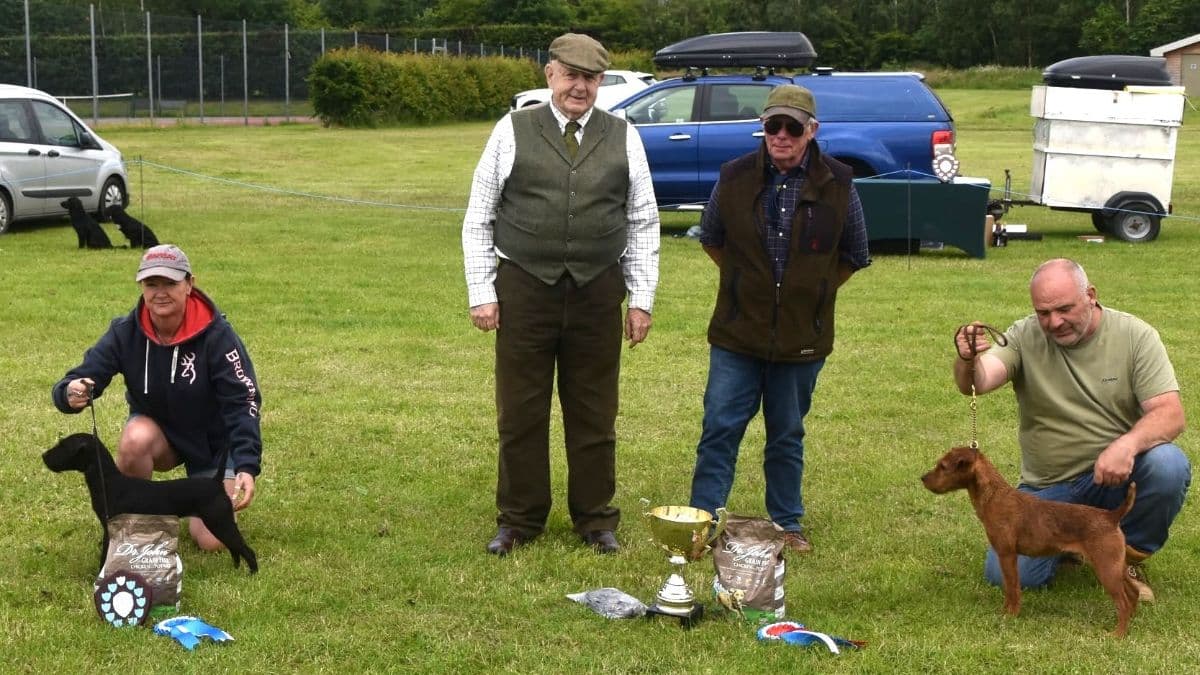
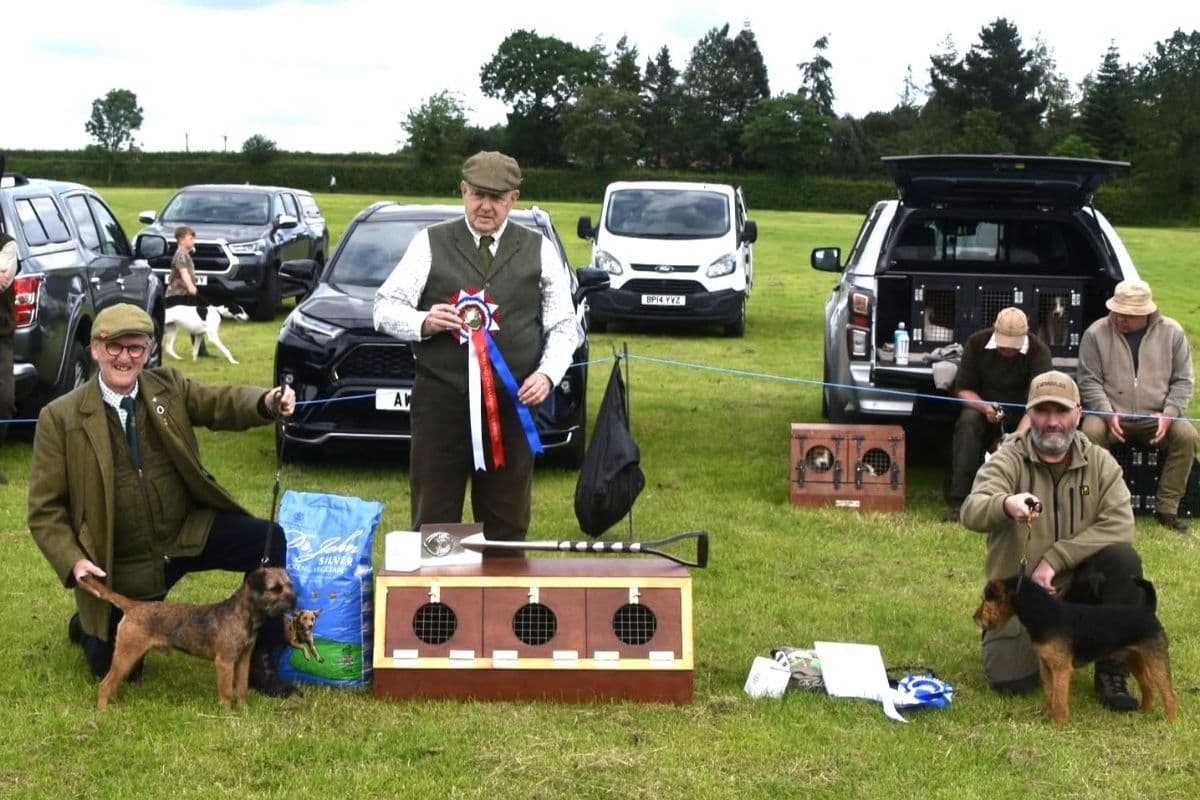
At the “regular” F&MWTC show that followed the Best of the Best Competition, two judges were required to determine the Champion and Reserve. The black Fell Terrier on the left was Reserve while the Lakeland on the right was the overall Terrier Champion (and ultimately the Supreme Champion) for the day. My fellow judge, terrier man Phil Bell, a Yorkshire native, is a breeder of Fell and Border Terriers. He knows working terriers through and through, and has a reputation for choosing a well-made, workmanlike dog over a more showy exhibit. The fact that we could agree on these two choices was nothing short of miraculous and is a testimony to the quality of the dogs themselves.[/caption]
The initial go ‘round in the traditional left-handed circle doesn’t show much. These aren’t show dogs and the gaiting was… well, let’s say, a little rough. But they went around twice and we got down to business. Working terriers are judged a bit differently on both sides of the pond. There’s no table or ramp… a ring steward, if you are lucky. The judge is positioned in the middle of the ring and calls the dogs one at a time for individual examination. The judge may ask the handler to pick up and hand him the dog to be examined, or may choose to bend down to the dog on the ground and lift it for examination. Some judges squat, some bend on one knee. I could do that, but I’d never get up again. Some years ago, a gentleman from the Blencathra taught me a trick of sitting on a hay bale, making it easier to get up and down a hundred or so times. There being no bales available (they were busy making them on the day of the show), I was able to borrow a very low stool from the food vendor, which served the purpose perfectly.
The judge follows a “normal” pattern of examination, but it is spanning and balance that receive special attention. A working terrier, to excel, must be spannable, and among the entries here, every single exhibit was easily spanned. This “up close and personable” look at the dog tells you more about it than any table exam. You can feel the musculature and hard condition. You can feel the balance of the dog and the real size and structure of the bone. To my surprise, the battle scars displayed by many of the dogs exactly choose their working style. The Border Terriers displayed some moderate scarring in the fill in the otter-shaped head while the numerous Lakelands had a bit more damage to the nose and teeth, again typical of their confrontational type of hunting. The Jack Russells? There were lots of them, broken coated and smooth, and all of them beautiful. Not a lot of battle scars, but their teeth were a wreck. No worries though, it’s what they do! The Patterdales, again plentiful, are the true “in your face” warriors and indeed looked the part with honorable scars white against the black.
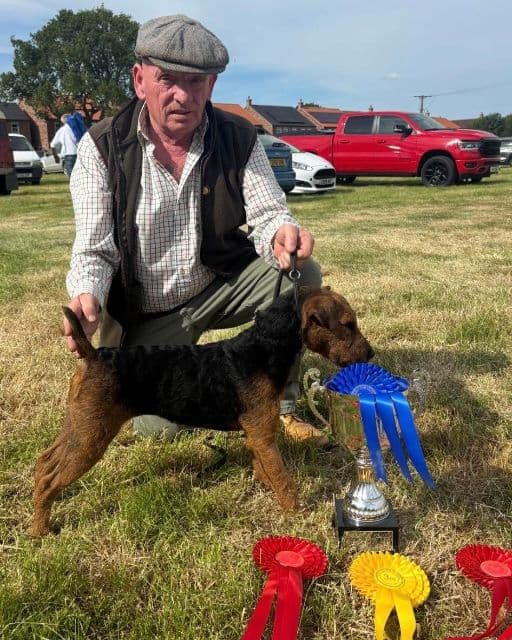
This Lakeland Terrier puppy is representative of the breed in its home country. Sturdy but not coarse, with a coat that looks way more than proper. The breed here is different than in North America. Neither better nor worse, but certainly of a different and equally pleasing conformation. The same is true of the Patterdales, Jack Russells, even the Whippets. The exchange of ideas between “show people” and “working people” is a most valuable tool for both.
I had been instructed to make a cut, since in this competition there is only a Champion and Reserve Champion and there were so many worthy competitors. The first cut was done with ten dogs left standing. As many judges do, I repeated much of the individual examination process. The second cut left four. And then there were two. Standing in the middle of the field, I was surrounded by some of the world’s most knowledgeable terrier men and women, and confronted with two absolutely incredible representatives of their breed: a Border Terrier and a Lakeland Terrier. It took a great deal longer than the requisite 2–1/2 minutes to make the choice. In the end, it was the BT for reasons that shall forever remain my own. The Lakie was equally worthy of the championship and more, although the final pictures do it a huge disservice. It is indeed a near-perfect dog.
The picture of the BT Champion was posted on Facebook and brought rave reviews from among the best Border breeders stateside and in Canada. Name? Owner/breeder? Pedigree? Breeding information? I had none of that. Subsequent inquiry revealed that the dog is Foxghyll Edwardian, owned by Mr. A.H. Kelly, a “semi-retired” gamekeeper. Despite his greatness, he is not kennel club registered.
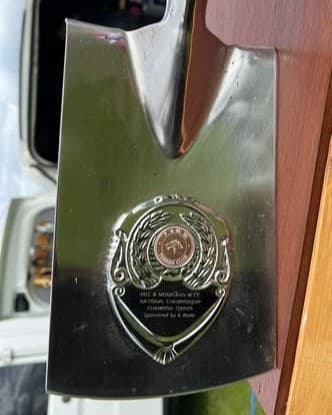
Now, if you hadn’t had enough yet, noon brought the F&MWTC “regular” show with additional classes in breed and a variety of opportunities for terriers, lurchers, and Whippets. There’s no pre-entry, and if you wish to compete you simply show up in the ring when the class is called. The steward walks through the entries with a purse and you deposit your £2 entry fee before the start of the judging. Lest you think of this as a cheap date, most dogs are entered in multiple classes, and the owners spend a significant amount in entry fees. There are three class prizes, each of them a small rosette. Then there are the individual championship competitions and perpetual trophies.
What I did NOT see was any grooming at all at the show itself. There are classes for family dogs and such where the exhibits showed signs of being nicely groomed. Among the working terriers though, there were four exhibits which had obviously been trimmed or clippered whereas all the rest were either artfully hand-stripped or just naturally neat and tidy. A good, harsh terrier coat is basically self-cleaning, and nowhere was this more evident than at this show.
So, if you have stayed with me for this long, I thank you. The takeaway is that if you ever have the opportunity to judge a breed at its point of origin (or to a lesser extent in its country of origin), take that opportunity. Time spent with mentors who know and work the breed and care little for titles or recognition is golden and eye opening. After decades of experience with hounds in England, I found a whole new world in the terriers of the border counties and a profound respect for the dedicated terriermen. Although there were plenty of signs in this land of all things bright and beautiful, I never did run into James Herriott.

Meet the Judges
Polly Smith reflects on judging the Terrier Group at Westminster 2026, discussing entry quality, key placements, and her Group winner.