01/Overview
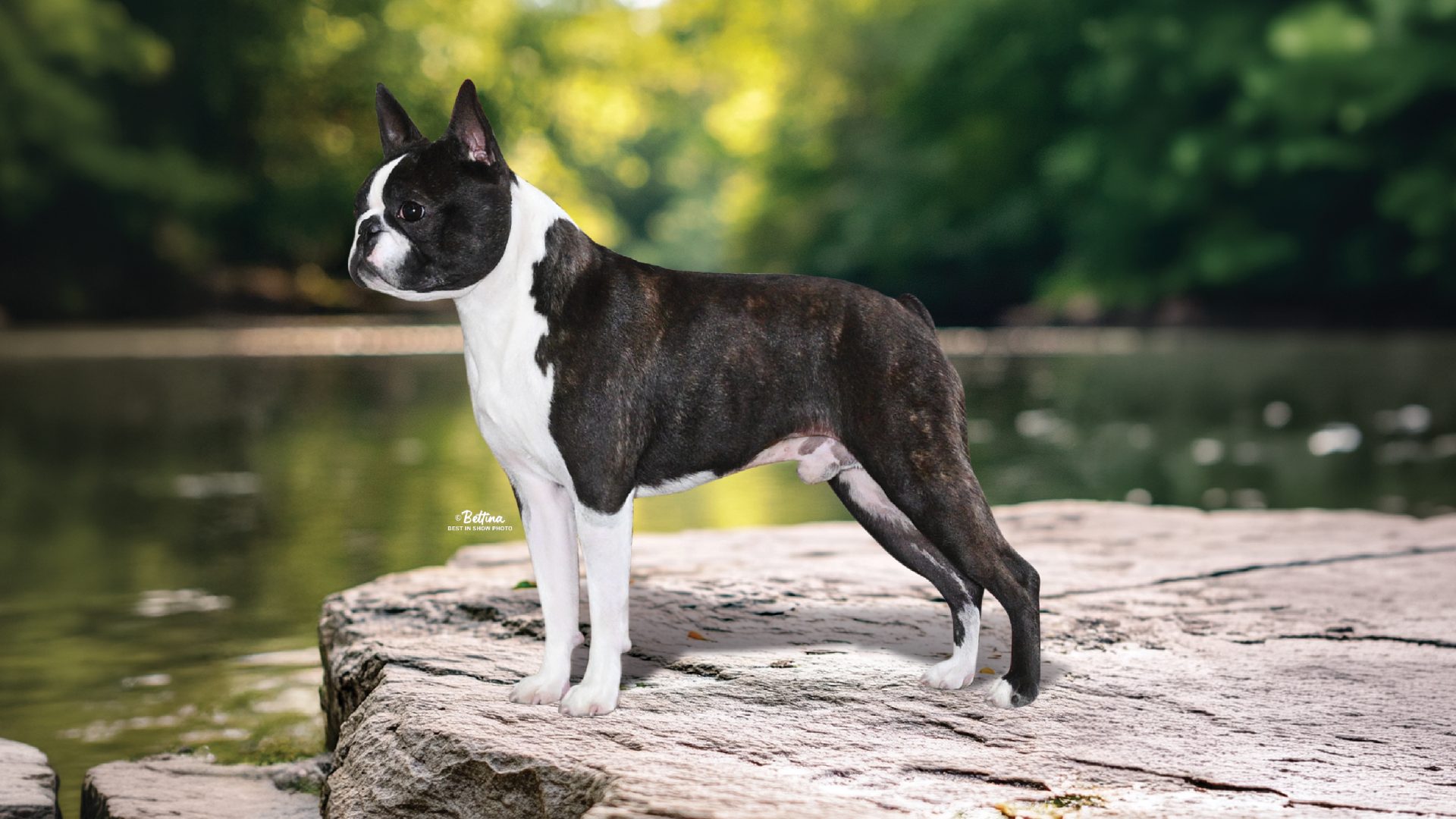
An American original: The American Gentleman. A 10-25-pound people-loving, attentive, intelligent, enthusiastic, easy-care partner, making the journey of life more fun with every toss of the ball or side-tilt of the head. Excels at sharing the sofa.
Highlights
02/History
The following short history of the Boston Terrier is excerpted from a small book, The Boston Terrier, written by J. Varnum Mott, M.D., combined with information from the archives of the Boston Terrier Club of America, Inc.
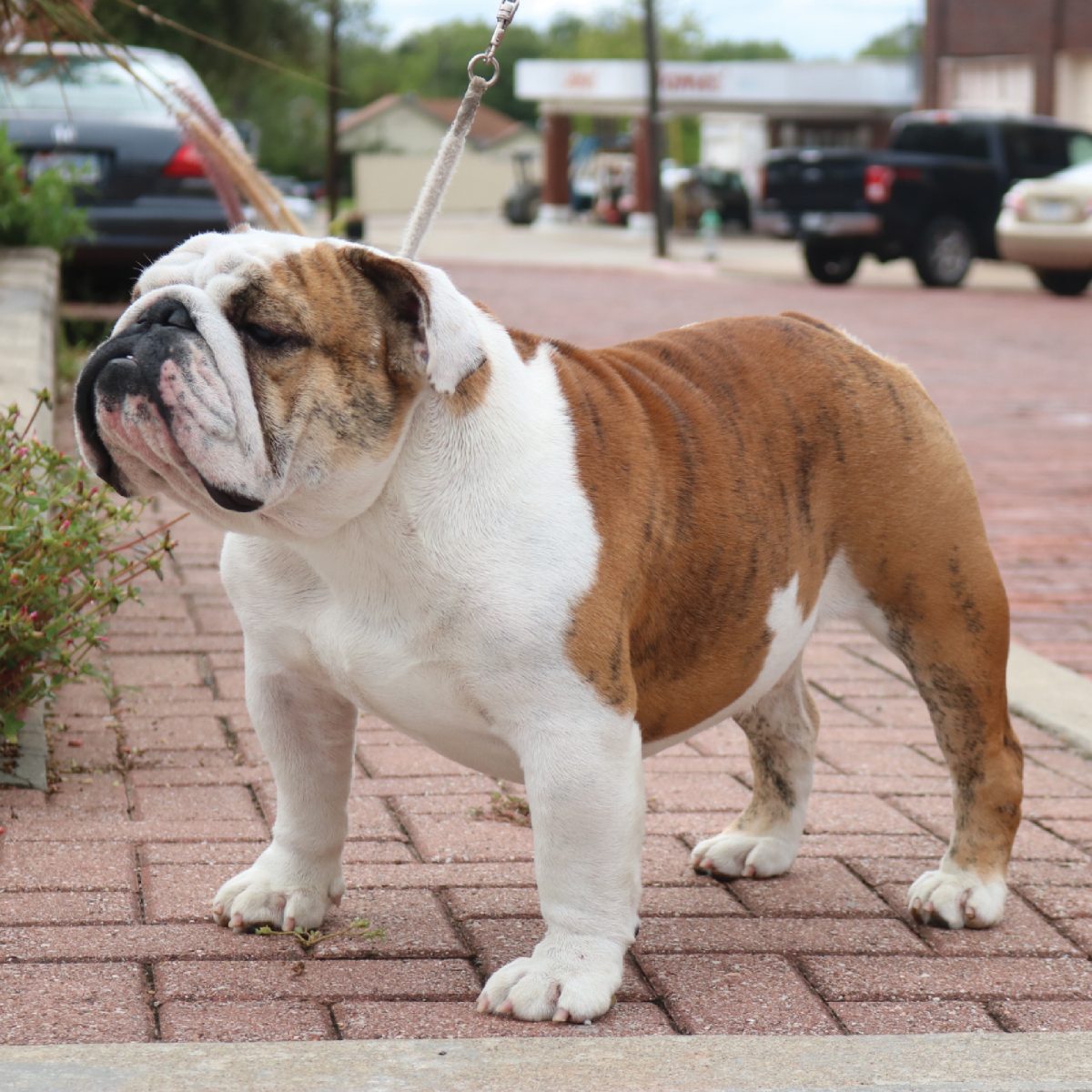
“The question is often asked, ‘How did the Boston Terrier originate?’ Briefly stated it may be said to have resulted from a cross between the English Bulldog and the white English Terrier, and then to have been considerably inbred. Incidental peculiarities of the first dogs used as sires are partly responsible for the present type.
“…Mr. Robert C. Hooper, of Boston imported a dog named Judge. This dog, which he purchased of Mr. William O’Brien of the same city, was undoubtedly imported from England. Judge, commonly known as Hooper’s Judge, was destined to be the ancestor of almost all the true modern Boston Terriers. He was a cross between an English Bulldog and a white English Terrier. He was a strongly built, high stationed dog of about thirty-two pounds weight. In color he was a dark brindle, with a white stripe in the face. His head was square and blocky, and he resembled the present Boston Terrier in that he had a nearly even mouth. Judge was bred to Burnett’s Gyp (or Kate). Gyp was a white bitch, owned by Mr. Edward Burnett, of Southboro, MA. She was of about twenty pounds weight, had a fine three-quarter tail, and was quite low stationed. She was of stocky build, showing considerable strength in her make-up. Her head was good, being short and blocky.
“…From Judge and Gyp descended Well’s Eph. This dog was of strong build, and like his dam was low stationed. His weight was about twenty-eight pounds. He was of dark brindle color, even white markings, and like Judge, had a nearly even mouth.
“…Eph was mated with Tobin’s Kate. This bitch was of small size, weighing only twenty pounds. She had a fairly short head, was of golden brindle color, and had a straight three-quarter tail.”
From these dogs can be traced the start of the breed, the Boston Terrier. On March 31, 1891, Charles Leland organized a first meeting of breeders. As an output of this meeting, on April 7, 1891, the first Boston Terrier Breed Standard was presented and soon after a stud register was established. This register consisted of 75 dogs whose ancestors could be traced back three generations.
03/Appearance
Weight is divided by classes as follows: Under 15 pounds; 15 pounds and under 20 pounds; 20 pounds and not to exceed 25 pounds. The length of leg must balance with the length of body to give the Boston Terrier its striking square appearance.
Skull: The skull is square, flat on top, free from wrinkles; cheeks flat; brow abrupt; and the stop well defined.
Expression: The ideal Boston Terrier expression is alert and kind, indicating a high degree of intelligence. This is a most important characteristic of the breed. (Note: not the most important but a most important).
Eyes: The eyes are wide apart, large and round, and dark in color. The eyes are set square in the skull and the outside corners are on a line with the cheeks as viewed from the front. Disqualification - Eyes blue in color or any trace of blue.
Ears: The ears are small, carried erect, either natural or cropped to conform to the shape of the head, and situated as near to the corners of the skull as possible.
Muzzle: The muzzle is short, square, wide, and deep, and in proportion to the skull. It is free from wrinkles, shorter in length than in width or depth; not exceeding in length approximately one-third the length of the skull. The muzzle from the stop to the end of the nose is parallel to the top of the skull.
Nose: The nose is black and wide, with a well-defined line between the nostrils. Disqualification - Dudley nose.
Bite: The jaw is broad and square with short, regular teeth. The bite is even or sufficiently undershot to square the muzzle. The chops are of good depth, but not pendulous, completely covering the teeth when the mouth is closed.
Faults: Serious Fault - Wry mouth. Head Faults - Eyes showing too much white or haw; pinched or wide nostrils; size of ears that are out of proportion to the size of the head. Serious Head Faults - Any showing of the tongue or teeth when the mouth is closed.
The Boston Terrier is a sturdy dog and must not appear to be either spindly or coarse. The bone and muscle must be in proportion, as well as an enhancement to the dog's weight and structure. Fault - Blocky or chunky in appearance.
Texture: The coat is short, smooth, bright, and fine in texture.
The Boston Terrier shall not be solid black, solid brindle, or solid seal without required white markings. It also must not be any color not described in the Standard.
Disqualifications - Solid black, solid brindle, or solid seal without the required white markings; any color not described in the Standard, which includes fawn, blue, red, merle, dapper, black and tan, lilac, and any other color. The only colors are brindle, seal, and black with the required white markings. Period!
Per the AKC Breed Standard, the required markings for a Boston Terrier are: White muzzle band, white blaze between the eyes, white forechest. It is icing on the cake to have the desired markings: White muzzle band, even white blaze between the eyes and over the head, white collar, white forechest, white on part or whole of forelegs and hind legs below the hocks.
Note: A representative specimen should not be penalized for not possessing "Desired Markings." A dog with a preponderance of white on the head or body must possess sufficient merit otherwise to counteract its deficiencies.
Standard Colors
04/Consider
Consider your lifestyle. It’s best when your lifestyle matches the personality of the Boston. Boston Terriers are active, enthusiastic, and love daily activities with their humans. They are adaptable to different living arrangements but still desire daily, loving interactions with people. They are equally adept at running zoomies in the backyard, walking down city sidewalks, and stealing your favorite recliner.
Interaction With Family
The level of affection a breed typically shows towards family members and familiar individuals.
Good With Other Dogs
The innate friendliness of a dog towards other dogs can depend on its breed.
Good With Young Children
The degree to which a breed will typically be patient with young children.
Amount Of Shedding
How much hair a breed typically leaves behind on clothes, furniture and floors.
Frequency Of Grooming
How often a breed needs brushing, bathing or a professional trim to stay in condition.
Amount Of Drooling
How prone a breed is to drool — worth knowing before you keep a towel by the door.
Openness To Strangers
How openly a breed tends to greet new people, visitors and strangers.
Protective Nature
How likely a breed is to alert you to — and stand between you and — anything unfamiliar.
Playfulness Level
How enthusiastic a breed stays about games and play well past puppyhood.
Trainability Level
How readily a breed takes direction and works with you rather than around you.
Barking Level
How much a breed uses its voice, and how readily.
Energy Level
How much get-up-and-go a breed brings to an average day.
Health
Recommended Tests/CHIC Program Requirements: The Orthopedic Foundation for Animals (OFA) works with the Boston Terrier Club of America and recommends basic health screening tests for all breeding stock. Dogs meeting these basic health screening requirements will be issued a Canine Health Information Center (CHIC) number. For CHIC certification, all results do not need to be normal, but they must all be in the public domain so that responsible breeders can make more informed breeding decisions.
Active, alert and Intelligent. Can be the class clown. Loves finding the squeaker in dog toys and any activity with his/her favorite people.
Exercise Expectations
Grooming Expectations
The Boston Terrier is versatile being able to adapt to apartment life, a single family home, a country estate or a farm. The Boston is at home in any of these environments. Very easy to live with. Though not the best hunter, herder or security dog, the Boston Terrier thrives in winning the hearts and souls of their owners by being friendly, active, loyal and funny.
06/Activities
Some European countries discriminate against the brachycephalic breeds, saying they cannot live long, useful lives because they cannot breathe properly. The Boston Terrier Club of America rejects any such notion. Dogs bred to our AKC Breed Standard excel in all of the dog sports. We offer a consistent record of excellence and achievement as evidenced by the soundness and good health of a well-bred Boston Terrier.
In October 2024, 130 Boston Terriers earned various titles from the AKC. This is a typical number for every month of the year.
Boston Terriers are a fixture on the dog show circuit. Their good looks and formal appearance have earned them the title of “The American Gentleman.” Well-bred Bostons excel in the show ring, but they are capable of much more. In fact, they are standout performers in the myriad dog sports offered by the American Kennel Club.
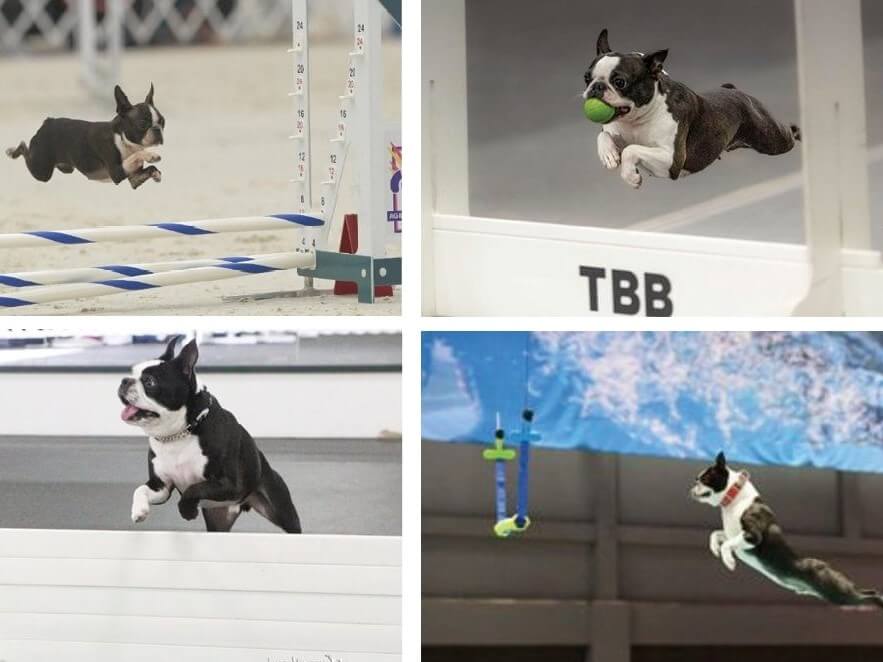
Bostons participate in many sports. You will find them in the Obedience ring, Rally trials, Agility trials, Flyball, Fast CAT, Disc Dog, Dock Diving, Barn Hunt, and even Tracking events. A healthy, sound Boston is an athlete who can hold her head up among the best of them. A Boston can sail over the jumps and race around the ring, exuding joy at every turn.
The Boston Terrier Club of America supports Bostons in AKC Companion events by holding Obedience, Rally, and Agility trials at its annual Specialty.
The club also recognizes the achievements of our breed at its annual awards banquet, awarding certificates to the dogs in the Top 10 in Agility MACH competition and the Top 5 in Agility PACH competition.
Gallery
07/Standards
The Boston Terrier is recognized by the world's leading registries and kennel organizations, which categorize the breed into a specific Group based on its unique characteristics. This breed is recognized worldwide under the following Group designations:
The ideal Boston Terrier is described by a Breed Standard that is approved by each of the world’s leading registries and kennel organizations. The Breed Standards for this breed may be found in the following links:
08/Clubs
Boston Terrier Club of AmericaA list of affiliate clubs can be found at:https://bostonterrierclubofamerica.org/btca-affiliate-clubs/
09/Rescue
The Boston Terrier Club of America has a Rescue Committee. The BTCA Rescue Committee’s purpose is to aid rescued Boston Terriers through coordination with local organizations and volunteers, and rescue parents. Our main focus is to act as a central contact point for rescue organizations and prospective adopters through a referral system (similar to breeder referral) and networking with local contacts. The Rescue Committee will also provide, with the board’s approval, financial aid based on need and according to the established guidelines. We want to ensure our national club’s support of Boston Terriers, regardless of pedigree, health condition, or age.More information can be found at:https://bostonterrierclubofamerica.org/boston-terrier-rescue/
Official Standard of the Boston Terrier
General Appearance: The Boston Terrier is a lively, highly intelligent, smooth coated, shortheaded, compactly built, short-tailed, well balanced dog, brindle, seal or black in color and evenly marked with white. The head is in proportion to the size of the dog and the expression indicates a high degree of intelligence. The body is rather short and well knit, the limbs strong and neatly turned, the tail is short and no feature is so prominent that the dog appears badly proportioned. The dog conveys an impression of determination, strength and activity, with style of a high order; carriage easy and graceful. A proportionate combination of "Color and White Markings" is a particularly distinctive feature of a representative specimen. "Balance, Expression, Color and White Markings" should be given particular consideration in determining the relative value of General Appearance to other points.
Size, Proportion, Substance: Weight is divided by classes as follows: Under 15 pounds; 15 pounds and under 20 pounds; 20 pounds and not to exceed 25 pounds. The length of leg must balance with the length of body to give the Boston Terrier its striking square appearance. The Boston Terrier is a sturdy dog and must not appear to be either spindly or coarse. The bone and muscle must be in proportion as well as an enhancement to the dog's weight and structure. Fault - Blocky or chunky in appearance. Influence of Sex. In a comparison of specimens of each sex, the only evident difference is a slight refinement in the bitch's conformation.
Head: The skull is square, flat on top, free from wrinkles, cheeks flat, brow abrupt and the stop well defined. The ideal Boston Terrier expression is alert and kind, indicating a high degree of intelligence. This is a most important characteristic of the breed. The eyes are wide apart, large and round and dark in color. The eyes are set square in the skull and the outside corners are on a line with the cheeks as viewed from the front. Disqualify - Eyes blue in color or any trace of blue. The ears are small, carried erect, either natural or cropped to conform to the shape of the head and situated as near to the corners of the skull as possible. The muzzle is short, square, wide and deep and in proportion to the skull. It is free from wrinkles, shorter in length than in width or depth; not exceeding in length approximately one-third of the length of the skull. The muzzle from stop to end of the nose is parallel to the top of the skull. The nose is black and wide, with a well defined line between the nostrils. Disqualify - Dudley nose. The jaw is broad and square with short regular teeth. The bite is even or sufficiently undershot to square the muzzle. The chops are of good depth, but not pendulous, completely covering the teeth when the mouth is closed. Serious Fault - Wry mouth. Head Faults - Eyes showing too much white or haw. Pinched or wide nostrils. Size of ears out of proportion to the size of the head. Serious Head Faults - Any showing of the tongue or teeth when the mouth is closed.
Neck, Topline and Body: The length of neck must display an image of balance to the total dog. It is slightly arched, carrying the head gracefully and setting neatly into the shoulders. The back is just short enough to square the body. The topline is level and the rump curves slightly to the set-on of the tail. The chest is deep with good width, ribs well sprung and carried well back to the loins. The body should appear short. The tail is set on low, short, fine and tapering, straight or screw and must not be carried above the horizontal. (Note: The preferred tail does not exceed in length more than one-quarter the distance from set-on to hock.) Disqualify - Docked tail. Body Faults - Gaily carried tail. Serious Body Faults - Roach back, sway back, slab-sided.
Forequarters: The shoulders are sloping and well laid back, which allows for the Boston Terrier's stylish movement. The elbows stand neither in nor out. The forelegs are set moderately wide apart and on a line with the upper tip of the shoulder blades. The forelegs are straight in bone with short, strong pasterns. The dewclaws may be removed. The feet are small, round and compact, turned neither in nor out, with well arched toes and short nails. Faults - Legs lacking in substance; splay feet.
Hindquarters: The thighs are strong and well muscled, bent at the stifles and set true. The hocks are short to the feet, turning neither in nor out, with a well defined hock joint. The feet are small and compact with short nails. Fault - Straight in stifle.
Gait: The gait of the Boston Terrier is that of a sure-footed, straight gaited dog, forelegs and hind legs moving straight ahead in line with perfect rhythm, each step indicating grace and power. Gait Faults - There will be no rolling, paddling, or weaving, when gaited. Hackney gait. Serious Gait Faults - Any crossing movement, either front or rear.
Coat: The coat is short, smooth, bright and fine in texture.
Color and Markings: Brindle, seal, or black with white markings. Brindle is preferred only if all other qualities are equal. (Note: Seal Defined. Seal appears black except it has a red cast when viewed in the sun or bright light.) Disqualify - Solid black, solid brindle or solid seal without required white markings. Any color not described in the standard. Required Markings: White muzzle band, white blaze between the eyes, white forechest. Desired Markings: White muzzle band, even white blaze between the eyes and over the head, white collar, white forechest, white on part or whole of forelegs and hind legs below the hocks. (Note: A representative specimen should not be penalized for not possessing "Desired Markings.") A dog with a preponderance of white on the head or body must possess sufficient merit otherwise to counteract its deficiencies.
Temperament: The Boston Terrier is a friendly and lively dog. The breed has an excellent disposition and a high degree of intelligence, which makes the Boston Terrier an incomparable companion.
Summary:
The clean-cut short backed body of the Boston Terrier coupled with the unique characteristics of his square head and jaw, and his striking markings have resulted in a most dapper and charming American original: The Boston Terrier.
Scale of Points
General Appearance 10
Expression 10
Head (Muzzle, Jaw, Bite, Skull & Stop) 15
Eyes 5
Ears 5
Neck, Topline, Body & Tail 15
Forequarters 10
Hindquarters 10
Feet 5
Color, Coat & Markings 5
Gait 10
Total 100
Disqualifications: Eyes blue in color or any trace of blue. Dudley nose. Docked tail. Solid black, solid brindle, or solid seal without required white markings. Any color not described in the standard.
Approved February 11, 2011
Effective March 30, 2011

Agility
Unleash the athletic excellence of versatile Boston Terriers in dog sports, from Agility to Obedience, Dock Diving to Barn Hunt. See more!

Meet the Junior Handlers
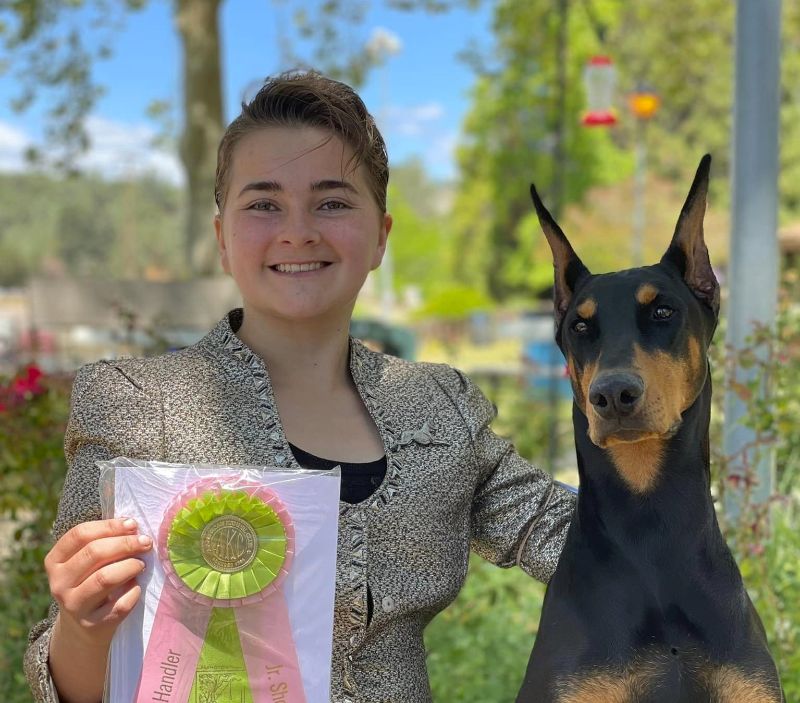
Interview with a Junior Handler, Audrey Boyer. Audrey shares her thoughts on various topics regarding the Junior Showmanship ring.
Meet the Breeders
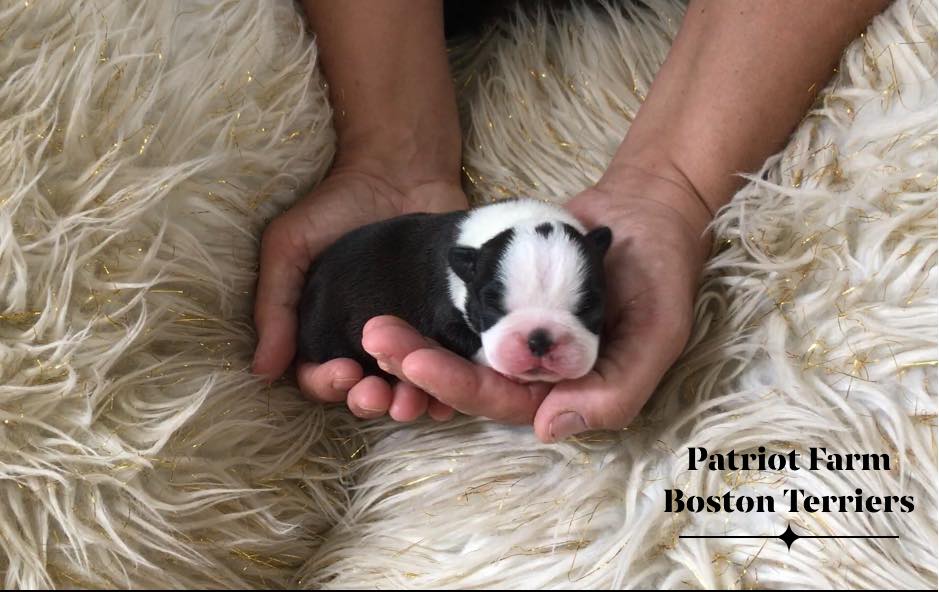
Lorraine Chapman is the breeder behind the Patriot Farm Boston Terriers. Read about the kennel’s beginnings, champions, puppies, and more!
Meet the Breeders
Dolores Ferrero is the breeder behind the Delphi Boston Terriers. Read about the kennel’s beginnings, dogs, puppies, and more!
Meet the Owner Handlers
Insights from Owner Handlers, Dolores Ferrero & John Flora. Read about their opinions on various topics about dog handling in the show ring.
Dog Sports
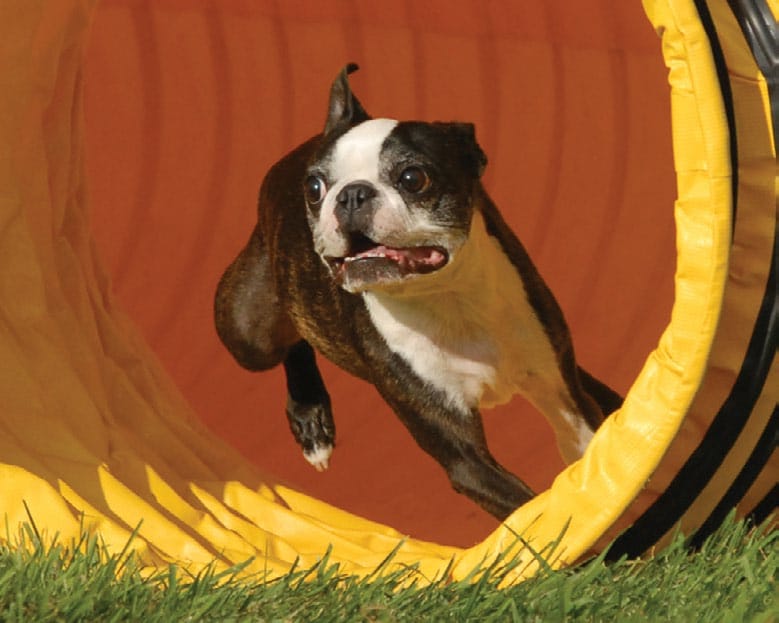
There is a fallacy that Boston Terrier dogs cannot compete in performance based sports and events, but they compete quite successfully.

US breeders have produced a number of hearty and hungry canine originals by combining established British, European, and Asian breeds with local village dogs.

Boston Terrier Standard | The hands that brought the world to Helen Keller were never far from her beloved “Phiz.” Cary Grant chose to own
The tail is set on low, short, fine, and tapering, straight or screw, and must not be carried above the horizontal. (Note: The preferred tail does not exceed in length more than one-quarter the distance from set-on to hock.) Disqualification - Docked tail.
Standard Markings
A Note About Color: Per the AKC Breed Standard, brindle, seal, or black with white markings. Brindle is preferred only if all other qualities are equal. Seal is defined as appearing black except it has a red cast when viewed in the sun or bright light.
Coat Type
Smooth
The structure of the coat this breed carries.
Coat Length
Short
How long the breed's coat grows when kept in condition.
Adaptability Level
How easily a breed copes with changes in home, routine, noise and weather.
Mental Stimulation Needs
How much a breed needs a job, a puzzle or training to stay content.
The Boston Terrier’s overall appearance is directly related to the quality of the diet. As owner, start with a carefully planned diet and regular exercise. Proper nutrition starts as a puppy to develop strong bone and well-conditioned muscles. Research and increase your own knowledge of canine nutrition, as there are ample resources available to aid us as owners to develop the best overall nutrition plan for our Boston Terriers (and ourselves).
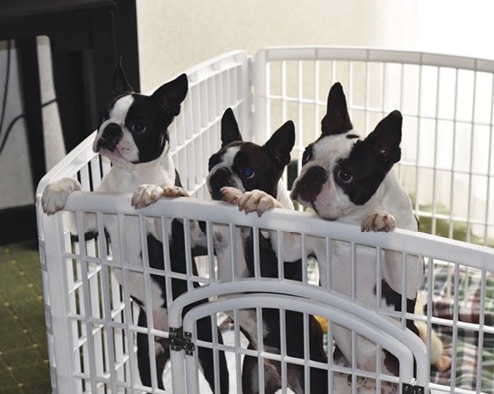
Boston Terriers bond well with humans, having a desire to please. Combining this desire with the lively enthusiasm and high level of intelligence make the Boston Terrier an ideal candidate for being trained to learn new skills. Just start with a gentle approach. Praise, enthusiasm, and rewarding their efforts lead to success. (Pictured: Six-week-old puppies “manding.”) Manding is a concept used in humans and animals, a non-verbal manner of communicating their desire. Mands can be used for many things such as not jumping up, sitting nicely to greet people, sitting nicely at the vets, and many others.