Members
01/Overview
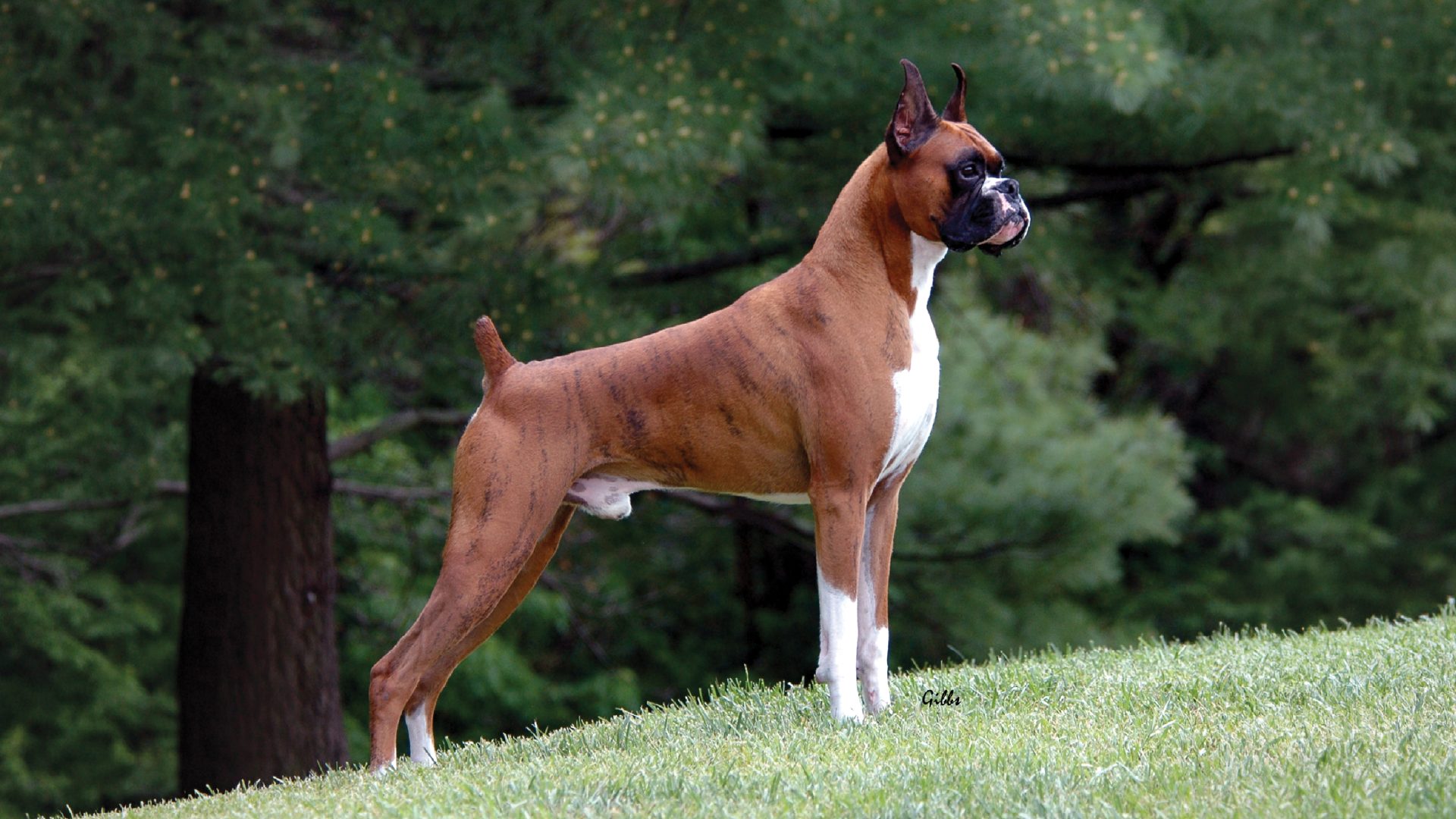
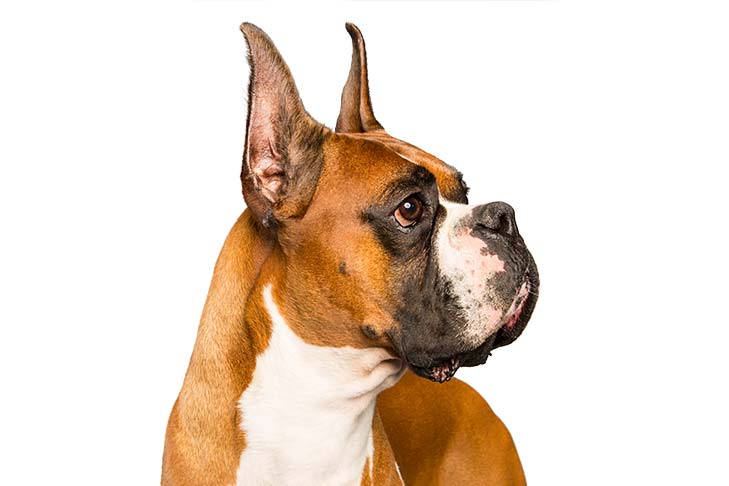
The Boxer is a medium to large-sized working breed known for its strong build, playful personality, and boundless energy. With their expressive faces, muscular physiques, and loyal temperaments, Boxers excel as both family companions and versatile working dogs. Their intelligence and adaptability have earned them a special place in the hearts of dog lovers worldwide.
Highlights
02/History
The Boxer’s history traces back to late 19th-century Germany, where the breed was developed by crossing the Bullenbeisser, a now-extinct German hunting mastiff, with Bulldogs and other breeds. The Bullenbeisser, prized for its strength and tenacity, was traditionally used to hunt large game such as boar and bear. Breeders aimed to create a more agile and refined dog while preserving the powerful traits of its ancestors.
By the late 1800s, the Boxer began to take shape as we know it today, with its name believed to derive from the breed’s characteristic "boxing" motion when using its front paws during play or defense. The breed was officially recognized in Germany in 1895, with the establishment of the first Boxer Club, which played a pivotal role in standardizing the breed's appearance and temperament.
The Boxer’s journey to international recognition began in the early 20th century. The American Kennel Club (AKC) officially recognized the breed in 1904, and the Boxer gained popularity in the United States after World War I, thanks to returning soldiers who brought these dogs home. Their combination of loyalty, intelligence, and athleticism made them excellent service dogs during wartime, often employed as messengers, guard dogs, and even ambulance dogs.
By the mid-20th century, the Boxer had firmly established itself as one of the most popular breeds in the United States, ranking consistently high in AKC registrations. The breed also gained recognition by other major kennel organizations, including the Fédération Cynologique Internationale (FCI) and The Kennel Club (UK).
03/Appearance
Male Boxers typically stand between 23 and 25 inches tall at the shoulder, while females measure slightly smaller, ranging from 21.5 to 23.5 inches. In terms of weight, males generally weigh between 65 and 80 pounds, whereas females are lighter, usually falling between 50 and 65 pounds.
Skull: The Boxer’s skull is proportionate to its body, slightly arched on top, with a pronounced stop.
Muzzle: Broad and blunt, with a one-third ratio to the total head length.
Eyes: Dark brown, moderately set apart, and conveying alertness.
Nose: Black with wide, open nostrils.
Ears: Medium-sized and either natural, lying close to the cheeks, or cropped to stand erect.
Bite: Undershot, with the lower jaw extending beyond the upper.
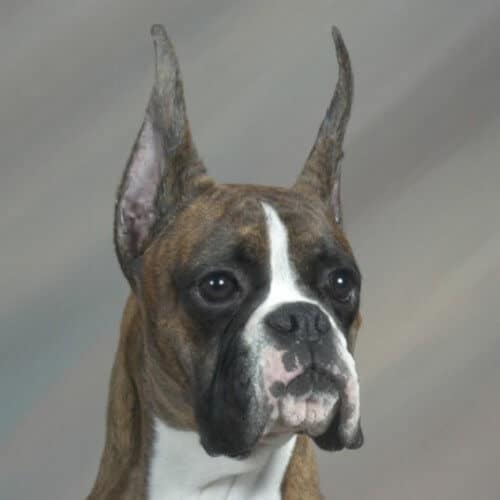
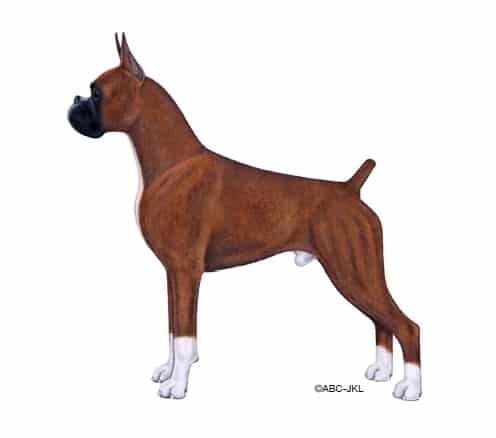
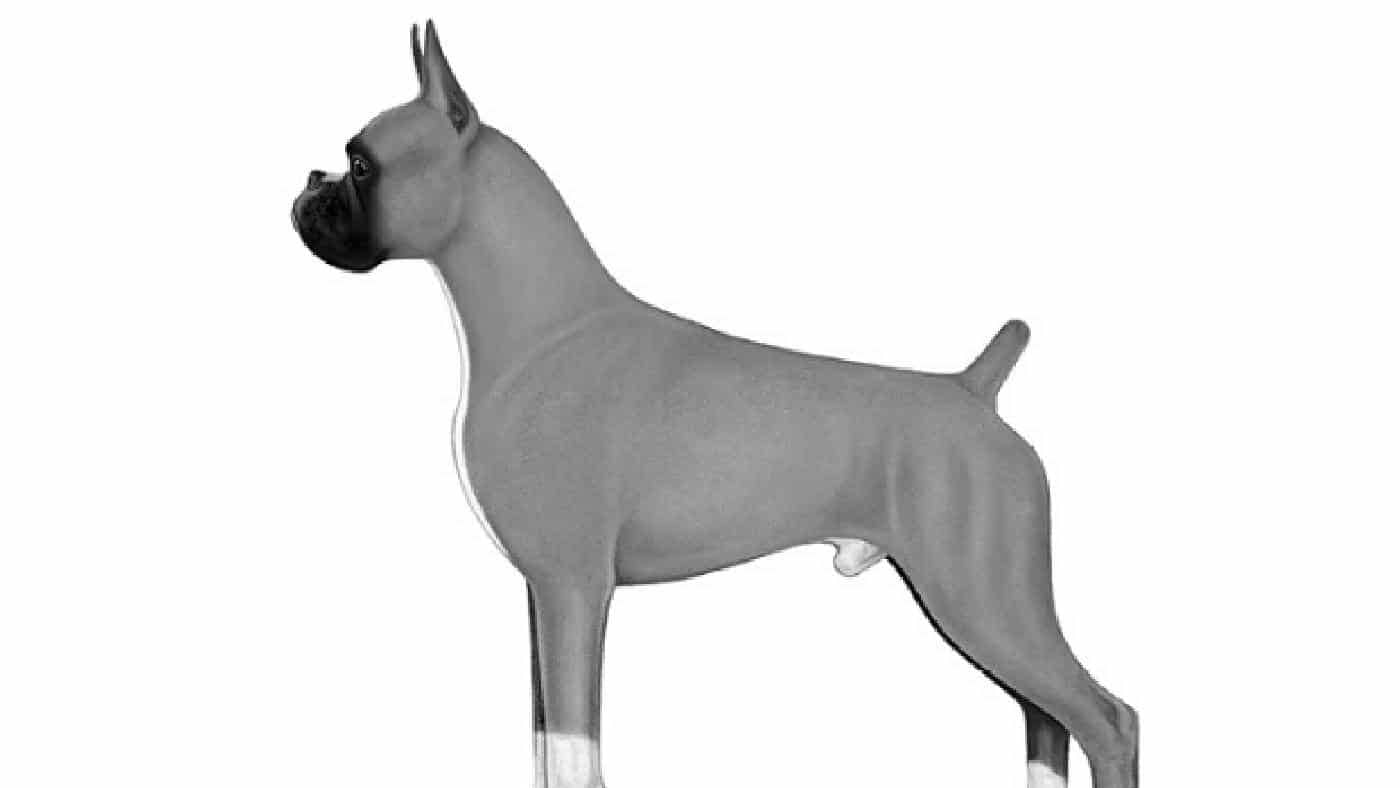
The Boxer possesses a square, well-balanced frame, where the length of the body from the point of the shoulder to the rear matches the height at the withers. The breed exhibits a strong, athletic build with substantial bone and well-developed muscles, creating an appearance of power and elegance. Despite the breed’s solid construction, Boxers are never heavy or clumsy, maintaining an agile and lively demeanor reflective of their working heritage.
Texture: The Boxer’s coat is short, smooth, and lies close to the body, offering a glossy appearance that enhances the breed’s athletic build. The texture is firm to the touch, and the coat requires minimal grooming due to its easy-care qualities.
Standard Markings
04/Consider
The Boxer is an athletic and intelligent breed that requires regular exercise, consistent training, and mental stimulation. Known for its strong bond with its family, the breed thrives on companionship and does not do well when left alone for long periods. Boxers are energetic and need experienced handlers to manage their strength and high activity levels. Potential owners should be prepared to provide a structured and active lifestyle to meet the breed’s physical and mental needs.
Interaction With Family
The level of affection a breed typically shows towards family members and familiar individuals.
Good With Other Dogs
The innate friendliness of a dog towards other dogs can depend on its breed.
Good With Young Children
The degree to which a breed will typically be patient with young children.
Amount Of Shedding
How much hair a breed typically leaves behind on clothes, furniture and floors.
Frequency Of Grooming
How often a breed needs brushing, bathing or a professional trim to stay in condition.
Amount Of Drooling
How prone a breed is to drool, worth knowing before you keep a towel by the door.
Openness To Strangers
How openly a breed tends to greet new people, visitors and strangers.
Protective Nature
How likely a breed is to alert you to anything unfamiliar, and stand between you and it.
Playfulness Level
How enthusiastic a breed stays about games and play well past puppyhood.
Trainability Level
How readily a breed takes direction and works with you rather than around you.
Barking Level
How much a breed uses its voice, and how readily.
Energy Level
How much get-up-and-go a breed brings to an average day.
Health
The Boxer is a typically healthy breed with a lifespan of 10 to 12 years. However, like all dogs, individual’s may be prone to certain health conditions that prospective caretakers should be aware of. Regular veterinary care, a balanced diet, and appropriate exercise are essential.
The Boxer is a friendly and playful breed that thrives on human interaction and companionship. Their energetic and outgoing nature makes them excellent family dogs, especially for active households.
While Boxers are generally good with children, their high energy and enthusiasm may require supervision around very young kids. They are typically good with other dogs when properly socialized but may be wary of strangers, often showing a natural protective instinct towards their family.
Boxers are highly sensitive dogs and do not respond well to harsh training methods, preferring positive reinforcement and a calm, consistent approach. Their strong desire for attention and connection with their human companions means they are not well-suited for extended periods of solitude.
Exercise Expectations
Without sufficient exercise, Boxers may develop destructive behaviors or restlessness due to boredom. They enjoy mentally stimulating activities like puzzle toys or learning new commands that engage their sharp minds. Boxers are naturally playful and can excel in sports such as Agility or Flyball, where they can combine their athleticism with their love of interaction. A securely fenced yard is needed for off-leash play, but Boxers should always be supervised during outdoor activities to prevent them from running off or chasing smaller animals.
Boxers are adaptable dogs but are best suited to homes with active families or individuals who can meet their exercise and companionship needs. They can live in apartments if given sufficient exercise, but access to a yard is ideal.
Due to their short coat, Boxers are sensitive to extreme temperatures. They may struggle in cold weather without protection, such as a dog coat, and are prone to overheating in hot weather. Exercise should always be moderated in high temperatures.
Boxers form strong bonds with their families and thrive in environments where they can be included in daily activities. Since they can develop separation anxiety or destructive behaviors if isolated, they are not well-suited to being left alone for extended periods of time.
05/Puppies
Boxer puppies are playful, curious, and energetic, requiring guidance and structure to grow into well-mannered adults. Early socialization and training are essential to help them channel their enthusiasm and develop confidence.
Their high energy levels and eagerness to interact make them enjoyable (but sometimes challenging) to raise. A structured environment with plenty of physical and mental stimulation is key to ensuring they thrive.
Caring for a Boxer puppy involves providing proper nutrition, exercise, and socialization. Each puppy should be fed a high-quality diet tailored to its growth, divided into three to four meals per day, with fresh water available at all times.
Age-appropriate exercise, such as short walks, gentle play, and supervised exploration, prevents strain on developing joints. Socialization is crucial, exposing the puppy to various environments, people, and animals to foster a well-rounded temperament.
Positive reinforcement training helps to establish good behavior and strengthens the bond between puppy and caretaker. Routine veterinary care, including vaccinations, deworming, and regular check-ups, ensures a healthy start in life. A loving, safe, and structured environment is essential for any puppy’s development.
06/Activities
Agility: Boxers excel in Agility, a fast-paced Dog Sport where they navigate obstacle courses, showcasing the breed’s natural athleticism and sharp reflexes.
Obedience: They perform exceptionally well in Obedience, a dog sport that highlights their intelligence and eagerness to work alongside their handler.
Rally: The Boxer’s focus and enthusiasm equip these dogs well for Rally, where they navigate courses that require the execution of a series of commands.
Flyball: They can enjoy Flyball, a high-energy relay race where their speed and agility are on full display.
Conformation Shows: Boxers are a popular breed in Conformation Shows, where their muscular build, striking appearance, and animation are on display.
Therapy Work: Their friendly and affectionate nature can make them excellent Therapy Dogs, bringing comfort to those in need.
Search and Rescue: They can be capable of performing Search and Rescue tasks, using their strength and determination to assist in emergency situations.
Canine Good Citizen: The Boxer’s intelligence and trainability allow these dogs to shine in AKC’s CGC Program, which assesses good manners in a public setting.
Gallery
07/Standards
The Boxer is recognized by the world's leading registries and kennel organizations, which categorize the breed into a specific Group based on its unique characteristics. This breed is recognized worldwide under the following Group designations:
The ideal Boxer is described by a Breed Standard that is approved by each of the world’s leading registries and kennel organizations. The Breed Standards for this breed may be found in the following links:
08/Clubs
American Boxer Club: Founded in 1935, this is the parent club for Boxers in the United States. The club works closely with the American Kennel Club (AKC) to promote the breed, organize events, and maintain the Breed Standard.
Boxer Club of Canada: Established in 1947, this club is dedicated to promoting responsible Boxer breeding, care, and training across the provinces. It is recognized by the Canadian Kennel Club (CKC) as the breed’s parent breed club.
The British Boxer Club: Founded in 1936, this is the breed club for Boxers in the United Kingdom. Recognized by The Kennel Club, this club’s members are responsible for upholding the Breed Standard in the UK and promoting breed-specific activities and events.
09/Rescue
Across America Boxer Rescue: This organization represents a national network of Boxer rescue groups across the United States, dedicated to rescuing, rehabilitating, and rehoming Boxers in need. Its volunteers also work to educate the public on responsible ownership.
Adopt a Boxer Rescue: This non-profit rescue organization is dedicated to finding loving homes for Boxers in the United States. It operates in several states and relies on a network of volunteers and foster homes.
Boxer Rescue Canada: A volunteer-run organization that rescues and rehomes Boxers across Canada, this group has a focus on finding loving homes for Boxers and educating the public about the breed.
10/Facts
A Working Heritage
Boxers were originally bred in Germany to hunt large game such as boar and bear, showcasing their strength and determination.
"Boxing" Behavior
The breed’s name is believed to come from their habit of using their front paws to play or defend themselves, resembling a boxer in a ring.
Wartime Heroes
Boxers served as messenger dogs, guard dogs, and even ambulance dogs during both World War I and World War II.
Late Bloomers
Boxers are known for their prolonged puppyhood, often retaining their playful, puppy-like behavior well into adulthood.
Celebrity Connections
Boxers have been favored by many celebrities, including Humphrey Bogart and Lauren Bacall who owned a Boxer named Harvey.
11/FAQ
Boxers typically have a lifespan of 10 to 12 years. Their longevity depends on factors like genetics, health, and the quality of care they receive, including regular vet visits and proper nutrition.

Written by
Dan Sayers is the Executive Editor of SHOWSIGHT. He is a member of the World Dog Press Association and the Dog Writers Association of America, which recognized his illustrations in the award-winning Encyclopedia of K-9 Terminology. Dan is a longtime supporter of the sport of dogs and an advocate for the conservation of recognized breeds in all their forms and functions. He is a member of the Morris and Essex Kennel Club, and for 45 years, the Irish Water Spaniel Club of America where he serves as AKC Delegate, Archivist, and approved Breed Mentor. Dan breeds under the Quiet Storm prefix and has judged the IWSCA National Specialty Sweepstakes twice.
Official Standard of the Boxer
General Appearance: The ideal Boxer is a medium-sized, square-built dog of good substance with short back, strong limbs, and short, tight-fitting coat. His well-developed muscles are clean, hard, and appear smooth under taut skin. His movements denote energy. The gait is firm yet elastic, the stride free and ground-covering, the carriage proud. Developed to serve as guard, working, and companion dog, he combines strength and agility with elegance and style. His expression is alert and his temperament steadfast and tractable. The chiseled head imparts to the Boxer a unique individual stamp. It must be in correct proportion to the body. The broad, blunt muzzle is the distinctive feature, and great value is placed upon its being of proper form and balance with the skull. In judging the Boxer first consideration is given to general appearance and overall balance. Special attention is then devoted to the head, after which the individual body components are examined for their correct construction, and the gait evaluated for efficiency.
Size, Proportion, Substance: Size - Adult males 23 to 25 inches; females 21½ to 23½ inches at the withers. Proper balance and quality in the individual should be of primary importance since there is no size disqualification. Proportion - The body in profile is square in that a horizontal line from the front of the forechest to the rear projection of the upper thigh should equal the length of a vertical line dropped from the top of the withers to the ground. Substance – Sturdy, with balanced musculature. Males larger boned than females.
Head: The beauty of the head depends upon the harmonious proportion of muzzle to skull. The blunt muzzle is ⅓ the length of the head from the occiput to the tip of the nose, and ⅔ the width of the skull. The head should be clean, not showing deep wrinkles (wet). Wrinkles typically appear upon the forehead when ears are erect, and are always present from the lower edge of the stop running downward on both sides of the muzzle. Expression - Intelligent and alert. Eyes - Dark brown in color, frontally placed, generous, not too small, too protruding, or too deep set. Their mood-mirroring character, combined with the wrinkling of the forehead, gives the Boxer head its unique quality of expressiveness. Third eyelids preferably have pigmented rims. Ears - Set at the highest points of the sides of the skull, the ears are customarily cropped, cut rather long and tapering, and raised when alert. If uncropped, the ears should be of moderate size, thin, lying flat and close to the cheeks in repose, but falling forward with a definite crease when alert. Skull - The top of the skull is slightly arched, not rounded, flat, nor noticeably broad, with the occiput not overly pronounced. The forehead shows a slight indentation between the eyes and forms a distinct stop with the topline of the muzzle. The cheeks should be relatively flat and not bulge (cheekiness), maintaining the clean lines of the skull as they taper into the muzzle in a slight, graceful curve. Muzzle and Nose - The muzzle, proportionately developed in length, width, and depth, has a shape influenced first through the formation of both jawbones, second through the placement of the teeth, and third through the texture of the lips. The top of the muzzle should not slant down (downfaced), nor should it be concave (dishfaced); however, the tip of the nose should lie slightly higher than the root of the muzzle. The nose should be broad and black. Bite and Jaw Structure - The Boxer bite is undershot, the lower jaw protruding beyond the upper and curving slightly upward. The incisor teeth of the lower jaw are in a straight line, with the canines preferably up front in the same line to give the jaw the greatest possible width. The upper line of the incisors is slightly convex with the corner upper incisors fitting snugly in back of the lower canine teeth on each side. Neither the teeth nor the tongue should ever show when the mouth is closed. The upper jaw is broad where attached to the skull and maintains this breadth, except for a very slight tapering to the front. The lips, which complete the formation of the muzzle, should meet evenly in front. The upper lip is thick and padded, filling out the frontal space created by the projection of the lower jaw, and laterally is supported by the canines of the lower jaw. Therefore, these canines must stand far apart and be of good length so that the front surface of the muzzle is broad and squarish and, when viewed from the side, shows moderate layback. The chin should be perceptible from the side as well as from the front. Any suggestion of an overlip obscuring the chin should be penalized.
Neck, Topline, Body: Neck - Round, of ample length, muscular and clean without excessive hanging skin (dewlap). The neck should have a distinctly arched and elegant nape blending smoothly into the withers.
Back and Topline: The back is short, straight, muscular, firm, and smooth. The topline is slightly sloping when the Boxer is at attention, leveling out when in motion. Body - The chest is of fair width, and the forechest well-defined and visible from the side. The brisket is deep, reaching down to the elbows; the depth of the body at the lowest point of the brisket equals half the height of the dog at the withers. The ribs, extending far to the rear, are well-arched but not barrel-shaped. The loins are short and muscular. The lower stomach line is slightly tucked up, blending into a graceful curve to the rear. The croup is slightly sloped, flat and broad. The pelvis is long, and in females especially broad. The tail is set high, docked, and carried upward. An undocked tail should be severely penalized.
Forequarters: The shoulders are long and sloping, close-lying, and not excessively covered with muscle (loaded). The upper arm is long, approaching a right angle to the shoulder blade. The elbows should not press too closely to the chest wall nor stand off visibly from it. The forelegs are long, straight, and firmly muscled, and, when viewed from the front, stand parallel to each other. The pastern is strong and distinct, slightly slanting, but standing almost perpendicular to the ground. The dewclaws may be removed. Feet should be compact, turning neither in nor out, with well-arched toes.
Hindquarters: The hindquarters are strongly muscled, with angulation in balance with that of the forequarters. The thighs are broad and curved, the breech musculature hard and strongly developed. Upper and lower thighs are long. The legs are well-angulated at the stifle, neither too steep nor over-angulated, with clearly defined, well "let down" hock joints. Viewed from behind, the hind legs should be straight, with hock joints leaning neither in nor out. From the side, the leg below the hock (metatarsus) should be almost perpendicular to the ground, with a slight slope to the rear permissible. The metatarsus should be short, clean, and strong. The Boxer has no rear dewclaws.
Coat: Short, shiny, lying smooth and tight to the body.
Color: The colors are fawn and brindle. Fawn shades vary from light tan to mahogany. The brindle ranges from sparse but clearly defined black stripes on a fawn background to such a heavy concentration of black striping that the essential fawn background color barely, although clearly, shows through (which may create the appearance of reverse brindling). White markings, if present, should be of such distribution as to enhance the dog's appearance, but may not exceed one-third of the entire coat. They are not desirable on the flanks or on the back of the torso proper. On the face, white may replace part of the otherwise essential black mask, and may extend in an upward path between the eyes, but it must not be excessive, so as to detract from true Boxer expression. The absence of white markings, the so-called "plain" fawn or brindle, is perfectly acceptable, and should not be penalized in any consideration of color. Disqualifications - Boxers that are any color other than fawn or brindle. Boxers with a total of white markings exceeding one-third of the entire coat.
Gait: Viewed from the side, proper front and rear angulation is manifested in a smoothly efficient, level-backed, ground covering stride with a powerful drive emanating from a freely operating rear. Although the front legs do not contribute impelling power, adequate reach should be evident to prevent interference, overlap, or sidewinding (crabbing). Viewed from the front, the shoulders should remain trim and the elbows not flare out. The legs are parallel until gaiting narrows the track in proportion to increasing speed, then the legs come in under the body but should never cross. The line from the shoulder down through the leg should remain straight although not necessarily perpendicular to the ground. Viewed from the rear, a Boxer's rump should not roll. The hind feet should dig in and track relatively true with the front. Again, as speed increases, the normally broad rear track will become narrower. The Boxer's gait should always appear smooth and powerful, never stilted or inefficient.
Character and Temperament: These are of paramount importance in the Boxer. Instinctively a hearing guard dog, his bearing is alert, dignified, and self-assured. In the show ring his behavior should exhibit constrained animation. With family and friends, his temperament is fundamentally playful, yet patient and stoical with children. Deliberate and wary with strangers, he will exhibit curiosity, but, most importantly, fearless courage if threatened. However, he responds promptly to friendly overtures honestly rendered. His intelligence, loyal affection, and tractability to discipline make him a highly desirable companion. Any evidence of shyness, or lack of dignity or alertness, should be severely penalized. The foregoing description is that of the ideal Boxer. Any deviation from the above described dog must be penalized to the extent of the deviation.
Disqualifications: Boxers that are any color other than fawn or brindle. Boxers with a total of white markings exceeding one-third of the entire coat.
Approved February 11, 2005
Effective March 30, 2005
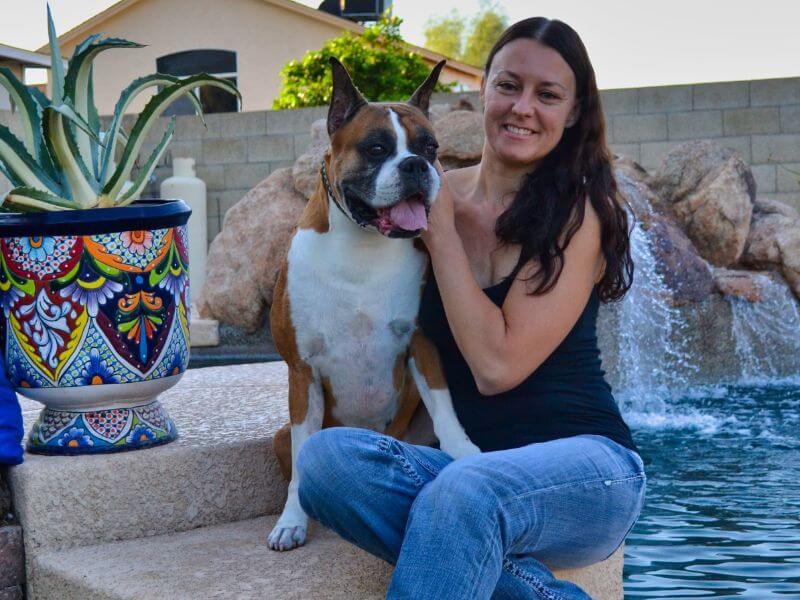

Meet the Breeders
Stephanie Davidson is the breeder behind South Willow Boxers. Read about the kennel’s beginnings, the sires, the dams, and much more!
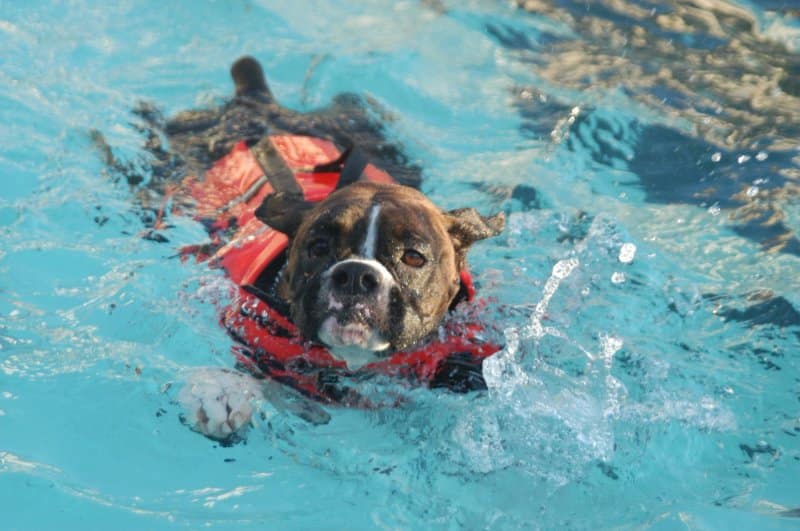
Find out where to look for essential information about the Boxer dog breed. The American Boxer Club’s website, Youtube channel, and more!

American Boxer Club Visual Standard | Whether new to purebred dogs or a longtime aficionado, the Boxer breed has always been admired for
American Boxer Club Visual Standard | Whether new to purebred dogs or a longtime aficionado, the Boxer breed has always been admired for
Discover the Boxer’s world – history, traits, and care in this concise guide. From loyal companions to versatile performers, Boxers bring joy.
The Boxer’s tail is set high and traditionally docked to a short length, continuing the clean, streamlined appearance of the breed. However, natural tails are not uncommon today and are typically carried upward. The natural tail is medium in length and tapers to a slight point.
A Note About Color: The Boxer is either fawn or brindle in color. Fawn shades vary from light tan to mahogany. The brindle ranges from sparse but cleanly defined black stripes on a fawn background to such a heavy concentration of black striping that the essential fan background color barely, although clearly, shows through. White markings may appear and be distributed so as to enhance the dog’s appearance, but may not exceed one-third of the entire coat. On the face, white may replace part of the otherwise black mask, and may extend between the eyes but not excessively as to detract from the expression. White should not appear on the flanks or on the back of the torso. Boxers without white markings are acceptable, but excessive white markings, and any color other than fawn or brindle, are not.
Coat Type
Smooth
The structure of the coat this breed carries.
Coat Length
Short
How long the breed's coat grows when kept in condition.
Adaptability Level
How easily a breed copes with changes in home, routine, noise and weather.
Mental Stimulation Needs
How much a breed needs a job, a puzzle or training to stay content.
A balanced diet is essential for maintaining the Boxer’s active lifestyle and overall health. Boxer puppies require high-quality puppy food designed to support their growth and development, typically divided into three to four meals per day.
Adult Boxers benefit from a high-protein diet to maintain their muscular build and energy levels, usually fed in two meals per day. The amount of food required depends on the dog’s size, age, activity level, and metabolism, but most adult Boxers consume about two to three cups of kibble daily.
It’s important to monitor their weight and adjust portions accordingly, as Boxers can be prone to obesity. Fresh water should always be available, and treats should be given in moderation to prevent overfeeding. Consulting a dog’s breeder and veterinarian can help to develop a feeding plan that suits an individual dog’s specific needs.
Boxers are intelligent and eager to please, making them generally responsive to training, especially when positive reinforcement methods are used. However, their high energy levels and playful nature can sometimes lead to distraction, so patience and consistency are crucial.
Early socialization is essential to make sure that Boxers are comfortable with new people, pets, and environments, helping to prevent unwanted assertiveness or shyness. While they are quick learners, Boxers can exhibit a stubborn streak, requiring firm but gentle guidance.
They can excel at Obedience Trials and often enjoy canine sports like Agility and Rally, which engage both their mind and body. Boxers are vocal dogs with a tendency to bark, particularly when excited or alerting to potential threats, so training to manage this behavior can be beneficial.
Boxers should always be exercised in secure areas or on a leash.
Grooming Expectations
These dogs are average shedders, though their grooming needs increase slightly during seasonal shedding periods. Regular ear cleaning, nail trimming, and dental care are essential for maintaining overall health and hygiene. Boxers are naturally clean dogs with little odor, so baths are only needed occasionally or when they become dirty. Their short coat makes grooming relatively easy, but their skin can be sensitive, so mild, dog-safe products are recommended.