Members
01/Overview
The Curly-Coated Retriever, often referred to simply as the "Curly," stands out among the retrievers in part because of its distinctive curly coat. As one of the oldest retrieving breeds, the Curly has been cherished for its versatility in hunting and for its confident and independent nature. Balancing playfulness with poise, this stylish breed is known for its loyalty, intelligence, and enduring energy.
Highlights
02/History
The Curly-Coated Retriever is among the oldest of the retrieving breeds, boasting a lineage that stretches back to the early 19th century in England. The breed’s precise ancestry remains a subject of debate among canine historians, but it's widely believed that they resulted from a mix of the now-extinct English Water Spaniel, the St. John's Newfoundland, the retrieving setter, and possibly the Poodle. The breed’s unique curly coat was bred intentionally to serve as an efficient water-resistant barrier, making these dogs particularly adept at waterfowl retrieving in marshy conditions.
As skilled hunters, they became increasingly popular among English gamekeepers and hunters for their proficient retrieving abilities, both in water and on land. The breed was known to be able to handle the rugged terrains and adverse weather conditions of the English countryside, proving to be resilient, tenacious, and hardworking.
The Curly-Coated Retriever's reputation crossed borders, and by the late 19th century, the breed had made its way to Australia and New Zealand, where the dogs were equally appreciated for their working skills and companionship.
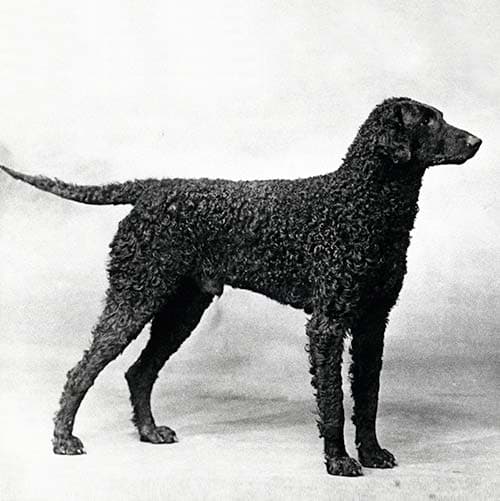
The American Kennel Club (AKC) recognized the Curly-Coated Retriever in 1924, and the breed's popularity in the United States grew slowly but steadily. Although never achieving the same widespread acclaim as some of the other retriever breeds, the Curly-Coated Retriever has maintained a loyal following of enthusiasts dedicated to preserving its unique characteristics and abilities.
Today, while still treasured as hunting companions, the Curly-Coated Retriever is also celebrated in various Dog Sports, Conformation Show rings, and most importantly, as beloved family pets. The history of the Curly is a testament to the adaptability, resilience, and enduring charm of this unique breed.
03/Appearance
Adult males typically stand between 25 and 27 inches tall at the shoulder, while mature females range from 23 to 25 inches.
Curly-Coated Retrievers typically weigh between 60 and 95 pounds, with females generally weighing less than the males.
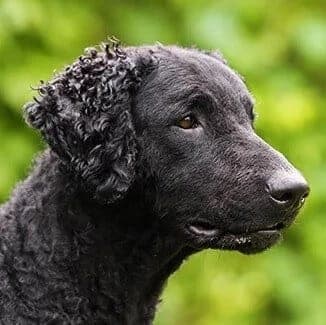
Skull: The Curly-Coated Retriever’s skull is broad and slightly round, ensuring ample room for the brain. A shallow and sloping stop exists between the skull and the muzzle.
Expression: The Curly’s expression is keen and self-confident, showcasing the breed's alert and energetic nature. The eyes often twinkle with mischief, reflecting a playful disposition.
Eyes: Set well apart, the eyes are almond-shaped and of medium size. Their color ranges from brown to black in black-colored dogs, and brown or amber in liver-colored dogs. The eyes should not appear sunken or protruding.
Ears: The ears are set slightly above the level of the eyes. They are small and lie close to the head, giving a sleek appearance. The lobular shape of the ears complements the head's overall contour.
Muzzle: The muzzle of the Curly-Coated Retriever is strong and square. It tapers slightly from the stop to the nose, but without appearing pointy. The jaws are strong, enabling the Curly to carry game efficiently.
Nose: The nose of the Curly is large and dark. In black dogs, the nose is black; liver-colored dogs have a liver-colored nose.
Bite: The Curly-Coated Retriever boasts a scissors bite where the upper incisors closely overlap the lower incisors, ensuring a strong grip. This bite alignment is vital for a retriever, as it allows the dog to hold game gently yet securely.
The Curly-Coated Retriever possesses a balanced build, ensuring strength without sacrificing agility. The length of the body is slightly longer than its height, giving it an off-square silhouette. The Curly showcases sturdy bone that's complemented by well-muscled hindquarters and a deep chest, emphasizing its capacity for endurance and power.
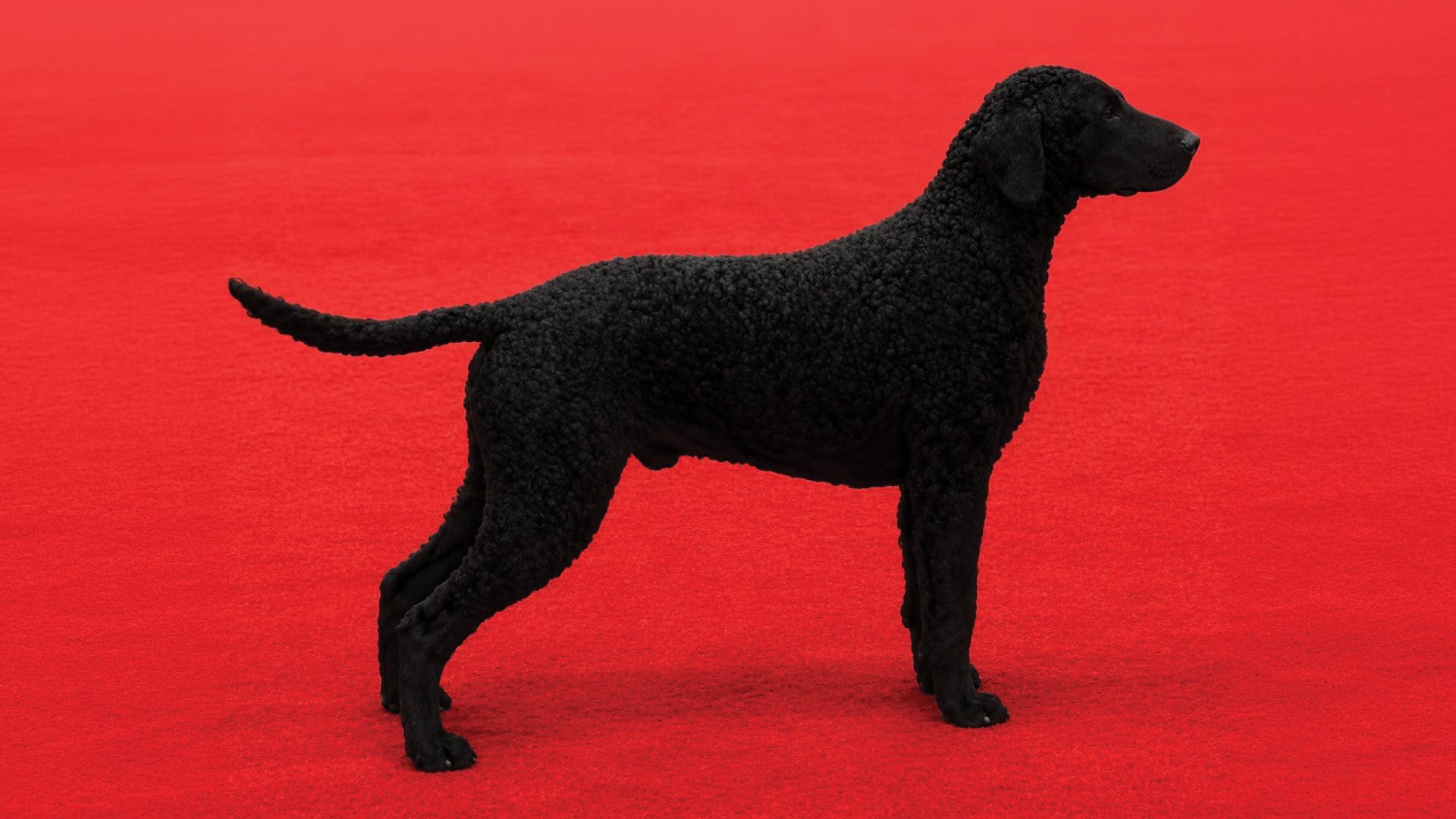
Texture: The Curly-Coated Retriever's coat is quite distinctive and is unlike that of any other breed of dog. The neck, body, and rear legs are covered in a thick mass of small, tight curls. However, the muzzle, forehead, fronts of the forelegs, and the feet are covered in short, smooth, and straight hair. Bald patches anywhere on the body are unacceptable as is a coat that is sparse, very harsh, brittle, fuzzy, or silky. The Curly's coat should remain dense throughout, ensuring the dog is well-equipped for working both in and out of the water.
Markings: This purebred dog has no markings.
Standard Colors
04/Consider
Owning a Curly-Coated Retriever brings joy, energy, and a touch of mischief to a household. As one of the oldest retrieving breeds, Curlies are known for their distinctive coat and effervescent personalities. They are highly versatile dogs, excelling in various canine sports and activities, Most make loving family companions, but their intelligence and independence can be both a delight and a challenge. Consequently, Curlies are a suitable choice for experienced dog owners.
Interaction With Family
The level of affection a breed typically shows towards family members and familiar individuals.
Good With Other Dogs
The innate friendliness of a dog towards other dogs can depend on its breed.
Good With Young Children
The degree to which a breed will typically be patient with young children.
Amount Of Shedding
How much hair a breed typically leaves behind on clothes, furniture and floors.
Frequency Of Grooming
How often a breed needs brushing, bathing or a professional trim to stay in condition.
Amount Of Drooling
How prone a breed is to drool, worth knowing before you keep a towel by the door.
Openness To Strangers
How openly a breed tends to greet new people, visitors and strangers.
Protective Nature
How likely a breed is to alert you to anything unfamiliar, and stand between you and it.
Playfulness Level
How enthusiastic a breed stays about games and play well past puppyhood.
Trainability Level
How readily a breed takes direction and works with you rather than around you.
Barking Level
How much a breed uses its voice, and how readily.
Energy Level
How much get-up-and-go a breed brings to an average day.
Health
Curly-Coated Retrievers, like all breeds and mixed breeds, can have specific health concerns that potential owners should be aware of. While they are generally robust and healthy dogs, it's crucial to provide regular veterinary check-ups and maintain a proactive approach to their well-being. With proper care, these retrievers tend to lead fulfilling lives that brim with vitality and fun. Lifespan: The average lifespan for a Curly-Coated Retriever ranges between 10 and 12 years.
Curly-Coated Retrievers are often described as confident, independent, and exuberant, bringing an unmatched vibrancy to any household. Their keen intelligence, paired with their playful nature, makes them engaging companions, though sometimes their independent streak might come across as stubbornness. This trait, while endearing to many, can pose challenges for novice dog owners. It's essential to establish leadership and consistency in training from a young age.
Socialization is a critical aspect of the Curly-Coated Retriever’s upbringing. Properly socialized Curlies are known to get along well with other dogs and can be quite gentle with young children. They tend to be more reserved around strangers, but rarely aggressive, often warming up once they assess the situation. Their inherent retrieving instincts make them naturally playful and interactive, always eager to fetch or play.
Despite their occasional bouts of independence, Curly-Coated Retrievers thrive on human companionship. They are loyal to their families and do not enjoy being left alone for extended periods. Providing them with interactive toys or puzzle feeders can help to keep them engaged during short periods of solitude. In a family setting, they often form deep bonds with everyone, ensuring their place as cherished family members.
Exercise Expectations
A daily routine should ideally incorporate not just walks but also more rigorous exercises like fetching, swimming, or running. A couple of brisk walks combined with some playtime can usually suffice for most Curlies, but remember, these are energetic dogs and they will appreciate more extended periods of activity. Swimming is a particularly favored activity for many Curly-Coated Retrievers. Given their water-repellent coat and natural inclination towards water, they often take to swimming with enthusiasm. It's also an excellent low-impact exercise, beneficial for their joints and overall well-being. While they are playful and energetic outdoors, most Curly-Coated Retrievers can be quite calm indoors, making them adaptable to various living situations as long as their exercise needs are met. However, neglecting their physical requirements can lead to undesirable behaviors, such as chewing or digging, as they seek alternative outlets for their energy. It's also beneficial to engage a Curly’s mind. Incorporating training sessions, puzzle toys, and interactive games into the daily routine can help keep this dog mentally sharp. Activities that tap into the breed’s natural retrieving instincts, such as fetch or even scent tracking, can provide both physical and mental stimulation, ensuring a happy and well-adjusted Curly.
Living with a Curly-Coated Retriever is a rewarding experience, especially for those who appreciate an active and loyal companion. Known for their independent spirit and confidence, Curlies bring a distinct blend of energy and intelligence to the household.
In terms of housing, Curly-Coated Retrievers show remarkable adaptability. They certainly relish the expansiveness of a yard, but they are not averse to apartment living as long as they receive enough exercise. Their calm indoor demeanor, combined with their zest for outdoor activities, renders them compatible with diverse living arrangements. Nonetheless, having access to a secure yard where they can freely roam and play remains a distinct advantage.
Climate-wise, the Curly's water-resistant coat offers protection against both wet and cold conditions. This makes the breed relatively tolerant of cooler weather, especially given its history of working in water and marshy terrains. However, like all dogs, the Curly should be protected from extreme weather conditions. During hot summer days, it's essential to ensure that this dog has plenty of access to shade and water, and it’s important to avoid midday exercises when temperatures peak.
Socially, Curly-Coated Retrievers are often reserved with strangers but warm up once they get to know someone. Early socialization is crucial to ensure they grow up to be well-rounded and confident in different situations. Their natural alertness can make them good watchdogs, but they're generally friendly and shouldn't be considered an option as a guard dog.
05/Puppies
The puppy phase for the Curly-Coated Retriever is an enchanting time marked by boundless energy, a penchant for exploration, and of course, those characteristic curly coats beginning to take form. Puppies of this breed are vivacious, inquisitive, and filled with a youthful enthusiasm that's hard to resist. From their earliest days, they display hints of the intelligence and independence for which the Curly-Coated Retriever is celebrated.
When bringing a Curly-Coated Retriever puppy home, preparation is key. Given the breed’s active nature, it's essential to puppy-proof the living space, ensuring there are no hazards like loose wires or easily swallowed objects.
Early socialization is paramount. Exposing Curlies to a myriad of sights, sounds, experiences, and different people can help to shape them into well-adjusted adult dogs. Enrolling in puppy kindergarten can be beneficial, not just for basic obedience but also for the social interaction it provides.
A balanced diet tailored to the needs of large breed puppies is essential for the rapid growth phase. Consulting with a veterinarian about the best nutrition plan is always a wise decision.
Additionally, while Curlies may be little bundles of energy, it's important to monitor and limit their physical activity. Over-exercising can put undue stress on their developing joints and bones. On the flip side, mental stimulation through games, toys, and simple training exercises can be introduced early.
Routine vet check-ups are crucial during this stage to ensure they are growing healthily and to initiate a vaccination schedule. Keeping up with regular deworming and flea and tick prevention is also indispensable.
Finally, it is important to instill good habits early. Training, grooming, and even basic commands are easier to teach when a Curly-Coated Retriever is young. This will lay the groundwork for a well-behaved and well-adjusted adult.
06/Activities
The Curly-Coated Retriever is an exuberant and agile breed, making it not only a superb hunting companion but also an excellent candidate for various dog sports and activities. The breed’s energy and intelligence mean it thrives when engaged in structured, fun activities that challenge both the body and mind.
Agility: Given their athletic nature, Curly-Coated Retrievers excel in Agility. Navigating through obstacle courses not only provides physical exercise but also mentally stimulates them, enhancing their problem-solving skills.
Obedience: These retrievers possess a keen intelligence, and when guided with consistent training, they can shine in Obedience Trials, showcasing their ability to follow commands and exhibit discipline.
Field Trials: Their historical role as waterfowl and game retrievers means that Field Trials can be a natural fit. These events assess a dog’s ability to retrieve under realistic hunting conditions, showcasing stamina, intelligence, and training.
Dock Diving: With their strong swimming abilities, Curly-Coated Retrievers can truly demonstrate their prowess in the sport of Dock Diving. While jumping from a dock to retrieve a toy in the water, they compete for either distance, height, or speed.
Conformation Shows: The upstanding appearance and distinctive curly coat of this retriever mean this breed is often an admired participant in Conformation Shows. Competition in such events allows the dog's appearance, structure, and movement to be evaluated against the Breed Standard.
Search and Rescue: Beyond sports, the Curly-Coated Retriever's keen nose and trainability can be harnessed in more altruistic pursuits, such as Search and Rescue operations.
Participation in these sports and activities not only keeps a Curly-Coated Retriever physically fit and mentally sharp, it also strengthens the bond between dog and handler. Moreover, it provides a fantastic avenue for socialization with other dogs and people.
Gallery
07/Standards
The Curly-Coated Retriever is recognized by the world's leading registries and kennel organizations, which categorize the breed into a specific Group based on its unique characteristics. This breed is recognized worldwide under the following Group designations:
The ideal Curly-Coated Retriever is described by a Breed Standard that is approved by each of the world’s leading registries and kennel organizations. The Breed Standards for this breed may be found in the following links:
08/Clubs
Curly-Coated Retrievers have a small but dedicated following, with breed clubs around the world that support the preservation, education, and promotion of this distinctive breed. These clubs often play pivotal roles in championing responsible breeding practices, holding specialty shows, organizing events, and providing resources for both breeders and owners alike.In the United States, the Curly-Coated Retriever Club of America (CCRCA), chartered in 1979, stands out as the parent club for the breed. Recognized by the American Kennel Club, it provides a plethora of information on the Breed Standard, breed health, social events, and more for Curly enthusiasts.In the United Kingdom, the Curly Coated Retriever Club has been operational since 1910, making it one of the oldest breed-specific clubs in the UK. This club is deeply committed to the well-being of Curly-Coated Retrievers, offering resources on care, training, health, and various events.For Curly-Coated Retriever enthusiasts, becoming a member of these established clubs can offer many benefits, from networking opportunities with fellow breed admirers to gaining access to exclusive events and insights.
09/Rescue
The Curly-Coated Retriever, while loved by many, sometimes finds itself in need of rescue, rehoming, or rehabilitation. Dedicated rescue groups and organizations work tirelessly to ensure these dogs find loving forever homes, and they also play a crucial role in educating the public about the breed's needs and characteristics.In the US, the Curly-Coated Retriever Club of America Rescue Committee works tirelessly to help Curlies in need. The club assists with both adoptions and placements, ensuring each dog finds an appropriate and loving home.Canada has individual breed enthusiasts and general retriever rescues that are ready to step in and offer assistance to any Curly-Coated Retriever in need. While there may not be a specific national Curly-Coated Retriever rescue group, these broader organizations can help individuals of this lesser-known breed.In the United Kingdom, organizations like the RSPCA and Battersea Dogs & Cats Home could potentially receive a Curly-Coated Retriever in need of adoption, and there are other rescues and networks as well that can assist in rehoming and rescuing a Curly in need.
10/Facts
Oldest Retriever Breed
The Curly-Coated Retriever is often cited as the oldest of the retriever breeds, having been recognized for its distinct features and skills in the early 19th century.
Distinctive Coat
The breed’s tight, water-resistant curls serve a practical purpose: they help to repel water and resist burrs in the field. This means that after a swim or run through tall grass, the Curly-Coated Retriever remains relatively clean and dry.
Versatility in the Field
Historically, the Curly-Coated Retriever was bred for upland bird and waterfowl hunting. The breed’s versatility is showcased in its ability to work in different terrains, from marshy swamps to thick woodland areas.
Late Bloomers
Curly-Coated Retrievers mature more slowly than some other breeds, often retaining their playful, puppy-like demeanor well into their adult years.
World Travelers
This breed, originating in England, has found favor in many parts of the world, from the United States and Canada to Australia and New Zealand.
Less Common
Despite the breed’s many admirable traits, the Curly-Coated Retriever is less common than other retriever breeds, such as the Labrador and Golden Retrievers.
11/FAQ
Curly-Coated Retrievers do shed, but typically less so than many other breeds. Their curly coats might appear low-shedding, but like most dogs, they have seasonal shedding periods, often once or twice a year.

Written by
Dan Sayers is the Executive Editor of SHOWSIGHT. He is a member of the World Dog Press Association and the Dog Writers Association of America, which recognized his illustrations in the award-winning Encyclopedia of K-9 Terminology. Dan is a longtime supporter of the sport of dogs and an advocate for the conservation of recognized breeds in all their forms and functions. He is a member of the Morris and Essex Kennel Club, and for 45 years, the Irish Water Spaniel Club of America where he serves as AKC Delegate, Archivist, and approved Breed Mentor. Dan breeds under the Quiet Storm prefix and has judged the IWSCA National Specialty Sweepstakes twice.
Official Standard for the Curly-Coated Retriever
General Appearance: This smartly upstanding, multi-purpose hunting retriever is recognized by most canine historians as one of the oldest of the retrieving breeds. Developed in England, the Curly was long a favorite of English gamekeepers. Prized for innate field ability, courage and indomitable perseverance, a correctly built and tempered Curly will work as long as there is work to be done, retrieving both fur and feather in the heaviest of cover and the iciest of waters. To work all day a Curly must be balanced and sound, strong and robust, and quick and agile. Outline, carriage and attitude all combine for a grace and elegance somewhat uncommon among the other retriever breeds, providing the unique, upstanding quality desired in the breed. In outline, the Curly is moderately angulated front and rear and, when comparing height to length, gives the impression of being higher on leg than the other retriever breeds. In carriage, the Curly is an erect, alert, self-confident dog. In motion, all parts blend into a smooth, powerful, harmonious symmetry. The coat, a hallmark of the breed, is of great importance for all Curlies, whether companion, hunting or show dogs. The perfect coat is a dense mass of small, tight, distinct, crisp curls. The Curly is wickedly smart and highly trainable and, as such, is cherished as much for his role as loyal companion at home as he is in the field.
Size, Proportion, Substance: Ideal height at withers: dogs, 25 to 27 inches; bitches, 23 to 25 inches. A clearly superior Curly falling outside of this range should not be penalized because of size. The body proportions are slightly off square, meaning that the dog is slightly longer from prosternum to buttocks as he is from withers to ground. The Curly is both sturdy and elegant. The degree of substance is sufficient to ensure strength and endurance without sacrificing grace. Bone and substance are neither spindly nor massive and should be in proportion with weight and height and balanced throughout.
Head: The head is a longer-than-wide wedge, readily distinguishable from that of all other retriever breeds, and of a size in balance with the body. Length of foreface is equal, or nearly equal, to length of backskull and, when viewed in profile, the planes are parallel. The stop is shallow and sloping. At the point of joining, the width of foreface may be slightly less than the width of the backskull but blending of the two should be smooth. The head has a nearly straight, continuous taper to the nose and is clean cut, not coarse, blocky or cheeky. Expression Intelligent and alert. Eyes-Almond-shaped, rather large but not too prominent. Black or brown in black dogs and brown or amber in liver dogs. Harsh yellow eyes and loose haws are undesirable. Ears-Rather small, set on a line slightly above the corner of the eye, and lying close to the head. Backskull-Flat or nearly flat. Foreface-Muzzle is wedge-shaped with no hint of snipiness. The taper ends mildly, neither acutely pointed nor bluntly squared-off but rather slightly rounding at the bottom. Mouth is level and never wry. Jaws are long and strong. A scissors bite is preferred. Teeth set straight and even. The lips are tight and clean, not pendulous. The nose is fully pigmented; black on black dogs, brown on liver dogs. Nostrils are large. Neck, Topline, Body: Neck-Strong and slightly arched, of medium length, free from throatiness and flowing freely into moderately laid-back shoulders. Backline-The back, that portion of the body from the rear point of the withers to the beginning of the loin, is strong and level. The loin, that part of the body extending from the end of the rib cage to the start of the pelvis, is short and muscular. The croup, that portion of the body from the start of the pelvis to the tail set-on, is only slightly sloping. Body- Chest is decidedly deep and not too wide, oval in cross-section, with brisket reaching elbow. While the impression of the chest should be of depth not width, the chest is not pinched or narrow. The ribs are well-sprung, neither barrel-shaped nor slab-sided, and extend well back into a deep, powerful loin with a moderate tuck-up of flank. Tail-Carried straight or fairly straight, never docked, and reaching approximately to the hock. Never curled over the back and should not be kinked or crooked. Covered with curls and, if trimmed, tapering toward the point.
Forequarters: Shoulder blades are very long, well covered with muscle, and are moderately laid back at about a 55 degree angle. The width between shoulder blades is adequate to allow enough flexibility to easily retrieve game. Upper arm bones are about equal in length with shoulder blades and laid back at approximately the same angle as the blades, meaning the forelegs are set under the withers. The equal length of shoulder blade and upper arm bone and the balanced angulation between the two allows for good extension of the front legs. The forelegs are straight with strong, true pasterns. Feet are round and compact, with well-arched toes and thick pads. Front dewclaws are generally removed.
Hindquarters: Strong and in balance with front angulation. Thighs are powerful with muscling carrying well down into the second thigh. Stifle is of moderate bend. The hocks are strong and true, turning neither in nor out, with hock joint well let down. Rear dewclaws are generally removed.
Coat: The coat is a distinguishing characteristic and quite different from that of any other breed. The body coat is a thick mass of small, tight, crisp curls, lying close to the skin, resilient, water resistant, and of sufficient density to provide protection against weather, water and punishing cover. Curls also extend up the entire neck to the occiput, down the thigh and back leg to at least the hock, and over the entire tail. Elsewhere, the coat is short, smooth and straight, including on the forehead, face, front of forelegs, and feet. A patch of uncurled hair behind the withers or bald patches anywhere on the body, including bald strips down the back of the legs or a triangular bald patch on the throat, should be severely penalized. A looser, more open curl is acceptable on the ears. Sparse, silky, fuzzy or very harsh, dry or brittle hair is a fault. Trimming-Feathering may be trimmed from the ears, belly, backs of forelegs, thighs, pasterns, hocks, and feet. On the tail, feathering should be removed. Short trimming of the coat on the ear is permitted but shearing of the body coat is undesirable.
Color: Black or liver. Either color is correct. A prominent white patch is undesirable but a few white hairs are allowable in an otherwise good dog.
Gait: The dual function of the Curly as both waterfowl retriever and upland game hunter demands a dog who moves with strength and power yet is quick and agile. The ground-covering stride is a well-coordinated melding of grace and power, neither mincing nor lumbering. The seemingly effortless trot is efficient and balanced front to rear. When viewed from the side, the reach in front and rear is free-flowing, not stilted or hackneyed. When viewed from the front or rear, movement is true: the front legs turn neither in nor out and the rear legs do not cross. Well-developed, muscular thighs and strong hocks do their full share of work, contributing to rear thrust and drive. The extension in front is strong and smooth and in balance with rear action. Balance in structure translates to balance in movement and is of great importance to ensure soundness and endurance; extremes of angulation and gait are not desirable.
Temperament: Self-confident, steadfast and proud, this active, intelligent dog is a charming and gentle family companion and a determined, durable hunter. The Curly is alert, biddable and responsive to family and friends, whether at home or in the field. Of independent nature and discerning intelligence, a Curly sometimes appears aloof or self-willed, and, as such, is often less demonstrative, particularly toward strangers, than the other retriever breeds. The Curly’s independence and poise should not be confused with shyness or a lack of willingness to please. In the show ring, a correctly-tempered Curly will steadily stand his ground, submit easily to examination, and might or might not wag his tail when doing so. In the field, the Curly is eager, persistent and inherently courageous. At home, he is calm and affectionate. Shyness is a fault and any dog who shies away from show ring examination should be penalized. Minor allowances can be made for puppies who misbehave in the show ring due to overexuberance or lack of training or experience.
Approved October 12, 1993
Effective November 30, 1993

Meet the Breeders
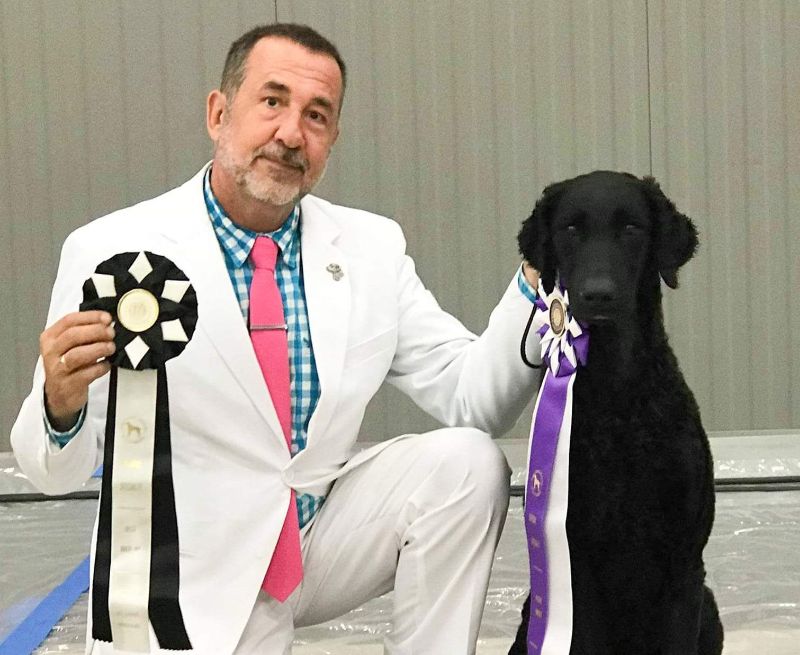
Victor Hewer is the breeder behind Tyneside Curly-Coated Retrievers. Read about the kennel’s beginnings, the sires, the dams, and more!

All About Judging
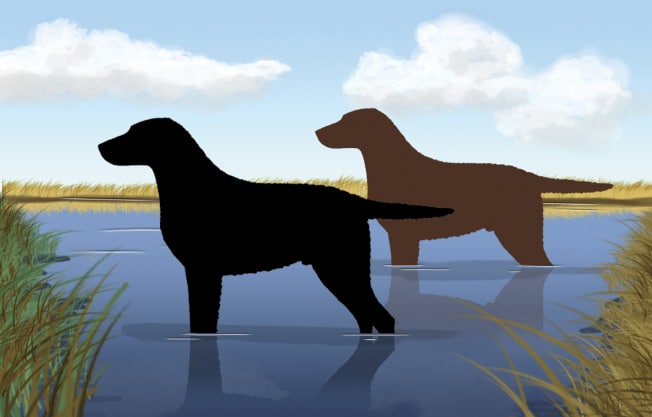
The Curly-Coated Retriever has a unique profile that distinguishes it from other breeds. The characteristic silhouette of an erect, upstanding, athletic-appearing Curly-Coated Retriever is achieved through the body shape, proportion, and substance, coupled with the head and tail, that create a distinctive outline.
The tail of the Curly-Coated Retriever is an extension of its agile and balanced build and plays a vital role in both movement and expression. Set just below the level of the back, it is carried straight or with a slight upward curve. It should never, however, curl over the back. The tail is of medium length, reaching approximately to the hock, and showcases the breed's characteristic curls. In action, the tail functions as a rudder, assisting with balance in or out of the water. When the Curly is alert or active, the tail's movement reflects its energy and mood.
The tail is never docked for this breed, its natural length adding to the Curly-Coated Retriever's distinctive and elegant appearance.
A Note About Color: The Curly-Coated Retriever is a solid, self-colored dog in either black or liver. White hairs are allowable on an otherwise good dog, but a prominent white patch of hair is unacceptable in the breed.
Coat Type
Double, Curly
The structure of the coat this breed carries.
Coat Length
Short
How long the breed's coat grows when kept in condition.
Adaptability Level
How easily a breed copes with changes in home, routine, noise and weather.
Mental Stimulation Needs
How much a breed needs a job, a puzzle or training to stay content.
Feeding a Curly-Coated Retriever requires understanding nutritional needs at various life stages. As active dogs, Curlies require a balanced diet that fuels their energy and sustains their muscular build. Always ensure that the food provided meets the specific needs of this breed, taking into account factors such as age, activity level, and overall health.
Puppies are ever-growing and need a diet rich in protein and essential nutrients to support their development. It's often recommended to feed Curly-Coated Retriever puppies three to four times a day, gradually transitioning to twice-a-day feeding as they approach adulthood. High-quality puppy food designed for large breeds can be beneficial during this stage.
For adult Curly-Coated Retrievers, a diet that includes lean proteins, healthy fats, and essential vitamins and minerals is ideal. On average, an active adult might consume 2.5 to 3.5 cups of high-quality dry dog food daily, divided into two meals. However, it's crucial to adjust the quantity based on the dog's activity level and metabolism. Overfeeding or providing calorie-dense treats without enough exercise can lead to obesity, a condition you'll want to avoid for the overall health and longevity of your Curly.
Always ensure the Curly-Coated Retriever has access to fresh and clean water. Keeping an eye on the dog’s weight, monitoring for any sudden changes, and having regular vet consultations can help to ensure that their nutritional needs are being met adequately. Remember, every dog is an individual, so adjustments might be necessary based on a dog’s specific requirements and any health concerns.
The Curly-Coated Retriever's intelligence and eagerness to please can make training a rewarding experience, but the breed’s independent nature can sometimes present challenges. Their self-assured demeanor means that they may occasionally decide to do things their own way. Thus, early training and consistent leadership are paramount to mold them into well-behaved companions.
Curlies respond best to positive reinforcement techniques. Harsh training methods or undue punishment can lead to a distrustful or even more stubborn dog. Incorporating games, especially retrieving games, into their training regimen can capitalize on their innate abilities and make sessions more engaging for them. It's also essential to keep training sessions relatively short and varied enough to hold their interest.
Socialization is another vital aspect of training. Exposing your Curly to various environments, people, and other animals from a young age will help them develop into well-rounded, confident adults. This breed's inherent caution around strangers makes early and consistent socialization even more crucial to prevent excessive shyness or undue apprehension.
Despite their somewhat independent streak, Curly-Coated Retrievers have the potential to excel in Obedience and Agility Trials. Their keen senses and natural retrieving instincts can also make them standouts in Field Trials. Engaging them in such activities can not only enhance their skills but also strengthen the bond between dog and handler. With patience, understanding, and a bit of creativity, training a Curly can be a fulfilling endeavor for both the dog and the trainer.
Grooming Expectations
While they do shed, the Curly-Coated Retriever's shedding is less noticeable than that of other breeds, given the nature of their curls. The tight curls can trap the loose hairs, making them less apparent around the house. However, a regular, gentle brushing once a week can help to remove these trapped hairs and keep the coat looking its best. When brushing, it's essential to be careful to avoid breaking the curls. Beyond brushing, it's crucial to check the Curly's ears regularly for signs of infection, given its love for water. Any moisture that remains in the ear can lead to bacterial growth. Cleaning them gently with a vet-approved solution can help to prevent any potential issues. Their nails should be trimmed once or twice a month, or as needed, to prevent overgrowth and splitting. Regular checks of the Curly’s teeth and gums are also advised. Brushing the teeth a few times a week will help to maintain good oral health and fend off potential bad breath.
Lastly, while Curlies cherish the time spent with their family, they are known for their independent nature. This means that while they might not always be the kind to constantly seek attention, they are always up for play, training, or a cuddling session whenever invited.