Members
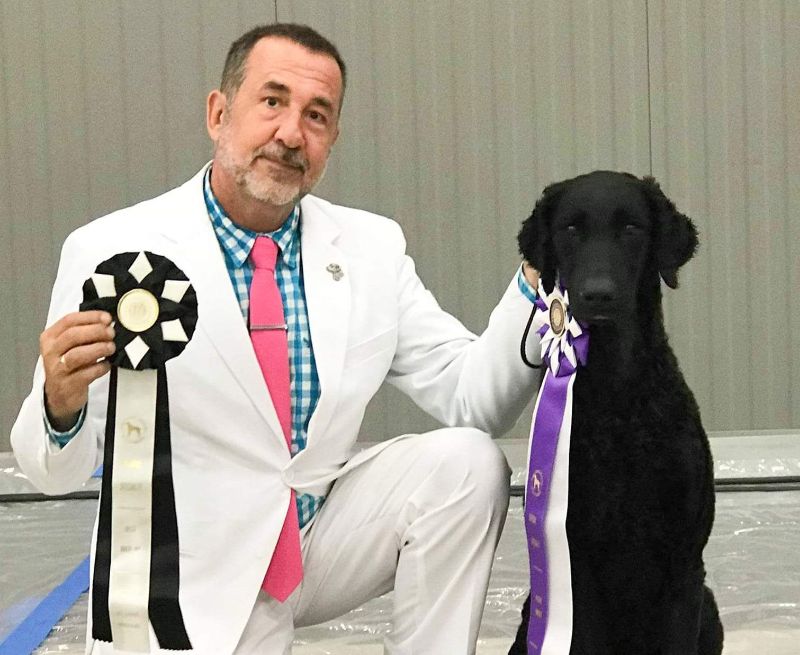
Victor Hewer is the breeder behind Tyneside Curly-Coated Retrievers. Read about the kennel’s beginnings, the sires, the dams, and more!
The Weekly Brief
The best of SHOWSIGHT editorials, weekly wins, and breeder commentary — delivered to your inbox every Sunday morning.
Victor Hewer: We are located in N. Florida. I started with Labrador Retrievers in the Midwest when I was 16. Ì was founding president of the Shawnee Mission Labrador Retriever Club (SMLRC) and served as division rep for the bench show committee of the Labrador Retriever Club (LRC). After 12 years in Labs, I got out of dogs and then returned with Curlies 8 years ago.
Victor Hewer: Our kennel name is Tyneside, which is the area of England where my ancestors come from. We currently have four bitches here in our home and a boy currently out on the road being shown. However, for preservation purposes, we also maintain a considerable number of co-ownerships as potential breeding stock.
GCH Tyneside’s Midnight Romance (Romeo). His sire, CH Stormacre Take A Bow (Daryl), was brought from England specifically to sire this boy for us. We leased his dam from Canada who had both American and British lines. Romeo has won several Sporting Groups and was No. 1 All-Breed Curly of 2022.
CH Sun Devil Waiting for the Next Surprise (Supra) is a Group Placer and has won in huge competition, including Best of Breed at last year’s AKC National Championship Show.
GCH Tyneside’s Queen of Hearts (Fury) is a multiple Group Winner, Select at the National, and a top-ranking bitch in 2021.
CH Stormacre Take A Bow, CGC (Daryl) is our most influential sire. We borrowed Daryl on a co-ownership, as an adult proven stud dog, from England. I put his AKC Championship on him, and he sired three litters for us before returning to the UK. He has already proven to be a very influential sire for not only us, but also on the breed in general here in the US.
Our two primary foundation bitches, Supra and Candy, both from Sun Devil, also produced exceptionally well for us.
Victor Hewer: We keep all of our dogs in the house as our companions. Puppies are whelped and raised in the house until old enough to eat, and then they spend the daytime in an outdoor playpen set up for them. We do sensory stimulation as babies. I spend a lot of time with them, so I get to know each puppy individually. This way, they can be paired with the perfect home.
I make every effort to prepare my puppies for a successful transition and start in their new home.
Victor Hewer: We evaluate for show prospects when our puppies are seven weeks old. Not only is structure considered, but also the overall temperament and personality. Because I get to know the puppies, I can select those with more presence in carriage and bearing for Performance and Hunting homes. We have placed several Service Dog prospects by personality alone. Curlies bond very deeply with their owners and have an innate desire to please. Selection is all about knowing the puppies individually.
Victor Hewer: Although we are not as overly competitive in Companion and Performance events as some of our owners and co-owners, we have put titles on dogs in other areas like Dock Diving, CGC, etc. We also have advanced Therapy Dog titles, and one of our Curlies is my partner’s Diabetic Service Dog.
Victor Hewer: Basic hunting and retrieving instinct is more important to me than competition. Keeping the hunting instinct identified in Hunt Tests is very important, but my preference is placing the Curly in a home where hunting is a natural extension of being the family dog.
Overall, the Curly is not separated between hunting and show lines. It is the owner’s responsibility to encourage and refine the hunting ability of the Curly.
Victor Hewer: The Curly’s coat is wash and wear. Other than maybe a supplement to keep them from blowing coat, there really isn’t much to keeping the coat conditioned. A Curly should be robust and active. They require exercise to stay in top physical condition, and a Curly with room to run stays in pretty decent physical condition. The great thing about a Curly is its ability to turn on and turn off, making the breed the ideal hunter and family companion.
Victor Hewer: Curlies look strong, but due to a 70-plus percent genetic loss in the breed, their systems can be somewhat fragile. We never feed rich puppy food to our puppies. We separate vaccinations and take other health preventative measures. With DNA, we are able to avoid such things as GSD and PRA. Hip dysplasia does occur, but over all, it is rarely bad enough to have any effect on the dog’s quality of life. Seizures and bloating are the most common concerns.
Victor Hewer: No, I do not. There has been an overall attitude that any breeder breeding over two litters per year makes them a puppy mill. We have an insufficient number of breeding animals. In the past, and still today, some breeders put everything not showable (or that they are not keeping themselves) on limited registrations. This has been a huge detriment to our breed.
There seems to be a handful of breeders working at somewhat of a grassroots level to increase junior partnerships in showing, increase the number of Curly breeders to preserve and maintain the breed, and increase breed recognition through sponsored and unsponsored events. Also, an ongoing breeder mentorship is beginning to take place. So, efforts are certainly being made.
Victor Hewer: The Curly-Coated Retriever is absolutely suited to be an outstanding family dog. Curlies bond faithfully to their pack, be it human and/or canine. Once used to guard against poachers, the Curly has maintained that protective nature and will use it only when appropriate. Curlies are the thinking man’s dog.
We require owners to keep their dog in the house. A kennel run life is not acceptable for our dogs. Families and individuals that enjoy being active and doing things with their dogs are the types of homes we prefer. It is all about the dog’s quality of life for us.
Victor Hewer: Probably the biggest misconception is that the Curly is hypoallergenic and does not shed. Curlies are not and they do. Although not a misconception, I do feel that the breed’s wicked intelligence is often highly underestimated. You better be smarter than a Curly. Otherwise, the Curly will take full advantage of you.
Victor Hewer: I would ask them to pay closer attention to the “form follows function” rule. A good coat is paramount, but it means nothing if the dog is not conformationally correct so that it can work a field all day or swim through cold water to retrieve the duck or goose and be ready for the next fowl downed. Ultimately, the Curly is a “meat dog” in that it will retrieve any game available for consumption.
Victor Hewer: Get a solid mentor. Better yet, get more than one. It is critical to first understand structure, movement, COI, basic breeding principles, and many other factors before breeding on your own. You will never be successful without continued knowledge and understanding.
Victor Hewer: We have a ceramic dog dish that we put water in. It has a silver dollar-sized blue polka dot in the bottom. More than one puppy has convinced itself that it is a ball in the bottom of the dish. They each dunk, dig, and bark at it, wanting to play with it. It is quite entertaining.
The best way to ensure a long and happy relationship with a purebred dog is to purchase one from a responsible breeder. Not sure where to begin finding a breeder?
Contact the National Parent Club’s Breeder Referral person, which you can find on the AKC Breeder Referral Contacts page.
Did you know nearly every recognized AKC purebred has a dedicated rescue group? Find your new best friend on the AKC Rescue Network Listing.
Showsight Magazine is the only publication to offer dedicated Digital Breed Magazines for ALL recognized AKC Breeds.
Read and learn more about the intelligent Curly-Coated Retriever dog breed with articles and information in our Curly-Coated Retriever Breed Magazine.
If you enjoy the Curly-Coated Retriever Breed Magazine, help us educate the community by sharing it.

Meet the Breeders