Members
01/Overview
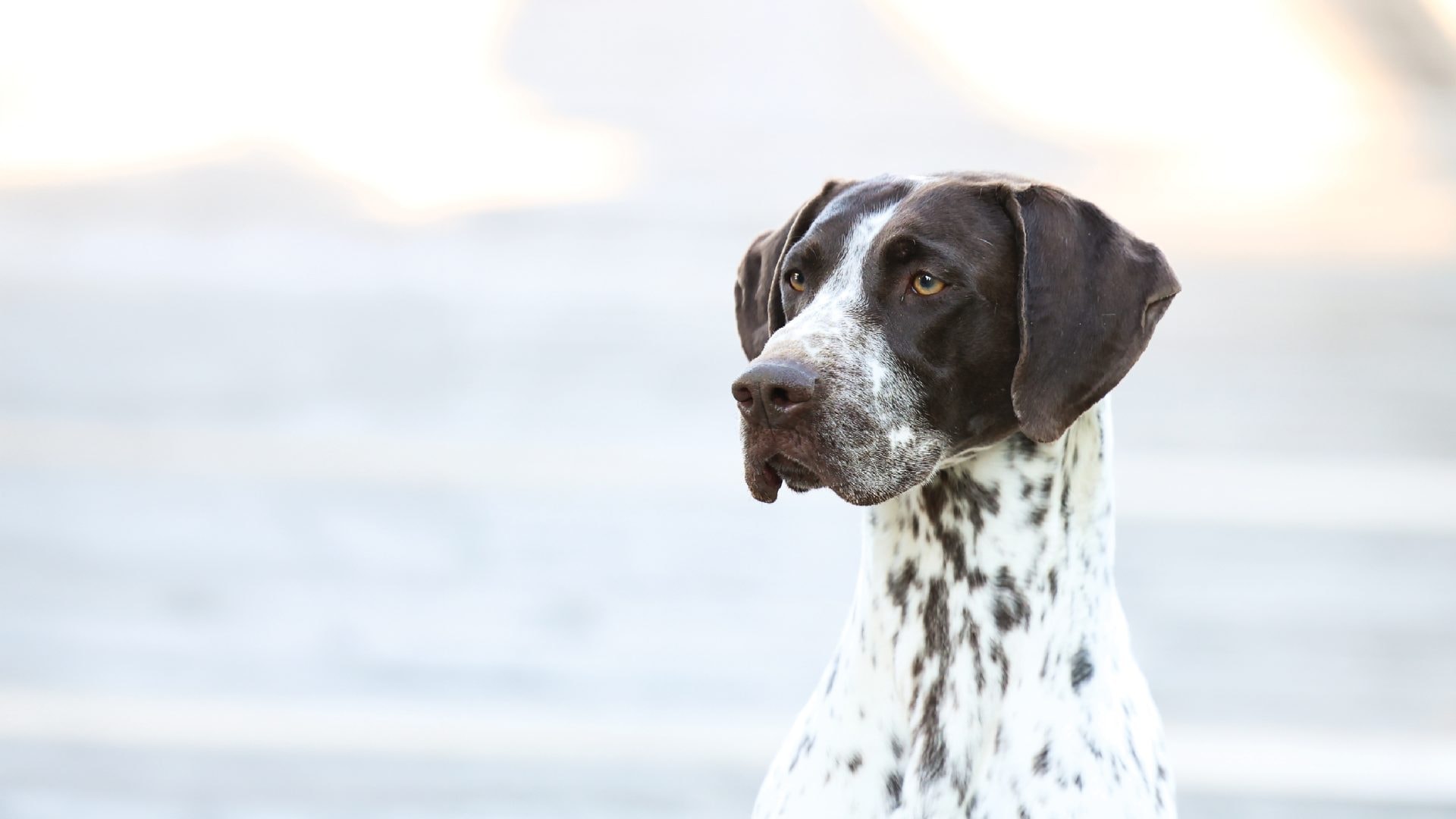
The German Shorthaired Pointer (GSP) is an athletic, intelligent breed developed in 19th-century Germany for hunting on land and water. Renowned for its versatility and friendly nature, the GSP is a loyal companion who thrives in active households.
Highlights
02/History
The German Shorthaired Pointer has roots dating back to 17th-century Germany. The breed’s development in its modern form began in the mid-to-late 19th century, with breeders striving to create a versatile hunting dog. By crossing Spanish Pointers with local bird dogs, Bloodhounds, and later, English Pointers, they refined the GSP into a highly adaptable hunter capable of tracking, pointing, and retrieving on both land and water.
Prince Albrecht zu Solms-Braunfeld of the Royal House of Hanover played a significant role in establishing a Breed Standard. He emphasized traits like intelligence, endurance, and versatility, shaping the GSP into a reliable hunting companion.
The first GSPs were imported to the United States in 1925 by Dr. Charles Thornton of Montana. In 1930, the American Kennel Club (AKC) officially recognized the breed, with Grief v.d. Fliegerhalde as the first registered GSP.
World War II posed significant challenges to the breed in Europe. To protect valuable bloodlines, breeders relocated some dogs to neighboring countries like Yugoslavia, though the limited gene pool in post-war Germany made recovery efforts difficult. Conversely, the breed thrived in the US where it gained popularity for its performance in both Field Trials and Conformation Shows. By 1968, GSPs dominated AKC National Field Trial Championships, with three of the top four finishers also holding Conformation titles.
Today, the German Shorthaired Pointer is one of the most popular Sporting breeds in the United States, consistently ranking among the top 10 most registered breeds with the AKC. This popularity reflects the breed’s adaptability, intelligence, and suitability as both a hunting partner and a family companion.
03/Appearance
Male German Shorthaired Pointers typically stand 23 to 25 inches tall at the shoulder and weigh between 55 and 70 pounds. Females are slightly smaller, standing 21 to 23 inches tall and weighing 45 to 60 pounds.
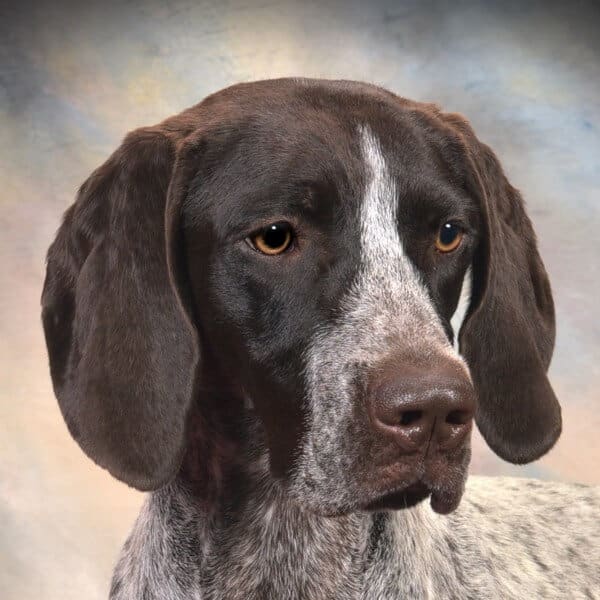 Photo: Tom Weigand - THEWINNINGIMAGE.COM[/caption]
The German Shorthaired Pointer is a medium to large breed with a muscular and well-proportioned body. In profile, the GSP may appear square or slightly rectangular when measured from the forechest to the rearmost projection of the rump. A deep chest and a tuck-up, and a firm, slightly arched topline, contribute to its sturdy yet elegant structure, ensuring strength and stamina in the field.
Texture: The coat of the German Shorthaired Pointer is short, dense, and tough to the touch. Its thickness provides protection in the underbrush and insulation in water. The hair on the head and ears is softer and finer, while the coat on the underside of the tail and back of the haunches may be somewhat longer; however, long or soft coats are undesirable.
Standard Colors
04/Consider
The German Shorthaired Pointer is an energetic and intelligent breed that thrives in active households. They require dedicated time for exercise, training, and mental stimulation. Understanding their health, personality, and care needs is essential before welcoming one into the home.
Interaction With Family
The level of affection a breed typically shows towards family members and familiar individuals.
Good With Other Dogs
The innate friendliness of a dog towards other dogs can depend on its breed.
Good With Young Children
The degree to which a breed will typically be patient with young children.
Amount Of Shedding
How much hair a breed typically leaves behind on clothes, furniture and floors.
Frequency Of Grooming
How often a breed needs brushing, bathing or a professional trim to stay in condition.
Amount Of Drooling
How prone a breed is to drool — worth knowing before you keep a towel by the door.
Openness To Strangers
How openly a breed tends to greet new people, visitors and strangers.
Protective Nature
How likely a breed is to alert you to — and stand between you and — anything unfamiliar.
Playfulness Level
How enthusiastic a breed stays about games and play well past puppyhood.
Trainability Level
How readily a breed takes direction and works with you rather than around you.
Barking Level
How much a breed uses its voice, and how readily.
Energy Level
How much get-up-and-go a breed brings to an average day.
Health
German Shorthaired Pointers are generally healthy dogs with an average lifespan of 10 to 12 years. Proper care, a balanced diet, and regular exercise contribute to their well-being, but like all dogs, they can be prone to certain health conditions.
The German Shorthaired Pointer is an energetic, intelligent, and loyal breed that thrives in active and attentive homes. These dogs can be well-suited for novice owners who are dedicated to providing consistent training and exercise. The sensitivity of the GSP to human emotions makes them deeply affectionate and eager to please, but they can struggle with being left alone for extended periods.
These dogs are typically friendly towards children, though their exuberance can overwhelm younger kids. With strangers, they are generally amiable, but they retain a strong protective instinct, making them reliable watchdogs. Their playful and curious nature ensures they are always engaged, making them delightful family companions for active households. When properly socialized from an early age, they typically get along well with other dogs and household pets.
Exercise Expectations
Their playful and energetic nature makes them excellent companions for active individuals or families. Without sufficient exercise, GSPs may become restless, leading to unwanted behaviors such as excessive barking or chewing. Engaging them in mentally stimulating games, such as puzzle toys or hide-and-seek, is equally important for preventing boredom.
The German Shorthaired Pointer thrives in homes where they are included as an active part of the family. They adapt well to suburban or rural environments, especially in homes with a fenced yard to accommodate their need for physical activity. Apartment living is possible but requires a strong commitment to daily exercise and mental engagement.
GSPs handle moderate climates well but may struggle in extreme cold or heat. Providing appropriate shelter, hydration, and weather-appropriate gear ensures their comfort. These dogs form close bonds with their human companions and prefer not to be left alone for long periods, as they can develop separation anxiety.
05/Puppies
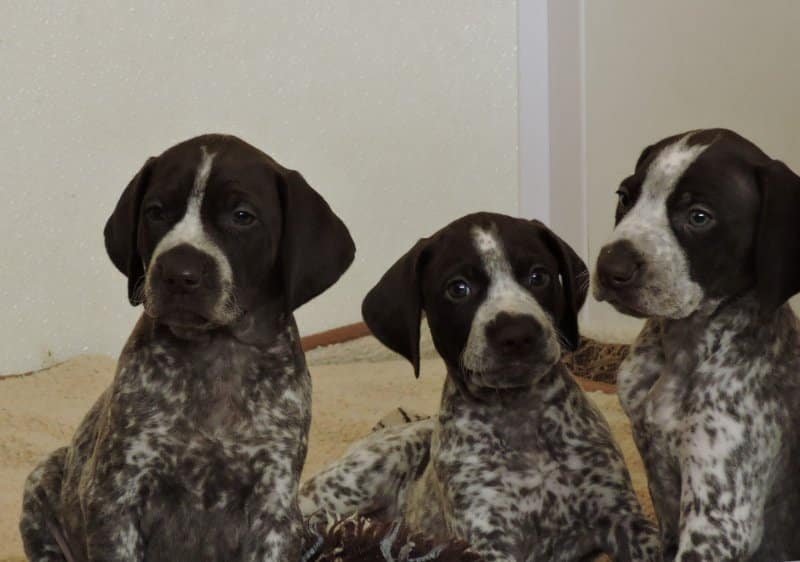
German Shorthaired Pointer puppies are energetic, curious, and quick to learn, making early socialization and basic training essential. Proper care, including a nutritious diet, regular vet visits, and safe, age-appropriate exercise will promote healthy development.
Caring for a GSP puppy involves feeding a high-quality, balanced diet served in three to four small meals daily, transitioning to two meals as the pup matures. Early training, including crate training, aids with housebreaking and provides a secure space for rest periods throughout the day.
Short walks and gentle playtime support the puppy’s energy needs without straining developing joints. Regular veterinary check-ups, vaccinations, and deworming will ensure a healthy start, setting the stage for a long, happy, and active life.
06/Activities
Gallery
07/Standards
The German Shorthaired Pointer is recognized by the world's leading registries and kennel organizations, which categorize the breed into a specific Group based on its unique characteristics. This breed is recognized worldwide under the following Group designations:
The ideal German Shorthaired Pointer is described by a Breed Standard that is approved by each of the world’s leading registries and kennel organizations. The Breed Standards for this breed may be found in the following links:
08/Clubs
09/Rescue
10/Facts
Webbed Feet
German Shorthaired Pointers have webbed feet, making them excellent swimmers and ideal for retrieving waterfowl.
Distinctive Coat
Their dense, short coat is water-resistant, providing insulation and protection.
Natural Pointing Instinct
The GSP instinctively freezes and "points" when detecting game, a behavior that is present even in young puppies.
Celebrity Owners
Famous owners include Bradley Cooper and country music star Tim McGraw, highlighting the breed’s widespread appeal.
Record-Breaking Speed
GSPs are one of the fastest dog breeds, capable of reaching speeds up to 40-45 miles per hour.
11/FAQ
Yes, the German Shorthaired Pointer sheds moderately year-round, with heavier shedding in spring and fall. Regular grooming helps to manage shedding during these seasons.
Official Standard for the German Shorthaired Pointer
General Appearance: The German Shorthaired Pointer is a versatile hunter, an all-purpose gun dog capable of high performance in field and water. The judgment of Shorthairs in the show ring reflects this basic characteristic. The overall picture which is created in the observer’s eye is that of an aristocratic, well balanced, symmetrical animal with conformation indicating power, endurance and agility and a look of intelligence and animation. The dog is neither unduly small nor conspicuously large. It gives the impression of medium size, but is like the proper hunter, “with a short back, but standing over plenty of ground.” Symmetry and field quality are most essential. A dog in hard and lean field condition is not to be penalized; however, overly fat or poorly muscled dogs are to be penalized. A dog well balanced in all points is preferable to one with outstanding good qualities and defects. Grace of outline, clean-cut head, sloping shoulders, deep chest, powerful back, strong quarters, good bone composition, adequate muscle, well carried tail and taut coat produce a look of nobility and indicate a heritage of purposefully conducted breeding. Further evidence of this heritage is movement which is balanced, alertly coordinated and without wasted motion.
Size, Proportion, Substance: Size – height of dogs, measured at the withers, 23 to 25 inches. Height of bitches, measured at the withers, 21 to 23 inches. Deviations of one inch above or below the described heights are to be severely penalized. Weight of dogs 55 to 70 pounds. Weight of bitches 45 to 60 pounds. Proportion – measuring from the forechest to the rearmost projection of the rump and from the withers to the ground, the Shorthair is permissibly either square or slightly longer than he is tall. Substance – thin and fine bones are by no means desirable in a dog which must possess strength and be able to work over any type of terrain. The main importance is not laid so much on the size of bone, but rather on the bone being in proper proportion to the body. Bone structure too heavy or too light is a fault. Tall and leggy dogs, dogs which are ponderous because of excess substance, doggy bitches, and bitchy dogs are to be faulted.
Head: The head is clean-cut, is neither too light nor too heavy, and is in proper proportion to the body. The eyes are of medium size, full of intelligence and expression, good-humored and yet radiating energy, neither protruding nor sunken. The eye is almond shaped, not circular. The preferred color is dark brown. Light yellow eyes are not desirable and are a fault. Closely set eyes are to be faulted. China or wall eyes are to be disqualified. The ears are broad and set fairly high, lie flat and never hang away from the head. Their placement is just above eye level. The ears laid in front without being pulled, should extend to the corner of the mouth. In the case of heavier dogs, the ears are correspondingly longer. Ears too long or fleshy are to be faulted. The skull is reasonably broad, arched on the side and slightly round on top. Unlike the Pointer, the median line between the eyes at the forehead is not too deep and the occipital bone is not very conspicuous. The foreface rises gradually from nose to forehead. The rise is more strongly pronounced in the dog than in the bitch. The jaw is powerful and the muscles well developed. The line to the forehead rises gradually and never has a definite stop as that of the Pointer, but rather a stop-effect when viewed from the side, due to the position of the eyebrows. The muzzle is sufficiently long to enable the dog to seize game properly and be able to carry it for a long time. A pointed muzzle is not desirable. The depth is in the right proportion to the length, both in the muzzle and in the skull proper. The length of the muzzle should equal the length of the skull. A dish-shaped muzzle is a fault. A definite Pointer stop is a serious fault. Too many wrinkles in the forehead is a fault. The nose is brown on a liver dog and black on a black dog. The larger the nose the better and nostrils should be well opened and broad. A spotted nose is not desirable. A flesh colored nose disqualifies. The chops fall away from the somewhat projecting nose. Lips are full and deep yet are never flewy. The teeth are strong and healthy. The molars intermesh properly. The bite is a true scissors bite. A perfect level bite is not desirable and must be penalized. Extreme overshot or undershot disqualifies.
Neck, Topline, Body: The neck is of proper length to permit the jaws reaching game to be retrieved, sloping downwards on beautifully curving lines. The nape is rather muscular, becoming gradually larger toward the shoulders. Moderate throatiness is permitted. The skin is close and tight. The chest in general gives the impression of depth rather than breadth; for all that, it is in correct proportion to the other parts of the body. The chest reaches down to the elbows, the ribs forming the thorax show a rib spring and are not flat or slabsided; they are not perfectly round or barrel-shaped. The back ribs reach well down. The circumference of the thorax immediately behind the elbows is smaller than that of the thorax about a hand’s breadth behind elbows, so that the upper arm has room for movement. Tuck-up is apparent. The back is short, strong, and straight with a slight rise from the root of the tail to the withers. The loin is strong, is of moderate length, and is slightly arched. An excessively long, roached or swayed back must be penalized. The hips are broad with hip sockets wide apart and fall slightly toward the tail in a graceful curve. A steep croup is a fault. The tail is set high and firm, and must be docked, leaving approximately 40 percent of its length. The tail hangs down when the dog is quiet and is held horizontally when he is walking. The tail must never be curved over the back toward the head when the dog is moving. A tail curved or bent toward the head is to be severely penalized.
Forequarters: The shoulders are sloping, movable, and well covered with muscle. The shoulder blades lie flat and are well laid back nearing a 45 degree angle. The upper arm (the bones between the shoulder and the elbow joint) is as long as possible, standing away somewhat from the trunk so that the straight and closely muscled legs, when viewed from the front, appear to be parallel. Elbows which stand away from the body or are too close result in toes turning inwards or outwards and must be faulted. Pasterns are strong, short and nearly vertical with a slight spring. Loose, short-bladed or straight shoulders must be faulted. Knuckling over is to be faulted. Dewclaws on the forelegs may be removed. The feet are compact, close-knit and round to spoon-shaped. The toes are sufficiently arched and heavily nailed. The pads are strong, hard and thick.
Hindquarters: Thighs are strong and well muscled. Stifles are well bent. Hock joints are well angulated and strong with straight bone structure from hock to pad. Angulation of both stifle and hock joint is such as to achieve the optimal balance of drive and traction. Hocks turn neither in nor out. Cowhocked legs are a serious fault.
Coat: The hair is short and thick and feels tough to the hand; it is somewhat longer on the underside of the tail and the back edges of the haunches. The hair is softer, thinner and shorter on the ears and the head. Any dog with long hair in the body coat is to be severely penalized.
Color: The coat may be of solid liver or a combination of liver and white such as liver and white ticked, liver patched and white ticked, or liver roan. Or the coat may be of solid black or any combination of black and white such as black and white ticked, black patched, and white ticked, or black roan. Any other color or color combination is a disqualification. A dog with any area of red, orange, lemon or tan, or a dog solid white will be disqualified.
Gait: A smooth lithe gait is essential. It is to be noted that as gait increases from the walk to a faster speed, the legs converge beneath the body. The tendency to single track is desirable. The forelegs reach well ahead as if to pull in the ground without giving the appearance of a hackney gait. The hindquarters drive the back legs smoothly and with great power.
Temperament: The Shorthair is friendly, intelligent, and willing to please. The first impression is that of a keen enthusiasm for work without indication of nervous or flightly character.
Disqualifications: China or wall eyes. Flesh colored nose. Extreme overshot or undershot. Any color combination of colors other than liver or black as described in the standard. A dog with any area of red, orange, lemon or tan or a dog solid white.
Approved October 11, 2022
Effective January 1, 2023

All About Judging
Dr. Michelle Wiberg is the breeder behind Chrishelle German Shorthaired Pointers. Read about the kennel’s beginnings, puppies, and much more!

Meet the Breeders
Sharon & Steve Dattilio, Kahla Ennis are the breeders behind Shomberg German Shorthaired Pointers. Read about the kennel.
Meet the Breeders
Jennifer Murphy is the breeder behind White Oak Kennels German Shorthaired Pointers. Read about the kennel’s beginnings, puppies, and more!


Meet the Breeders
Valerie Nunes-Atkinson is the breeder behind the VJK-MYST Kennels. Read about the kennel’s beginnings, the sires, the dams, and more!
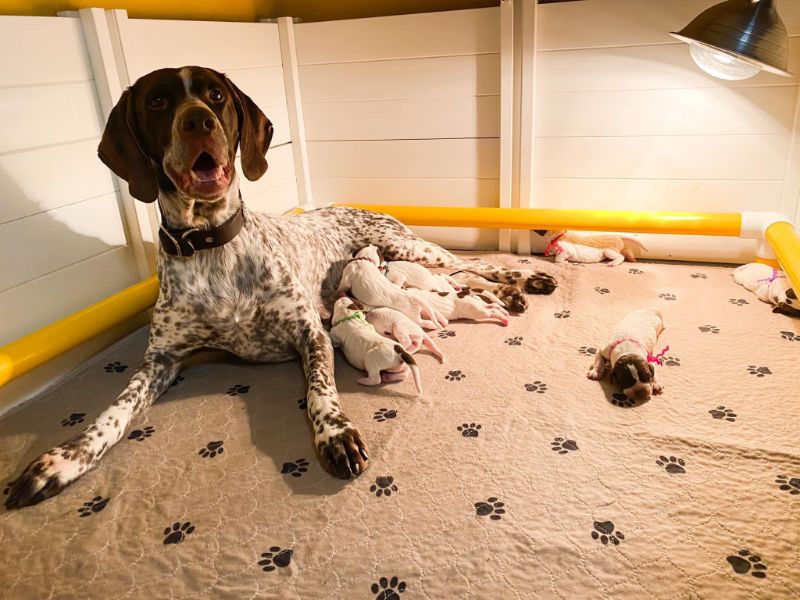
Meet the Breeders
Christy Hale is the breeder behind Halestorm Kennel. Read about the kennel’s beginnings, the sires, the dams, the puppies, and more!
Meet the Breeders
Sharon and Steve Dattilio are the breeders behind Shomberg GSP. Read about the kennel’s beginnings, the sires, the dams, and more!

Any good dog parent knows that ALL dogs have the potential to help us stay active. That being said, check out this list of energetic dogs.


All About Judging
The correct shoulder assembly varies from breed to breed. This variation depends upon the tasks the breeds were developed to perform.
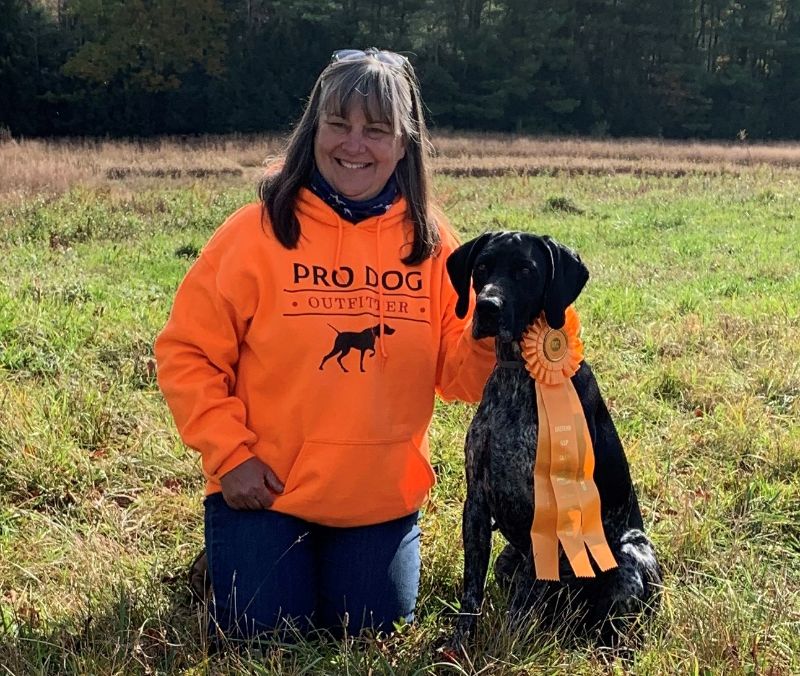
German Shorthaired Pointer Breed Standard hasn’t changed since 1992. As of January 1, 2023, it will allow black and black & white GSPs.
The German Shorthaired Pointer's tail is set high and firm. The tail is docked to about 40 percent of its natural length, a practice tied to hunting utility. In countries where the practice is prohibited, the natural tail tapers to a fine point. When at rest, the tail hangs naturally, but when the dog is moving it may be carried slightly above the topline without curving over the back towards the head.
Standard Markings
A Note About Color: Any other color or combination of colors is unacceptable in the breed, including but not limited to red, orange, lemon, tan, and solid white.
Coat Type
Smooth
The structure of the coat this breed carries.
Coat Length
Short
How long the breed's coat grows when kept in condition.
Adaptability Level
How easily a breed copes with changes in home, routine, noise and weather.
Mental Stimulation Needs
How much a breed needs a job, a puzzle or training to stay content.
German Shorthaired Pointers are active dogs requiring a high-quality diet to fuel their energy and maintain their health. Puppies need specially formulated puppy food that is rich in proteins and essential nutrients to support rapid growth. Feeding three to four small meals a day is recommended until they transition to adult food.
For adult GSPs, two balanced meals per day are sufficient. The amount of food depends on the dog’s size, age, and activity level, with active dogs requiring up to three cups of kibble daily. Caretakers should monitor weight closely, as overfeeding can lead to obesity and associated health issues.
As they age, senior Shorthairs benefit from a diet tailored to their changing nutritional needs, with lower calories and joint-supporting supplements. Access to fresh water at all times is essential, particularly for these active dogs. Consulting a dog’s breeder and veterinarian for personalized dietary recommendations can ensure optimal nutrition at every life stage.
German Shorthaired Pointers are highly intelligent and eager to learn, making them relatively easy to train for experienced handlers. However, their independence and high energy levels require patience, consistency, and positive reinforcement techniques. Early socialization and basic obedience training are critical to fostering a well-mannered dog.
The breed’s tendency to bark and alert the family makes the GSP a natural watchdog, but this behavior should be managed through training to prevent excessive barking. These dogs have a strong prey drive and need to run, so recall training and a secure yard are vital for keeping them safe. They thrive on mental challenges and excel in activities like Agility, Tracking, and Scent Work.
Grooming Expectations
Bathing should be done only when necessary, using a gentle dog shampoo to maintain the natural oils in the coat. The hanging ears require regular cleaning to prevent wax buildup and infections, as moisture can easily get trapped. Nails should be trimmed regularly to avoid discomfort, and teeth should be brushed frequently to promote good oral health.