Members
Discover the Polish Lowland Sheepdog (PON): A shaggy, intelligent herding breed with rich history, loyalty, and versatile talents.

Martin & Beverly Cabral
The Weekly Brief
The best of SHOWSIGHT editorials, weekly wins, and breeder commentary — delivered to your inbox every Sunday morning.
The Polish Lowland Sheepdog is commonly referred to as a “PON.” How did they come to be known as a PON? This Polish breed was accepted into the Fédération Cynologique Internationale (F.C.I.) in 1959. Their Polish registered name is Polski Owczarek Nizinny. “PON” is a shorter and easier way to pronounce their name based on the initials of their Polish name. Translated into English, it is Polish Lowland Sheepdog.
The PON is thought to have originated when the Huns brought their herding dogs into Europe. They were crossed with other breeds of Central Asian and Tibetan descent. It’s believed that the PON is a descendant of the Hungarian herding dog, the Puli, along with the Tibetan Terrier and the Tibetan Spaniel, with the intent of breeding a self-sufficient herding dog. Its roots go back to a written history of a medium-sized, shaggy herding dog in the 13th century.
In 1514, a ship sailed from Poland to Scotland to trade a load of grain for sheep. So impressed was the Scot watching six PONS separate 20 prized sheep from a flock of 60, then herd them aboard the ship, that the Scot negotiated an additional trade of a prized ram and ewe for one PON male and two PON females. It’s believed that the PON is one of the ancestors of the Scottish herding dog, the Bearded Collie. It’s not surprising when you see the resemblance!
Throughout the centuries, the PON was known for its legendary herding ability, intelligence, and ability to survive the harshest of conditions in the rugged terrain of the Polish farmlands. This medium-sized, well balanced, shaggy in appearance dog with a lack of tail allowed them to easily blend in with the sheep, thereby acting as protectors against small predators, such as the fox.
The PON grew in popularity across Europe until 1939 and World War II. This war devastated Poland, and like so many dog breeds in Europe after World War II, the PON almost went extinct. Luckily, a Polish veterinarian is credited with saving the breed.
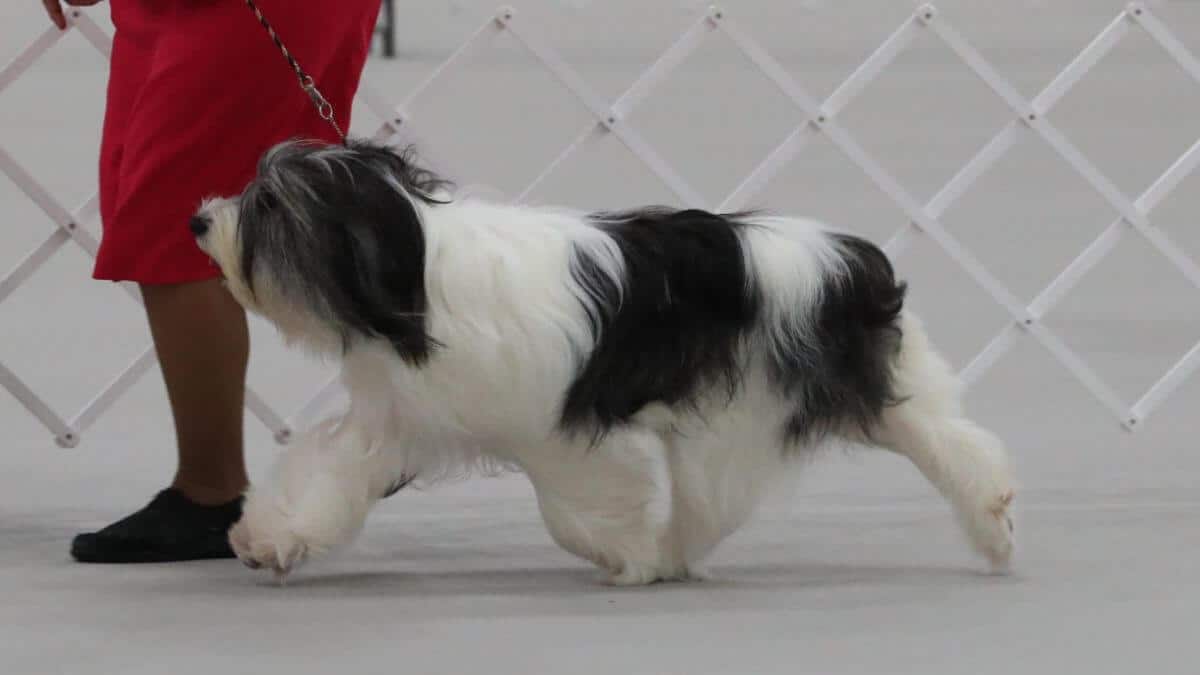
The PON is a lively working dog that is slightly off-square, with a body ratio of 9 (height) to 10 (length). The PON is passionate about herding with bravery and determination, but also has a clever and affectionate nature. They have a robust, stocky build. Height at the withers for an adult dog is 18 to 20 inches, and 17 to 19 for a bitch. They are double-coated. The entire body is covered with a long, dense, thick, and shaggy coat. And while not trimmed, their hair perpetually covers their eyes. They come in a range of colors, including brown, fawn, gray, black, and white, but the most common color combination is black and white. Tails are to be no longer than two vertebrae or else it will change the silhouette of the dog.
The Polish Lowland Sheepdog was initially put into the Miscellaneous Class in 1999 by the American Kennel Club and was moved to the Herding Group in 2001.
The PON is a highly vigilant and watchful breed, which is consistent with sheepdog characteristics. Since PONs are highly intelligent and hardworking, they tend to be happiest when they have a job to do.
The PON’s temperament is confident and stubborn yet adaptable. While they may appear aloof with strangers, they are affectionate and devoted to their families.
The PON’s movement should cover ground with good reach and drive. Their topline remains strong and level. Their head carriage is not high. It should be level with the topline to approximately 10:30. Because of their thick body and bone, they are not an elegant dog in the show ring.
Regardless, these intelligent, devoted, and loving dogs can be wonderful companions for the right family.
PONs are known for loving to play, protect children, and guard the family chickens and sheep. Because of their loyalty, they are easily trained to do any job or task. This highly intelligent breed excels in Obedience, Agility, Rally, Trick Dog, Herding, Tracking, Nosework and Farm Dog. This is truly a gem of a breed.
News