Members
01/Overview
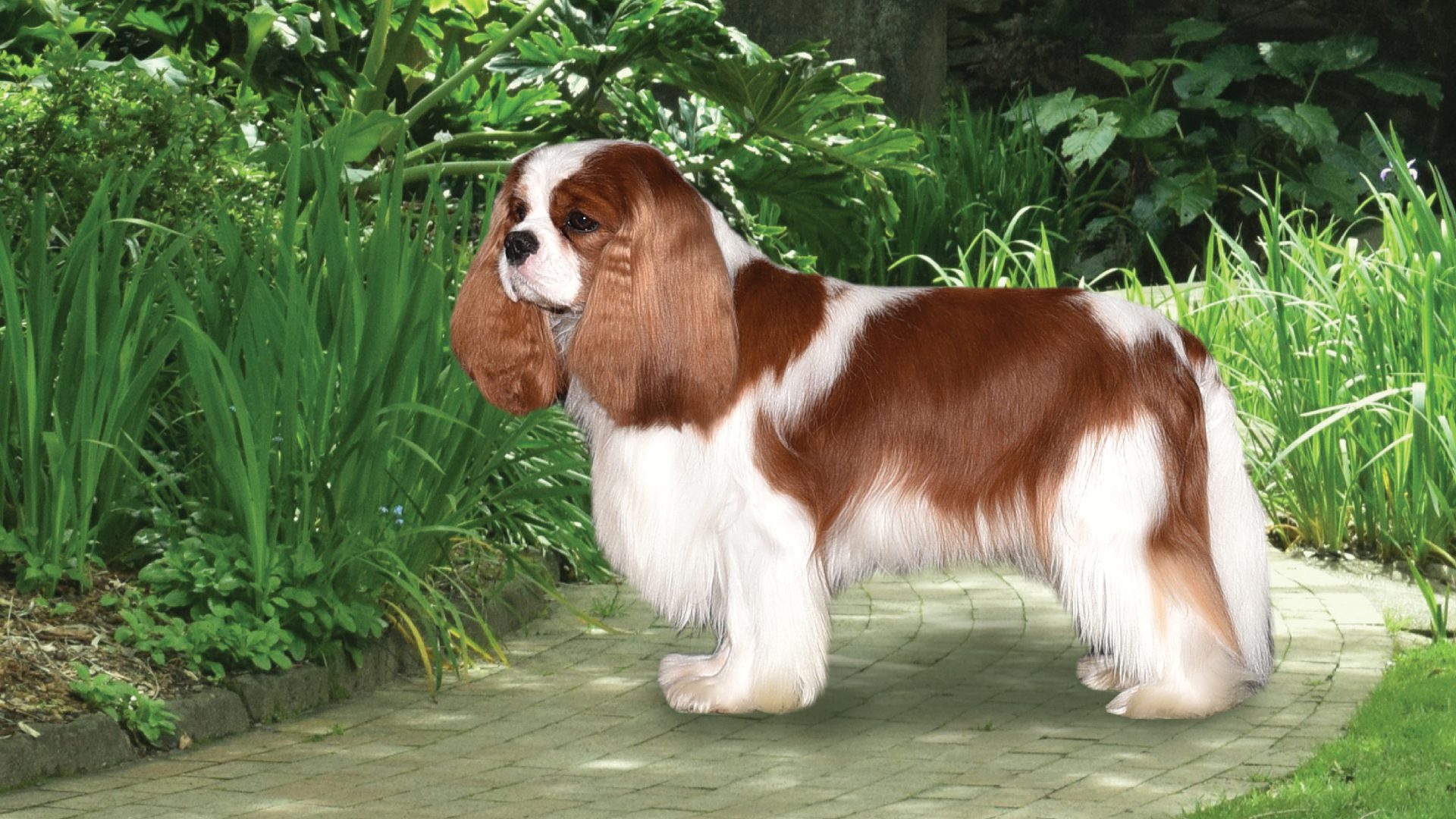
The Cavalier King Charles Spaniel (correctly shortened to “Cavalier,” not “King Charles”) is a graceful, active, well-balanced toy spaniel, gay and free in action, fearless and sporting in nature, yet at the same time gentle and affectionate. It is this typical happy and carefree temperament, combined with true elegance and royal appearance which are of paramount importance in the breed. Natural appearance with no trimming, sculpting or artificial alteration is essential to breed type.
Highlights
02/History
Today’s Cavalier is descended from the small toy spaniels seen in so many paintings of the 16th, 17th, and 18th centuries by Titian, Van Dyck, Lely, Stubbs, Gainsborough, Reynolds, and Romney. These paintings depict small spaniels with flat heads, high-set ears, almond eyes, and rather pointed noses. During Tudor times, toy spaniels were quite common as ladies’ pets, and under the Stuarts they were given the royal title of King Charles Spaniels. King Charles II was seldom seen without two or three toy spaniels at his heels. So fond was he of his little dogs that he wrote a decree that the King Charles Spaniel should be accepted in any public place, even in the Houses of Parliament, where animals were not usually allowed. This decree is still in existence today in England. As time went by, and with the coming of the Dutch court, toy spaniels went out of fashion and were replaced in popularity by the Pug. In time, the moderate toy spaniels of the past gave way to dogs with a completely flat face, undershot jaw, domed skull with long, low-set ears and large, round, frontal eyes associated with the modern English Toy Spaniel (as it is known in North America; King Charles Spaniel everywhere else in the world).
In the mid-1920s, an American, Roswell Eldredge, went to England in search of the old type spaniels with the moderate face and muzzle that he saw in the paintings by the masters. Disappointed to hear those dogs were extinct, he offered a prize of 25 pounds at Crufts, the world-famous dog show, to the first breeder who succeeded in recreating the old type “nosey” spaniels that were favored by King Charles II. In 1927 a dog named Ann’s Son was declared the winner of Eldredge’s money prize, and in 1928 a Breed Standard was drawn up using Ann’s Son as the model.
The first Cavaliers were sent to America in 1952, and in 1956 a national club was formed, the Cavalier King Charles Spaniel Club, USA. The AKC admitted the breed into the Miscellaneous Class. There it remained until the early 1990s. Club specialties were held for the breed, but the majority of members did not wish for the breed to gain AKC recognition. A group of member-breeders who did favor AKC recognition formed the American Cavalier King Charles Spaniel Club in 1993 and went to the AKC, asking to become the parent club. AKC granted the request. On January 1, 1996, the Cavalier King Charles Spaniel became the AKC’s 140th recognized breed. Interestingly, the CKCSC,USA is still very much in existence, maintaining its registry and holding specialty shows monthly in various regions of the country.
03/Appearance
12 to 13 inches at the withers; weight proportionate to height, between 13 and 18 pounds.
Skull: Slightly rounded, but without dome or peak; it should appear flat because of the high placement of the ears. Stop is moderate, neither filled nor deep.
Expression: The sweet, gentle, melting expression is an important breed characteristic.
Eyes: Large, round but not prominent and set well apart; color a warm, very dark brown, giving a lustrous, limpid look. Rims dark. There should be cushioning under the eyes which contributes to the soft expression.
Ears: Set high, but not close, on top of the head. Leather long with plenty of feathering and wide enough so that when the dog is alert, the ears fan slightly forward to frame the face.
Muzzle: Full, slightly tapered. Length from base of stop to tip of nose about 1-1/2 inches. Face well filled below the eyes.
Nose: Uniformly black without flesh marks and nostrils well developed.
Bite: A perfect, regular and complete scissors bite is preferred.
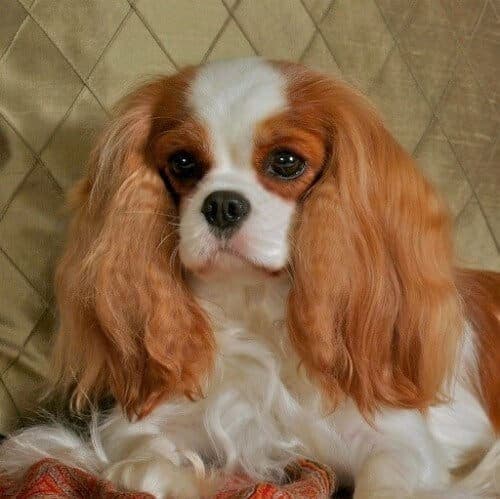
The body approaches squareness, yet if measured from point of shoulder to point of buttock, is slightly longer than height at the withers. Bone is moderate in proportion to size. Weedy and coarse specimens are to be equally penalized.
Texture: Silky, free from curl, slight wave permissible.
Standard Colors
Standard Markings
04/Consider
The Cavalier is a delightful little breed, a “sporting toy,” sturdy enough to enjoy outdoor activities yet content to be a lap dog and get utterly spoiled by an indulgent owner. His tail is ever wagging, and at dog shows Cavaliers have a hard time staying still, being much too interested in all the goings on. They make perfect family companions for owners of all ages, gentle with seniors and kind children. They are easily trained and have a great desire to please. They have an elegance about them, a royal air, yet their grooming needs are manageable, and with four different colors and patterns to choose from, owners can find a dog that suits their personal tastes.
Interaction With Family
The level of affection a breed typically shows towards family members and familiar individuals.
Good With Other Dogs
The innate friendliness of a dog towards other dogs can depend on its breed.
Good With Young Children
The degree to which a breed will typically be patient with young children.
Amount Of Shedding
How much hair a breed typically leaves behind on clothes, furniture and floors.
Frequency Of Grooming
How often a breed needs brushing, bathing or a professional trim to stay in condition.
Amount Of Drooling
How prone a breed is to drool, worth knowing before you keep a towel by the door.
Openness To Strangers
How openly a breed tends to greet new people, visitors and strangers.
Protective Nature
How likely a breed is to alert you to anything unfamiliar, and stand between you and it.
Playfulness Level
How enthusiastic a breed stays about games and play well past puppyhood.
Trainability Level
How readily a breed takes direction and works with you rather than around you.
Barking Level
How much a breed uses its voice, and how readily.
Energy Level
How much get-up-and-go a breed brings to an average day.
Health
Like all breeds, Cavaliers can have health issues, but responsible breeders are rigorous in screening for these afflictions and use the soundest dogs in their breeding program. They provide documentation on the health status of sires and dams, and stand behind their dogs. Likewise, Cavalier clubs around the world recommend best practices to promote the breeding of mature, health-tested adults. Lifespan: Well-cared-for Cavaliers that come from health-tested parents and see the veterinarian at regular intervals can live comfortably into the double digits.
Cavaliers are gentle, fun loving and must be with their people in order to thrive. Known throughout history as the “comforter spaniel,” they were never bred to be anything other than a gentle companion and lap dog. They adore their comforts, and will go to great lengths to manipulate their owners so they can claim the best furniture. It was also important to the royals that Cavaliers retain a sporting nature, so they could run behind a horse and enjoy a day’s activities outside the palace walls.
Exercise Expectations
Grooming Expectations
Cavaliers are easy, mellow dogs to live with. They are the largest of the Toy breeds; not tiny and frail, yet portable enough to take to the office, travel on city transit, and tuck under your seat in the cabin of a plane. Although they were bred by English royalty and today seem to be the chosen companion of every celebrity and media VIP, they are just as happy living in a big-city apartment or frolicking in a suburban backyard. A royal breed but not a snob.
05/Puppies
Cavaliers take their job as comforter spaniels very seriously. They are cuddlers, and easily trained. Early on, get your puppy used to grooming and bathing, nail trimming, and spending time in his crate with toys. If this is your first dog, Puppy Kindergarten classes are highly recommended for both of you; he will learn basic commands in an environment of distractions, and you will develop confidence in interacting with your Cavalier.
06/Activities
Cavaliers are an intelligent and versatile breed that will happily participate in whatever activities you care to pursue. If you are hoping to compete in performance events, Cavaliers are very successful in Obedience, Agility, and Rally. They also make great little show dogs, if your breeder thinks he has the potential. Most all-breed kennel clubs offer handling classes to start you on your way. Pet therapy is another area in which Cavaliers excel, and many owners get great pleasure from taking their dogs to visit hospitals and senior citizens’ facilities.
Gallery
07/Standards
The Cavalier King Charles Spaniel is recognized by the world's leading registries and kennel organizations, which categorize the breed into a specific Group based on its unique characteristics. This breed is recognized worldwide under the following Group designations:
The ideal Cavalier King Charles Spaniel is described by a Breed Standard that is approved by each of the world’s leading registries and kennel organizations. The Breed Standards for this breed may be found in the following links:
08/Clubs
American Cavalier King Charles Spaniel ClubCavalier King Charles Spaniel Club of CanadaCavalier King Charles Spaniel ClubAll these clubs publish a newsletter or magazine for members, and maintain a presence on social media.
09/Rescue
American Cavalier King Charles Spaniel Club; Rescue: 1-888-314-7779Cavalier King Charles Spaniel Club of Canada: Rescue Contact: Helen Godfrey, godfrey_helen@yahoo.caCavalier Rescue and Welfare Services
10/Facts
The Origin of the “Blenheim Spot”
The Blenheim Spot, a unique and highly prized spot on top of the head of many Blenheim Cavaliers, is also known as the “mark of the Duchess Thumb Print.” The legend goes that Sarah Churchill, Duchess of Marlborough, while awaiting news of her husband’s safe return from the Battle of Blenheim, pressed the head of an expectant Cavalier dam with her thumb, resulting in five puppies all bearing the lucky mark.
Queen Victoria’s Love Affair with Cavaliers
Queen Victoria was passionate about many dog breeds, including Cavaliers. Her favorite Cavalier was a beloved tricolor named Dash, whose image has been captured in countless paintings, prints, and needlepoints. It is said she was so head over heels in love with Dash that, on the day of her coronation, in 1837, she left the grand event, changed her clothes, and gave her little spaniel a bath.
A New King Charles Gives Even More Visibility to the Breed
The Cavalier has always been hugely popular in England, but with Prince Charles recently becoming King Charles, there has been an even greater global spotlight shone on the breed. A hundred or more Cavalier owners braved the rain with their dogs to line the streets and pay their respects to the new King Charles, a sight that was captured on YouTube, and shared on television newscasts the world over.
11/FAQ
Not necessarily. The spot or lozenge is considered icing on the cake for a show dog; it is unique and special, but not a requirement, so there are many worthy Blenheim champions without the spot, and many well-loved non-champion pets that do sport the Blenheim spot.

Written by
Although Allan Reznik has worn many hats over his 60 years in the sport—breeder, exhibitor, journalist, club board member, steward, mentor, dog show announcer, media commentator—he is probably best known as the Editor-in-Chief of several award-winning national dog magazines. DOGS IN REVIEW, DOG WORLD, DOG FANCY and DOGS IN CANADA each won highest honors from the Dog Writers Association of America under his stewardship. He has bred and finished champion Afghan Hounds, Cavalier King Charles Spaniels and Tibetan Spaniels, all owner-handled. He is currently approved to judge the following breeds, across the Hound, Toy and Non-Sporting Groups (as well as their NOHS Groups): Afghan Hound, Borzoi, Dachshund, Greyhound, Ibizan Hound, Petit Basset Griffon Vendeen, Pharaoh Hound, Rhodesian Ridgeback, Saluki, Cavalier King Charles Spaniel, Chinese Crested, English Toy Spaniel, Italian Greyhound, Maltese, Pomeranian, Poodle (Toy), American Eskimo Dog, Lhasa Apso, Poodle (Miniature & Standard), Tibetan Spaniel, Tibetan Terrier, Xoloitzcuintli.
Official Standard of the Cavalier King Charles Spaniel
General Appearance: The Cavalier King Charles Spaniel is an active, graceful, well-balanced toy spaniel, very gay and free in action; fearless and sporting in character, yet at the same time gentle and affectionate. It is this typical gay temperament, combined with true elegance and royal appearance which are of paramount importance in the breed. Natural appearance with no trimming, sculpting or artificial alteration is essential to breed type.
Size, Proportion, Substance: Size- Height 12 to 13 inches at the withers; weight proportionate to height, between 13 and 18 pounds. A small, well balanced dog within these weights is desirable, but these are ideal heights and weights and slight variations are permissible. Proportion- The body approaches squareness, yet if measured from point of shoulder to point of buttock, is slightly longer than the height at the withers. The height from the withers to the elbow is approximately equal to the height from the elbow to the ground. Substance- Bone moderate in proportion to size. Weedy and coarse specimens are to be equally penalized.
Head: Proportionate to size of dog, appearing neither too large nor too small for the body. Expression- The sweet, gentle, melting expression is an important breed characteristic. Eyes- Large, round, but not prominent and set well apart; color a warm, very dark brown; giving a lustrous, limpid look. Rims dark. There should be cushioning under the eyes which contributes to the soft expression. Faults- small, almond-shaped, prominent, or light eyes; white surrounding ring. Ears- Set high, but not close, on top of head. Leather long with plenty of feathering and wide enough so that when the dog is alert, the ears fan slightly forward to frame the face. Skull- Slightly rounded, but without dome or peak; it should appear flat because of the high placement of the ears. Stop is moderate, neither filled nor deep. Muzzle- Full muzzle slightly tapered. Length from base of stop to tip of nose about 1½ inches. Face well filled below eyes. Any tendency towards snipiness undesirable. Nose pigment uniformly black without flesh marks and nostrils well developed. Lips well developed but not pendulous giving a clean finish. Faults- Sharp or pointed muzzles. Bite- A perfect, regular and complete scissors bite is preferred, i.e. the upper teeth closely overlapping the lower teeth and set square into the jaws. Faults- undershot bite, weak or crooked teeth, crooked jaws.
Neck, Topline, Body: Neck- Fairly long, without throatiness, well enough muscled to form a slight arch at the crest. Set smoothly into nicely sloping shoulders to give an elegant look. Topline- Level both when moving and standing. Body- Short-coupled with ribs well sprung but not barrelled. Chest moderately deep, extending to elbows allowing ample heart room. Slightly less body at the flank than at the last rib, but with no tucked-up appearance. Tail- Well set on, carried happily but never much above the level of the back, and in constant characteristic motion when the dog is in action. Docking is optional. If docked, no more than one third is to be removed.
Forequarters: Shoulders well laid back. Forelegs straight and well under the dog with elbows close to the sides. Pasterns strong and feet compact with well-cushioned pads. Dewclaws may be removed.
Hindquarters: The hindquarters construction should come down from a good broad pelvis, moderately muscled; stifles well turned and hocks well let down. The hindlegs when viewed from the rear should parallel each other from hock to heel. Faults- Cow or sickle hocks.
Coat: Of moderate length, silky, free from curl. Slight wave permissible. Feathering on ears, chest, legs and tails should be long, and the feathering on the feet is a feature of the breed. No trimming of the dog is permitted. Specimens where the coat has been altered by trimming, clipping, or by artificial means shall be so severely penalized as to be effectively eliminated from competition. Hair growing between the pads on the underside of the feet may be trimmed.
Color: There shall be four allowed colors for the Cavalier King Charles Spaniel. Blenheim- Rich chestnut markings well broken up on a clear, pearly white ground. The ears must be chestnut and the color evenly spaced on the head and surrounding both eyes, with a white blaze between the eyes and ears, in the center of which may be the lozenge or “Blenheim spot.” The lozenge is a unique and desirable, though not essential, characteristic of the Blenheim. Tricolor- Jet black markings well broken up on a clear, pearly white ground. The ears must be black and the color evenly spaced on the head and surrounding both eyes, with a white blaze between the eyes. Rich tan markings over the eyes, on cheeks, inside ears and on the underside of tail. Ruby- Wholecolored rich red. Black and Tan- Jet black with rich, bright tan markings over eyes, on cheeks, inside ears, on chest, legs, and on underside of the tail. Faults- Heavy ticking on Blenheims or Tricolors, white marks on Rubies or Black and Tans. Dogs not of an allowed color shall be disqualified.
Gait: Free moving and elegant in action, with good reach in front and sound, driving rear action. When viewed from the side, the movement exhibits a good length of stride, and viewed from front and rear it is straight and true, resulting from straight-boned fronts and properly made and muscled hindquarters.
Temperament: Gay, friendly, non-aggressive with no tendency towards nervousness or shyness. Bad temper, shyness, and meanness are not to be tolerated and are to be severely penalized as to effectively remove the specimen from competition.
Disqualifications:
Dogs not of an allowed color.
Approved January 10, 2023
Effective March 29, 2023
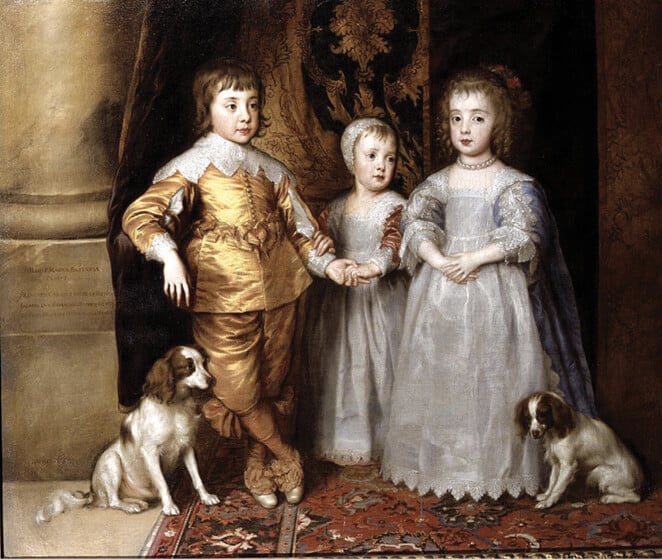
At this point in history of the Cavalier King Charles Spaniel roads diverge as to how the recreation of the breed truly came about.
Dog Show Candids
Ringside photos and dog show candids from this year’s Crab Orchard Kennel Club dog show which was held August 07-08, 2021 in Marion, IL.

Meet the Breeders
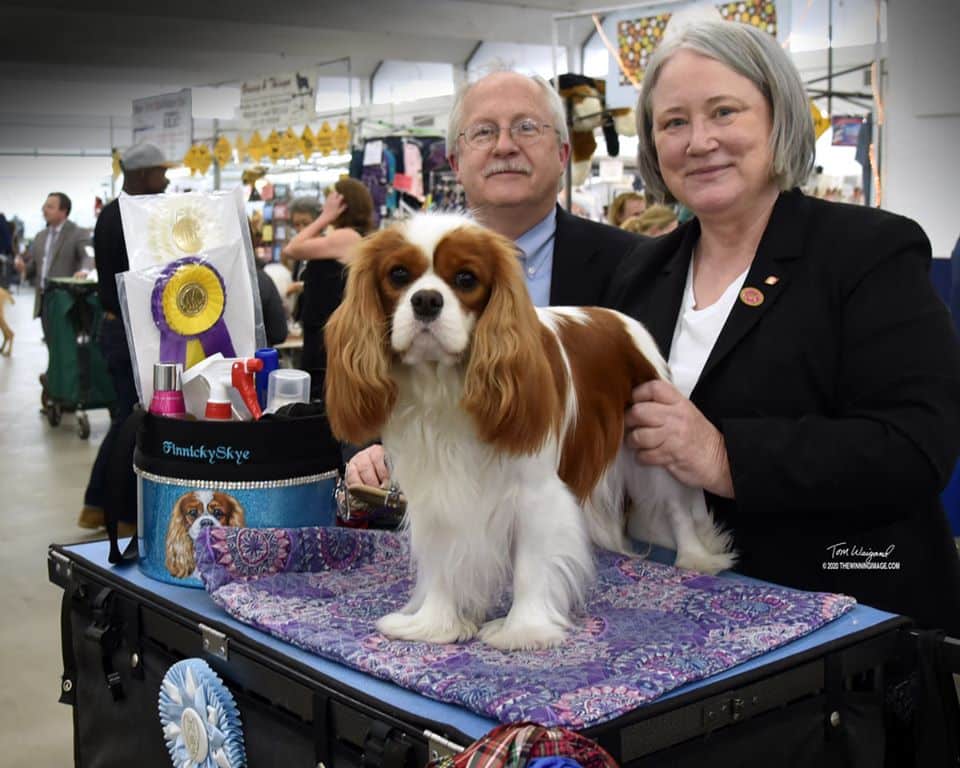
Owner Handler’s Sharon Onorato Utych & James Utych: We became involved in the sport when we got our first Cavalier King Charles Spaniel.

Meet the Breeders
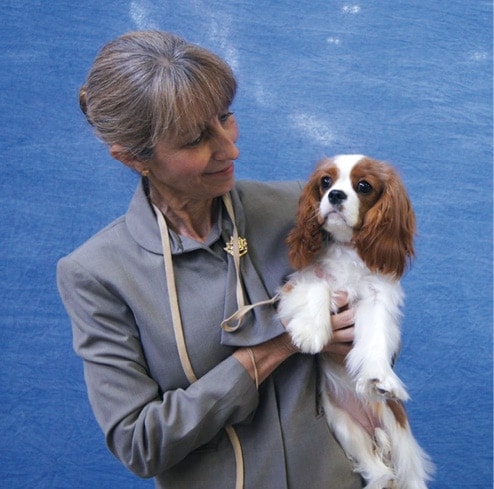
Showsight Magazine asked Breeder / Owner Handler Dr. Tracie Laliberte – Infinidad Cavaliers on her thoughts on showing her purebred dogs.
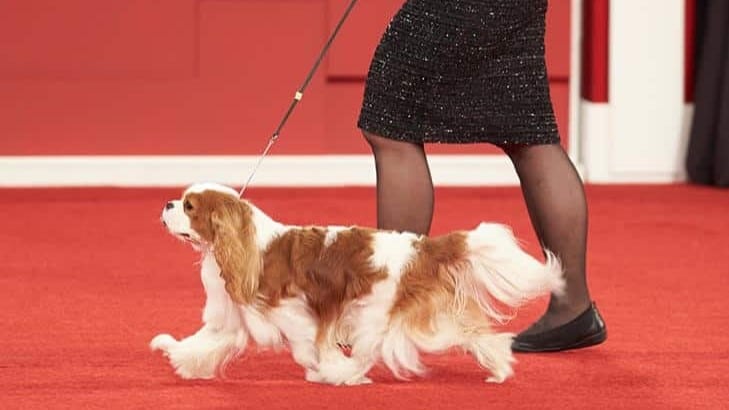
Perfect Correct Ring Presentation of Cavalier: Master natural self-stacking, graceful trotting, and showcase authentic charm with precision.
Well set on, carried happily but never much above the level of the back, and in constant, characteristic motion when the dog is in action.
A Note about Color: Blenheim - Rich chestnut markings well broken up on a clear, pearly white background. Ears must be chestnut, with color surrounding both eyes, and a white blaze. The lozenge or “Blenheim spot” on top of the head is unique and desirable, though not essential. Tricolor - Jet black markings, well broken up on a clear, pearly white background, with rich tan markings over the eyes, on cheeks, inside the ears, and on the underside of the tail. Ruby - Whole-colored rich red. Black and Tan - Jet black with rich, bright tan markings over the eyes, on cheeks, inside the ears, and on the chest, legs, and on the underside of the tail. Faults are heavy ticking on Blenheims and Tricolors; white marks on Rubies and Black and Tans.
Coat Type
Wiry, Silky
The structure of the coat this breed carries.
Coat Length
Medium
How long the breed's coat grows when kept in condition.
Adaptability Level
How easily a breed copes with changes in home, routine, noise and weather.
Mental Stimulation Needs
How much a breed needs a job, a puzzle or training to stay content.
Cavaliers are not known to be picky eaters. In fact, pet Cavaliers are frequently a few pounds overweight because their indulgent owners cannot resist their dogs’ beguiling expression.
Cavaliers are easily trained because they want to please. They make a perfect first dog for inexperienced owners. Early and ongoing socialization is important because, otherwise, they can become needy and clingy, and suffer from separation anxiety. Puppy Kindergarten classes are an excellent way to expose Cavalier puppies to other dogs of all sizes, as well as build confidence in new owners.