Members
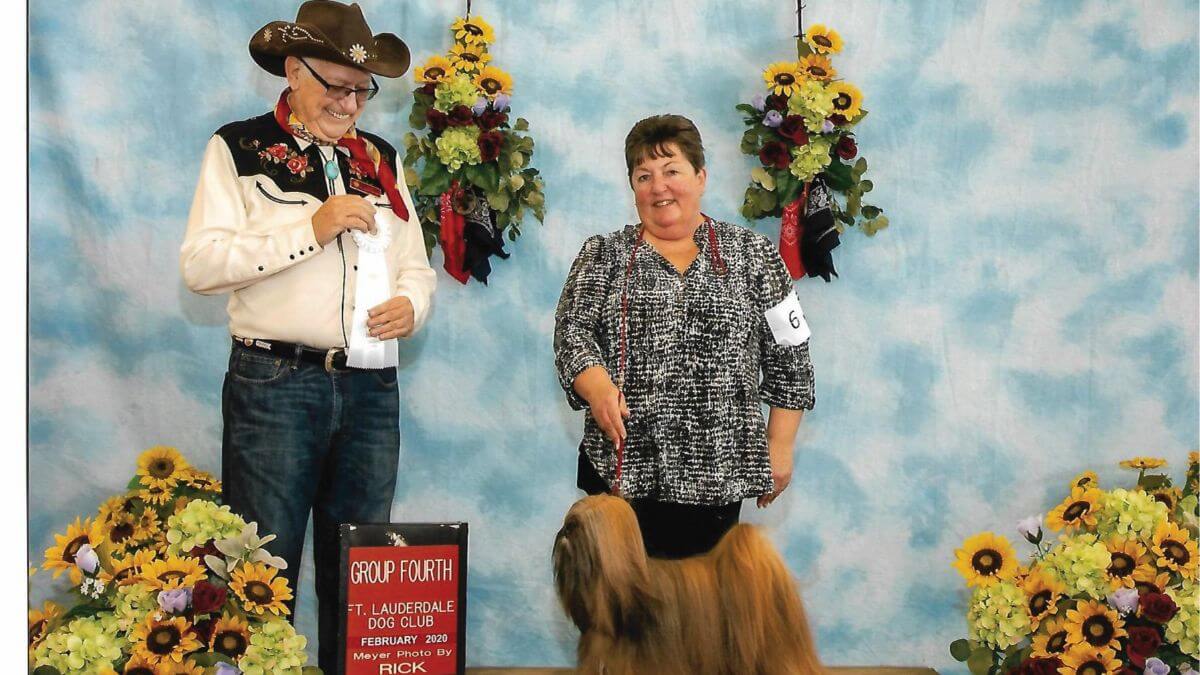
Interview with Carla and Nick Varney, breeders of Hi Tide Lhasa Apsos. Read about the kennel’s beginnings, the puppies, and more.
The Weekly Brief
The best of SHOWSIGHT editorials, weekly wins, and breeder commentary — delivered to your inbox every Sunday morning.
We are Carla and Nick Varney of Hi Tide Lhasa Apsos ROM. When I got my first dog around 1990, I got a Lhasa Apso from the Humane Society where I lived. At that time, I lived in New Hampshire. I am actually allergic to dogs and looked for a non-allergenic one. There happened to be a Lhasa Apso available. I had no idea how to train a dog, I had never had one. Of course, it did not go well, but at the same time, I know now that there was truly something wrong with that dog. It would go into a “rage” and take a while to calm down. I ended up euthanizing her. Then the vet helped me find a good breeder in my area. My first mentor, Terre Mohr, sold me her second pick of a litter at about two years old in full coat. I hadn’t intended to show her and didn’t do so for a couple of years, but I had kept her in coat and thought I would try it. I managed to finish her within a year and bred her shortly after. So, we started about 35 years ago.
We have had as many as 10 Lhasas at our very highest, but we now have only three.
The most influential dog for us was CH Singh You Sinner Of Talimer. He was a black and tan with fabulous movement. So far, we have managed to keep that original movement while improving on type, especially our heads. The next dog would be GCH Kai-la-Sha Hellfire from Dr. Cathy Marley. I currently have daughters that will be bred.
We decided right from the start that we didn’t want to get into a heavy kennel situation. We like to travel. We like to take all of our dogs with us. They live in the house, not a kennel. They are whelped in a bedroom in the house. They are then moved to the kitchen. Their best training day is football time when we are all screaming at the TV.
We never pick a dog for show. We always pick the dog with the best attributes for the breed. We don’t usually have a problem finishing it, and if it is stable enough for the Group, it will go on to be a Special.
The biggest preparation for showing a Lhasa Apso is, of course, a bath, trimming the hair out of their pads, and putting a part in their hair from head to tail. If the part isn’t correct it can impact the way the dog looks. It can impact the look of the head and the topline should it not be correct.
One of the concerns for my breed is too much emphasis on hair. This is supposed to be a sturdy mountain dog. As long as the coat is in good condition, there is no reason for it to be dragging on the ground. We don’t wrap coat or keep them in wire pens. Our dogs go outside and live like normal dogs. We won’t have it any other way. Also concerning is the lack of body. The Breed Standard says, “Chest of good depth extending to or slightly below the elbow. Prosternum well developed. Well ribbed up with the ribs extending well back towards hindquarters, strong loin, well-developed quarters and thighs.” Without the depth of chest, the dog wouldn’t even be alive in Tibet because it would not be able to breathe at the high altitude. This is one area I wish judges would pay more attention to. I’ve had so many judges not even put their hands on my dog and just run their hand over the topline. Hair hides a lot.
The Lhasa Apso can be a good family dog, but they are very good at manipulating you to get what they want. There has to be a strong alpha in control or THEY will be the alpha. They are great in any size house, including apartments, and if you keep them cut short there is not much shedding.
I think one of the biggest misconceptions about the breed is that the coat is hard to keep. This is true if you have a soft, cotton-like coat, but a good, hard coat is very easy and sheds the dirt.
I know some complain there are too many shows, but think about how busy everyone is. Having too few shows means having to travel, which can be difficult for the average family. I think media attention has helped a lot. I think/hope it helps people to see dog shows on TV and how much fun the dogs have and that they are not crated all the time. And I think it helps with getting younger people involved. I also think it has helped the perception that we are all elites, jet-setting around, when plenty are just average working people who take the time and energy to produce great dogs that are good pets and/or show dogs, and who get out to shows on the weekend. I will say, I don’t like the “big check” presentations at shows. It makes us look like we are getting “rich” off our dogs. And we all know that is not the truth, at least for the average breeder who shows their dogs themselves. I think it detracts from the fact that we do this because we love dogs.
I know some complain there are too many shows, but think about how busy everyone is. Having too few shows means having to travel, which can be difficult for the average family.
I think one positive thing that has happened in the last decade, at least in the Southeast area where I am, is that there have been a couple of breeders, including myself, who have been willing to take a chance on selling a show dog to new people. Many people worry about “protecting their pedigrees.” To be honest, many times it doesn’t work out because they can’t keep the coat, they are too busy, etc. However, we have been willing to try, and lately, we have added quite a few new fanciers in our area. It really feels great to see new people succeeding and the Lhasa Apso population growing.
Well, one day when Nick was still in the Navy, an officer asked him to go play golf on the weekend. Nick just answered without thinking that he couldn’t because he was showing his bitch that weekend. The officer then went to Nick’s superior to talk about his attitude towards women. He thought Nick said he could’t play golf this weekend because “he was showing off his bitch this weekend.”

Meet the Breeders