Members
01/Overview
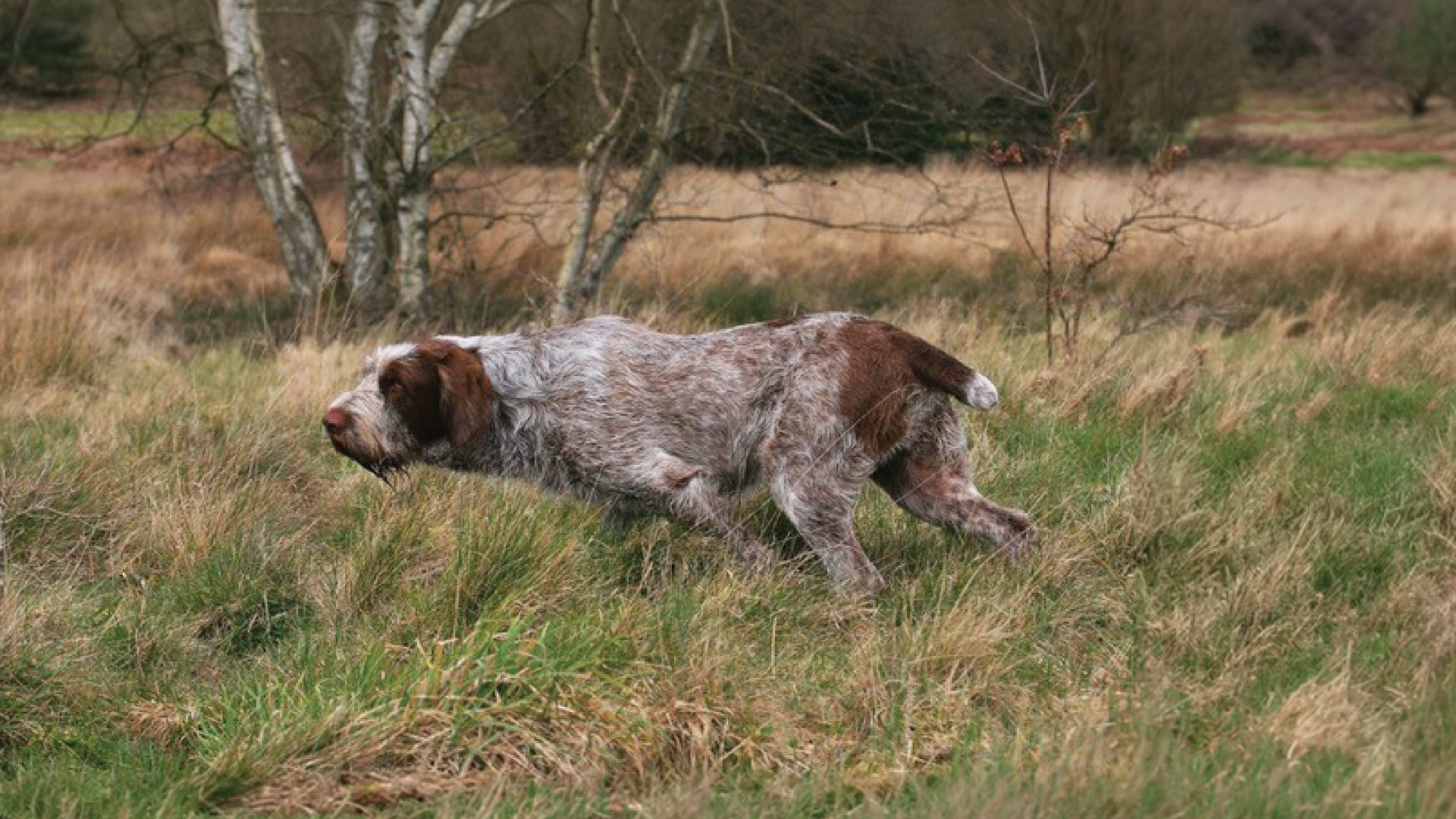
The Spinone Italiano is an ancient and versatile hunting dog, renowned for its distinctive rough coat and soulful, expressive eyes. Bred in Italy for pointing and retrieving game, this breed’s gentle nature and steady temperament make it a favorite among both hunters and families alike. Spinoni are loyal, affectionate companions that thrive best in active, loving households.
Highlights
02/History
The Spinone Italiano has a rich history as one of Europe’s oldest gundog breeds, with roots that trace back several centuries. Artistic depictions of dogs resembling the Spinone appear in Italian Renaissance frescoes, including works by Andrea Mantegna, indicating the dogs’ early role as trusted hunting companions. The breed’s name, derived from the Italian word spino (meaning thorn or briar), reflects the Spinone’s ability to navigate dense underbrush while tracking game in the rugged terrain of Northern Italy.
Believed to have descended from ancient rough-coated dogs brought to Italy by traders or invaders, the Spinone evolved to become a versatile and resilient hunter, known for its stamina and keen sense of smell. Unlike faster gundogs, the deliberate and methodical hunting style of this dog allowed it to excel in challenging environments, making it invaluable to hunters seeking precision over speed.
The Spionone faced a decline during the 20th century, particularly during the two World Wars, as economic hardship and changing hunting practices impacted its population. However, dedicated breed enthusiasts preserved the breed by focusing on its working abilities and distinctive features.
Official recognition by the Italian Kennel Club (ENCI) came in 1949, followed by recognition from the Fédération Cynologique Internationale (FCI) in 1955.
The Spinone Italiano was introduced to the United States in the mid-20th century and was officially recognized by the American Kennel Club (AKC) in 2000 as a member of the Sporting Group. Today, the breed continues to thrive as a cherished hunting partner and family companion.
03/Appearance
The Spinone Italiano is a medium-to-large-sized breed, with males typically standing 23 to 27 inches tall at the shoulder, and females measuring slightly less at 22 to 25 inches. Weight is in direct proportion to the size and structure of a dog in good working condition.
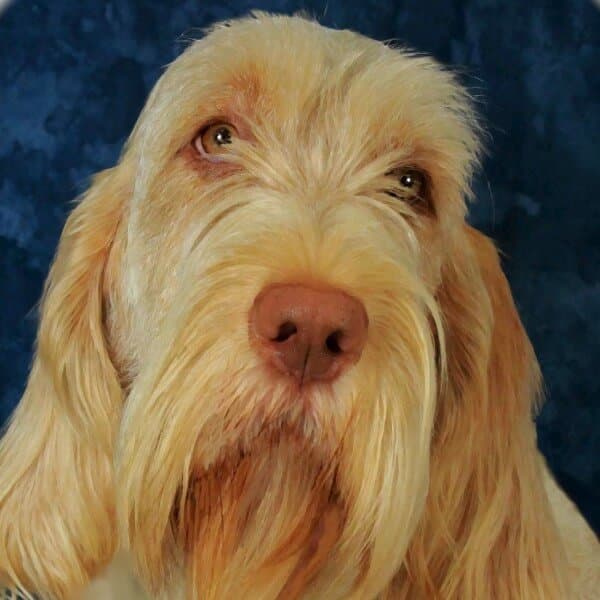
The Spinone Italiano has a squarely built frame, with a length from the point of shoulder to the point of buttock equal to that of the dog’s height at the withers. This proportional structure ensures efficient movement and stamina during extended hunts. The breed’s substance is solid and muscular, reflecting its strength and endurance without appearing heavy or coarse. And its unique topline, consisting of two segments, is a breed-distinguishing characteristic.
Texture: The Spinone Italiano’s coat is rough and dense, offering excellent protection against harsh weather and rough terrain. The hair is medium in length and lies close to the body, with a slightly wiry texture. The ideal length is 1-1/2 to 2-1/2 inches on the body but shorter on the head, ears, top of the muzzle, and fronts of the legs and feet. The back of the legs forms a rough brush without fringes, and the eyes and lips are framed by long, stiff hair forming eyebrows, and a mustache and beard..
Standard Colors
Standard Markings
04/Consider
The Spinone Italiano is a versatile and devoted breed, suitable for active families and individuals who can meet their needs for exercise, companionship, and mental stimulation. Understanding their health, personality, and care requirements is essential to fostering a happy and fulfilling relationship with this gentle yet hardworking dog.
Interaction With Family
The level of affection a breed typically shows towards family members and familiar individuals.
Good With Other Dogs
The innate friendliness of a dog towards other dogs can depend on its breed.
Good With Young Children
The degree to which a breed will typically be patient with young children.
Amount Of Shedding
How much hair a breed typically leaves behind on clothes, furniture and floors.
Frequency Of Grooming
How often a breed needs brushing, bathing or a professional trim to stay in condition.
Amount Of Drooling
How prone a breed is to drool, worth knowing before you keep a towel by the door.
Openness To Strangers
How openly a breed tends to greet new people, visitors and strangers.
Protective Nature
How likely a breed is to alert you to anything unfamiliar, and stand between you and it.
Playfulness Level
How enthusiastic a breed stays about games and play well past puppyhood.
Trainability Level
How readily a breed takes direction and works with you rather than around you.
Barking Level
How much a breed uses its voice, and how readily.
Energy Level
How much get-up-and-go a breed brings to an average day.
Health
The Spinone Italiano is a generally healthy breed with a lifespan of around 10 to 12 years. Regular veterinary care and a balanced lifestyle contribute to a long and happy life for this robust yet gentle dog.
The Spinone Italiano is a gentle, affectionate breed, known for its steady temperament and strong connection with its human companions. Spinoni thrive on interaction and are excellent family dogs, being patient with children and sociable with other pets. While their calm demeanor makes them suitable for novice owners, they require consistent engagement to prevent boredom.
The friendly nature of the breed extends to strangers, and Spinoni rarely display aggressive tendencies. Although not excessively vocal, they may bark to alert their family of strangers or unusual activity. They are sensitive dogs, responding best to positive reinforcement and patient training, and they do not adapt well to being left alone for extended periods.
Exercise Expectations
Although not as high-energy as some other gundog breeds, Spinoni enjoy long walks, hikes, swimming, and any opportunity to explore their environment. Regular exercise helps to prevent boredom, which can lead to undesirable behaviors like chewing or vocalizations. Their playful nature makes them wonderful companions for families that enjoy an active lifestyle.
Grooming Expectations
The Spinone Italiano adapts well to various living environments, provided their exercise and companionship needs are met. These sweet yet opinionated dogs can thrive in an apartment if given ample outdoor activity, but they are ideally suited to homes with a yard where they can roam and play. Their rough coat offers decent protection in cold weather, though they should not be left outside for prolonged periods in extreme cold. In hot weather, they need access to shade and fresh water, as their thicker coat can make them prone to overheating.
Spinoni are affectionate and enjoy being part of the family, often seeking out their human companions for attention and cuddles. Their calm nature indoors makes them suitable for homes with children and other pets. They do best in a home where they are not left alone for long periods, since they form strong bonds and can develop separation anxiety.
05/Puppies
Spinone Italiano puppies are playful, affectionate, and filled with curiosity, making them a delightful addition to any family. These pups grow into strong and capable dogs, but their early months are a critical period in their development. Proper care throughout puppyhood is needed to lay the foundation for a well-behaved and happy adult companion.
Caring for a Spinone Italiano puppy requires patience, consistency, and a structured routine. Early socialization is key, exposing the pup to various environments, people, and animals that will help to build confidence and establish good manners. Positive reinforcement training works best, as Spinoni are eager to please but may show some independence at times.
The Spinone puppy should be fed high-quality large-breed puppy food, divided into three to four meals a day to support steady growth and prevent overfeeding. Exercise should be moderate throughout the first year of life to protect developing joints. Short walks and supervised play sessions are best. Grooming should start early to get the puppy accustomed to brushing, nail trimming, and handling.
06/Activities
Gallery
07/Standards
The Spinone Italiano is recognized by the world's leading registries and kennel organizations, which categorize the breed into a specific Group based on its unique characteristics. This breed is recognized worldwide under the following Group designations:
The ideal Spinone Italiano is described by a Breed Standard that is approved by each of the world’s leading registries and kennel organizations. The Breed Standards for this breed may be found in the following links:
08/Clubs
09/Rescue
10/Facts
Ancient Origins
The Spinone Italiano is one of Europe’s oldest gundog breeds, with depictions in Italian art dating back to the Renaissance.
“Monk’s Habit” Brown
The Spinone’s most prized shade of brown, known as "monk’s habit," is a deep chestnut color that reflects the breed’s Italian heritage and its connection to the rustic countryside.
Unique Hunting Style
Unlike faster gundogs, the Spinone Italiano hunts at a steady pace, making the breed ideal for rugged terrain and dense cover where precision is more important than speed.
Webbed Feet
Spinoni have webbed feet, which make them excellent swimmers and highly capable of retrieving game from water.
Beard and Eyebrows with Purpose
The Spinone Italiano’s characteristic beard and pronounced eyebrows are not just for looks—they help to protect the dog’s face from thorns and debris while hunting in dense vegetation.
11/FAQ
Yes, Spinone Italiano dogs shed moderately despite their wiry coats. Regular brushing helps to control shedding and keeps the coat healthy and tidy.

Written by
Dan Sayers is the Executive Editor of SHOWSIGHT. He is a member of the World Dog Press Association and the Dog Writers Association of America, which recognized his illustrations in the award-winning Encyclopedia of K-9 Terminology. Dan is a longtime supporter of the sport of dogs and an advocate for the conservation of recognized breeds in all their forms and functions. He is a member of the Morris and Essex Kennel Club, and for 45 years, the Irish Water Spaniel Club of America where he serves as AKC Delegate, Archivist, and approved Breed Mentor. Dan breeds under the Quiet Storm prefix and has judged the IWSCA National Specialty Sweepstakes twice.
Official Standard of the Spinone Italiano
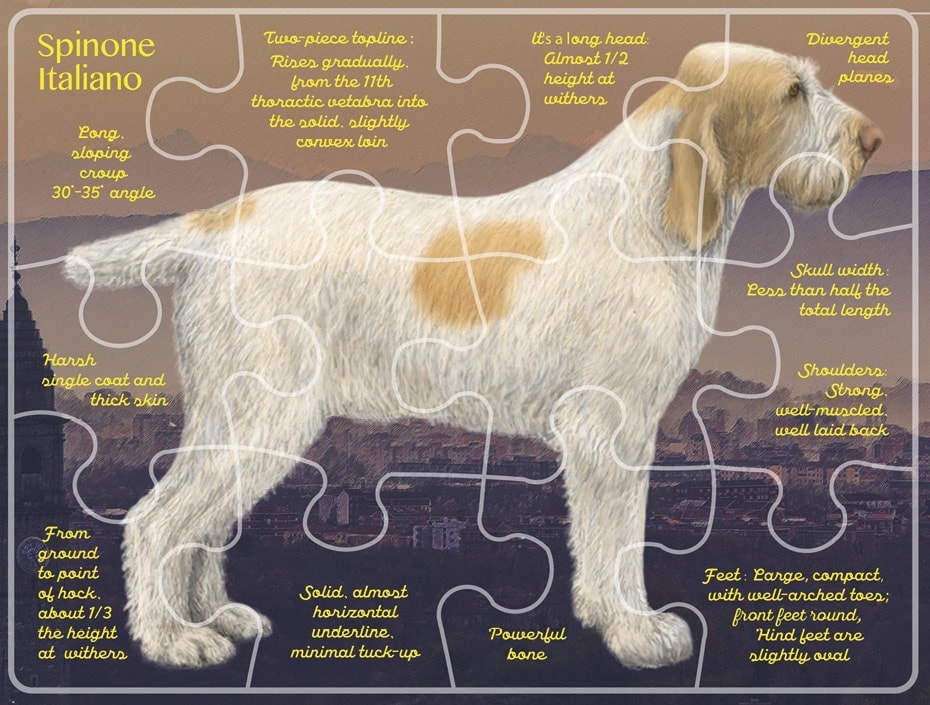
General Appearance: The Spinone has a distinctive profile and soft, almost-human expression. The breed is constructed for endurance. Muscular, vigorous and with powerful bone, the Spinone has a robust build that makes him resistant to fatigue and able to work on almost any terrain; big feet and a two-piece topline give the dog stability on rough ground. The Spinone covers ground efficiently, combining a purposeful, easy trot with an intermittent gallop. A harsh, single coat and thick skin enable the Spinone to negotiate underbrush and endure cold water that would punish any dog not so naturally armored. This versatile pointer is a proficient swimmer and an excellent retriever by nature. The Spinone is patient, methodical and cooperative in the field, and has a gentle demeanor.
Size, Proportion, Substance: The height at the withers is 23½ to 27½ inches for males and 22½ to 25½ inches for females. Weight: In direct proportion to size and structure of a dog in working condition. Proportion: His build tends to fit into a square. The length of the body, measured from the point of the shoulder to the point of the buttocks, is equal to or slightly greater than the height at the withers. Substance: The Spinone is a solidly built dog with powerful bone.
Head: Long, with muzzle length equal to that of the backskull. The length of the head is equal to 4/10 of the height at the withers; its width measured at the zygomatic arch is less than half of its total length. The profile of the Spinone is unusual. The occipital protuberance is well developed, and the upper longitudinal profiles of the skull and muzzle are divergent, downfaced, i.e., if extended, the top line of the muzzle emerges in front of or tangential to the occipital protuberance. A dish-faced muzzle is to be faulted so severely as to eliminate from further competition. The skull is oval, with sides gently sloping from the sagittal suture in a curve to the zygomatic arch. Cheeks are lean. The medial-frontal furrow is very pronounced. Muzzle - Stop is barely perceptible. Bridge of the muzzle is straight or slightly Roman. Square when viewed from the front. The width of the nasal bridge measured at its midpoint is a third of its length. The upper lips are rather soft and are rounded in front. The lower profile of the muzzle is created by the lower line of the upper lip. Eyes - A soft sweet expression is of paramount importance to the breed. It shall denote intelligence and gentleness. Ochre (a soft golden brown) in color, darker eyes with darker colored dogs, lighter eyes with lighter colored dogs. The eyes are large, almost round, well opened, and set well apart on the frontal plane. The lid fits the eye closely. The eye is neither protruding nor deep set. Eye rim is clearly visible and will vary in color from flesh colored to brown depending on the color of the dog. Loose eyelids must be faulted. Disqualification - Walleye (an eye with a whitish iris; a blue eye, fisheye, pearl eye). Nose -Large, bulbous and spongy in appearance with a rounded upper edge. Nostrils are large and well opened. In profile, the nose protrudes past the forward line of the lips. Pigment is a rosy flesh color in white-and-orange dogs, brown in brown-and-white or brown-roan dogs; in solid-white dogs, it can range from flesh colored to brown. Disqualification - Any pigment other than described or total depigmentation of the nose. Teeth - Jaw is powerful; at mid-length, the sides of the mandible are very lightly curved. Teeth are positioned in a scissors or level bite. Disqualification - Overshot or undershot bite. Ears - Almost triangular in shape with a slightly rounded tip, they are set on a level with the eye; long, but not more than 2 inches below the line of the throat; pendulous, carried close to the head and with little erectile power. The leather is fine, covered with short, thick hair mixed with longer sparser hair, which becomes thicker along the edges. The forward edge is adherent to the cheek, not curled, but turned back on itself.
Neck, Topline, Body: Neck - Strong, thick, and muscular, clearly defined from the nape, blending into the shoulders in a harmonious line. The length of the neck shall not be less than two-thirds of the length of the head. The throat is moderate in skin with a double dewlap. Chest -Broad, deep, well-muscled and well rounded; extending at least to the elbow. The ribs are well sprung. The distance from ground to the elbow is equal to ½ the height at the withers. Back -The topline consists of two segments. The first slopes slightly downward in a nearly straight line from the withers to the eleventh thoracic vertebra. The second rises gradually and continues into a solid and slightly convex loin without rising above the withers. The underline is solid. It is almost horizontal in the sternal region, then ascends only slightly towards the belly; there is minimal tuck-up. Croup - Wide, well-muscled, long. The hipbones fall away from the spinal column at an angle of about 30 to 35 degrees, producing a lightly rounded, well filled-out croup. Tail - Follows the line of the croup, thick, with no fringes. The tail is carried horizontally or down, flicking from side to side while trotting. The tail is customarily docked to a length of 6 to 10 inches. The structure and carriage of an undocked tail are consistent with those of a docked tail.
Forequarters: Shoulders - The shoulders are strong, well-muscled, long and well laid back; they are capable of moving freely and form an angle with the upper arm of approximately 105 degrees. The tops of the shoulder blades are not close together. The upper arm is of equal length to the shoulder blade. Angulation of shoulder is in balance with angulation in the rear. Forelegs: The forelegs are straight when viewed from the front, with strong, oval bone, well-developed muscles and well-defined tendons; elbows are set under the withers and close to the body. Pasterns are long, lean and flexible, following the vertical line of the forearm. In profile, they are slightly slanted. Feet - Front feet are large, compact, rounded, with well-arched toes which are close together, covered with short, dense hair, including between the toes. Pads are lean and hard with strong nails curving toward the ground, well pigmented, but never black. Dewclaws may be present.
Hindquarters: Thighs are strong and well-muscled, stifles show good functional angulation, lower thigh to be well developed and muscled with good breadth. The distance from the point of the hock to the ground is about one-third of the height at the withers, and the rear pastern is strong, lean and perpendicular to the ground. Feet - The rear foot is slightly more oval than the forefoot, with the same characteristics. Dewclaws may be present on the inner side of the rear pastern.
Skin: The skin must be very thick, closely fitting the body. The skin is thinner on the head, throat, groin, under the legs and in the folds of the elbows, where it is soft to the touch. Pigmentation is dependent upon the color or markings of the coat. Disqualification: Any black pigmentation.
Coat: A Spinone must have a correct, harsh, single coat to be of correct type. There is no undercoat. The ideal coat length is 1½ to 2½ inches on the body. The hair is shorter on the head, ears, and along the top of the muzzle and front sides of legs and feet. The hair on the backsides of the legs forms a rough brush, but there are never any fringes. The eyes and lips are framed by long, stiff hair forming eyebrows, mustache and beard. The coat is coarse, dense and rather flat. The Spinone is exhibited in a natural state, in accordance with his function as a field dog.
Color: The accepted colors are: Solid white, white and orange; orange roan with or without orange markings; white with brown markings, and brown roan with or without brown markings. The most desired color of brown is a chestnut, "monk’s habit" brown, however, other shades of brown are acceptable. Disqualification - Any black in the coat, tri-color in any combination, tan points or any color other than accepted colors.
Gait: He has a free, relaxed trot, geared for endurance. This trot, with intermittent gallop, allows the Spinone to cover maximum ground with the least amount of effort. Profile of the topline is kept as the dog trots.
Temperament: Sociable, docile, affectionate and patient.
Faults: Any departure from the foregoing points constitutes a fault which when judging must be penalized according to its seriousness and extent. Any characteristic that interferes with the accomplishment of the function of the Spinone shall be considered a serious fault. Disqualifications Walleye (an eye with a whitish iris; a blue eye, fisheye, pearl eye.) Any pigment other than described or total depigmentation of the nose. Overshot or undershot bite. Any black pigmentation. Any black in the coat; tri-color markings in any combination, tan points or any color other than accepted colors.
Approved August 14, 2018
Effective January 1, 2019
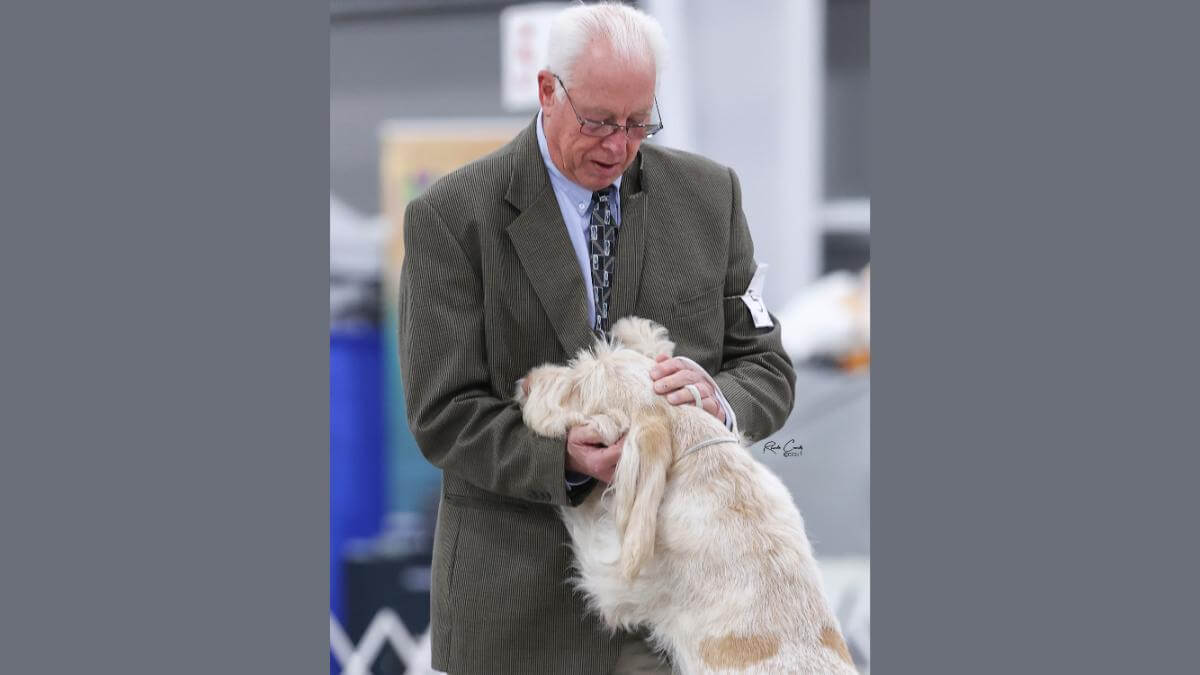

Meet the Breeders
Join John Brusk as he shares his journey as a breeder/owner handler, his passion for Spinoni & Gordons, and insights into NOHS.
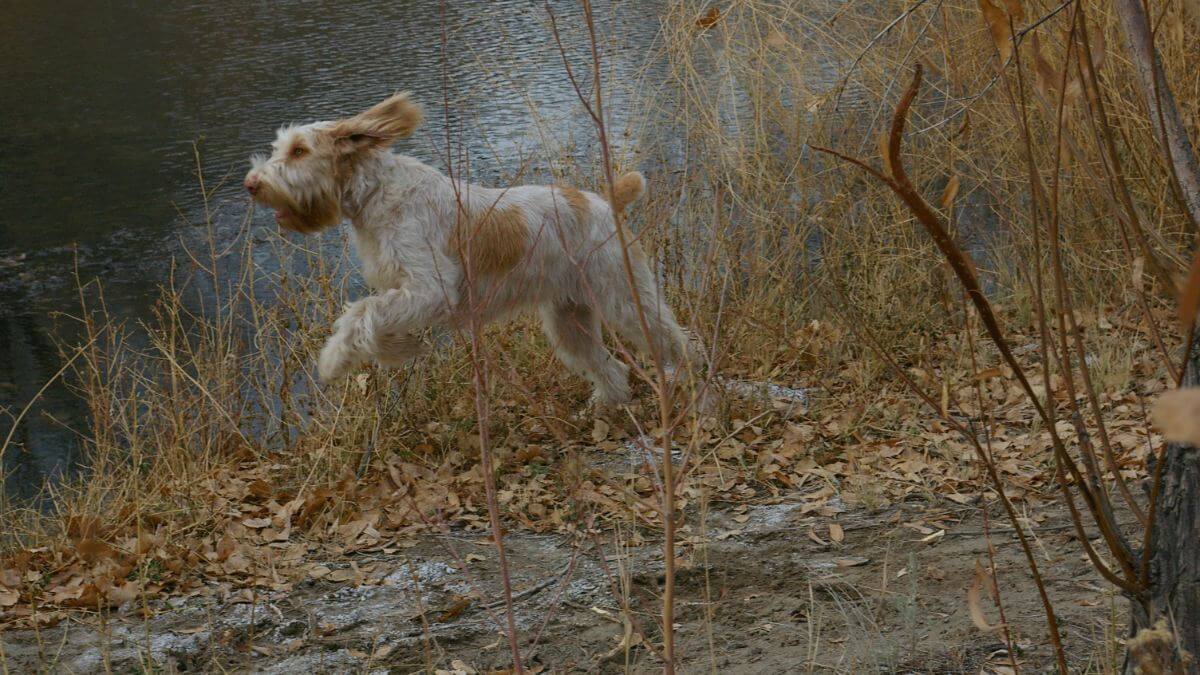
Explore key judging insights for Spinone Italiano, including head planes, toplines, movement, and coat quality considerations.
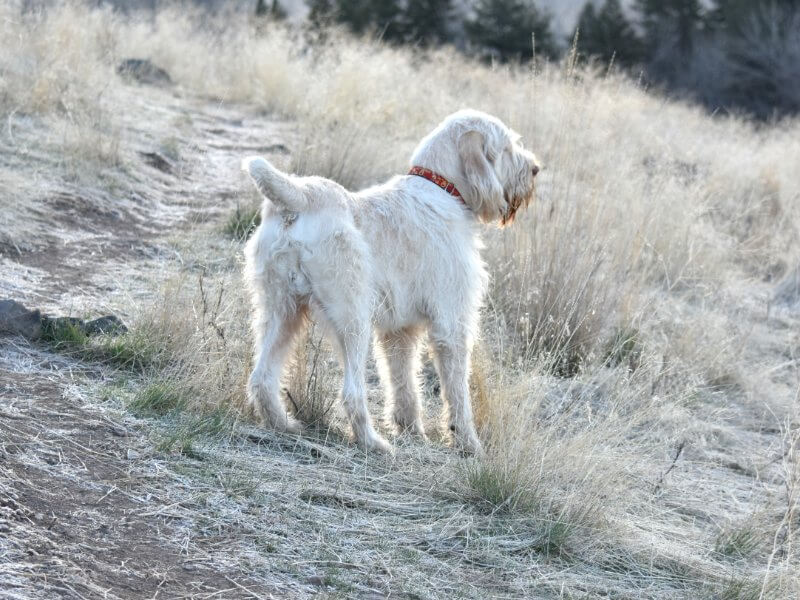
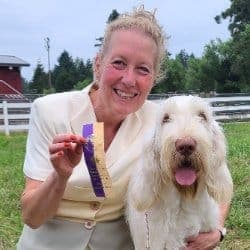
Explore the origins and remarkable qualities of the Spinone Italiano, a hunting breed known for its methodical yet determined nature.
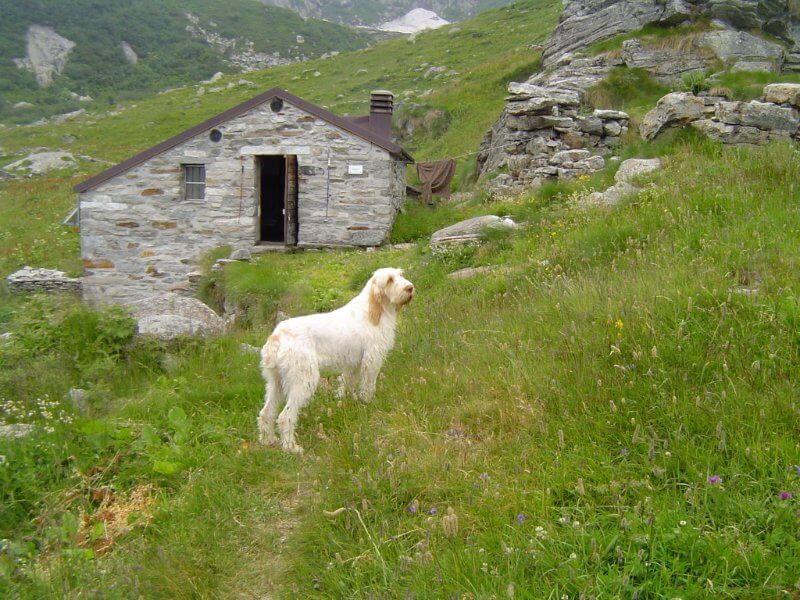
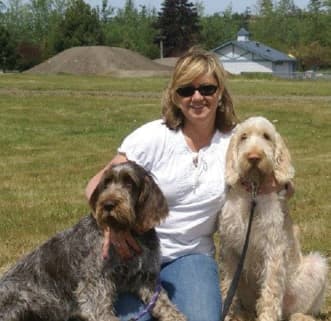
Explore the history, features, and puzzle of the Spinone Italiano, a versatile hunting breed with a distinctive head and gentle temperament.


Meet the Breeders
Claire Wisch Abraham is the breeder behind Mountain View German Wirehaired Pointers. Read about the kennel’s beginnings, the dogs, and more!
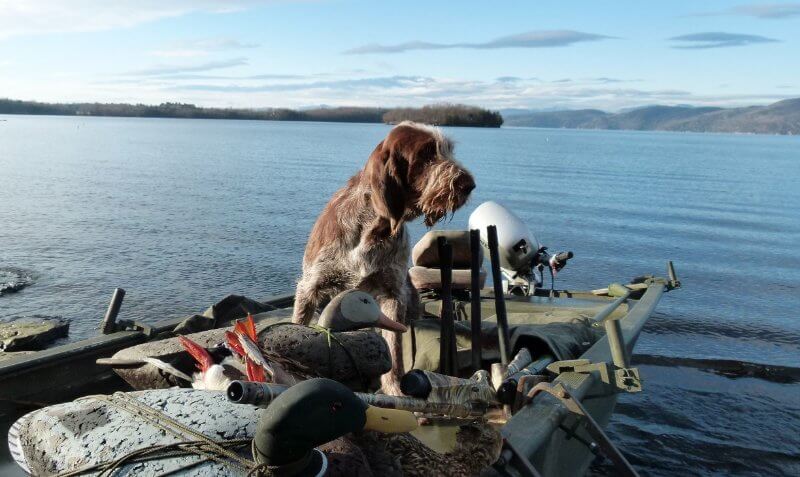
Learn more about living with a Spinone Italiano dog; personality, temperament, nutrition, health, and everything else you need to know.
All About Judging
Win with Humility and Lose with Grace | This Is a Mantra for All Exhibitors“The Thrill of Victory, The Agony of Defeat.” This was the opening
The Spinone Italiano’s tail is traditionally docked, typically to about half its natural length. In its natural state, the tail is thick at the base and tapers to a point, reaching the hock. It is carried level or slightly raised when the dog is in motion.
A Note About Color: The recognized coat colors for the Spinone Italiano include solid white, white and orange, orange roan with or without orange markings, white with brown markings, and brown roan with or without brown markings. The preferred shade of brown is a rich chestnut, often referred to as "monk’s habit" brown, though other shades of brown are also acceptable. Any presence of black in the coat is not permitted, as is tri-color in any combination.
Coat Type
Wiry
The structure of the coat this breed carries.
Coat Length
Medium
How long the breed's coat grows when kept in condition.
Adaptability Level
How easily a breed copes with changes in home, routine, noise and weather.
Mental Stimulation Needs
How much a breed needs a job, a puzzle or training to stay content.
The Spinone Italiano thrives on a balanced diet that supports the breed’s moderate activity level and sturdy build. Puppies should be fed high-quality food designed for large-breed puppies, divided into three or four meals daily to promote steady growth.
As adults, Spinoni typically require 2.5 to 4 cups of food per day, split into two meals to maintain energy levels and avoid bloat. Portion sizes depend on their age, weight, and activity level, so monitoring their overall condition is essential to prevent obesity. Fresh water should always be available, and it is best to consult with a veterinarian or the dog’s breeder to determine a diet tailored to a dog’s individual needs.
The Spinone Italiano is intelligent and eager to please, making training a rewarding experience when approached with patience and positive reinforcement. The breed responds well to consistency and encouragement but may become resistant if training is overly harsh or repetitive.
Spinoni are naturally cooperative and excel in obedience and fieldwork, though they may exhibit occasional independence due to their natural hunting instincts. Early socialization is crucial to help them grow up to become well-rounded dogs, while basic obedience commands lay the foundation for advanced training. With their docile and sociable temperament and strong bond with their human companions, these versatile dogs thrive in training environments that are engaging and supportive.
Bathing is only necessary when the Spinone becomes particularly dirty, as overbathing can strip the coat’s natural oils. Cleaning the beard frequently is important to prevent residue buildup from food and water. Routine care, including nail trimming, ear cleaning, and dental hygiene, will make sure this extraordinary bird dog stays comfortable and healthy.