Members
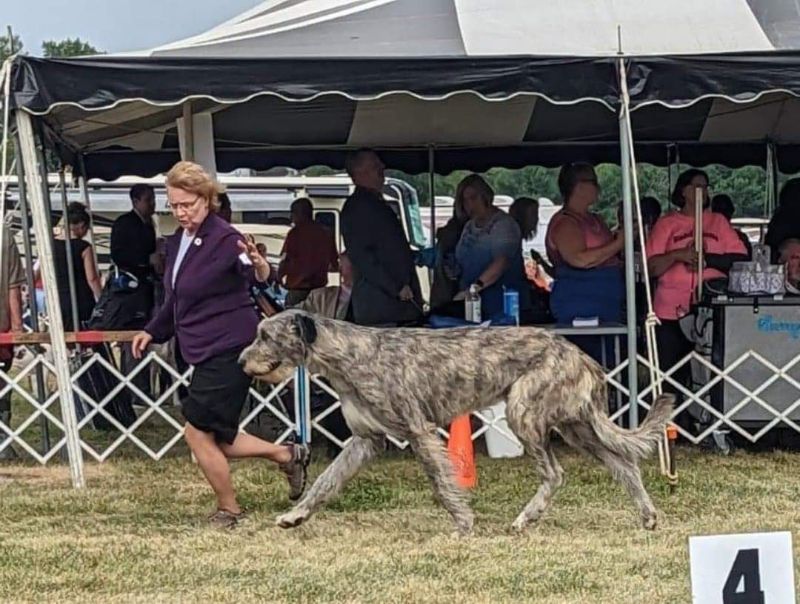
Jeanie Pitzenberger is the breeder behind the Boondocks Irish Wolfhounds. Read about the kennel’s beginnings, the puppies, and much more!
The Weekly Brief
The best of SHOWSIGHT editorials, weekly wins, and breeder commentary — delivered to your inbox every Sunday morning.
Jeanie Pitzenberger: I live in Southeast Iowa outside of Nichols. I started in Irish Wolfhounds in 2006, buying my first, and in 2009 I purchased my second. I had gone to a show with the second hound and liked it. He was just a pet, and just like how a lot of people get started, he was not from reputable breeder. I did learn a lot from showing him, though. I then found a couple of quality, reputable breeders who mentored me and I had my first liter in 2015. It has been a thrilling ride since.
Jeanie Pitzenberger: My kennel name is Boondocks and is a registered kennel name with the American Kennel Club. I currently have 11 Irish Wolfhounds.
Jeanie Pitzenberger: My foundation bitch, GCHB Brimstone Boondocks Serenity (River) started me out with two Best of Opposite Sex in Specialty wins. She competed in the NOHS since its inception and we did very well. I have had two different puppies win Best Puppy in Sweepstakes. I have won two Specialties, one with a bitch I bred and another with a bitch from a great kennel in California (Rysheron). In the last few years, my dogs have won a Best in Show, two Reserve Bests in Show, 12 Hound Group Ones, and multiple other Hound Group placements. My current special, CH Boondocks Mountain Ash, is doing very well at Specialties, All-Breed Shows, and with the NOHS.
Jeanie Pitzenberger: My most influential dam is GCHB Brimstone Boondocks Serenity (River) and the sire is CH BISS Nightwing’s Silencer. “Silencer” was our National Specialty winner in 2017. I had bred to him in 2015. Although I currently have a girl that I bred, last year was her first time in the show ring. I went to back-to-back Specialties in June. She went WB both days (she had never been in the ring before), and she is the dam of my current special, CH BIS RBIS MBISOH Boondocks Mountain Ash.
Jeanie Pitzenberger: I have four large yards where my dogs are separated according to size, gender, and personality. All puppies are whelped in my house in a room set up just for that purpose. I used chalkboard paint on two walls because it is so easy to jot down notes such as weight, date of nail trims, etc., and then transfer all that information into my binder. I use a combination of Puppy Culture and Avidog techniques with all puppies. None of puppies leave until 12 weeks of age and only after they are liver shunt tested. I register all the puppies myself and enroll them in AKC Reunite at the time of registration.
Jeanie Pitzenberger: I start watching my puppies’ movement from the time they get up on their legs and start moving out across their yard. I can sit for hours watching them play with each other, running through the tunnels and tugging on the toy gym. I am always looking for that sound movement, even as babies. I watch their little toplines and how they naturally stand when they finally do stop.
Jeanie Pitzenberger: I would like to start becoming active in some Performance Events such as Fast CAT or LGRA. I do find that I run out of time. (I own a flooring company, am an active member with my parent club, and I am also president of a newly formed AKC Club, the Iowa Hound Association, so my time is limited.) The Iowa Hound Association has been accepted by AKC to be on their accelerated program. We just finished our Sanctioned B Match in October. We are hopeful that our Sanctioned A Match will be successful, and that in 2024 we can start planning to hold a Hound Specialty.
Jeanie Pitzenberger: Conditioning is very important in my breed. I cannot stress enough that an Irish Wolfhound needs exercise. There is nothing worse than seeing an obese Wolfhound—and I see a lot, even in the ring. Yes, Irish Wolfhounds love to lay on your couch, but they do need to get out and gallop.
Jeanie Pitzenberger: Before breeding, our parent club recommends OFA hips, elbows, heart, and eyes. All Puppies need to be liver shunt tested before they go to their new homes. This is the responsibility of the breeder and not the new owner. The new owner should not be charged an additional fee either, to have the puppy liver shunt tested. That is ridiculous and the “for profit only” kennels are doing that.
Jeanie Pitzenberger: Irish Wolfhounds are wonderful pets, but they do need a physical fence. They are large, powerful sighthounds. I will not sell a puppy to someone without a fence. My guys have prey drive and they must be fenced. My neighbors would not be happy if I let my guys run loose. (I can only imagine the damage they could do to the calves or goats.)
You must make your puppy buyers know that these are independent hunters. If they see something, they will chase it.I read constantly on social media that you just need to teach them recall. Sorry, but once they focus on that prey they could care less that you are calling them. I have spoken to many canine officers in the army and in law enforcement, and they will tell you truthfully that no dog is 100 percent, no matter how well-trained you think it is.
Irish Wolfhounds also need to learn house manners because of their size. All my guys rotate in the house and everyone also learns RV manners for when we go to shows. And their tails could be considered a dangerous weapon; boy does it hurt when they really start whipping them around and you get whacked with one on your legs, or even in the face if you are bent over. That will leave a bruise!
Jeanie Pitzenberger: I sometimes think judges tend to look at just size; it happens a lot in all species. In the 1980s, Arabian horses went through a “bigger is better” time—and still might be going through it. There are a lot of Irish Wolfhounds in the ring today that are just plain obese and unsound. Please remember, bigger is not better and “great size and commanding appearance” does not equate to big fat hairy mastiffs. And having that tail tucked tight up to their belly is not commanding either.
Jeanie Pitzenberger: For new people, please find a quality, responsible breeder to mentor you. My first two Wolfhounds came from totally bad kennels that were only interested in making money. Thankfully, the first one no longer breeds, but the second one is going strong, hiring PHs to put a CH in front of the name to sell more puppies. If a new person is serious, I suggest they go to as many Specialties as they can. We, of course, have our National Specialty. This year it is in McKinney, Texas, and next year it’s at Purina Farms.
We also have numerous Regional Clubs that put on Specialties throughout the country, many of them back-to-back. They are a great way to meet the old preservation breeders and see some lovely, lovely hounds. If a new person wants to meet quality, responsible breeders, they must go to Specialties. Specialties, for us, are more important than all-breed (AB) shows. If a Specialty and an AB show that I am interested in are on the same weekend, I am going to the Specialty. I do a fair amount of AB shows, and really like them, but my priorities are the Specialties. If a new person meets someone who does not go to Specialties, they are not a quality, responsible breeder.
The best way to ensure a long and happy relationship with a purebred dog is to purchase one from a responsible breeder. Not sure where to begin finding a breeder?
Contact the National Parent Club’s Breeder Referral person, which you can find on the AKC Breeder Referral Contacts page.
Did you know nearly every recognized AKC purebred has a dedicated rescue group? Find your new best friend on the AKC Rescue Network Listing.
Showsight Magazine is the only publication to offer dedicated Digital Breed Magazines for ALL recognized AKC Breeds.
Read and learn more about the Irish Wolfhound dog breed with articles and information in our Irish Wolfhound Breed Magazine.
If you enjoy the Irish Wolfhound Breed Magazine, help us educate the community by sharing it.

Meet the Breeders