Members
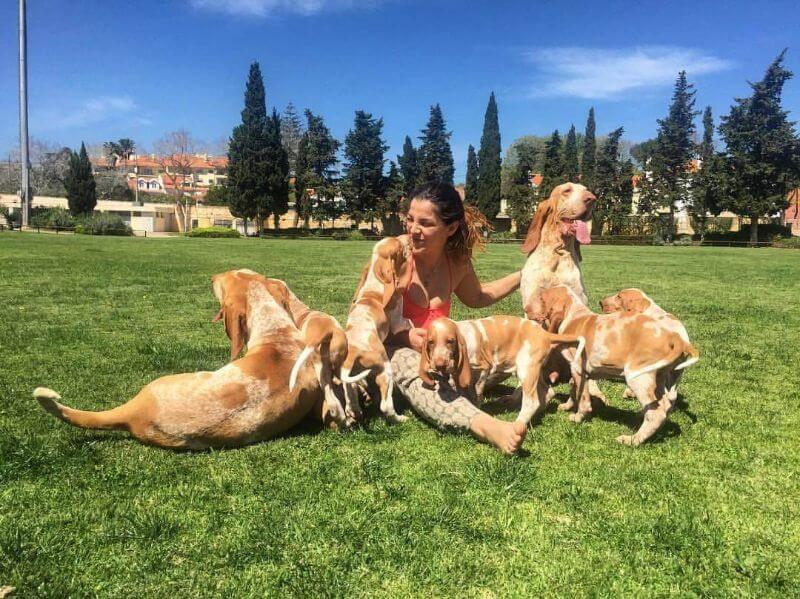
Raquel Colaco is the breeder behind the Raki’s Place Bracchi Italiani. Read about the kennel’s beginnings, the puppies, and much more!
The Weekly Brief
The best of SHOWSIGHT editorials, weekly wins, and breeder commentary — delivered to your inbox every Sunday morning.
Raquel Colaco: Hello! I’m Raquel Colaço and I live in Portugal at the beautiful Village of Sintra. Since I was born, I have always been with dogs. I don’t remember my life without dogs. My interest as a breeder started with my mom’s Weimaraner, who was my first show dog. I was six years old. Then we saw the Bracco Italiano in magazines, read about the breed, and decided to go to Italy to visit some kennels. We fell in love.
My first Bracco Italiano, 20 years ago, was Delor the Ferrabouc Paolina Borgese. The founder of this kennel, Fernando Delor de Ferrabouc, is a huge reference to the breed who helped with preventing its extinction, and “Paolina” was for sure a true Bracco.
Raquel Colaco: My kennel name is Raki’s Place. “Raki” is my nickname that my mother founded for me. Currently, I have the old ones (they deserve more than anything) that are four, the younger two, and two puppies.
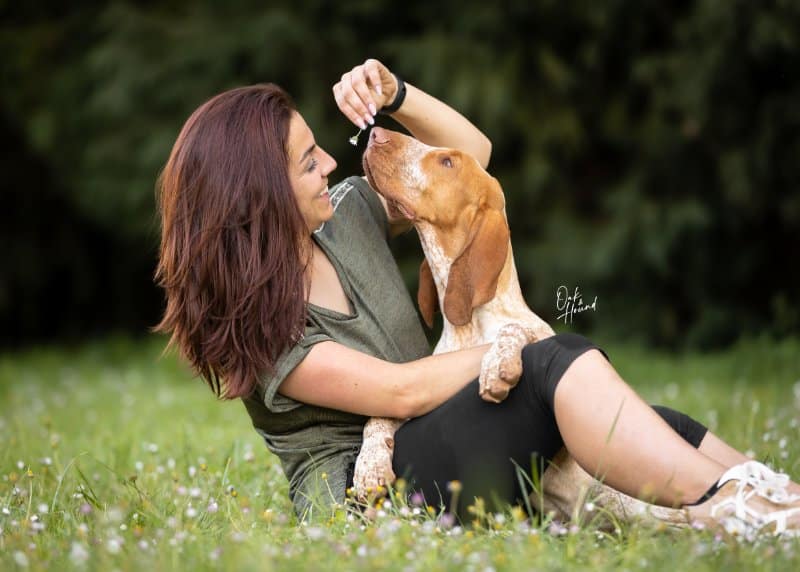
Raquel Colaco: Happily, I have some! Nicodemo Del Tavuliddaro, “Nico,” was my one-in-a-million, just not the perfect dog because there are no perfect dogs. Freisa de Val Ravanaga was a golden girl too. Then, bred by us, the most noteworthy winners we have are “Hian,” “Hypsea,” and “Parma.” Hypsea is really my pride as a breeder.
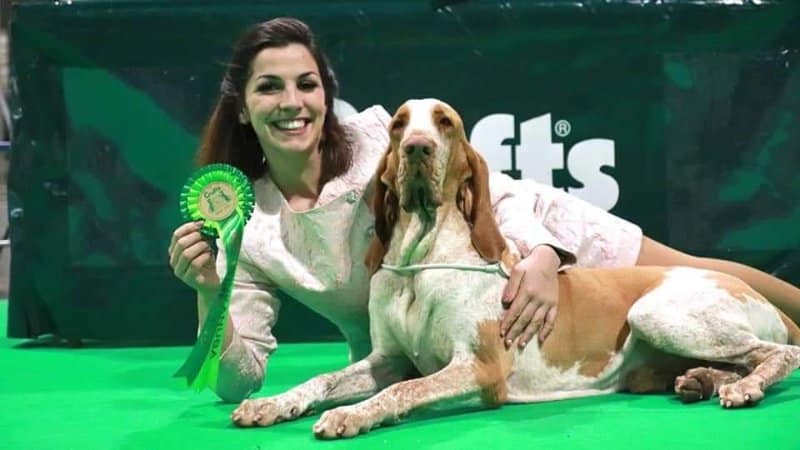
Raquel Colaco: The most influential sire, for sure, was Nico. The dams have been Olimpia del Tavuliddaro and Raki’s Place Hypsea. They gave us wonderful puppies. We do not often have litters. We just do so when we want to keep a puppy for ourselves.
Raquel Colaco: We have kennels, but we don’t use them—hahaha. We have one hectare [2.47 acres], and they are free to be wherever they want. We also have a large room next to ours where they can rest and be with us. They live with us, and that’s the only way we understand. As already told, we just do a few litters when we want to keep a puppy. All litters are born in our room, and they stay for four weeks, at least. We stay next to them all the time. As the litter grows, we change spaces and activities. Everything changes according to age and needs, but always with us.
Raquel Colaco: Selecting puppies is not easy. I know people who have even said that they can select when the puppies are born… but, in conformation, we can see at around 6 to 8 weeks. After that there comes a phase of ugly ducklings. Concerning in terms of temperament, as we all know, the Bracco is a very sensitive breed, and in the junior phase it is necessary to be very careful; be patience so as not to destroy it. In the field, they are always kings, for company too. A show dog has to like to show off. We have to go see the puppies and work on it.
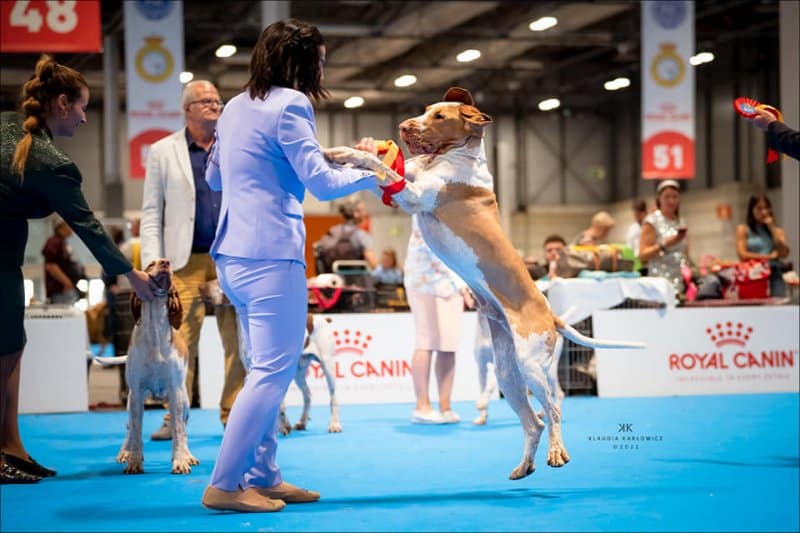
Raquel Colaco: We compete in Conformation dog shows.
Raquel Colaco: We are not hunters, but I do find this is important for the breed too. I do the first innate test on the puppies and have some of my puppies working, with wonderful results. Of course, we find the field trials and hunting are important. This is the purpose of the breed, but not all dogs are innate hunters. This doesn’t stop them from being Bracchi and having a fantastic life in another function, like with the disabled. I’ve already had mine do that job and they are wonderful. The important thing is to keep them busy in a task to be balanced.
Raquel Colaco: They do not have big health problems. My dogs are all tested for elbow and hip dysplasia. They are big dogs, so the best is to test. I know that some lines have kidney problems; I never had this in my own. Ears need to be checked a lot, and more often if they are in fields. Nutritionally, I find Bracchi are very easy even if they eat a lot—hahaha. Mine are fed with Royal Canin, special for working dogs, or Maxi for the ones who do not work. At the age of puppies, supplement them with condroprotector, chondroitin, and extra vitamin C.
Raquel Colaco: Yes, I think so. In Italy, there are a large number of breeders, and a few more out there who do a great job.
Raquel Colaco: Yes, they are wonderful family dogs even though I know that they are not for everyone. For me, the best candidate is a family, a family who works with them no matter which trial (Hunting, Agility, Obedience, or any other long walks) lets them show their abilities. And they can be a family dog too. They are a very sensitive breed. A wrong interpretation of their behavior can destroy the temperament. They are an easy training breed, and if you do right by a puppy, you are going to have a very well-balanced adult dog.
Raquel Colaco: I think there are two biggest misconception. First, in show dogs, because Bracchi are beautiful movers, it doesn’t mean that every one can show; they need a very strong connection with the “handler” to feel safe for showing. Second, in hunting, they have a very different way to work. Whoever really wants a Bracco needs to think before they have one.
If we have the breed’s best-kept secret, the best is for them to stay like that.
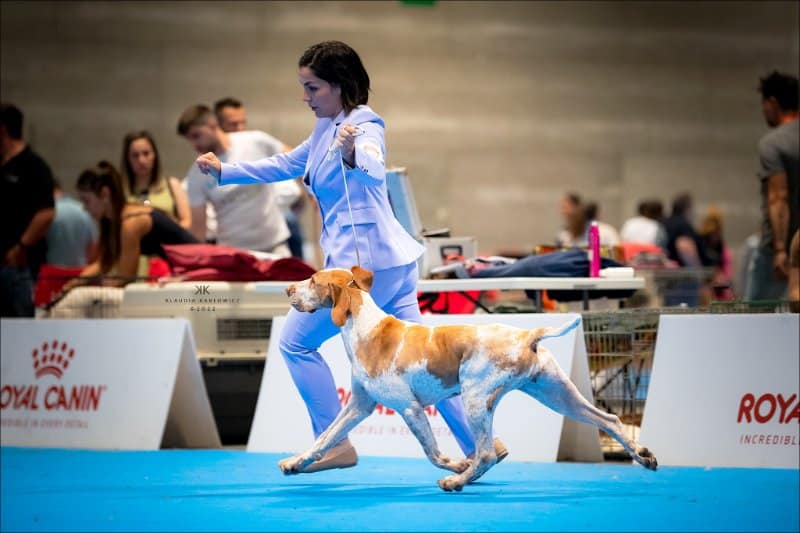
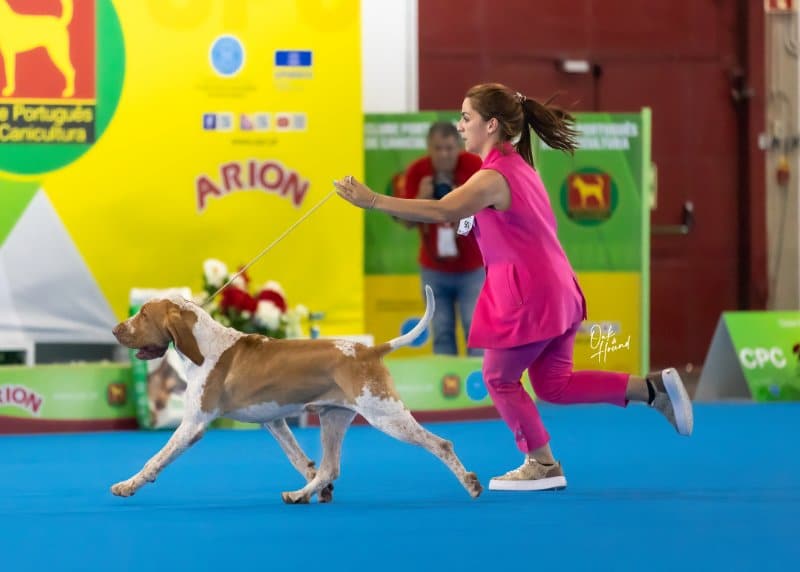
Raquel Colaco: The Bracco has a very extensive trot with free movement; very, very typical. Do not judge by others breeds, please.
Raquel Colaco: For the newer breeder, my words are to read the Breed Standard, several times. It is very specific, technical, and enlightening. If possible, visit several kennels. Change ideas and never just go after champion dogs. Be faithful to the Bracco.
Raquel Colaco: Bracchi are clowns. They are always very funny! I remember, a few years ago at the AKC National Championship in Orlando, Florida, when we went to represent Portugal in the Eukanuba Challenge. We were talking with a judge who was telling us that Nico was amazing, with outstanding movement, and asked to take him around. I passed the leash to his hand and Nico staked his four paws on the ground and didn’t even take a step with him. It was hilarious, but it’s so Bracco!

Meet the Breeders