

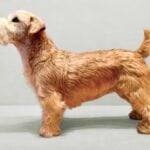

Featured photo: Willow Isle C’est La Vie, age 5 (photo by Susan Elwart Hall)
Since the practice of pursuing game with hounds switched from stags to foxes in the sixteenth century, organized foxhunters, both mounted and afoot, have always sought after the perfect terrier to go to ground, bolt the fox, and allow the chase to continue. That quest has led to the development of most of today’s recognized terrier breeds and more than a few breeds that are known only to those who have a distinct need for their specialized services and abilities. You probably haven’t met a Heide, Decker, Plummer, or Fell Terrier, but they all play a part in hunting with terriers. The type of hunting, habits and size of the quarry, and even the type of landscape to be hunted all contribute to the design and selection of a working terrier. Nowhere is this concept better understood than in organized foxhunting by the recognized packs in North America and England. They can and do breed a type of dog (or hound) that it takes to get the job done.
The early twentieth century, despite World War I, saw a huge interchange of foxhunting methods, equipment, horses, hounds, clothing, and even foxes themselves between the founding fathers of the sport in the United States and the better-established hunts in England. As most know, the first foxhounds were imported here by George Washington and Robert Brooke. The early 1900s was the “Gilded Age” of foxhunting; most of the wealthy participants spent as much time in England as in the US, for they considered that type of hunting as better sport. And at that same time, the tide began to turn with as much exportation of goods, hounds, and culture TO England as from it. The English began to visit and hunt with the North American packs and brought with them hounds and, of course, terriers. (On one occasion, 16 braces of red fox were shipped to England from the US, this after the original red fox were imported to the US from England.)
One such sportsman (as now defined by the AKC Code, of course) was Robert Strawbridge, a wealthy Philadelphia businessman and ardent foxhunter and horseman who maintained homes in both America (Bryn Mawr, Pennsylvania) and England (Melton Mowbray, Leicestershire) and hunted often in both places. Strawbridge was a member of the Radnor Hunt, (the oldest hunt recognized by the Masters of Foxhounds Association of North America in the United States.)
Having traveled to Market Harborough in England to purchase a horse, Strawbridge encountered Frank “Roughrider” Jones. Jones was a horse trainer and trader who had developed a lucrative side gig selling small brown terriers to Cambridge University students, allegedly to keep vermin from their unheated dormitory rooms. Bred from working terrier lines, the “Jones Terriers” themselves had neither the training nor the opportunity to hunt to ground. Still, Robert Strawbridge was enchanted, and in 1914 he brought a male, suitably named “William Jones,” to America where he was tried as hunt terrier to the Radnor. This drop-eared Norwich, now a Norfolk Terrier, had the call name of “Willum.” That name was recalled by the late Joan Read when she bred the Westminster winner CH Chidley Willum The Conqueror.
For all of that noble heritage, Willum proved to be less than a “perfect demon” at his work and was content to serve as stable help at the Radnor, a fact that was made known by Strawbridge to his friends in England who included Sir Jocelyn Lucas (1889-1980). Lucas was a Member of Parliament, the Master of a recognized Harrier pack, and a world-famous breeder of Sealyham Terriers under the Ilmer prefix. These were Kennel Club registered Sealys, although Lucas kept them as a pack and worked them occasionally on badger, fox, and otter, but most frequently on rabbit and hare. His success on these quarries was limited, however, by the size and shape of the dogs he was breeding.
For his part, Major Sir Jocelyn Lucas hunted his Sealyhams in what would today be considered a large pack. The limited photos and video from that era shows them amicably covering ground, but pictures of them actually working to ground are rare, but they do exist. The pack eventually did quite well hunting hare and rabbit, but like most ex-military officers that turn to foxhunting, Lucas always wished for a smaller Sealyham that could safely hunt badger and fox to ground. It should be noted that he was both a member of The Kennel Club and a judge of terrier breeds under its rules. As such he did advocate for the smaller Sealy, but mixed breeding was a deep dark secret (as it often is today) until the 1940s.
We believe that the initial cross between the (drop-eared) Norwich and an Ilmer Sealyham occurred sometime between 1914 and 1920. That breeding was in direct response to Strawbridge’s complaint about the lack of working ability in Willum and Lucas’ own concern that the Sealys of the day were too large to do the job. There is little doubt that the cross was successful and development of the Lucas continued to be as prevalent in North America as in England, or even more so. By the 1940s, Sir Jocelyn was openly breeding and exporting to the US the Norfolk/Sealyham crosses that would later bear his name.
Like the Jack Russell Terrier, the Lucas Terrier began as a “type” rather than a breed. The desired result was achieved very quickly, with height being between 10-12 inches and the weight as low as 11 pounds.
The Sealyham Breed Standard of The Kennel Club (UK) in 1886 called for a height at the withers of 8-12 inches and a weight up to 15 pounds. The scale of points at that time placed coat as most important (20 pts) with height and weight second (15 pts). Then, as now, the Standard often did not exactly reflect what was winning in the show ring. (Writings in 1886 indicated that the Americans were starting to adopt “rules for judges,” and that could “certainly lead to problems.” If they only knew!)
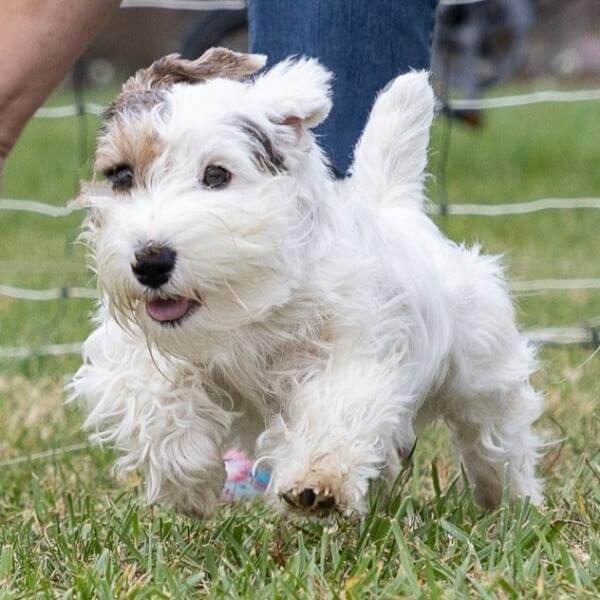
The Lucas Terrier Club, founded in 1988 by Anne “Jumbo” Frost, LVO (Lieutenant of the Royal Victorian Order) and Jane Irwin after the passing of Lucas’ kennel manageress, the Hon. Enid Pliummer, was and is the registering body in England with more than 700 individuals registered and pedigrees on file. Management of that club has since passed from Lucas to others who have been long involved with the breed.
The Lucas Terrier Club of America was organized in 2006 and a separate American Lucas Terrier Society went out of existence in 2020. Today’s United States Lucas Terrier Association (USLTA) was organized in 2019 and today works closely with the British club to provide stability and stewardship of the breed. USLTA has strict rules for breeding and registration in the US. Among them is the requirement that Lucas Terriers have direct (and traceable) lines back to the original Ilmer Sealyhams. The preservation of the traditional Lucas Terrier is paramount, and the club is moving toward entry of the breed into the AKC’s Foundation Stock Service where accurate pedigrees and other tools for preservation of the breed (and its working heritage) can be obtained. The traditional Lucas Terrier in North America is currently recognized by the American Rare Breeds Association and is eligible to compete at its shows.
A survey of the breed in 2026 finds that we have a rather pleasant smallish terrier very closely resembling a small Sealy, with heights averaging the desired 10-12 inches and weight in proportion to that measurement at 14 pounds or so. According to Lisa R. Miller, the club’s Chair, there isn’t a white Lucas Terrier registered with USLTA that is outside the 13-15-pound range.
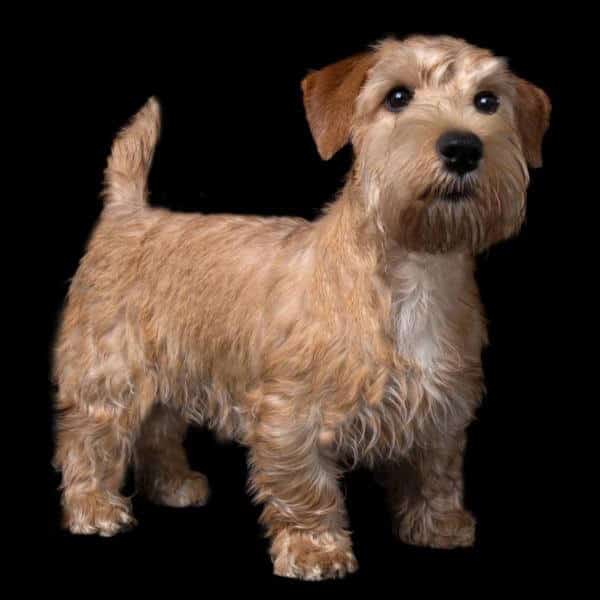
The traditional Lucas Terrier should not be confused with a similar breed known as the Sporting Lucas Terrier. The latter broke off (partially under the influence of the late Brian Plummer) and formed a separate breed and separate club when other breeds, notably Jack Russell Terriers, were introduced into the mix. The Sporting Lucas Terrier is currently recognized by the United Kennel Club in North America.
The traditional Lucas Terrier’s coat today is the same harsh double coat required of both the Sealy and the Norfolk. It is never curly or wavy and should be hand stripped for the best condition. The predominate white of the Sealy has been sometimes replaced with the black and tan or red, or grizzle, of the Norfolk with a very pleasing result. Where the breeding lines have been restricted to Norfolks and Sealys (of Ilmer lines, of course) there seems to be no deterioration of coat quality or suitability. I’m anxious to see what the terrier pros can produce through hand stripping and rolling.
Since their heyday in the 1940s, Lucas Terriers, like most breeds, have encountered their share of health issues, but diligent breeding and comprehensive testing have all but eliminated many of the problems encountered in the original breeds. Today’s Lucas Terriers are a healthy lot. The prospective buyer of a puppy needs to be assured that relevant health testing has been completed on both parents, particularly with respect to PLL, DM, and IVDD which are virtually unheard of in the US Lucas population.
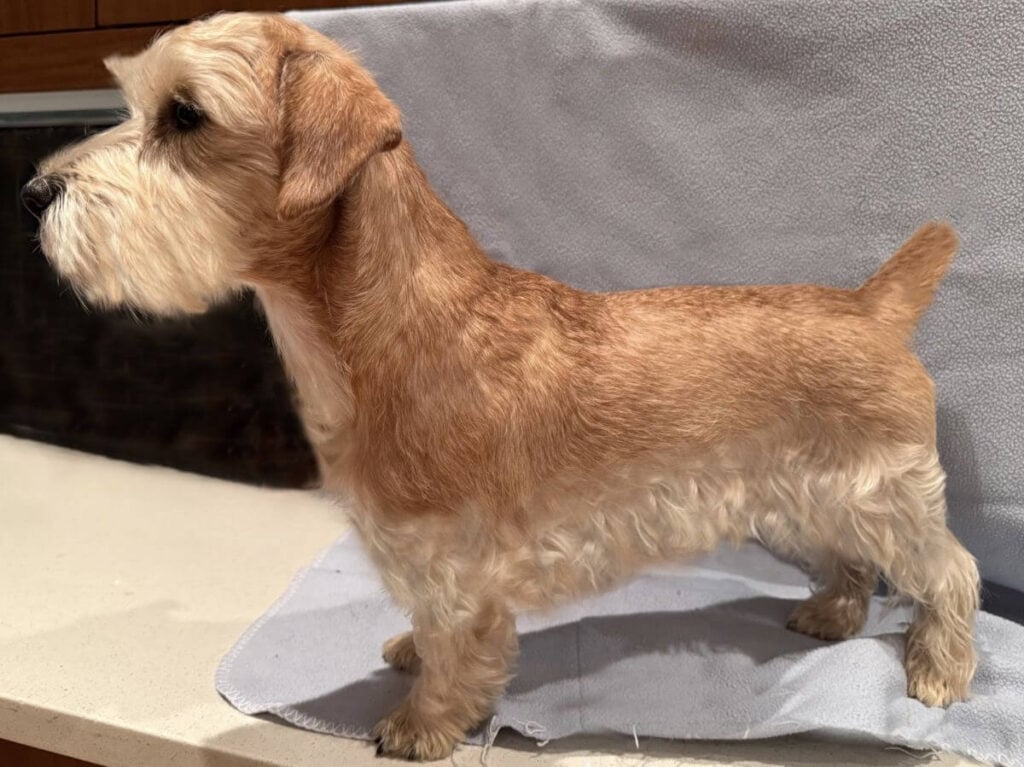
We don’t know personally of anyone hunting Lucas today. Sir Jocelyn was known to mix them into his pack of Sealys, and for this reason the breed does well with other dogs and people. Although amiable and accepting by nature, the Lucas Terrier is more than willing to participate in sparring when on a lead. Nonetheless, they seem to do well working together. (Major Lucas was known to allow up to 12 dogs in a single burrow or sette… a major sin to today’s terrierists where it is strictly one dog down at a time.)
Despite their short legs and well-sprung ribs, the Lucas Terrier is not achondroplastic. It stands four-square with straight front legs and moderate angulation. The hocks are well let down in order that the dog can propel itself both backwards and forwards in the tight confines of the earth.
In 2022, the Deutscher Teckelklub 1888, the German parent club for Dachshunds, changed their Standard to use chest circumference, rather than weight, to determine the respective sizes of the varieties of Dachshunds, and FCI followed suit. At this writing, the average chest circumference for Lucas Terriers, both dogs and bitches, is between 15 and 15.5 inches, making them fully capable of earthwork in North America. The trend now is toward breeding smaller dogs while still keeping soundness, balance, and breed type. (The writer hopes that the ULTA club will add the process of spanning to its final Breed Standard thus assuring continuity of the appropriate size.)
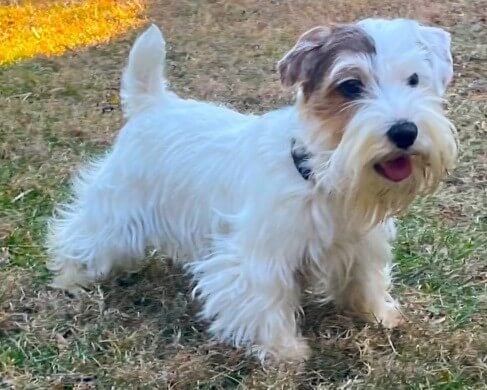
In North America, the Lucas tail is usually docked so as to leave two-thirds of the natural length. That longer length serves the dog well in making it possible to retrieve the dog from the earth. The current Standard requires a rounded tip, which might be better accomplished through judicious grooming rather than during the actual docking. A full tail is, of course, the norm in the UK, but unless the tail carriage is darn near perfect, the tail tends to wind up over the back whilst in the hole. That makes it tough to get them out in a hurry.
Conscientious breeding, both in North America and the UK, has produced a proven working terrier that is both unique and genuinely useful. With more bone and substance than its “Russell type” cousins and a temperament that leads to a more moderate style of earthwork, the Lucas is less likely to sustain injury from the quarry. They are amiable in packs, cautious in their approach, and relentless in their pursuit. The coat can equal the Sealyham in its protective qualities, and the “powerful and square” jaw of the Sealy is easily seen in the traditional Lucas of today. Relying on the smaller Ilmer lines, most Lucas today are of a useful size for North American terrier work.
So, there you have it. A small, very attractive working terrier that combines the very best of the Sealyham and Norfolk Terriers. Invented by an American and perfected by one of the great sportsmen and canine breeders in England. Under the stewardship of the preservation breeders of The Lucas Terrier Club (UK) and the United Lucas Terrier Association, the breed has not only survived, but thrived and advanced. We have every reason to believe that that progress will continue. Messrs. Strawbridge and Lucas would be proud.
Sturdy, symmetrically built, working terrier like an old-fashioned Sealyham type. The Lucas Terrier was originally created by crossing a Norfolk Terrier to Sealyham Terrier.
Every authentic Lucas Terrier can trace its ancestry back to Sir Jocelyn Lucas’ 20th century Ilmer kennels and each contemporary Lucas Terrier must demonstrate a direct link back to an Ilmer Lucas Terrier.
Friendly, with no aggressive tendencies towards people or other dogs, and not fearful or nervous.
Broad skull, a little curved between the ears, flattening to a slight but definite stop. The jaw should be strong, deep and well developed. A medium length, deep muzzle. The nose black irrespective of the color of the dog. Dark, almond shaped eyes, well set, with pigmented eye rims. The drop-ears should be of medium size and v-shaped.
The teeth should be strong, sound and regularly placed, gripping with level or scissor-like action, the lower incisors close behind and just touching the upper. Not to be overshot, undershot or wry.
The neck is strong, muscular and of medium length broadening to blend into the body.
The shoulders are broad of blade, sloping, muscular and well angulated to the upper arm and the point of the shoulder should not be too closely set. The forelegs have strong, round bone, extending to the feet without weakness of the pasterns. The forelegs should be perfectly straight when viewed from the front.
The hindquarters are broad, strong and muscular. Thighs are long, broad and well let down. When viewed from behind, the hind legs, from the hocks to the feet, are straight and placed neither close nor too wide apart.
The length of the body from the point of the breast bone in a straight line to the buttocks is slightly greater than the height at the shoulder. The topline is level, back strong, with ribs well sprung and ribbed (not barrel ribbed). The chest is deep and muscular and moderately broad, loins are broad, deep and muscular with deep flanks strongly coupled between the fore and hindquarters.
Either docked or un-docked. Docked: tail of medium length with one-third off, two-thirds on, with a rounded tip and preferably carried erect. Undocked: tail of moderate length and ideally carried erect, but not excessively over the back, and with no curl, kink or twist.
The coat should be weather resistant with a soft, dense undercoat, a fairly harsh, wiry top coat and of medium length.
May be colored or white.
Measured at the shoulder: 10-12 ins (25-30 cms); Bitches 11 ins (28 cms).
Dogs 14-20 lbs (6-9 kg); Bitches 11-17 lbs (5-8 kg).
Soundness is essential. The action should be true, free and supple, and with capability of quick and sudden movement.
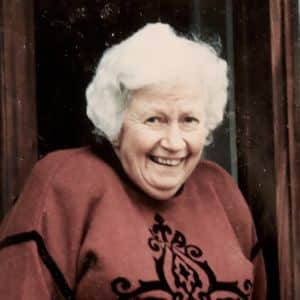
It’s customary to put an author’s credit in this space. In this case, I’m just the wordsmith and three noteworthy ladies are the true creators. Joan Redmond Read (1920-1995) literally wrote the book on Norfolk Terriers. She knew firsthand the Lucas Terrier story and shared it with me early on. She was a mentor to me and to many, and her Norfolk and Norwich Terriers were themselves legend. I also need to thank Leslie Jaseph, a legend herself and a preservation breeder of Sealyhams, for hours of help. But none of this would have been possible without the help of Lisa Miller and the United States Lucas Terrier Association.