Members
Explore the vital role of proprioception in your dog’s well-being. Learn how to keep your dog active and injury-free!

The Weekly Brief
The best of SHOWSIGHT editorials, weekly wins, and breeder commentary — delivered to your inbox every Sunday morning.
Proprio—what? Proprioception is from the Latin proprius, meaning “one’s own,” and capere, meaning to grasp. Thus, proprioception means to grasp one’s own position in space, including the position of the limbs in relation to each other and the body as a whole.
Proprioception is how a baseball player hits a 3-inch ball going 95 mph with a 2-1/2-inch bat. It’s how your Agility dog flies over the dog walk, placing its feet in exactly the right spots on a narrow board. Check out the dog in the image below; the dog’s right rear foot has about one inch to spare! Proprioception is how your athletic dog snags a thrown ball in mid-air and lands running. It’s responsible for your dog’s paw-eye and mouth-eye coordination. A well-tuned proprioceptive system will prevent your dog from making one or many missteps that could lead to a catastrophic injury.
Proprioception is so important that EVERY living thing has a proprioceptive system—mammals, birds, reptiles, and even insects.
Proprioception is so important that EVERY living thing has a proprioceptive system—mammals, birds, reptiles, and even insects. In fact, even plants have proprioception. It is how flowers know to lean towards the sun for optimal energy production.
Your dog’s proprioceptive system is like a body-wide GPS system. Just as your cell phone can tell others where you are on the map, there are billions of sensors, called proprioceptors, throughout your dog’s body that constantly deliver neurological messages that tell your dog’s brain where the parts of its body are.
…proprioception means to grasp one’s own position in space, including the position of the limbs in relation to each other and the body as a whole.
As your dog moves, proprioceptors send messages that contain information about the exact positions of all parts of the body, how fast and in which directions those body parts are moving, and how much load they are bearing so that instantaneous corrections can be made. So, if your dashing dog makes an error in foot placement, the proprioception system instantaneously tries to correct it. You can see why this system is so important in injury prevention!
Most of us are familiar with the sensory and motor components of the nervous system, which control the senses, like sight and hearing, and movement. But did you know that proprioception is a third component of the nervous system, with its own nerves and pathways in the spinal cord? That’s how important it is!
The following table lists examples of canine activities that get a major assist from proprioception:
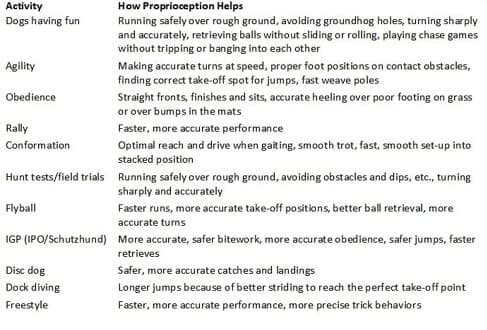
Unfortunately, “use it or lose it” seems to be the motto of the neurological system. Despite our best intentions, there are times when the proprioception system can go into decline. Here are some examples:
All types of exercise give the proprioceptive system a workout. However, specific exercises should also be used to really polish and strengthen those pathways. Here are some:
Interestingly, chiropractic is specifically designed to hone proprioception, so getting regular adjustments should be a part of every active dog’s maintenance routine.
Hopefully you realize the importance of the proprioceptive system for improving your dog’s ability to experience a full and active life while reducing the likelihood of musculoskeletal injury. Surprisingly, few people add proprioceptive exercises to their dogs’ fitness regimens. That might be because these exercises seem… well… too simple. They don’t seem to get the dog panting or tire them out, so sometimes people believe they aren’t that important. But in fact, unseen neurological changes are taking place when your dog executes these exercises.
Keeping your dog’s proprioceptive system honed might be the most important thing you can do to reduce the risk of injuries, with all of their associated costs, downtime, and heartache. In addition, the scientific evidence suggests that proprioceptive exercises are one of the best ways to increase your dog’s health span—the length of time your dog is healthy and active—and who doesn’t want that? So, just do it. Only 10 minutes twice a week and you’re good to go!
Canine Health