



Finnish Spitz
Suomenpystykorva
National Dog of Finland
Finsk Spets
Finnish Prick-Eared Dog
Finnish Hunting Dog
The Barking Bird Dog
Of all the names this ancient breed is known by, it seems the only one most people can remember is the last one. The comment most often heard after “Oh, it looks like a fox!” is “Oh, they’re the ones that bark.” Yes, they are the red dogs that can bark so loud and so fast that everyone within a wide hearing range can clearly hear them—and perhaps wish they had brought earplugs. A bark that is arguably known throughout the world, and even celebrated with Finland’s King Barker contest, which one dog won with an impressive 160 barks per minute!
This may come as a shock, but almost all dogs bark! Even the ones that don’t bark still make noise of some sort, such as howling or yodeling or baying. Some of them bark less. Some of them actually bark more! But the ones that get the bad rap for it are the Finnish Spitz.
And that’s sad. Because if that’s all people remember, they miss the most important part of this fascinating and versatile breed! They are one of the best companion dogs anyone could ask for, especially for a family who loves the outdoors. They are incredibly sensitive to their surroundings, and to their people, often becoming a self-appointed babysitter in a family with children or a comforting presence when their human is ill or down. They’re not only smart (sometimes too smart for their own good), they’re intelligent and love to interact and learn. They’re big enough to be soundly hugged, but small enough to be picked up if necessary. Their fur is coarse enough to shed mud and dirt, but soft enough to be soothing.
Truly, this is a wonderful breed to share your life and home with.
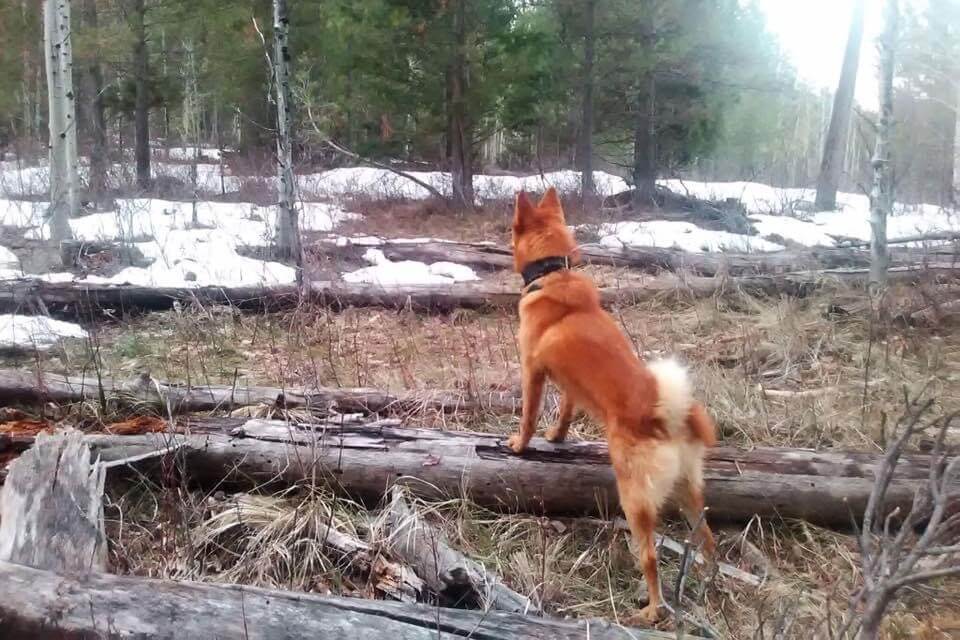
What can be difficult to appreciate when their resonating bark is ringing in your ears is that this is a breed at least 3,000 years in the making! Generations of Finno-Ugrian tribes bred for very specific traits, including that ringing bark. The Finnish Spitz was developed primarily to aid them in hunting game in the forests common in the region near what we know now as the Finnish/Russian border and encompassing a large geographical area, roughly from the Danube River into Siberia, including the Ural Mountains.
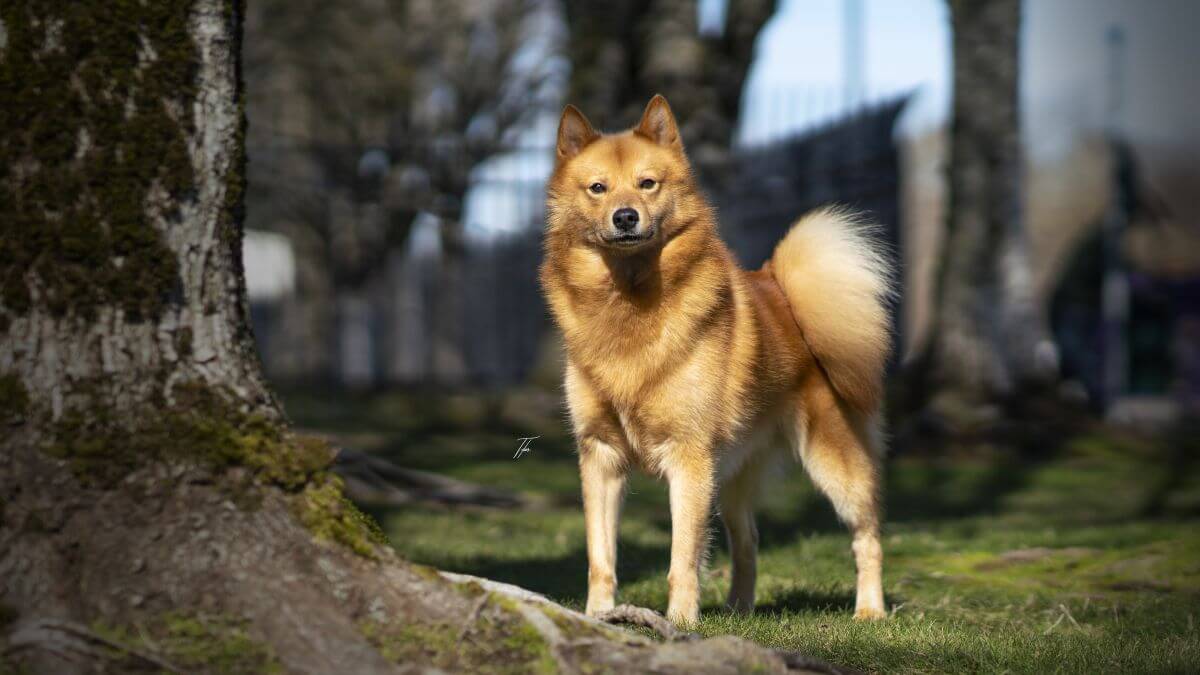
The dog those tribes created was lightly built by many spitz standards, but quick and agile; their square form enabled them to spring onto or over rocks and fallen trees or negotiate steep slopes that would stop most rectangular breeds in their tracks. Their variegated red coats blend into the woods, underbrush, and forest floor; their light, springy gait helps them move relatively silently, but their gleaming gold tails—even now described in the Breed Standard as their “crowning glory”—enabled their human partners to see them even from a distance. As one half of a hunting “team,” they tend to form closer bonds to their people than to other dogs, unlike their sledding counterparts that tend to be more pack oriented.
The dogs known distinctly as Finnish Spitz are believed to date to the early 1800s, and the breed was officially recognized by the Finnish Kennel Club in 1892. Like many breeds we know from the European continent, the breed struggled to survive the conflicts and conditions during and after World War II; their numbers were drastically depleted and the genetic pool shrank. Deeply loved and treasured in their homeland, they survived that trial and eventually became the National Dog of Finland in 1979. Even as their limited gene pool and relative rarity in the world has them pegged as a breed facing possible extinction, this will never be a problem in their home country. The Finns cherish this beautiful and vivacious breed, and they strive to maintain their historic integrity, still emphasizing their substantial innate hunting ability.
In both the United States and Canada, the Standard for the Finnish Spitz is taken from the Finnish Kennel Club Standard for the breed. But no matter the country of origin, most Standards are a bunch of words and numbers, rather dryly written, that are supposed to conjure up a picture of the perfect dog. But no living dog is the perfect embodiment of their Standard, nor is it nearly as boring.
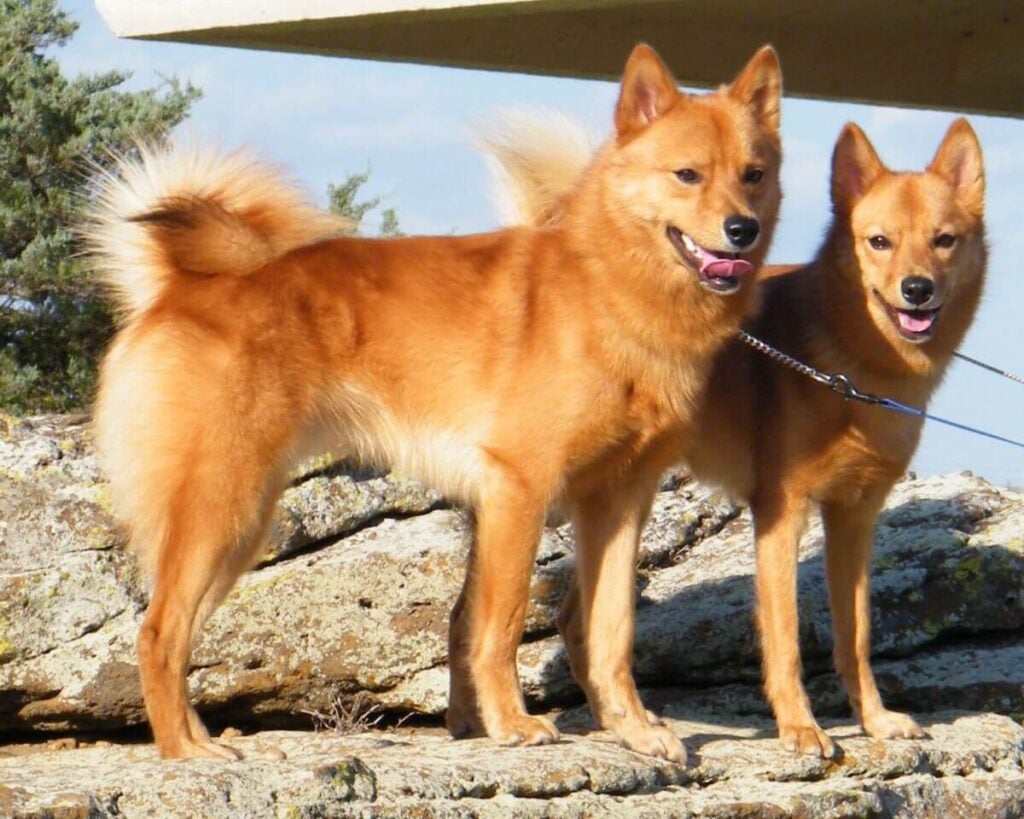
In the real world, there is more to the Finnish Spitz than a wedge-shaped head with dark eyes and pigment, with a 4 to 5 body-to-leg ratio in a square package, and a reddish gold double coat topped off with a bushy golden cream tail.
Sunlight makes their glorious red-gold coat seem to glow, and turns their golden tails, called their “crowning glory,” into flashing beacons. In the speckled shadows of the forest, the variegated reds of their guard hair with a creamy gold undercoat become ideal camouflage, so all that can be seen is that bright gold tail bobbing through the underbrush or over tall grasses. Those well-plumed tails often twitch in time with the rhythm of those barks, or wagging or waving to distract or even hypnotize their prey. Their square builds power lithe, but sure-footed, springs onto rocks, fallen trees, or other myriad obstacles with hardly any effort, or bounding up or down a steep gorge that would stop the powerful sledding breeds in their tracks. Their quick, light movement combines with that to enable seemingly impossible changes of direction or elevation, even mid-leap, so they can track and keep their prey in sight. Their primary prey is the capercaillie, a black bird similar in size and appearance to the North American forest grouse or a small wild turkey. But it’s not uncommon for them to be called on to hunt prey from elk or moose to bear, or even go to ground after badger. If the hunter is after a specific prey animal, the reverse is also true: the dog can infer what it is they’re after by the gear the hunter brings with them or the differing types of collars they may wear, or even whether there is more than one hunting team going on the hunt.
The Finnish Spitz’s unique hunting style melds several jobs into one, creating a versatile hunter rather than a specialist in only one of the steps of a successful hunt. A team of hunter and dog start together, but the hunter soon sends the dog alone on a loop to see what prey can be found. Humans are slow when the terrain is rough or buried deep in winter snow, and noisy when walking through a forest; for humans to search would take hours or days. In just the space of a few minutes, a great swath of territory can be traversed with ease by the light-footed Finnish Spitz, their sensitive eyes, ears, and noses picking up even a slight trace of a potential quarry—or lack thereof. No joy? Move on to another area and try again, and then again until “dinner” is found. Joy! First flush it from the brush, then pursue it until it stops, then alert and guide the hunter to it.
The pointing and holding of their prey is where the “barking bird dog” description comes from. Once the prey is found, they break into a ringing, rhythmic bark that is designed to be able to be heard up to five miles away in a forest. Most who own them and who care to try to discern their barks can tell you that they have a different bark for different prey. Some of those barks are low and slower, others are high-pitched and come in rapid bursts like machine gun fire, and still others sound something like an air raid siren punctuated by occasional explosions of forceful barks. Even a longtime owner who has never gone hunting can tell you whether their dog is barking at a cat, a rat, squirrels, or “unauthorized dog walking” down the street in front of the house, or “my sister has my bone/toy/bed/horde” or even “my brother is blocking the hallway and won’t let me pass!” In addition to the wide-ranging possibilities of specific barks, they have a truly remarkable range of other sounds that they make. This full vocal toolbox is used to “entertain” their audience: the Finnish Spitz is an award-winning storyteller!
A capercaillie in a tall tree thinks it’s safe from the noisy foxy-looking dog, and gazes down at the bouncing red and gold in disdain. It feels secure on its perch in the canopy, even if the barky creature follows it from tree to tree. A moose is first startled into active retreat, but soon finds a copse of pines to shelter. Originally frightened by the foxlike predator on its heels, it’s eventually amused or possibly annoyed by the loquacious, fanciful stories being told by the overly happy creature rolling on the ground. The story is punctuated by an occasional powerful bark to keep the hunter on the right track. But the barking has masked the approach of the human, who stops at a safe distance so as not to alert or spook the game. Soon the hunt is declared a success and the hunting team is on the way back home with food for all, possibly to a warm fire to curl up near while staying close enough to have velvety ears stroked.
The Finnish Spitz’s voice is iconic and memorable, but it isn’t their only remarkable trait.
Although not often used for hunting in the United States and Canada, their instinct is deeply ingrained and is obvious to anyone who recognizes their quick but careful movements, the way they assess their surroundings, and the way they stalk a noise-making toy or their siblings before pouncing. Their job, in a nutshell, is to locate, flush, point, hold and, when necessary, follow prey to the next location to again point and hold them, all while being a beacon to guide the hunter to them.
The Finnish Spitz is intelligent enough to find prey in a vast wilderness, by themselves while the hunter waits where the search began. They can learn when it is appropriate to bark and when it isn’t. Most of the time, even as puppies, they don’t bark unless there’s a reason. Don’t get me wrong, they LOVE to talk. A lot. But talking isn’t the ringing bark they can produce, which you can sometimes feel hit you like a sonic wave if you’re in front of them. Granted, it takes some work to teach them the difference between Inside Voice and Outside Voice, and the appropriate times to use their varying vocal talents. But like any dog, they can be taught. The only true problem comes when they have decided that the only way to relieve boredom or get attention is to bark until somebody gets tired of it. For a dog designed to bark and be heard, that means constant barking for days before they lose their voices.
Barking is their superpower, but even superheroes don’t display their gifts unless necessary.
Eternally happy. Clowns and entertainers in the ring. Finding and exuding joy in and about life in general. With only the rarest of exceptions, they’re one the happiest in the Canine Kingdom. It’s raining? GREAT! It’s sunny? GREAT! You had a bad day at work? The smile, the antics, the joy at your return soon makes all that an unimportant memory.
Still worried about their iconic and memorable voice? Please remember that they are hunters, not just pointers. Any hunting dog worth hunting with knows that if they bark while hunting, all the prey will high-tail it to safety long before they can even be tracked, much less found. All their barking takes place AFTER the prey is found. They find the prey on their own, not with the direction of any human, so they must be intelligent and discerning. That intelligence serves you well if you teach them and mold it to everyone’s benefit, but as with any of the Arctic breeds, that same intellectual prowess can find you playing catch up or losing the game of chess that is life with a dog designed to work independently. They can be taught when it is appropriate to use their voice and when it isn’t.
Most people automatically associate the American Kennel Club with Conformation shows, but the AKC offers several venues for dog owners to compete and earn titles that have little to do with dressing up and running in circles. Unfortunately, many people with Arctic breeds avoid them. First, there is the deep-seated fear of letting their dogs off leash only to watch them bound off across the show grounds. Then there is the knowledge that one would get more success and satisfaction beating down a brick wall with one’s head (and that would also be far less embarrassing than the creative disobedience at which Arctic dogs excel). But those who have dared to step into these rings have found that Finnish Spitz not only enjoy these events but excel at them. Creatively, of course.
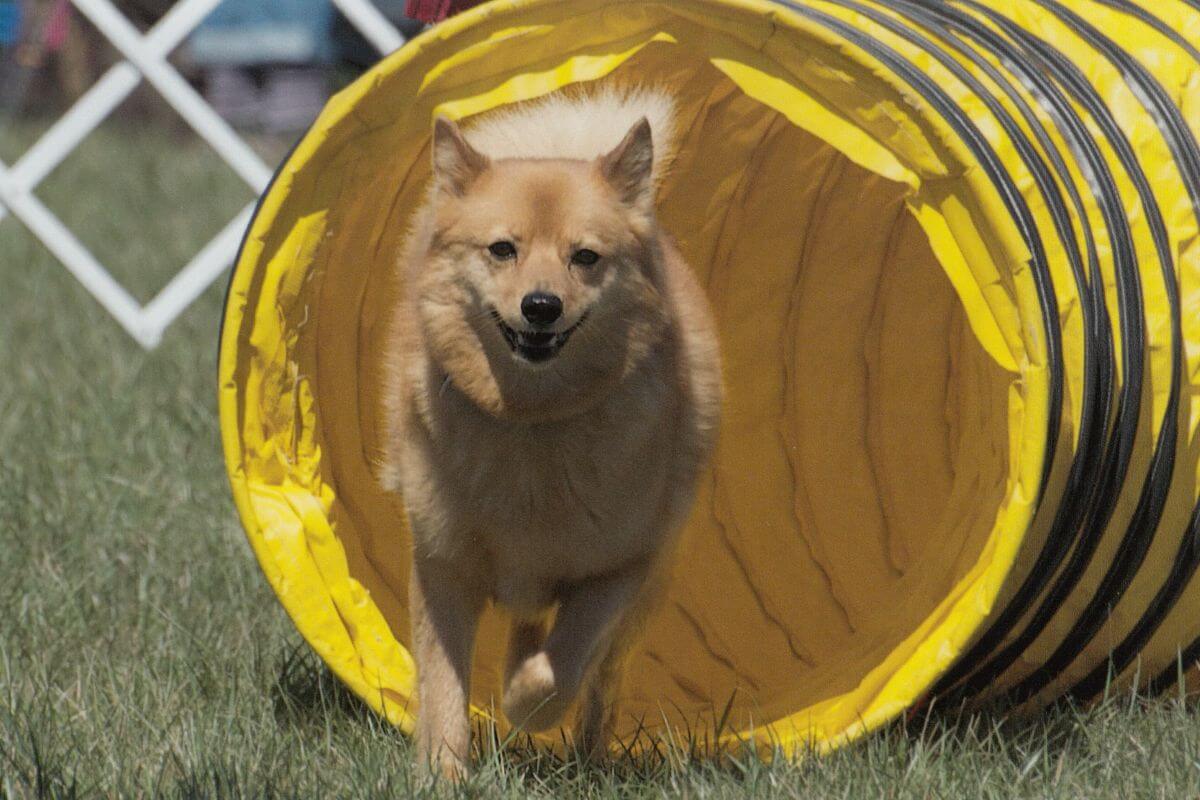
This is a breed that is bred to think, not just bark, and loves to use their brain power. Obedience, Rally, Agility, Trick Dog, Tracking, or any of the AKC’s Companion events are ones that the Finnish Spitz is sure to enjoy. The challenge is not to fall into the mindset of “training” them. Instead, teach them. Instinctively they know they have a long and proud ancestry, and that pride is surprisingly easily insulted!
Some Performance judges may be surprised when the foxlike dog with the golden tail prepares to enter their ring. Some may even be condescending. Don’t let it stress you out, as your Finnish Spitz may decide to try to relieve your stress with antics that aren’t part of the exercises. Heeling on the right instead of the left was a popular choice with one dog in regular Obedience, or even completing the next exercise without being told—after all, they always came in the same order, which was boring. Another dog decided Rally was stupid, and when scolded she flipped her tail and headed for the exit. In Agility, the same dog stopped at a fence to bark at the handler, chest nearly touching the bar, then cleanly jumped the fence from a standstill—something only a square breed could do. Though it may seem like they’re going out of their way to embarrass you, be proud! Thousands of years of being bred to entertain prey is not wasted when competing in Companion events.
Because of where, how, and what they were bred to hunt, the Finnish Spitz is highly sensitive. They can hear the flutter of a bird’s wings as it moves overhead from tree to tree. More of a mid-distance sighthound, they can spot movement a hundred yards away. The hairs in their chevrons (the slightly longer and often slightly lighter-colored hairs behind their shoulders) are sensitive to the lightest touch to help them quickly gauge their position in brush, similar to how a cat’s whiskers work. They need to be able to “read” their prey, anticipating what it might do next. This sensitivity, both physically and in observation, serves them well as a companion.
For instance, there are several Finnish Spitz that are successful Service Dogs, and many of them were self-taught—meaning they noticed a need and created a way to address it. One deduced that his owner had a blind side, so in a crowd, would purposefully walk on that side to help deflect anything or anyone from getting too close. Another noticed the anxiety his owner had in certain situations and made sure to stay close, even touching, when that happened. They seem to have innate understanding of when their humans need a quiet, supportive presence. Several have been credited with becoming a close companion to a person with special needs, even if that wasn’t what they were purchased to do. Even ones not raised with children seem to become a protective presence around them, one even carefully curling himself around an infant as she slept, not only soothing her but keeping her from rolling away or off a bed.
They especially enjoy activities that tap into that vast reservoir of hunting abilities and instincts. The Finnish Spitz loves adventure, whether hiking with its family or playing tag in the backyard. There are few things more wonderful or even miraculous than taking a Finnish Spitz hiking. Suddenly, you too realize how full of life and variety the world around us truly is. The Finnish Spitz loves life and isn’t shy about letting the world know it!
In the home, their agile abilities can find them on your counters, couch backs, or balancing on windowsills. Their finely developed senses can find the cookies on the counter—still in the package, the songbirds in the trees, the neighbor’s cat behind the shrub in its own backyard, or “unauthorized dog walking” across the street or several houses down. With time and practice, their barks can be interpreted so that you know without looking out the window what it is they’re alerting to. They can be accomplished escape artists; after all, their instinct is to run away and bark a lot. But that instinct will also bring them home sooner than later, barring outside interference.
Apply their fantastic minds and innate sensitivity to other day-to-day problems or challenges. There is nothing that a breed deemed “tractable” or “trainable” can do that a Finnish Spitz cannot, as long as you are willing to spend the time and apply patience to teaching those skills. A Finnish Spitz wants to be your partner, not a biddable subordinate. Mutual respect will take you far in whatever activity you wish to try.
Of course, there are downsides to the Finnish Spitz besides their occasionally extreme vocalizations. Like many Arctic breeds, they enjoy digging. Often there is good reason (like their barking), such as voles or other underground varmints. Excavating random holes in the backyard is a baffling pastime, and one that can twist an ankle at the very least.
One of their most endearing “flaws” is their love of hoarding. Yes, like a dragon. Their treasure can range from toys and bones to shoes or even remote controls. Some take offered things and squirrel them away in their chosen location, which can be in their crates, on a bed (theirs or yours), in the hallway, or behind a chair or even completely out in the open. A puppy still learning the fine art once gathered everything she could find into the middle of the living room, then crowned it with a roll of paper towels she’d managed to get from somewhere. In another household, dishes, cooking utensils, and even some pans kept disappearing. One day while doing laundry, Mom decided to add the Finnish Spitz crate cushioning—in this case an old blanket—and as she grabbed it was met with a shocking clatter and clanging: the missing dishes and utensils! The blanket had shown no sign of being a hiding place, so expertly had the Finkie arranged it over his horde. One was an adept thief, so visitors were encouraged to keep their purses and bags sealed, and things like shoes and cell phones on their person. ALL shopping bags were subject to searches, and their contents subject to seizure. If anything came up missing, the item’s owner was advised to check his crate or his secondary hoarding site behind the recliner. There is rarely a dull moment when a Finnish Spitz shares your home and your life!
Though it can be tempting to walk away from a Finnish Spitz once you hear their oft-quoted but misunderstood nickname, or hear their ancient call to attention in person, dare to look beyond the bark. They are a dog with a noble heritage, beloved by those who own and breed them, whether in North America, Finland, or across the seas. They are the National Dog of Finland, representing their homeland, beloved as an icon and symbol of the Finns’ ties to their lands and history.
The Finnish Spitz loves its people. That is the one thing that encompasses all else about it, beyond all of its other skills and talents, beyond its looks and light-stepping movement, beyond its happy-go-lucky approach to life and unquenching optimism. But at the end of the day, when the outside world has darkened, it loves to be curled on the bed just close enough for the human to stroke its velvety soft ears.