Members
A whimsical gathering of cynologists explores how we measure dogs, blending history, humor, and timeless debates in canine structure.
The Weekly Brief
The best of SHOWSIGHT editorials, weekly wins, and breeder commentary — delivered to your inbox every Sunday morning.
I think not a single judge worth their salt will say that they do not know the standard method of measuring the height and length of a dog. These are the most basic of all considerations that describe the general proportions of a breed, or individual within the breed, and can determine the adherence of any given dog to the Breed Standard. Who ever heard of a square German Shepherd Dog?
Through the magical powers of library research, let’s attend a Christmas party with some of the great figures of cynology. Our hostess has invited Vero Shaw from 1881, Harold Spira from 1982, who came with Curtis and Thelma Brown from 1995. She knew she could count on her good friend Professor Giuseppe Solaro from 1958 to bring some fine Italian wine, and he came accompanied by his student Franco Bonetti. Unfortunately, Pierre Megnin from 1888 could not make it, since he had sent her a note explaining that his son, Paul Henri, had made a jumble of the layout for the upcoming issue of L’Eleveur, so the type had to be completely reset by tomorrow morning. Friederun Stockmann from 1930 came alone, but immediately sat down with Professor Solaro, so no introductions were necessary. One of her final guests was Professor Milivoje Urošević from 2025, invited with Dr. Martin Fischer who was prevented from coming due to a bad head cold, so he introduced her to a chap he’d met just recently, Mr. Louis Donald, also from 2025.
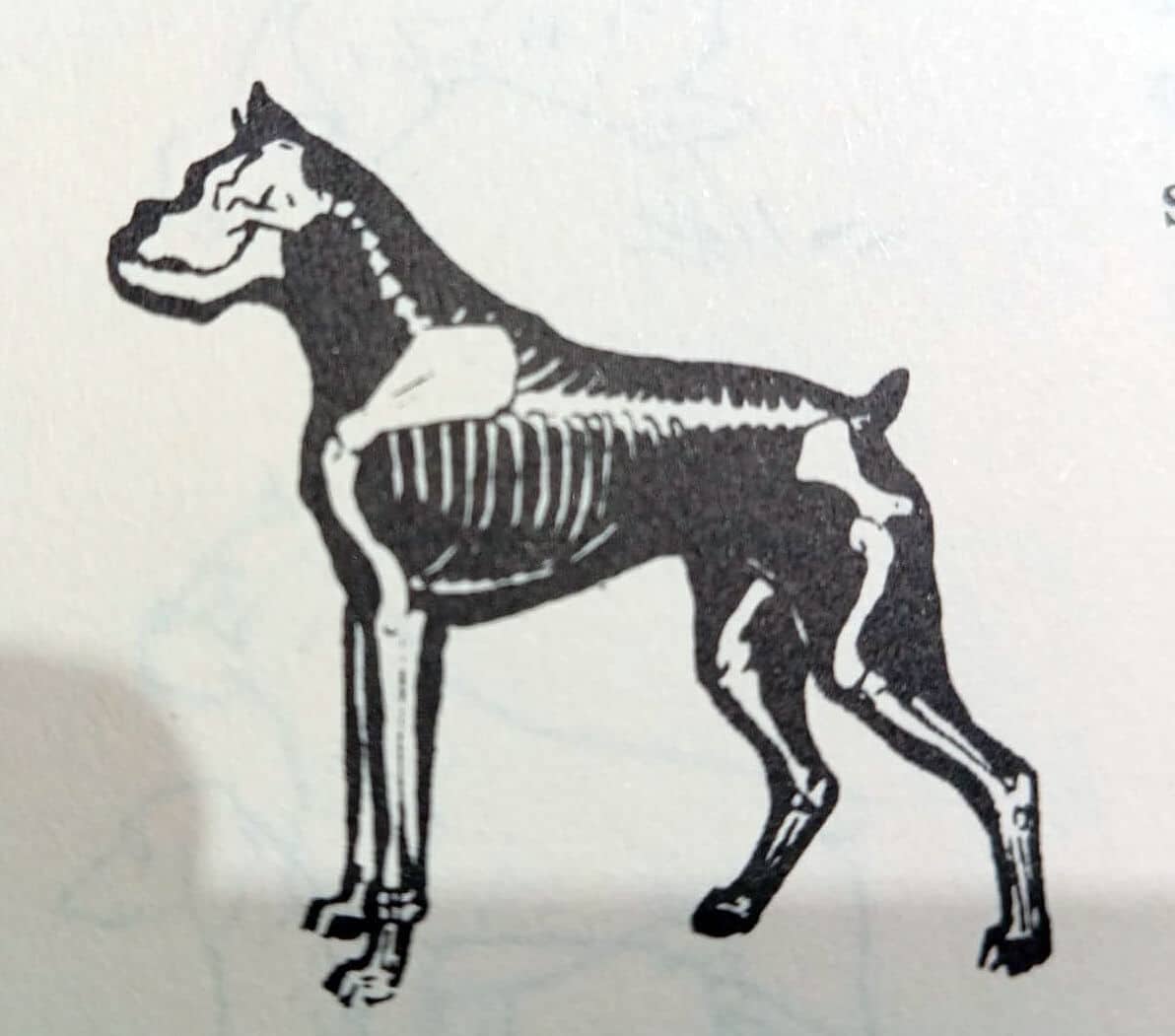
When the gathering comes into full swing, the cynologists are thrown together in a corner where they make better acquaintance. As the wine begins to soak in a bit, Friederun takes out her sketchbook to show Professor Urošević, not only a cynologist and judge but a famous zoologist, who has been commenting on the increasing slope of the Boxer topline since her day. “Here, Professor,” she says turning to a page. “You see, it should be fairly level though short, of course, being a square breed.”
“Excellent, yes!”
Louis Donald, standing behind the sofa, could not help interposing. “Of course, the cranial edge of the scapula should be higher than the apophyses of the vertebral spires.”
Friederun raised her eyebrows and looked more closely at her drawing, but Professor Urošević furrowed his brow, gesturing for Louis to button his lips.
Curtis Brown had overheard and added encouragingly, “The illustration on the cover of my book has the scapula well below the apophysis of the spires.”
“Our book, dear,” interjected Thelma, causing Curtis to inspect the tips of his shoes.
“I concur,” interjected Harold Spira, stepping a bit closer. “I have clearly stated, on page 62, ehm, that the scapula is positioned a short distance below the first, second, and third vertebral spires.”
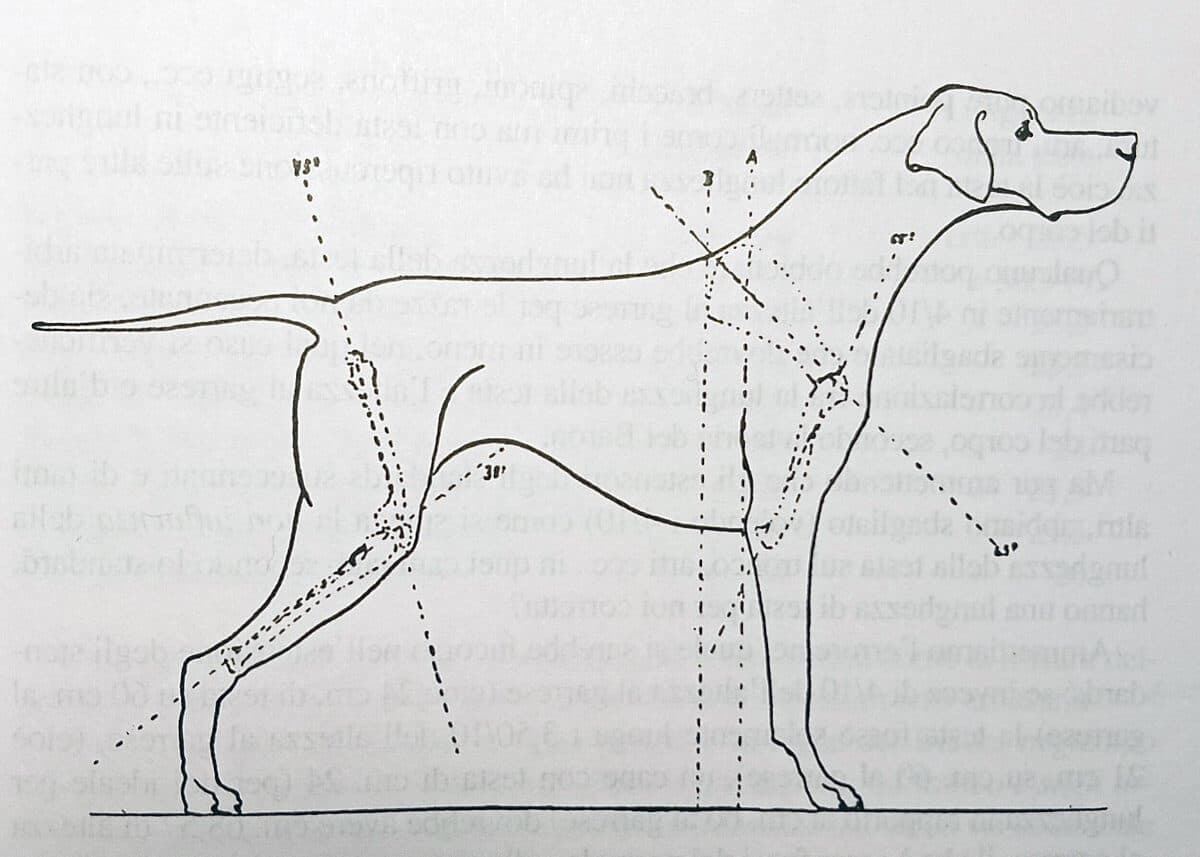
“Escusa me very much,” said Professor Solaro, bowing slightly to the group and especially the beautiful Friederun. “The scapola must be long, long and sloping. If it is so, it will be in the correct place as I have drawn here. He held out a hand, and his student passed him a small book open to page 67. Solaro held out the open book, and everyone leaned in to have a look.
“Quite right,” observed Vero Shaw. “Damn thing is, if the scapula is poorly placed, the height at withers is affected, eh?”
Everyone turned their attention to Shaw. “Heh?” asked Shaw, but the question fell flat, so he used his pipe stem in a jabbing way like a bayonet to help make his point. “If you stand the dog against a wall and place something straight across the two shoulder blades, at the highest point, mind you, then measure from the spot on the wall to the ground—you get your height. If the blade is too upstanding or well-laid-back, you get a different measurement altogether for the same dog, heh?”
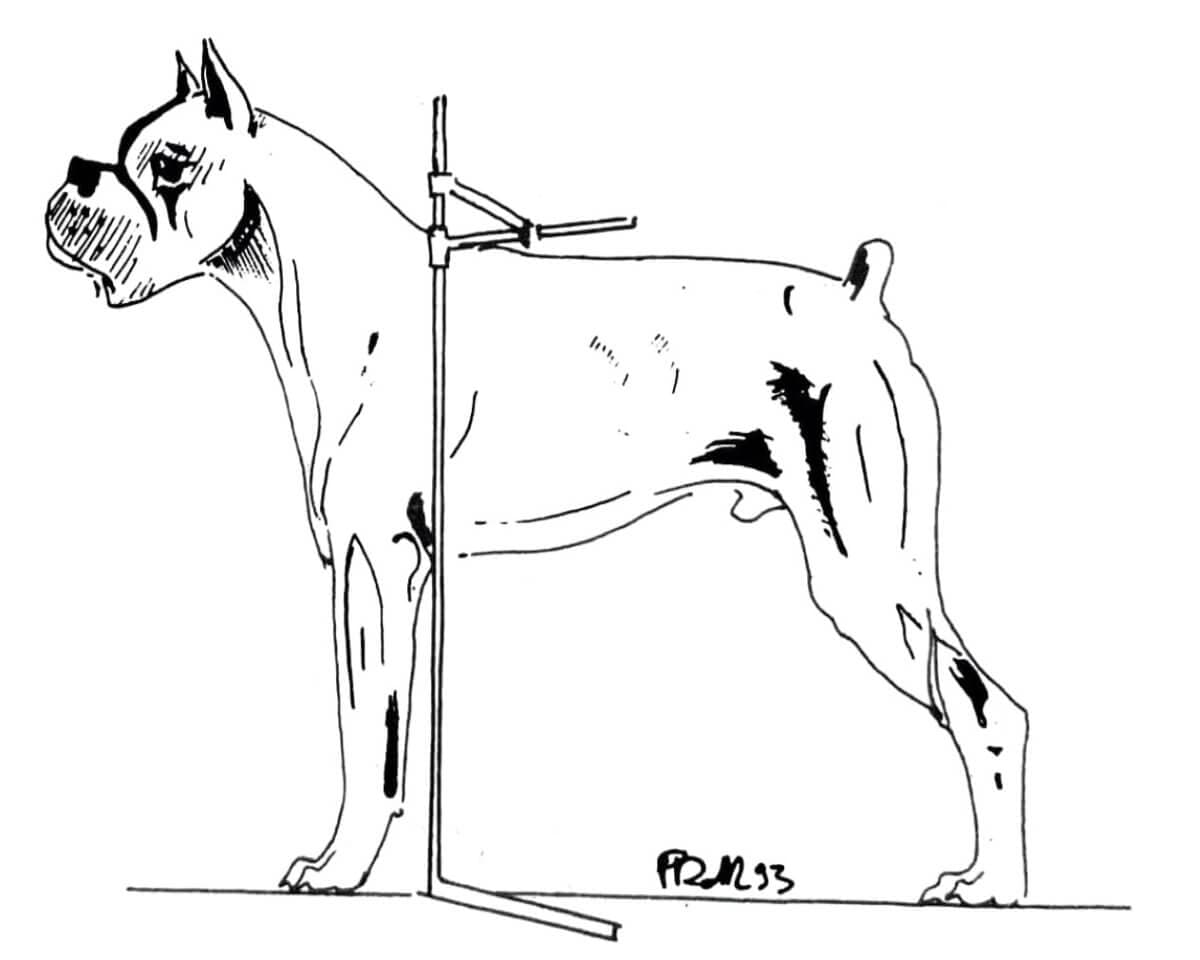
Solaro was ready with his reply, “If you will escusa me, Vero, a cinometro is much more reliable than a stick on the wall.” He followed this with an engaging nod and made light of his own comment with an elegant little laugh. Friederun laid a hand on his arm and agreed, her colleague in Italy, Mario Perricone, from 1989, used a cinometro. Franco borrowed Friederun’s notebook, and the small group stood around him as he made a quick sketch of this tool in use to measure a Boxer, much to Friederun’s satisfaction.
Louis was looking at this with Vero Shaw and observed, “I am not sure we can measure the height of the dog using the leg; after all, the scapula is part of the appendicular structure, and as Vero points out, the scapula is changeable. The correct or incorrect placement of it will affect the accuracy of the measurement. Would it not be more correct to measure height at the tip of the first thoracic vertebra, which is a stable value?”
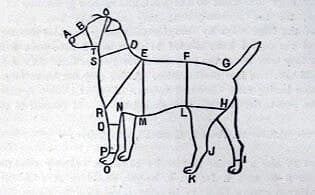
“Out of the question,” replied Shaw in a jolly way that took the sting out of the negation. “Utter nonsense, my boy, you need to use a tape measure for that, and to get to the spine you have to go ‘round the scapula. It is not an accurate measurement at all if you think about it.”
“If you had one of these tools that the Italians are talking about…” began Louis, but Vero Shaw was eyeing a tray of hors d’oeuvres being brought nearly within his reach. Having secured some, he popped one in his mouth and continued. “Height and length, good fellow, basic stuff, can’t be messed about, you know?”
Professor Urošević had also dipped into the tray and nodded vigorously. “Length—from the point of shoulder to the point of buttocks.”
Shaw guffawed and spat a few crumbs in his abrupt reply. “Hey Ho, slow down, good sir. Length is from the base of the withers to the set of the tail!”
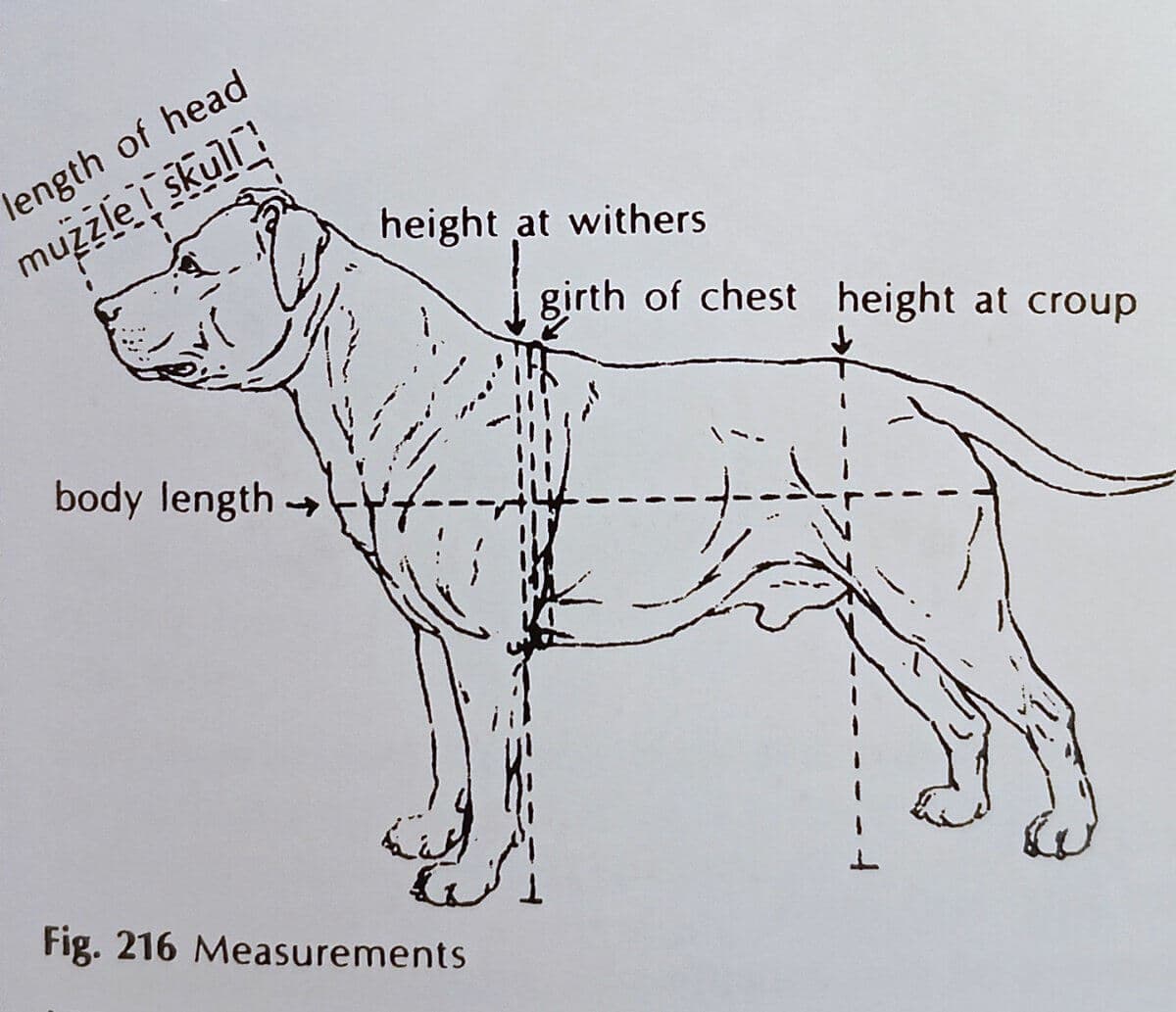
Harold Spira had been discussing basic morphometric parameters of the Macedonian Shepherd Dog with Professor Urošević until they had been drawn into the neighboring conversation between Donald and Shaw. He felt safe enough here to intervene. “I stand with the Professor on this point; length is not measured on the topline but on the body, from the point of shoulder to the furthest point of the rear.”
Louis shook his head, he was thinking out loud, “If you put a saucer on a napkin, do you measure the length of the napkin starting from the edge of the saucer? Certainly not. So, if we are measuring length of body, why start with the shoulder, which is part of the leg? You must use measuring points on the body, the axial structure, so it must be from the point of manubrium to the point of buttocks.”
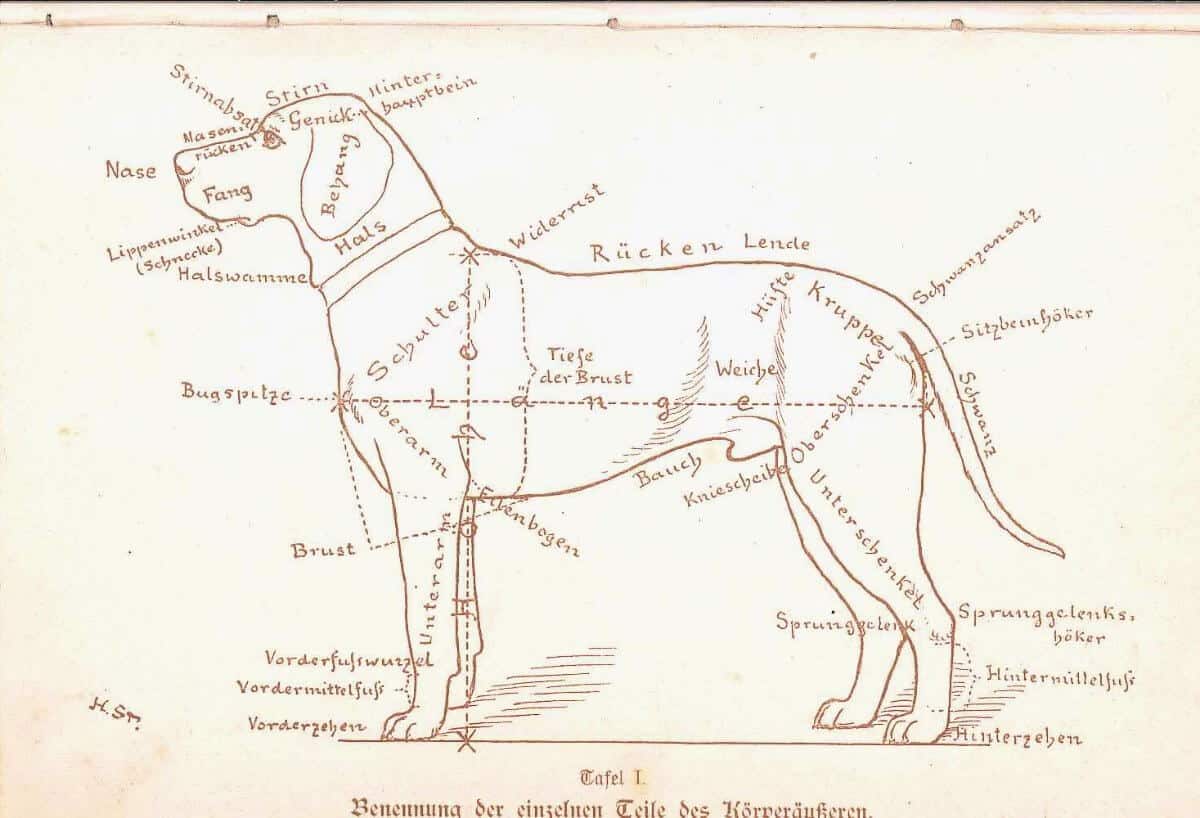
“Well, this is not what I wrote at all,” said Spira a bit defensively, then turned to have his glass refilled by the waiter.
“Page 25! (soft female giggles bubbled up.) That’s why we corrected it for you in our drawing!” the voices came from behind the waiter who then moved away.
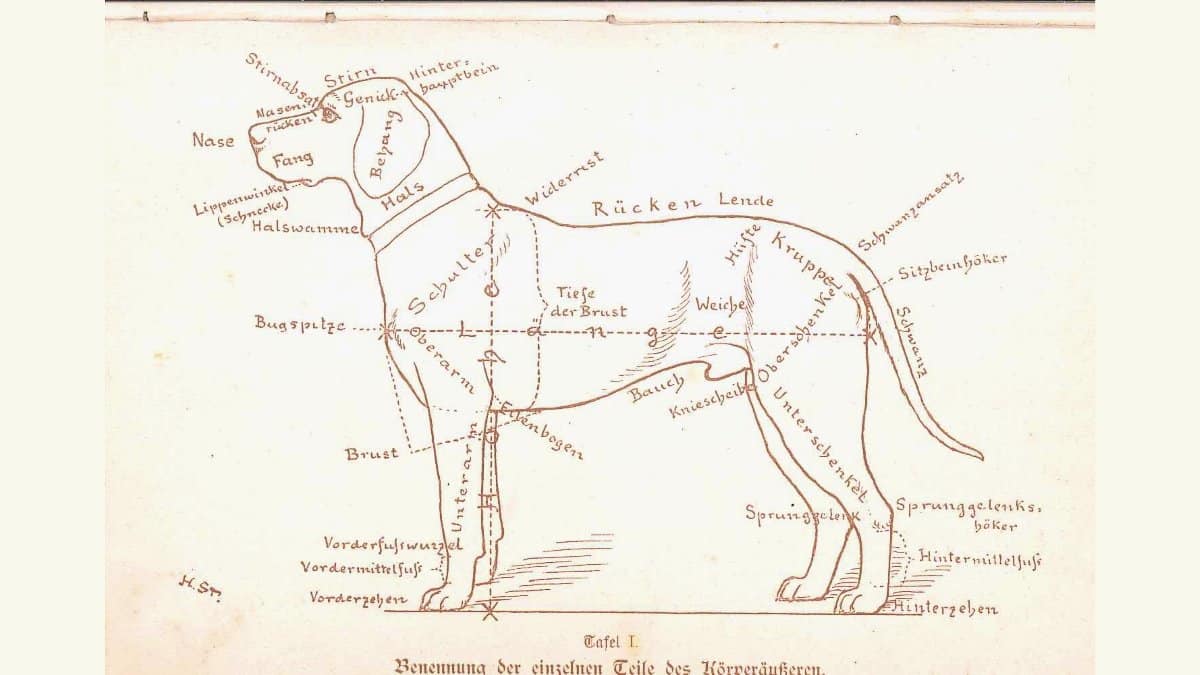
Harold saw two elderly and strikingly similar ladies who twiddled their fingertips in greeting. “So glad you could make it!” he smiled with a sinking feeling. “Gentlemen, and Mrs. Stockmann, Mrs. Brown, please meet Mary and Peggy Davidson, they illustrated my book.” Everyone smiled warmly at the charming sisters. Friederun and Franco offered Peggy the little sketchbook, so she could show the group what their drawing in Harold’s book looked like. “Yes, said Friederun, gleefully turning back some pages. “…look at zis drawing by my German colleague from 1897, just
the same!”
Louis admired the two drawings and began describing the pivotal points and their importance in gait.
Everyone quieted down when they heard Professor Solaro clink his glass. “Attention, my dear friends and colleagues! We are joined by my old friend Eugène Herout…” Everyone murmured good evening. “But first, let me make a toast to General Proportions—the very basis of our beloved disciplines of Cynology
and Cynognostics!”
“And Cynometrics,” added his student standing at his elbow.
“Yes, Franco, thank you, and let me conclude by saying, height necessarily involves BOTH the thoracic vertebral apophysis AND the cranial angle of the scapula, after all, they are the bones that define the withers.” There was some lively murmuring during the brief pause before Solaro continued. “AND, length can be measured EITHER from the point of shoulder OR the point of manubrium!” he broke into a wide conciliatory smile and lifted his glass.
“Page 66…” added Franco, thumbing through Solaro’s little book.
“Franco, please put the book away, thank you.”
“And now, allow me to demonstrate the method of Monsieur Herout to measure the angle of stop, what we may more precisely call the facial-cranial angle, no? Franco, please come here in the middle of us all and look up at the ceiling.” Professor Solaro balanced the butts of two butter knives on the bridge of Franco’s nose and began opening and closing them. “Imagine there is a hinge at the base of these two knives…”
The library is closing, and so we must leave the company to carry on their conversations. Taking our stack of books to check out at the front desk, we begin to reflect on the rock-solid certainties the greatest authorities have bequeathed us in our canine pursuits.
The author is indebted to her colleague, Giuseppe Nugnes, with whom these questions arose in conversation, for his valuable contribution to the research.
Canine Health