
The lore of the Beauceron continues to express itself in our dogs to this very day. It lives in their keen intelligence and inventive cunning, in their brave and uncanny presence, and most of all in their unwavering loyalty to their masters. This is a breed shaped by purpose and preserved by devotion, a guardian of both flock and hearth whose character remains as vital now as it was centuries ago.
The Beauceron has stood the test of time, it is our responsibility to safeguard the qualities that define it. To ensure its continued integrity, we wish to draw attention to specific elements of the Breed Standard and encourage judges to give these points careful and deliberate consideration. In honoring the Standard, we honor the history, function, and spirit of the Beauceron itself.
As breeds ebb and flow over time, certain traits naturally emerge that need to be prioritized. When attention shifts to specific traits that require heightened focus in a given context, other characteristics may be temporarily deprioritized. This dynamic is an inherent aspect of the selective breeding process. However, breed type should persist as the paramount and most enduring consideration despite shifting priorities over time. Without it, the Beauceron risks becoming indistinguishable from other herding breeds, lacking the defining characteristics that establish its unique identity.
We would like to draw thoughtful attention to several traits within the Breed Standard that may not always receive the emphasis they deserve in evaluation.
“The ideal Beauceron is a well-balanced, solid dog of good height and well-muscled without heaviness or coarseness. The whole conformation gives the impression of depth and solidity without bulkiness, exhibiting the strength, endurance and agility required of the herding dog.” This should not be interpreted as describing a dog of merely medium stature. The breed is not excessively large, and no individual feature should dominate the overall impression. Proportions must convey moderation, balance, and harmony throughout while still embodying a dog of substance.
“Dogs are characteristically larger throughout with a larger frame and heavier bone than bitches. Bitches are distinctly feminine, but without weakness in substance or structure.” Sexual dimorphism in the breed is subtle but evident. The female may be smaller in frame, yet she fully expresses the breed’s defining traits. Though she embodies femininity, she nonetheless presents as a dog of substance.
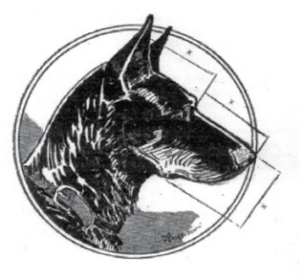
“The head is long, well chiseled with harmonious lines without weakness. The head must be in proportion with the body, measured from the tip of the nose to the occiput it is about 40 percent of the height at the withers. The height and width of the head are each slightly less than half its total length. The skull and muzzle are of equal length. The gaze is frank, alert, and confident.” The head can be measured in three parts, all of which are equal in length. From nose to stop, from stop to occiput, and the top skull. The nose, straight and strong, and top skull, flat and unrounded, will have parallel lines that meet at the stop that will be slight, but pronounced. Though lupine-like, they do not have a snipey appearance. The cheeks have a solid fill, but do not appear bulbous. The expression should leave a lasting impression.

“Beaucerons were used to move herds of 200 to 300 head traveling up to 50 miles per day without showing signs of exhaustion (general appearance). The construction of the forequarters is of the utmost importance, determining the dog’s ability to work and his resistance to fatigue (forequarters). The angulation of the hindquarters is balanced with the forequarters. The hindquarters are powerful, providing flexible, almost tireless movement (hindquarters).” The breed’s movement must be balanced, efficient, and capable of covering ground effortlessly. It should never appear heavy or cumbersome. Hackney-like action, abbreviated strides, or excessive overreaching and over-pedaling detracts from the ideal gait and should be severely penalized. The well- set shoulder and equal length upper-arm should meet in a 90-degree angle. The chest should never present itself as narrow and descend to the point of the elbow.
Berger du Beauce
By the American Beauceron Club
Diagrams extracted and edited from René Sauvignac: Le Berger de Beuce by C. Batson © 2005