Members
Anne M. Tureen uses the English Toy Terrier to show how understanding a Breed Standard reveals the connection between form and function.
The Weekly Brief
The best of SHOWSIGHT editorials, weekly wins, and breeder commentary — delivered to your inbox every Sunday morning.
Breeders or judges who aspire to become specialists in a given breed will, at one point, make an in-depth study of the Breed Standard. They will start from scratch—but what does that mean? It involves going through the Standard with fresh eyes, forgetting all the individual dogs they have ever seen, even the ones they may have bred. The objective is not to fit the Standard to a specific dog the reader may believe represents the Standard, but to approach it like a mystery story, taking each line, each word with a question mark, and delving into anatomy, theory, and the function for which the breed was developed to answer all the questions that arise. I propose doing this together, with a Standard that, I am betting, will be familiar to very few of my readers.
The English Toy Terrier Standard1 is among the most difficult to decipher, one I am still working on, so let’s see how far we can get in understanding this breed. The first question is always the same: What was this breed bred to do? To find our answer we must look into the history and development of the breed.
The Old English Black and Tan Terrier, a native type from the UK, was an all-around working dog, ratting in the farmyard, getting their noses, and as much of themselves as possible, into the nooks and crannies where vermin hide. They also went to ground into the dens to catch the pesky fox which carried off poultry and other small animals. This little dog was not bred, but reproduced itself, in the words of Rawdon Lee: “Terriers were principally owned by farmers and cottiers, who kept one or two roaming about their houses and farms, they were hardly likely to be very select in the manner of breeding.”2
From the mid-18th to the mid-19th century, when the sport of hunting was developing and arriving at its zenith of popularity, the Terrier became a key player in worrying the quarry but not killing it. The Fox Terrier became THE Terrier and had certain requirements such as covering ground, good self-control, and smart looks. Our hardy, handy black and tan, which did not run with the horses but worked on his own or with people on foot, branched out in a different direction to what we know as the Welsh Terrier, a sturdy fellow, and the Manchester Terrier, built for the chase.
After the brilliant innovations in farm management developed by Robert Bakewell, and Darwin’s famous book, On the Origin of the Species, science, breeding, and breeds evolved. Early Manchesters were bred3 as they still are in the US today4, coming in all sizes, the little ones useful for vermin indoors5, and the larger ones for work in the field. In the UK, however, they were divided into the Manchester Terrier and English Toy Terrier6. Our ETT7 is therefore a functional and elegant small dog, which stays close by and guarantees that rodents have no purchase in the room while he is on guard. It is an appealing and handsome dog, but not, originally, a fawning ladies’ companion like many of the coated toys8.
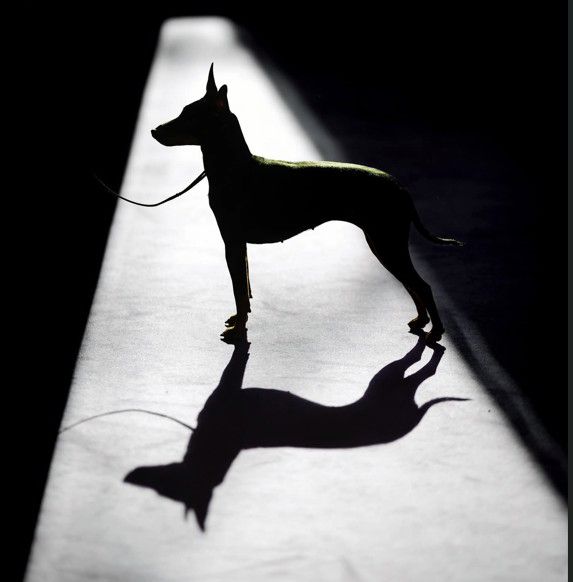 Bonwild Black Magic Woman, the most-winning ETT across the world in the history of the breed, presented here by Amanda Kelly, bred by Sari Laitinen.
We find many elements in this Standard that underline how the ETT must be a good ratter. Firstly, it is mentioned in the notes on temperament. Then in conformation we find he must have good fill under the eyes. This region of the cranium is where the roots of the molars reach and where the muscles of the jaws originate, so good bone through the transition from cranium to foreface (both cranium and foreface are described as wedge-shaped) is a fundamental characteristic, and snipey muzzles are undesirable. The interesting note that the wedge may cause the appearance of an overshot bite is, in my opinion, a result of the well-developed nose cartilage (the tip of the wedge) which protrudes slightly, much like it does in Dachshunds.
A point is made of the deep, dark pigmentation of the eye, and the small almond shape. This is only possible when the orbit is well set in good bone and is a continuation of the wedge theme, also connected to the flat top of the skull. The description of the head is as far from the Chihuahua or Chin as possible, and very Terrier. The ear shape is described as a candle flame9, which is wide at the bottom and tapers to a rounded tip which is proportioned like a real flame, not narrow, wide, short, or long.
The body is described as compact, which means two things. Firstly, the loin is not long but makes up about 20 percent of the length of trunk, and secondly, the entire physique is well-knit together, tight, muscular, and athletic; in our case, the way a long-distance runner would be, with flat muscles as opposed to a body builder with bulging muscle like the bull types. To support this analogy, we have the repeat of the word “elegant(ly)” under the heading Neck, the loin is well cut up, meaning, defined and tucked up in the underline, and the chest is narrow.
Spring of rib is always a tricky point, since most Standards require good or moderate spring of rib which could seem like a contradiction of a narrow chest. Spring refers to how the rib develops from the spine. If there is good spring of rib, the ribs will develop horizontally to begin with, creating a back that has some width10, then they curve gently downwards and rapidly narrow toward the sternum. The effect is a heart shape, in our case, a long, deep, narrow heart.
The topline is unlike the larger Manchester, which is slightly arched over the loin. Here we have a single continuous line flowing from neck to root of tail. The withers is not high on this breed, but is also not low. The hand should not stop abruptly at the base of the neck, but descend gently downwards, falling off the croup. This descent is described as a curve downwards from shoulders (withers) to root of tail. Therefore, no point is ever higher than the vertebrae before, but always slightly lower on down to the tail. The loin is well rounded, meaning, muscular and defined, which is very different from arched.
The limbs remind us of sighthound construction. The oval foot is the first hint of departure from classic Terrier ingredients. We find a rear well angled, but the front should fall straight from the shoulder. The scapula is well laid back, but the humerus should be more vertical than, say, the Jack Russell, which requires the foreleg well placed under the body. Pay close attention where the words “straight front” can be misleading. The front assembly has a straighter scapular humeral angle than most Terriers, but that is not the same thing as the front of the dog which involves the chest. It is a universal virtue for the first bones of the sternum to be well developed. Therefore, expect the breast (where the muscles that draw the leg forward are anchored) to present in front of11 the point of shoulder. The breast and the layback of shoulder ensure good front limb excursion.12
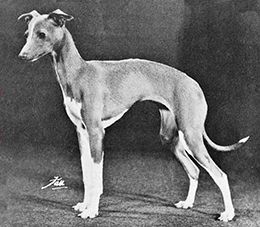 Italian Greyhound Ch. Tamoretta Tailormade, standing in the breed-typical position “under himself” due to very specific conformation, notably, general proportions equal to or slightly less long than tall, a loin slightly arched, and a croup very sloping. This is how an ETT should NOT look when standing.
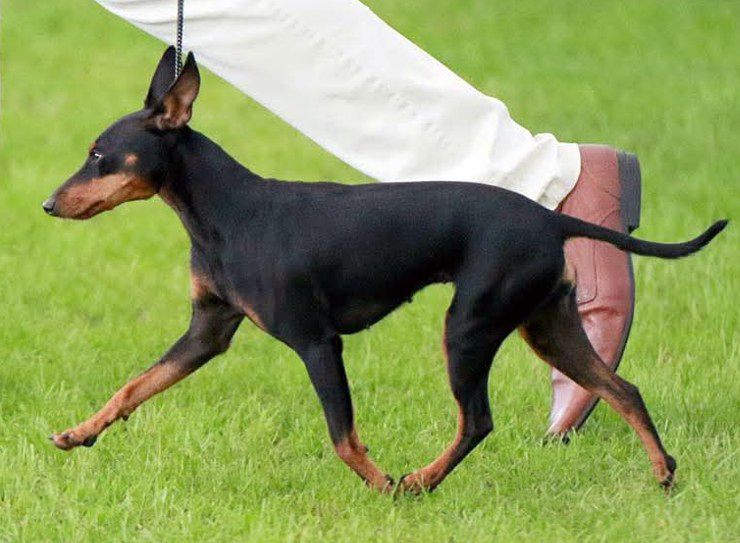
Rear limb excursion is one point that remains an open question for me. Some ETT do not have the topline described in the Standard, but let’s discuss those that do. While standing, the ETT may look the very picture of the Standard, then in movement, the rear rises and will bob a bit as the dog progresses. All ETT lower their head in movement, but the body should be tapering behind, not rising. The tail is not expected to be gay, but often is.
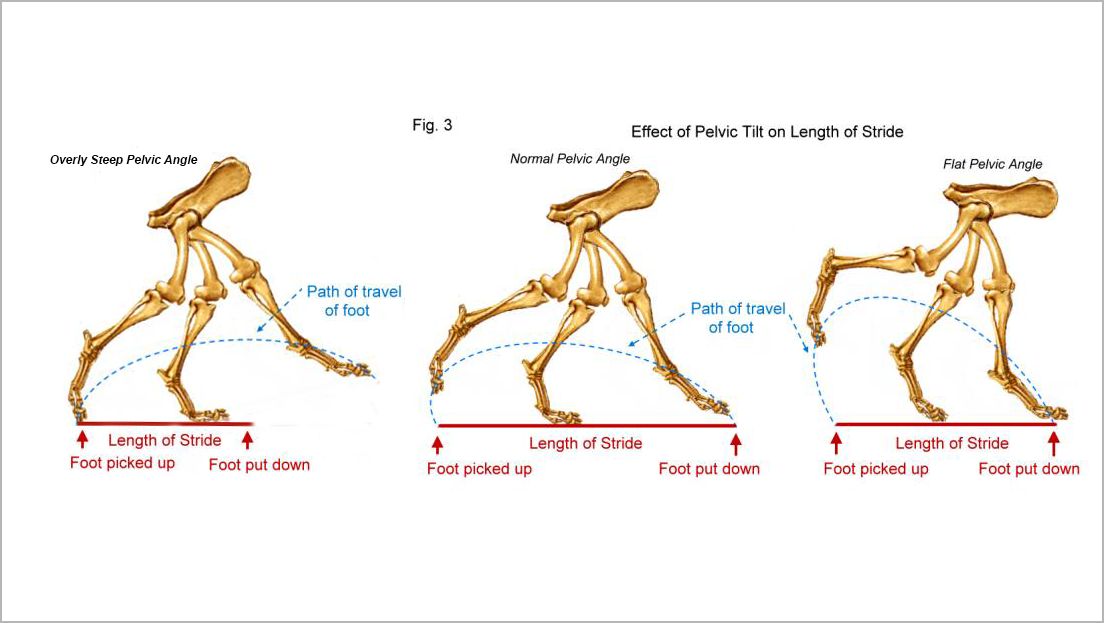
Rear action is described as smooth with drive, and the overall effect as flowing. What is often found, in an otherwise well-built dog, is that the rear has no drive, and the dog walks under himself13, meaning the legs flutter under the body, with no “backswing.” This phenomenon is not limited to the ETT, it can be found in other breeds as well; the rear excursion does not have a full pendular arc, but lifts off and forward from a nearly vertical point, to carry forward once more. My theory is that this is caused by an overly sloping croup, which brings the acetabulum angled forward, structurally inhibiting the femur from reaching behind the dog while gaiting. In many Terriers the croup is horizontal, which in physiological terms is about a 15-20-degree angle. The ETT Standard describes a topline “falling” over the croup, but under the heading General Appearance states buttocks gently rounded (muscular) and “a tucked under appearance” is undesirable, excluding the breed-typical “tucked under” Italian Greyhound silhouette. Yet the tail is not gay as Terriers’ tails usually are. Therefore, we must look for a fairly level pelvis but a sloping sacral region. This construction would ensure low tail carriage, but good forward and rear excursion of the hindlimb, resulting in “truly sound” movement “akin to the ‘extended trot’” as required by the Standard.
In practical application, after the physical examination, my feeling is that movement should be given even greater weight in evaluation than it already carries for other breeds during the judging process, both for purposes of grading in dog shows and for selection of breeding mates.
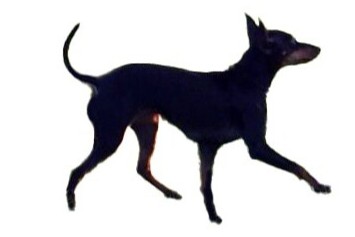
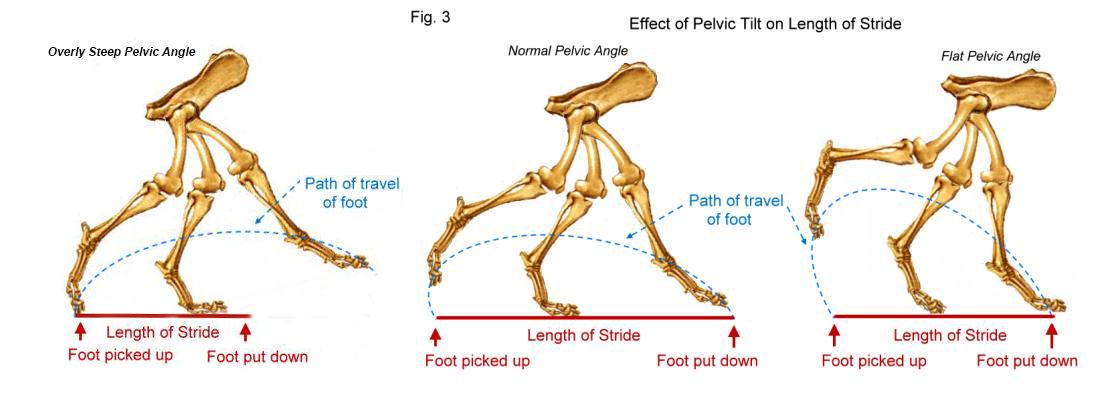 Author’s edit of Marg Brown’s illustration, including the third possibility of an overly sloping croup, common in the ETT.
Finally, I feel that the size should be a major goal post for breeders, since it is a defining characteristic linked to the division from the Manchester. The UK and FCI have the advantage in this, since to breed a truly small Toy with consistency over generations it is best to have a pedigree full of small dogs rather than a mix of large and small as occurs in the US.
From two sheets of paper, we have followed the instructions, joining the dotted lines. In our mind’s eye, a unique canine model has taken shape. We have seen: that the wedge-shaped head is not only a question of type but also of function; that the slim body and nearly vertical upper arm and oval foot remind us of the sighthounds; but the temperament, compact design, small eye, and flowing trot with drive land it solidly in the Terrier department, though elegance must prevail over power.
The next step might be to page through the newly revamped two volume Book of ETT Champions of this breed, which has been lovingly curated by Steve Inch14, a scholarly work and a joy for any dog lover. We are then ready to go out into the world and look for dogs that resemble the ideal of the breed we have built in our mind from the blueprint left for posterity by the founders. It is always advisable to put the horse before the cart.
1 This article will discuss the English Toy Terrier and the UK (also adopted in the FCI) Standard, since this is the country of origin. The Toy Manchester Terrier Standard used in the AKC is slightly different.
2 A History and Description of the Modern Dogs of Great Britain and Ireland, 1893.
3 As Dachshunds are bred in all countries.
4 Please note that the English Toy Terrier is listed as the Toy Manchester Terrier in the AKC.
5 I have been told that the English Toy Terrier is the magistrate’s shadow, controlling mice primarily in the offices and courts of law, but I have yet to find a written record of this affirmation.
6 Note that, though very close in many ways, the Standards of these breeds reflect the different uses they were put to. They have very different descriptions of the topline, and the temperament is entirely different.
7 English Toy Terrier
8 The ETT was, inevitably, also a marvellous companion to families and a playmate to little children, as many old illustrations, postcards, and photos testify.
9 A prominent breeder also remarked that, like a candle flame, the ETT ears flicker, meaning they crumple and then shoot up again, which I can confirm from experience.
10 Unlike the Bedlington Terrier, for example.
11 This is not a Weimaraner, so we are looking for at least a few millimeters of breastbone development; however, the more, the better!
12 Excursion is the pendular arc of movement equally forward and behind the vertical starting point.
13 Illustration originally published in Small Animal Pelvis and Pelvic Limb by Marg Brown RVT, BEd AD ED.
14 Book of ETT Champions Vol 1, 1884-1993. First edition by John Richardson (Reebrich Kennel) 1994, second edition with amplified content by Dr. Steve Inch OBE, ETT Club Chairperson and Club Archivist, 2025; Vol 2, 1994-2025, written and edited by Dr. Steve Inch OBE, 2026.
Canine Health