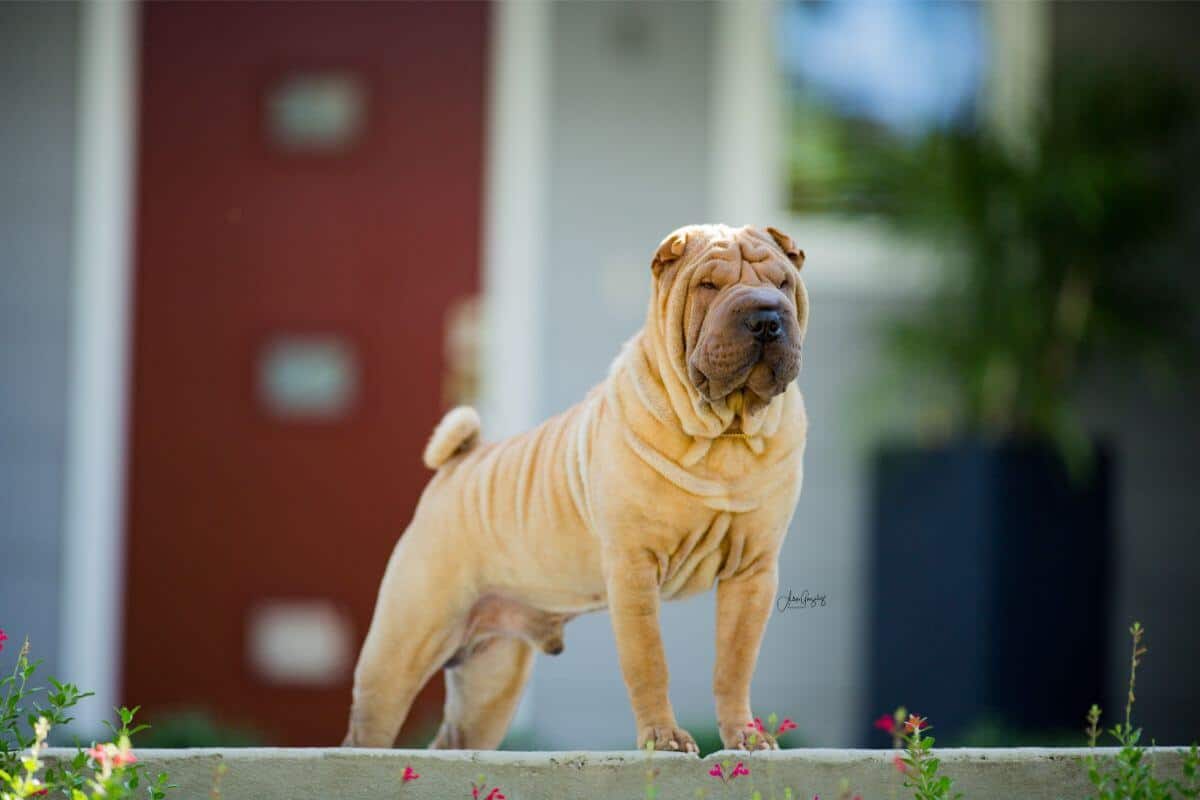
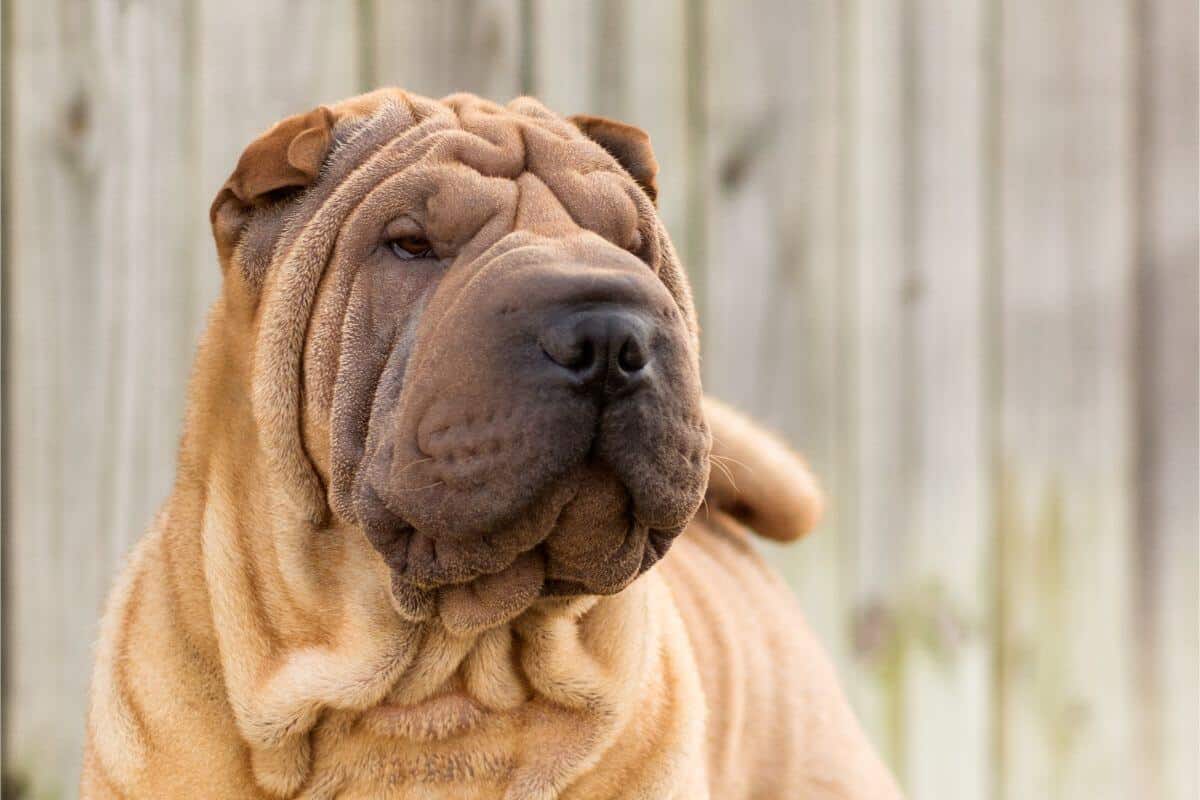
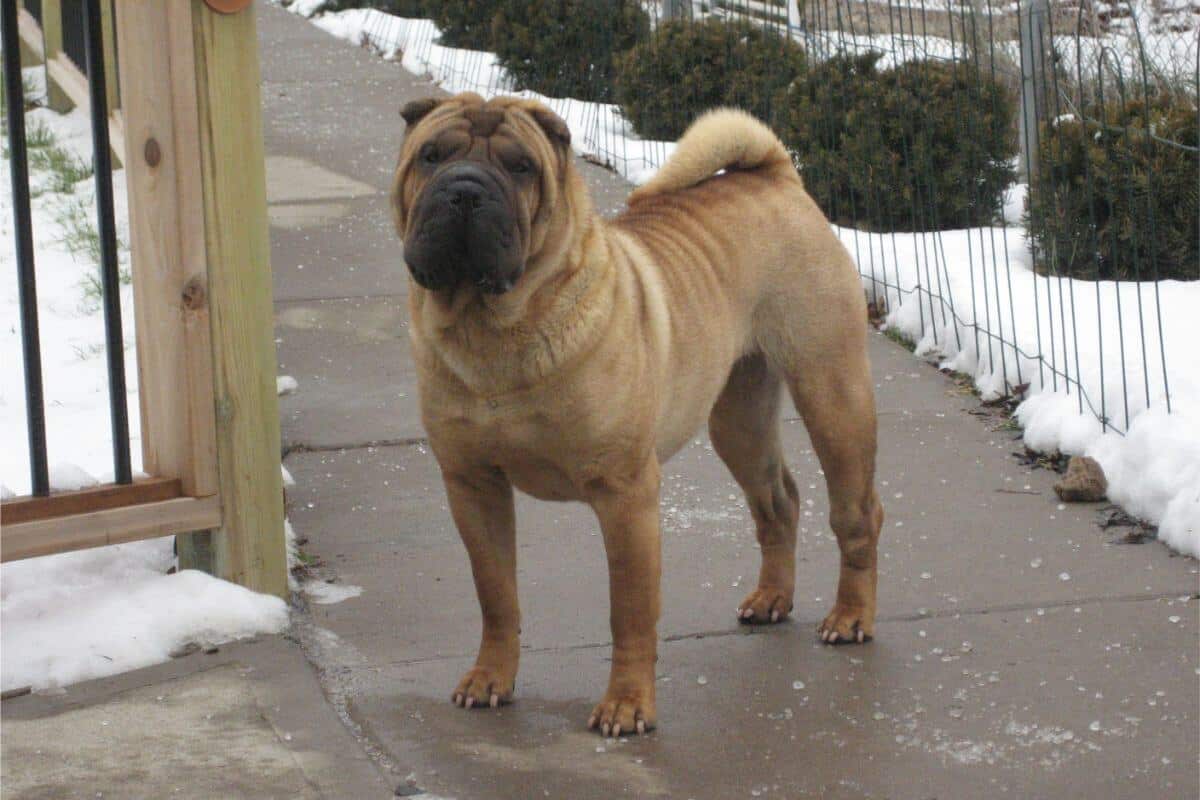
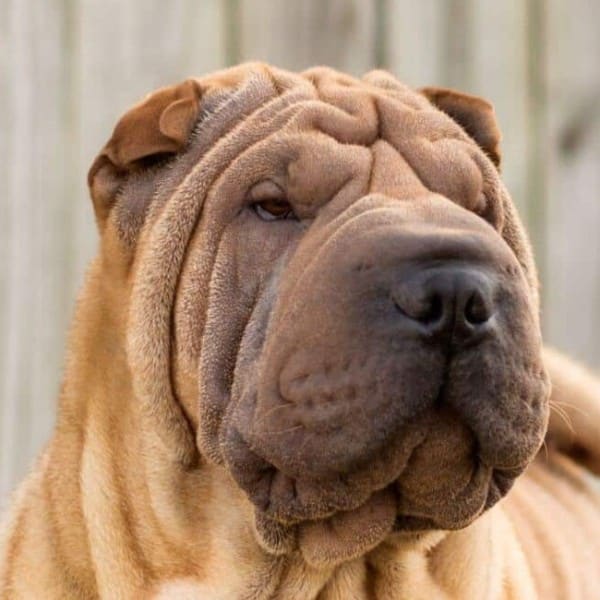
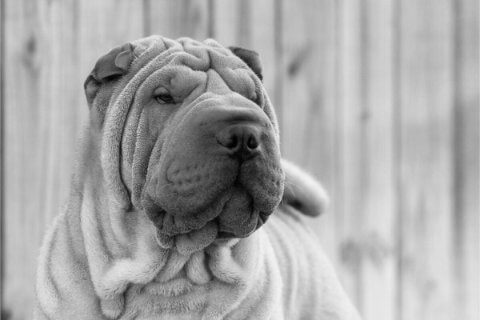
The name “Shar-Pei” itself literally means “sand-skin”, but translated more loosely as “rough, sandy coat” or “sand-paper-like coat” and refers to the two distinctive qualities of the Shar-Pei coat – roughness and shortness – which make the breed unique in the dog world
AKC Group
Non-Sporting
Height
18 – 20 inches
Weight
45 – 60 pounds
Lifespan
8 – 14 years
Highlights
Country of Origin
China
Bred For
Guarding, Hunting
Known For
Wrinkled Skin, Affection, Trainability
Popularity
Moderate
Temperament
Independent, Loyal, Calm
Activities
Hunting, Guarding, Running, Walking, Conformation Shows, Dog Sports, Swimming
“The Chinese Shar-Pei, an ancient and unique breed, is thought to have originated in the area around the small village of Tai Li in Kwangtung Province, and has existed for centuries in the southern provinces of China, apparently since the Han Dynasty (c. 200 B.C.). Statues bearing a strong resemblance to the Shar-Pei have been discovered and dated to this period. More recently, a Chinese manuscript of the 13th century has been translated; it refers to a wrinkled dog with characteristics much like those of the Shar-Pei.
The name “Shar-Pei” itself literally means “sand-skin”, but translated more loosely as “rough, sandy coat” or “sand-paper-like coat” and refers to the two distinctive qualities of the Shar-Pei coat – roughness and shortness – which make the breed unique in the dog world. The Shar-Pei shares another distinctive characteristic with only one other breed, the Chow-Chow, in having a blue-black tongue, which may indicate an ancestor common to both breeds. However, proof of such a relationship is difficult.
The history of the Chinese Shar-Pei in modern times is incomplete. However, it is known that following the establishment of the People’s Republic of China as a communist nation, the dog population of China was essentially eliminated. No dogs were seen in the cities, and few dogs remained in the countryside. During this period a few Chinese Shar-Pei were bred in Hong Kong, BC and in the Republic of China (Taiwan).
The breed was recognized by the Hong Kong Kennel Club until about 1968. Subsequently the Hong Kong and Kowloon Kennel Association established a dog registry and registered the Shar-Pei. This organization still registers the breed today as do other registries in Taiwan, Japan, Korea, as well as organizations in Europe, Canada and Great Britain.
In the United States, the documented history of the breed goes back to 1966 when a few dogs were imported from stock registered with the Hong Kong Kennel Club. The American Dog Breeders Association registered a Chinese Shar-Pei for J.C. Smith on October 8, 1970. Strong interest in the breed increased in 1973 when Matgo Law of Down-Homes Kennels, Hong Kong, appealed to dog fanciers in the United States to “Save the Chinese Shar-Pei”. The response was enthusiastic, and because of their rarity, a limited number of Shar-Pei arrived in the United States in the fall of 1973. The recipients of these dogs corresponded with each other and decided to form a national dog club and registry. The Chinese Shar-Pei Club of America, Inc. (CSPCA), held its first organizational meeting in 1974, and the club has been in continuous existence since that time. The first Annual National Specialty Show was held in 1978 and successive national shows have been held each year.
The Club’s primary purpose was to promote the breed, maintain the stud book registry and to provide a standard for the breed. On May 4, 1988 the Chinese Shar-Pei was accepted in to the American Kennel Club (AKC) Miscellaneous Class. The CSPCA continued to represent the breed and operated the registry until the AKC accepted the breed into the Non-Sporting Group on August 1, 1992. The CSPCA continues to promote the best interests of the breed, maintains the Standard and serves as a Member Club of the AKC.”
General Appearance
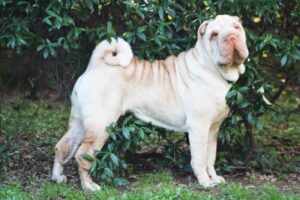
An alert, compact dog of medium size and substance; square in profile, close-coupled; the well-proportioned head is slightly, but not overly, large for the body. The short, harsh coat, the loose skin covering the head and body, the small ears, the “hippopotamus” muzzle shape, and the high-set tail impart to the Shar-Pei a unique look peculiar to him alone. The loose skin and wrinkles covering the head, neck, and body are superabundant in puppies, but these features may be limited to the head, neck, and withers in the adult.
Height & Weight
The height is 18 to 20 inches at the withers. The weight is 45 to 60 pounds.
Proportion & Substance
The dog is usually larger and more square bodied than the bitch but both appear well proportioned. The height of the Shar-Pei from the ground to the withers is approximately equal to the length from the point of breastbone to the point of rump.
Coat Texture, Color & Markings
Texture: The extremely harsh coat is one of the distinguishing features of the breed. The coat is absolutely straight and off-standing on the main trunk of the body but generally lies somewhat flatter on the limbs. The coat appears healthy without being shiny or lustrous. Acceptable coat lengths may range from the extremely short “horse coat” up to the “brush coat,” not to exceed one inch in length at the withers. A soft coat, a wavy coat, a coat in excess of one inch at the withers or a coat that has been trimmed is a major fault. The Shar-Pei is shown in its natural state.
Chinese Shar-Pei Colors:
Apricot Dilute
Black
Black Dilute
Lilac Dilute
Cream
Cream Dilute
Brown
Chocolate Dilute
Red
Five Point Red Dilute
Red Fawn
Fawn
Isabella Dilute
Black Sable
Cream Sable
Fawn Sable
Red Sable
Blue
Chinese Shar-Pei Markings:
Nothing is in the Breed Standard about markings as the breed is solid-colored, with potentially some shading.
A Note About Color: Only solid colors and sable are acceptable and are to be judged on an equal basis. A solid color dog may have shading, primarily darker, down the back and on the ears. The shading must be variations of the same body color and may include darker hairs throughout the coat. The following colors are disqualifications: Albino; Not a solid color, i.e., Brindle; Parti-colored; Spotted; Patterned in any combination of colors.
Head
The head is large, slightly, but not overly, proudly carried and covered with profuse wrinkles on the forehead continuing into side wrinkles framing the face.
Skull: Flat and broad, the stop is moderately defined.
Expression: The Shar-Pei has a scowling expression.
Eyes: Dark, small, almond-shaped and sunken, displaying a scowling expression. In the dilute-colored dogs the eye color may be lighter.
Ears: Extremely small, rather thick, equilateral triangles in shape, slightly rounded at the tips; edges of the ear may curl. Ears lie flat against the head, are set high, wide apart and forward on the skull, pointing toward the eyes. The ears have the ability to move. A pricked ear is a disqualification.
Muzzle: One of the distinctive features of the breed. It is broad and full with no suggestion of snipeyness. (The length from nose to stop is approximately the same as from stop to occiput.)
Nose: Large and wide and darkly pigmented, preferably black but any color conforming to the general coat color of the dog is acceptable. In dilute colors, the preferred nose is self-colored. Darkly pigmented cream Shar-Pei may have some light pigment either in the center of the nose or on the entire nose.
Bite: Teeth are strong, meeting in a scissors bite. Deviation from a scissors bite is a major fault. The lips and top of the muzzle are well padded and may cause a slight bulge above the nose. The tongue, roof of mouth, gums and flews are solid bluish-black is preferred in all coat colors except in dilute colors, which have a solid lavender pigmentation. A spotted pink tongue is a major fault. A solid pink tongue is a disqualification. (Tongue colors may lighten due to heat stress; care must be taken not to confuse dilute pigmentation with a pink tongue.)
Tail
The high-set tail is a characteristic feature of the Shar-Pei. A low-set tail shall be faulted. The tail is thick and round at the base, tapering to a fine point and curling over or to either side of the back. The absence of a complete tail is a disqualification.
The level of affection a breed typically shows towards family members and familiar individuals will vary. While some breeds may only show genuine warmth towards their owner, remaining standoffish with strangers, other breeds will treat everyone they meet as if they are their closest friend.
IndependentAffectionate
Good With Other Dogs
The innate friendliness of a dog towards other dogs can depend on its breed. Although supervision is always recommended during introductions, certain breeds tend to be inherently more or less sociable with other dogs, whether in a home setting or in public spaces.
Not RecommendedReliable With Other Dogs
Good With Young Children
The degree to which a breed will typically be patient with young children, and its overall suitability as a family member, will vary. It is important to always supervise interactions between dogs and the kids in the house, as well as with children who are not accustomed to being around dogs.
Not RecommendedDependable With Children
Amount Of Shedding
The amount of hair that a dog sheds will typically depend on its breed. Heavy-shedding breeds require more frequent brushing, have a higher chance of activating specific allergies, and often necessitate more frequent use of the vacuum cleaner and lint rollers.
LowHigh
Frequency Of Grooming
The regularity with which a breed needs bathing, brushing, trimming, or other forms of coat care is an all-important consideration. When evaluating the grooming effort required, consider your available time, patience, and budget. It is important to note that all breeds need routine ear, teeth, and nail care.
MonthlyDaily
Amount Of Drooling
The tendency of a breed to drool significantly varies from breed to breed. For those who prefer cleanliness or are particular about keeping things tidy, breeds that are likely to leave trails of drool on your arm or large slobbery marks on your clothing and furniture might not be the best fit.
LowHigh
Coat Type
smooth
wiry
hairless
rough
corded
double
curly
wavy
sikly
Coat Length
short
medium
long
Acceptance Of New People
The likelihood of a breed to be friendly towards strangers will vary. While some breeds may consistently exhibit reserve or caution around unfamiliar people, regardless of the setting, others are often eager to greet and interact with any new person they meet.
ReservedOutgoing
Protective Nature
The propensity of a dog to notify you of the presence of strangers is breed-dependent. Some breeds are more inclined to respond to any perceived threat, be it the mailman or a squirrel outside the window. However, most breeds are generally more accepting of strangers who are welcomed by their human family members.
Minimal InterestMaximum Vigilance
Playfulness Level
The likelihood of a breed remaining playful beyond puppyhood will vary. Certain breeds retain their enthusiasm for activities like tug-of-war or games of fetch well into their adult years, whereas others are more content to simply lounge on the sofa with you for the majority of time.
LowHigh
Adaptability Level
The ease with which a breed can adapt to changes in its environment can vary greatly. This adaptability encompasses how well a breed is likely to cope with alterations to its home and yard, noise levels, weather conditions, daily routines, and other fluctuations in everyday life.
LowHigh
Trainability Level
The ease with which a dog can be trained and its eagerness to learn new skills can depend on the breed. Some breeds are naturally inclined to please their owners and will readily accept training, while others tend to follow their own desires, often showing independence in how, when, and where they choose to do things.
StubbornEager
Barking Level
The frequency of vocalization, including barking and howling, will vary from breed to breed. Some may bark at each person who passes by and every bird in the sky, while others will typically bark only for a good reason. Additionally, a few breeds that do not typically bark will still be vocal, using different sounds to communicate.
QuietVocal
Energy Level
The level of physical exercise and mental engagement required will depend on the breed. High-energy breeds are always on the go. They are enthusiastic about their next activity and tend to be busy most of the time, running, jumping, and playing throughout the day. In contrast, low-energy breeds are akin to couch potatoes, content to just lounge around and take naps throughout the day.
Couch PotatoBusybody
Need For Mental Stimulation
The extent of mental stimulation needed to keep a dog content and healthy will vary by breed. Dogs bred for specific purposes may need tasks involving decision-making, problem-solving, and concentration. Without sufficient mental exercise, these dogs can resort to creating their own activities to engage their minds, resulting in unwanted behaviors like chewing, digging, and escaping.
Minimal EngagementIntensive Interaction
Chinese Shar-Pei Health
The most common health issues may be found on the Chinese Shar-Pei Club of America website: https://cspca.com/most-common-heath-issues/
Lifespan: Like most breeds, life expectancy will vary; however, most Shar-Pei live 8-14 years.
Potential Health Risks
While you can see some things on the Orthopedic Foundation for Animals (OFA) website, https://ofa.org/chic-programs/browse-by-breed/?breed=SP, the breed tendencies can be great or small. There is some elbow dysplasia, hip dysplasia, and patellar luxation; there are some autoimmune issues, and testing has been developed to help understand kidney issues, kidney amyloidosis, and auto-inflammatory disease.
Chinese Shar-Pei Personality
Shar-Pei are smart, stubborn, funny, very easy to housebreak, independent, and devoted to their family.
Chinese Shar-Pei Feeding & Nutrition
The owners/breeders of Shar-Pei feed quality commercial or raw diets, or a combination of those. It depends on the dog and the owner.
Chinese Shar-Pei Training
The breed has been trained in a wide range of areas, from simple Obedience to Therapy, to even things as far flung as Herding and Scent Trials. This is a very versatile breed!
Chinese Shar-Pei Exercise
Exercise Expectations
Energy Level
Can be low, moderate, or high, really, depending on the lifestyle of the owner. Shar-Pei can live happily in apartments with walks, homes with yards, or be working dogs and dogs that hike regularly!
Exercise Requirements
This varies, and is most often established by the home the Shar-Pei grows up in. On average, most would like a good walk, or a yard to run around the perimeter of, but they don’t require huge amounts of focused exercise. That said, young dogs love a good boot scoot race around every now and then; dogs used in different exercises can keep up well. The breed will play, some chase balls, very few dig or climb.
Chinese Shar-Pei Grooming
This is very much a “wash and wear” breed. The Shar-Pei can be brushed, though it’s not required, and is a good idea during the shedding season. Bathing can be weekly or monthly. Nails are very hard, and many use a Dremel weekly or every two weeks. Tooth brushing is good for all dogs. Some ears can have small canals and require more diligence, other ears are low maintenance.
Grooming Expectations
Coat Type
Horse Coat or Brush Coat
Grooming Requirements
Occasional Brushing, Weekly or Monthly Bathing, Routine Ear Cleaning, Weekly or Bi-Weekly Nail Trimming, Regular Tooth Brushing
Living with a Chinese Shar-Pei
Many people who own one Shar-Pei will own more, and many will always have one. The breed is easy to live with, and loving and funny!
Chinese Shar-Pei Puppies
Caring for a Chinese Shar-Pei Puppy
There is nothing specific about caring for a Shar-Pei puppy.
Chinese Shar-Pei Activities & Dog Sports
Of course, there is Conformation and Obedience, but Shar-Pei can and have competed in Scent Work, Tracking, Barn Hunt, Coursing, Trick Dog, Flyball, and nearly every other possible dog-related sport!
Group Classification & Standards
The Chinese Shar-Pei is recognized by the world’s leading registries and kennel organizations, which categorize the breed into a specific Group based on its unique characteristics. This breed is recognized worldwide under the following Group designations:
International Organizations
Organization
Group Designation
AKC (American Kennel Club)
Non-Sporting
UKC (United Kennel Club)
Northern
CKC (Canadian Kennel Club)
Non-Sporting
ANKC (Australian National Kennel Council)
Non Sporting
RKC (The Royal Kennel Club)
Utility
FCI (Fédération Cynologique Internationale)
Group 2: Pinscher and Schnauzer Molossoid Breeds – Swiss Mountain and Cattle Dogs; Section 2.1: Molossoid breeds, Mastiff Type
The ideal Chinese Shar-Pei is described by a Breed Standard that is approved by each of the world’s leading registries and kennel organizations. The Breed Standards for this breed may be found in the following links:
There are many rescue groups, and they are listed on the parent club website.
Chinese Shar-Pei Facts
In 1978, the breed was listed as the rarest dog in the world in the Guinness Book of World Records!
Often called “the wrinkle dogs,” those wrinkles are heaviest in puppies, and adults typically grow into most of them.
Shar-Pei have a unique look, from the scowling expression to the hippo head. They stand out in a crowd!
The Chinese Shar-Pei was very nearly extinct by the 1960s and has a great rescue and rebuild story.
Frequently Asked Questions (FAQ)
Do Chinese Shar-Pei get mold in the folds?
No, the wrinkles move and air can reach the skin!
Weren’t Chinese Shar-Pei fighting dogs?
They never had the temperament for a fighting dog, so while the Chinese tried to pit them and wager on them, it never worked!
Chinese Shar-Pei Club of America
The Chinese Shar-Pei Club of America (“CSPCA”) is a national nonprofit organization, incorporated under the laws of the State of Delaware. Fifteen individuals founded the club in 1974. With over 700 members representing most of the 50 states and several other countries, the CSPCA is the “parent” organization of multiple Chinese Shar-Pei Specialty Clubs located throughout the United States. The CSPCA is a member of the American Kennel Club (AKC) and, as such, is the only national Chinese Shar-Pei breed club which is recognized and sanctioned by the AKC. The primary objective of the club is to support the members whether they are pet, conformation, performance, versatility or therapy fanciers. We encourage our breeders, by selective breeding, to produce purebred Chinese Shar-Pei puppies that conform to the Standard for the Breed, and to do all possible, including testing before breeding, to advance and promote the perfection of these qualities.
The Chinese Shar-Pei’s silhouette: topline dipping behind the withers and rising over a broad, short loin, high-set tail and up-tilted anus. The silhouette formed by the topline dipping slightly behind the withers then rising over a broad, short loin with flat croup, extremely high-set tail, and up-tilted anus is unique in the dog world.