Members
As performance titles rise and conformation declines, the future of breed preservation – and the sport – hangs in the balance.
The Weekly Brief
The best of SHOWSIGHT editorials, weekly wins, and breeder commentary — delivered to your inbox every Sunday morning.
Dog shows are not simply evolving; they are imperceptibly changing in ways we have yet to understand. It may even be sneaking up on us. If you pay close attention when you stand by the ring in 2025, you will feel subtle changes beneath your feet. The real question isn’t if our sport will transform. It is how, how fast, and whether we’re prepared.
Everyone knows that our sport is changing. That’s not news. What is news is that the shift from Conformation specificity to versatility titles has been subtle over the last 10 years. Now it’s made a real dent in Conformation.
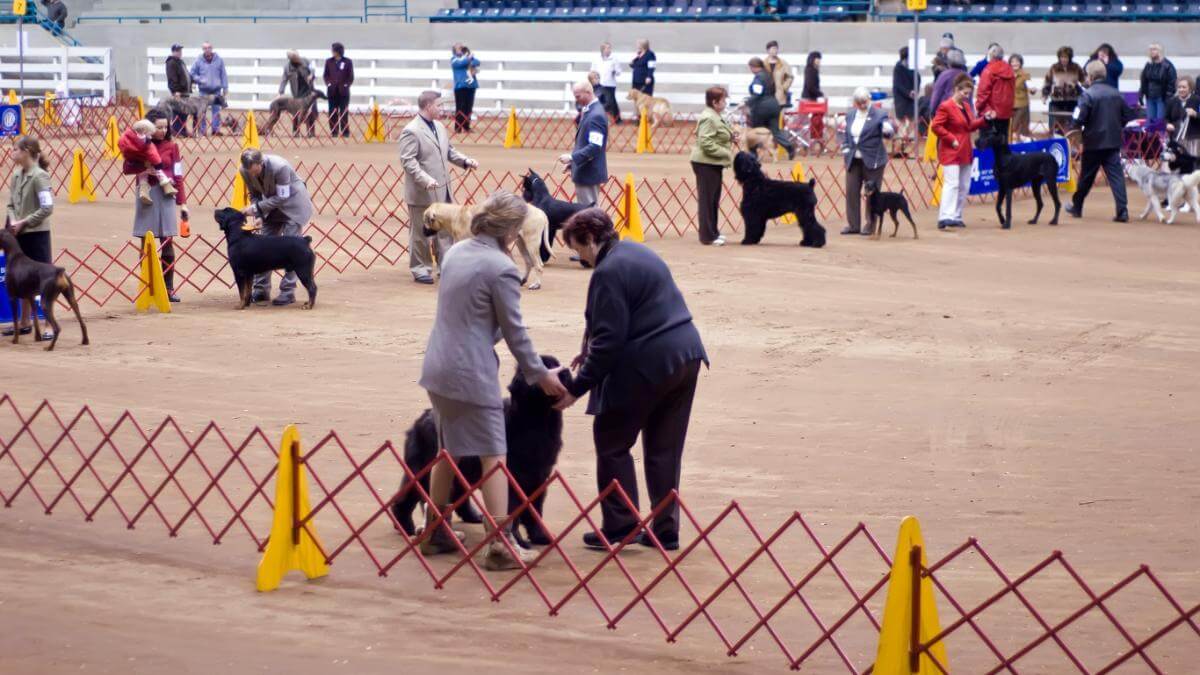
Once the lifeblood of our fancy, Conformation is now a shadow of its former self. According to a 2023 article by Dr. Gerry G. Meisels published in SHOWSIGHT, total entries in AKC (American Kennel Club) Conformation shows have dropped by nearly 28 percent over the past 20 years, even as the US dog population continues to climb. This decline is not just a statistic; it’s a threat to the very foundation of breed preservation.
As more exhibitors pursue Performance titles in areas like Agility, Rally, and Scent Work, the traditional Breed ring is shrinking, and with it, our responsibility to preserve breed essence is greater than ever before.
We must not lose sight of our responsibility to preserve the essence of each breed.
AKC still sanctions over 22,000 events each year, covering all events. Performance participation has surged, but for purebred guardians, Conformation remains the baseline; it’s the show ring’s pulse. If the decline continues, the core of the sport will suffer as well. So, the big question is, what happens to the knowledge base that the best judges rely upon to gain depth of expertise in each breed they study?
Our official Breed Standards demand precision: the curves of a Whippet, the skull shape of a Chihuahua. Yet modern certificates—Versatility, Companion, Performance—reward broad skillsets over breed essence. Some of these dogs will lack anything close to true breed type. We’re raising dogs that collect titles at multiple events rather than focusing on breed-specific conformation with close adherence to the Breed Standard.
Each Standard provides a blueprint for what the dogs should look like, as well as defining their original purpose and temperament quirks. These things are not mutually exclusive. You can have some dogs that are superb examples of their breed that are also exceptional in their versatility.
However, herein lies a fundamental divide: Do we prize titles or breed essence more? Can we value both and prioritize the latter? Some of this is beyond our control. If AKC continues broadening Performance tracks, Conformation may shift from an anchor event to an optional one.
Judges’ education, once taught by breeders in the grooming area, over dinner, and through ringside mentoring, is now largely virtual. Training, webinars, quizzes—these cultivate knowledge, but can they teach someone how to touch? Do they preserve the feel of a proper Wire Fox Terrier coat or the reach and drive in a Rottweiler’s stride? As more judges complete education online, we risk a generation that recognizes Standards intellectually but lacks sensory depth.
A judge may know that a Pekingese has an “unhurried” gait but without real exposure at grassroots shows, what frames ideal cadence? Without that framework, the art of judging flattens. If we lose “boots-on-the-ground” education, our Breed Standards risk becoming textual relics instead of living truths.
At one point, showing dogs was about preserving the Standard, pushing your dog to be better, and competing for worth. Now it’s about quick majors and innovative co-ownership plans. The pressure to gain points supremacy sometimes turns our sport into an efficiency contest.
Recently, one pro handler couple was observed having a dog in every Group, different breeds, and with careful observation, one could see them move each dog into place and watch their hands expertly guide the exhibits, holding heads and tails in the exact position the Standard demands, making every gesture count, and having the dogs exude the essence of their breed as the judge turned and approached, and in all, exceptional movement, their chemistry as one. Even the assistants worked as a finely oiled machine with
the team. Every one of their dogs was presented with purpose.
Already, we see many young handlers in the ring who have just aged-out of Junior Showmanship. Yes they are talented, but the development of timing and the grace of continual presentation of multiple dogs of multiple breeds is uncertain from a lack of long-term experience. They may take good care of the dogs, but most do not have the trappings of kennels, assistants, and appropriate vehicles. Additionally, they lack the depth of knowledge of understanding the subtleties that go into pulling off the scenario above.
Our clubs exist in several models. One is the local all-breed club, and another is the regional specialty club. Many specialty clubs run shows as their main event: supported and specialty shows. It is rare that even local specialty clubs hold official judges’ education. That is left to National Specialties. On-site education is dwindling. However, there is a growing trend for education to appear randomly on social media. Local and regional clubs must do more.
Imagine if these clubs replicated the “Meet the Breeds” format, where newcomers learn bite evaluation, tail set handling, and proper exhibition on the table. Judges could attend and learn the details of the breeds, hands on and in person. It would shift
clubs from mere hosts to instructors, curators, and teachers of the Breed Standards.
Unless clubs lean into education, they risk losing members to convenience: new exhibitors and judges who want to learn and earn titles but not tradition, and check boxes online rather than dig in.
You can’t predict what new breed show formats or streaming platforms may emerge, but you can anchor your goals:
Here is your pivot: If Conformation loses primacy, what fills the gap? Performance events. But without a breed-centric sport, the dog world loses its anchor. Performance—Agility, Rally, Scent Work—tests trainability. Breed shows test type, movement, and breed history. One shapes dogs; the other confirms them.
If titles become the only goal, we breed less for purpose and more for versatility. Breed becomes branding; points become currency and the ring becomes optional—or worse, irrelevant.
Dog shows in the next quarter-century are already being built by the fancy—YOU. What do you want and in which direction will you go with your dollars to AKC? Platforms are coming up to judge Trick Dog and other titles, online. Conformation is what roots the future to its heritage. Don’t let this become just another reality show.
If your foundation is Conformation, your ring performance becomes inevitable. If your foundation is convenience, breed preservation becomes wishful thinking.
We can embrace change, but we must develop a plan for mentoring judges in a way that elevates their depth of knowledge so that Conformation doesn’t just survive but thrives for the next generation in the 21st century.

Dog Show Community