


Home » Ekaterina Rekowski | Guardian Dog Central Asian Shepherd Dogs
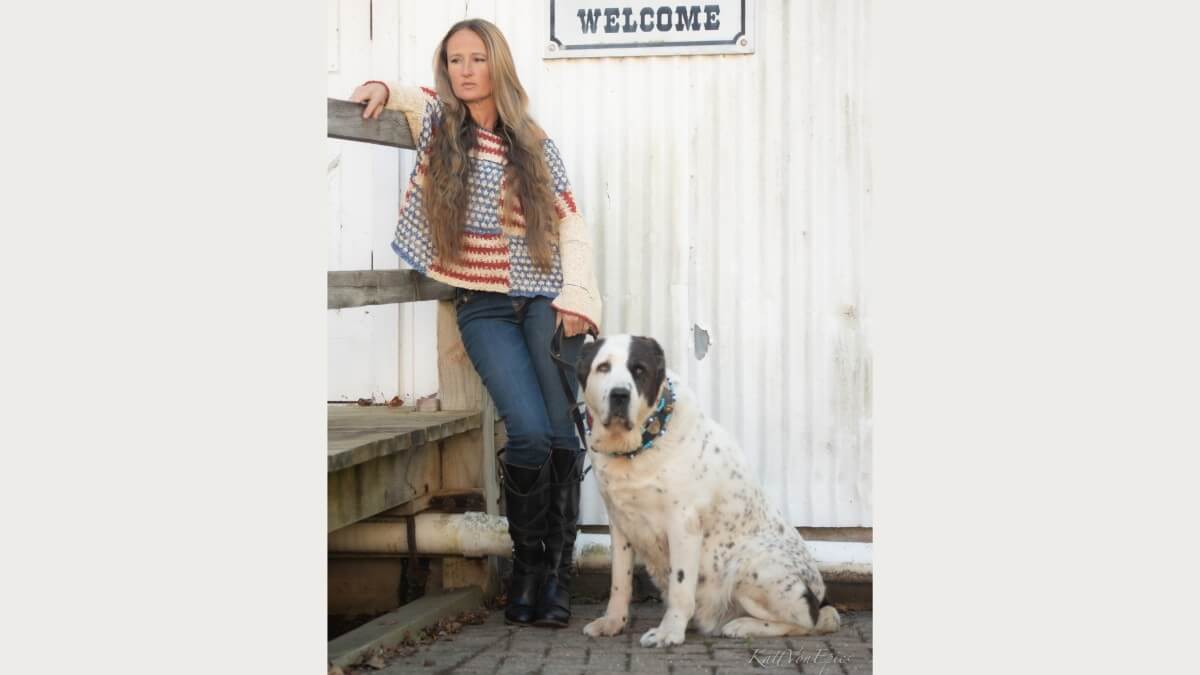
Ekaterina Rekowski: Our kennel name is Guardian Dog. My husband, Larry, and I are owners of six dogs. We imported our foundation dogs from Moscow in 2015; we traveled there and picked the puppies.
We have grandparents and great-grandparents here, and we don’t get rid of dogs that are retired. We do cherish our bond with them. We consider our dogs as family members and they participate in our everyday life rather than living in kennels as breeding stock.
Our dogs do travel with us to our up-north cabin, enjoy cross-country skiing there or running behind a four-wheeler in the summer in the woods. We even took our dog for ice fishing once. We live in Macomb County, which is about 40 minutes from Detroit. Our kennel website is: guardiandog.net.
I am very selective in creating pairs. I take into consideration not just the look and test results, but do deep pedigree research and temperament matching. Last summer, our dog Gulya traveled to Ottawa, Canada, to be bred with a rare bloodline stud.
I am a Certified Dog Trainer; it’s my everyday job. We have chickens, turkeys, and goats, but our dogs are not staying in a chicken coop or goat shed. Our dogs protect our whole property, and we have dogs staying outside at night to patrol the fenceline.
We are the only kennel in North America that is a member of the International Association of Turkmenistan Alabay dogs. I was personally invited to be a member by the Turkmenistan government. It’s an honor for me. If I travel back to Russia, where I was born, I always go to dog shows and meet with local breeders to keep learning about the breed situation and making connections to purchase a new blood.
Ekaterina Rekowski: The Central Asian Shepherd Dog is a guard dog first. Everyone who is interested in it should understand that owning a serious, powerful guard dog is not a joke but can be a liability in the wrong hands. It’s a great match for a family that wants a calm but protective dog that not only barks but can stop an intruder.
Our goal is to breed Central Asian Shepherd Dogs of correct temperament and structure, producing a few litters a year only.
Puppies will only be sold to responsible, educated owners, and I can assist in raising and training. I published two books which are sold all over the world: Central Asian Shepherd by Ekaterina R. Rekowski, available on Amazon; and I also published a new book a year ago: How to Raise and Train a Central Asian Shepherd, available for direct purchase from me.
Ekaterina Rekowski: This breed should be owned by certain people only. I see too many backyard breeders selling puppies year-round for a few hundred dollars to everyone who pays. This breed should not be easily available but only placed in serious hands.
It is not easy to find good homes for litters of boys. I devote myself to this process. When contacted by potential clients, I can spend over four hours a day on phone calls. I want people to get educated and not buy on impulse.
Ekaterina Rekowski: I do use DNA testing for diseases and x-ray for orthopedic abnormalities. These technologies were not available years ago.
I use video apps to communicate with our customers and do training online. I also use a YouTube channel that I created as an educational platform for the public.
Ekaterina Rekowski: There is a misconception in the US that this breed is strictly a farm dog that should be placed in a sheep or pig barn.
In the former Soviet Union, where this breed was established by kennels and researchers and the Breed Standard was created, it’s used differently. There, it is known as the best guard dog for a family and property. You don’t need to buy a cow to make your Central Asian Shepherd happy. But this is not a dog to place in a crowded elevator that takes you to your skyscraper apartment. This breed is not for the city, off-leash dog parks, or restaurants visits.
Ekaterina Rekowski: I’m concerned with US-based kennels that import strictly dog fighting bloodlines or giant, untypical dogs, or from kennels that breed dogs of a certain color only.
There are Conformation dog shows available for this breed with UKC and AKC.
Sadly, many judges are not educated about the Breed Standard and temperament, and it’s harming the breed.
Also, I’m irritated by people who advertise this breed as a Service or Therapy Dog. This is not fitting for this breed.
Ekaterina Rekowski: When I traveled to Russia and visited a few kennels, I noticed that this breed is not bred for size anymore. I met very good examples at two big dog shows I attended. It’s a big shift. In the early 2000s, the breed was in a critical stage due to crossbreeding and creating XL monsters. This is not like that in country of origin anymore, but it’s still popular in North America. I hope it will disappear soon once people learn about the history of this rare, old breed.
Judges should know that it’s a guard dog that should not be penalized at a show for being wary of strangers and should not be grabbed by judges like it’s a decorative breed or a happy-go-lucky Labrador.