Members
Learn about the Polish Hunting Spaniel, a rare sporting breed restored in Poland, known for its versatility and a balanced temperament.

Małgorzata Supronowicz
The Weekly Brief
The best of SHOWSIGHT editorials, weekly wins, and breeder commentary — delivered to your inbox every Sunday morning.
The Polish Hunting Spaniel (PHS) is a breed currently being restored. The process began in the late 1980s and early 1990s at the Wild Animal Park in Kadzidłowo, Poland, initiated by Dr. Eng. Andrzej Krzywiński, a naturalist, creator of the “Born to Be Free” program, hunter, breeder of hunting dogs, and working trial judge. During his research on the reintroduction of lynx and capercaillie in Poland, he became fascinated by the old spaniels from the Eastern Borderlands, which were bred at the beginning of the last century by Princess Izabella Radziwiłł in Mańkiewicze (Poland) and the surrounding estates. The princess based her breeding on dogs imported from England and France. One of her outstanding studs was the English dog Rolick Of Harting. These dogs were confiscated and taken deep into Russia during World War II, and their trace was lost.
The foundation female of the Polish Hunting Spaniel breed in the “Z Szerokiego Boru” kennel was a bitch named PESTKA, brought by the doctor from the former Eastern Borderlands. It quickly became apparent that her maternal instinct toward other mammal species living in the park was unique, and she helped raise many young animals.
After many years of breeding, thanks to the efforts of the doctor and his supporters, the Polish Kennel Club (PKC) provisionally recognized the breed in September 2016, and the Preliminary Stud Book was opened on January 1, 2017. Since then, the population has grown to nearly 1500 individuals. In March 2019, the breed was recognized by the Dutch Kennel Club (RvB), and today, the Polish Hunting Spaniel is recognized by over 20 FCI member countries. They live in many European countries and in the US. In England, there are currently about 10 dogs.
The Polish Hunting Spaniel is a medium-sized dog, which ensures both agility in the field and resistance to harsh conditions (e.g., mud, reeds). These dogs have a rectangular build (height-to-body length ratio of 9:10-12). The height from the ground to the elbow equals half the height from the ground to the withers. Females may be slightly longer than males, hence the Breed Standard’s notation 9: “10-12.”
According to the Breed Standard, updated in July 2024, the height at the withers for males is 17-19 inches, and for females it is 17-18 inches (+/- one inch in both sexes). The back should be straight and well-muscled (only in older working dogs may the loin be slightly arched). The croup should be adequately wide and muscular, straight or slightly sloping toward the tail base. The chest should be well-developed and ribbed. Body length, according to proportions, should result from chest and rib cage length, not from long loins—long loins are undesirable.
The head should be proportional: skull and muzzle are roughly equal in length; stop is weakly marked; muzzle is full and deep with a blunt end. Complete dentition is desirable (scissor bite is preferred, but level bite is acceptable). Nose is exclusively brown, with the nose leather protruding beyond the lip. Eyes are medium-sized, almond or triangular, with a friendly expression, color ranging from light to dark hazel. Ears are pendant, not too wide at the base, set at or slightly above the outer eye corner, and covered with soft, long, fringed hair. Neck is of medium length, muscular, and well-integrated into the body.
Forelegs, viewed from the front, are parallel, with elbows neither pressed in nor sticking out. Hind legs have strong thighs and lower legs, well-angled, and moving parallel. Front toes are slightly longer and not arched; hind toes are shorter, and slightly oval-shaped. Pads on both the front and hindlegs are large, thick, and firm, with longer hair between the toes forming “slippers.”
Coat is medium-length with an undercoat, straight but slightly wavy is allowed, and weather-resistant. Longer hair appears on the ears, forelegs, hindlegs, chest, belly, and tail (forming “feathers” on the tail). The coat must not curl or form visible waves (not to be confused with slightly wavy hair). Curly hair is undesirable! According to the latest Breed Standard, the base color is genetically determined by the B locus and is exclusively chocolate (genotype “bb”) in the following patterns: shaded chocolate, shaded chocolate with tan, and chocolate-and-white.
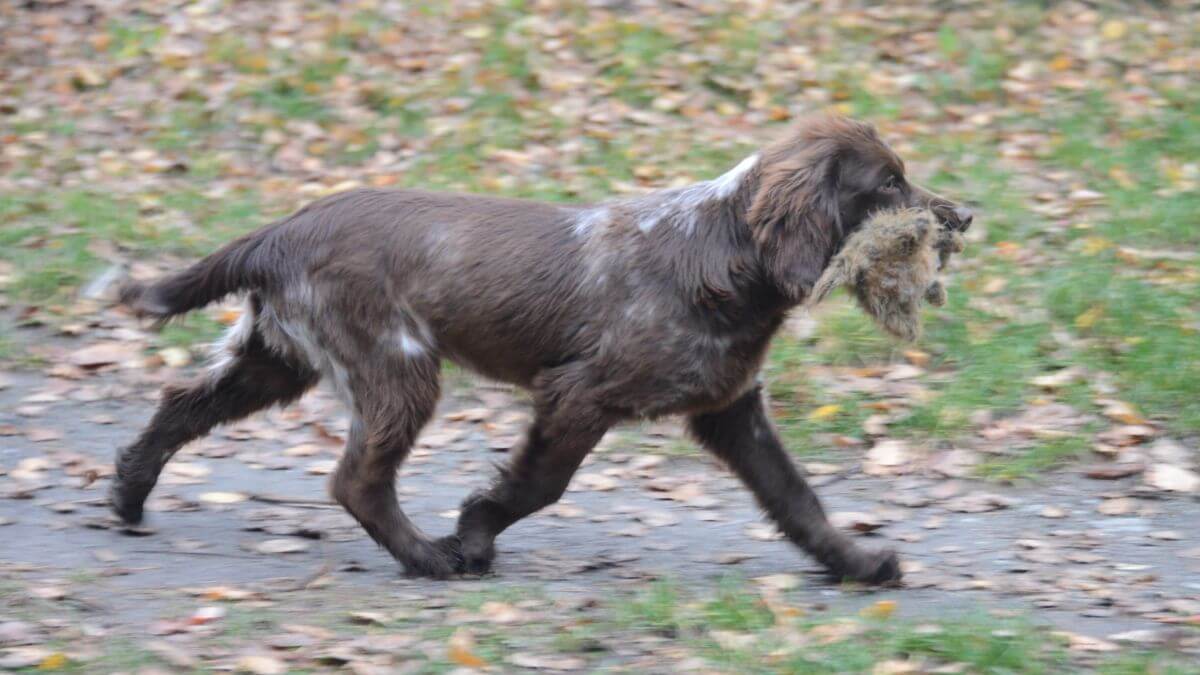
These dogs cooperate well with hunters and are charming and friendly, winning the hearts of everyone who meets them. DNA tests conducted by the Department of Genetics and Animal Protection at Warsaw University of Life Sciences (SGGW) have not revealed significant genetic diseases or dangerous carriers of conditions found in other spaniel breeds (there are no tests specific to the PHS). Breeding is pure, with no crossbreeding or blood infusion. Basic veterinary tests for heart, eyes, and hip/elbow dysplasia have shown no deviations from norms like those in other spaniels. Dogs of this breed are not subject to mandatory testing, but many breeders voluntarily perform tests for the welfare and healthy development of the breed.
The breed has so far been recognized by FCI national kennel clubs in the Netherlands, Denmark, Sweden, Belgium, Finland, Iceland, Switzerland, Slovenia, Hungary, Bosnia and Herzegovina, Serbia, Turkey, Lithuania, Albania, North Macedonia, Kosovo, Romania, Moldova, Montenegro, and Estonia. The Polish Hunting Spaniel is very sociable and attached to its owner, which, with proper upbringing and good socialization, makes it an excellent family dog. It is protective and patient with children, provided good relationships are established. Toward strangers, adults, and children, it may behave with reserve and sometimes distrust, making such dogs good home guardians. Their protectiveness, patience, and affection make them wonderful mothers—not just for their own species. Under the watchful eye of breed restorer Dr. Andrzej Krzywiński, females of this breed have raised young wolves, lynxes, otters, and foxes. The maternal love they show to defenseless newborns has saved many wild animals and returned them to nature.
Polish Hunting Spaniels impress with intelligence; they learn very quickly and surprise with ingenuity. Courage and endurance make them excellent working dogs in harsh conditions.
They require physical activity and mental stimulation, so if given enough exercise they will be calm and balanced at home; otherwise, boredom and destructive behaviors may occur. This is a working dog that combines energy with composure, loves its owner unconditionally, and enjoys doing tasks for them. It is an excellent hunting dog, a great service dog, and an ideal companion for people who enjoy dog sports and active families.
The Polish Hunting Spaniel combines the best traits of a flushing dog and a retriever, and with proper training can also successfully serve as a tracking dog. Its versatility, stable temperament, and strong hunting passion make it an extremely valuable tool for the modern hunter.
Training for the Polish Hunting Spaniel should begin at an early age. This breed is intelligent, quick to learn, and strongly bonded to its handler, which allows for rapid progress with consistent, calm guidance and time dedicated to both play and training.
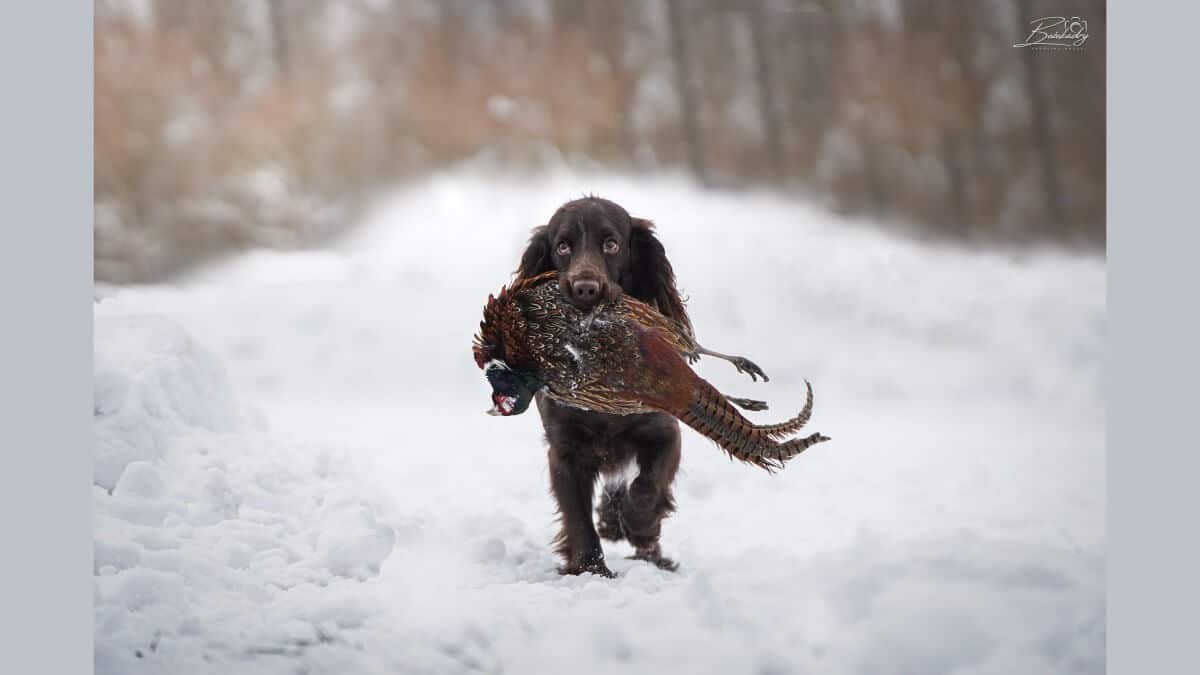
In the field, the Polish Hunting Spaniel initially works using the upper wind to catch fresh game scent. The dog moves in a fan pattern with a wide, rhythmic range of up to 50 meters, maintaining contact with the handler and regularly checking wind direction. Upon detecting a stronger scent, the dog lowers its nose and switches to ground scent work, focusing on locating the game’s resting place or trail. After flushing a bird, the dog remains under control and focused on the handler, enabling an effective shot and quick dispatch for retrieval. When tracking wounded birds—especially wood pigeons (stock doves) or pheasants that can travel far—the PHS can follow and complete a long track, often several hundred meters, until the bird is found. This breed excels in hunting pheasants, partridges, and wood pigeons, where versatility, thorough searching, and the ability to independently locate wounded game are essential.
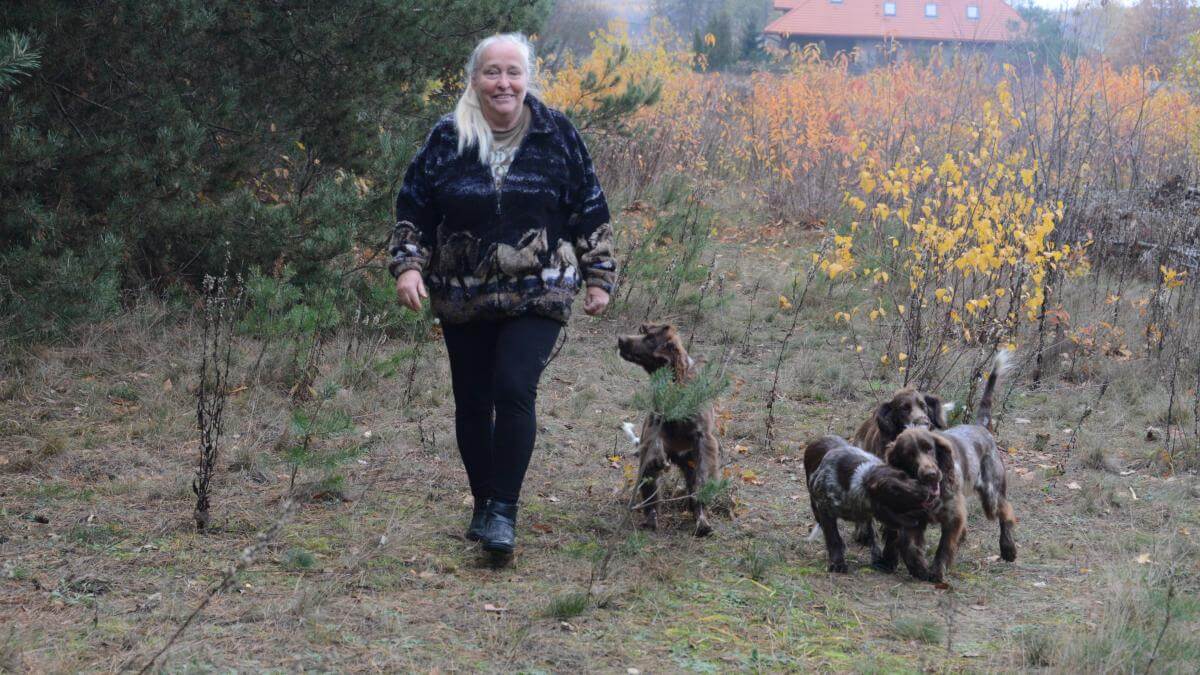
Water work is one of the most distinctive features of the Polish Hunting Spaniel’s utility and sets it apart from other flushing breeds. The PHS has a natural water instinct, evident from puppyhood in their eagerness to enter water. During duck hunts, the dog shows exemplary composure at the stand. The PHS is truly a working dog, excellent in gun work, performing roles as needed by the hunter: flusher, retriever, tracker, and water dog. Outside the hunting grounds, it thrives as a family and companion dog, and even as a therapy dog. It participates in hunting dog work trials, practical canine utility, dog sports, and can succeed in most disciplines. It can also serve as a working dog in the Police, Fire Service, Border Guard, or Prison Service. Its physical and mental traits provide a foundation for this versatility. Its strong hunting instinct and eagerness to cooperate with humans translate into high motivation for work. It is obedient, well-focused, and quick to respond to commands, making training easy. After intense work, it calms down beautifully, and this balanced temperament makes living with the PHS a pleasure. A dog whose needs are met becomes an ideal, trouble-free household member—a true “dog for life.” The breed is highly resilient and passionate, able to work in harsh weather and terrain. Although its primary purpose is hunting utility, it will gladly accept alternative activities. This is a dog that needs a job, but you can offer many activities that fit your lifestyle. For the PHS, what matters most is doing something with its handler—not what or where. The most important thing for the Polish Hunting Spaniel is its owner and a shared activity, so you can offer various sports such as:
Polish Hunting Spaniels do not suffer from brachycephaly, excess skin folds, hairlessness, or other traits linked to poor health. Some FCI member countries require such declarations before recognizing a new breed. In appearance, origin, and temperament, they differ significantly from other spaniel breeds already recognized by FCI.

Nine years have passed since the breed was officially recognized in Poland, and I assess its breeding and show successes quite positively. Polish Hunting Spaniels were officially presented for the first time at the annual FCI Breeding Commission meeting in Paris this February [2025]. The population of our spaniels is slowly growing (at a satisfactory rate); they are awarded at shows at home and abroad, recognized in Europe, healthy, and very popular among their owners (with a steadily growing fan base). So far, six club shows have been held, featuring between 55 and 107 Polish Hunting Spaniels.
For more information, please email Małgorzata Supronowicz at: sasquehanna@poczta.onet.pl

Dog Show Community