Members
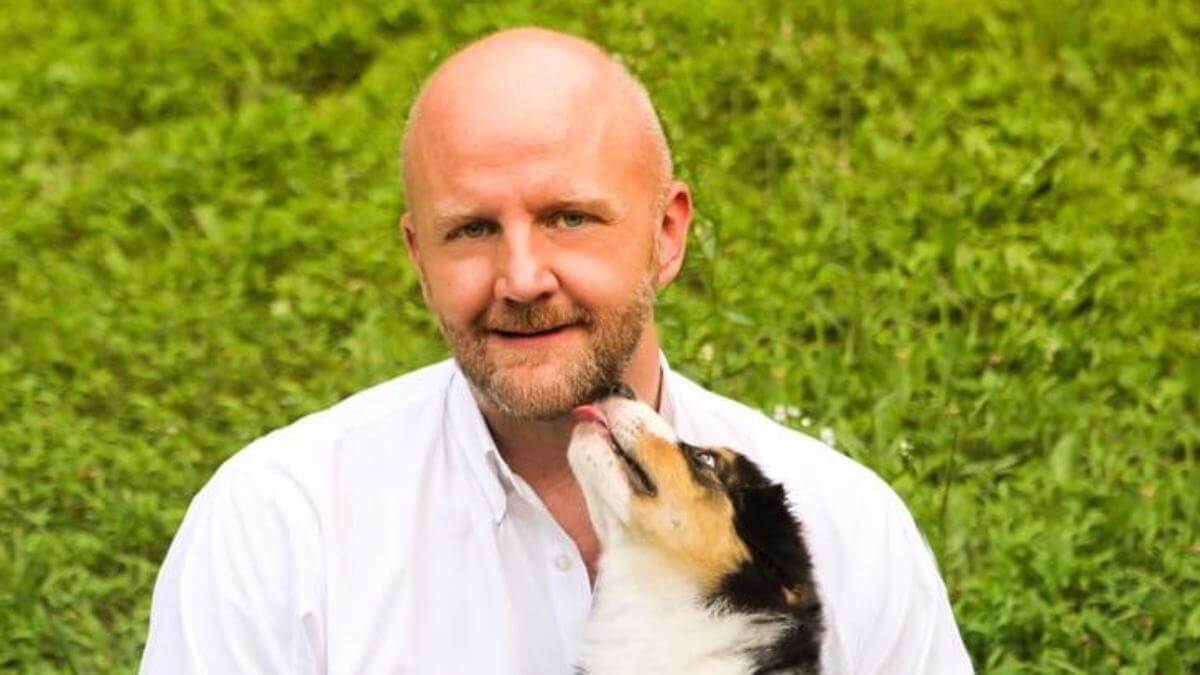
Breeder Jeff Margeson shares his journey with Australian Shepherds, breeding philosophy, and vision for the future.
The Weekly Brief
The best of SHOWSIGHT editorials, weekly wins, and breeder commentary — delivered to your inbox every Sunday morning.
Jeff Margeson: I’ve spent the bulk of my life on the East Coast. I grew up in Maryland, moved away for college, and eventually returned to the DC/Maryland/Virginia area to begin my professional career. The region’s mix of rural and urban life gave me a foundation that worked well for raising animals while supporting a corporate career.
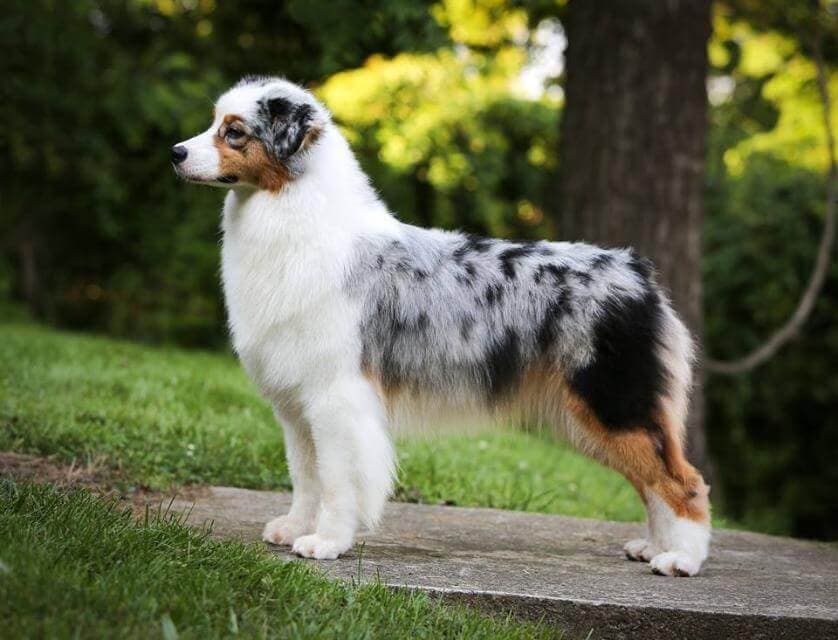
Jeff Margeson: While we always had German Shepherd Dogs at home, my family wasn’t involved in the world of dog shows or breeding. My real introduction to working with animals came through horses. My father and I began showing horses when I was in my early teens. I was hooked early on by the whole process—the training, grooming, and competition. Seeing the results of your effort come to life in the ring was deeply satisfying and planted the seed for everything that came next.
It was actually at those horse shows where I first encountered Australian Shepherds. Their intelligence, biddability, and striking appearance made an impression on me. After college, I decided I wanted a dog of my own—one compact enough to travel with in my small sports car but athletic and sturdy enough for hiking and adventure. My late husband, Chris Dale-Margeson, had a similar background with horses, and also appreciated the Aussie. Together, we purchased our first Australian Shepherd puppy in 1994, a working-bred dog that I planned to train for Obedience and Agility. That dog sparked what would become a lifelong devotion to the breed.
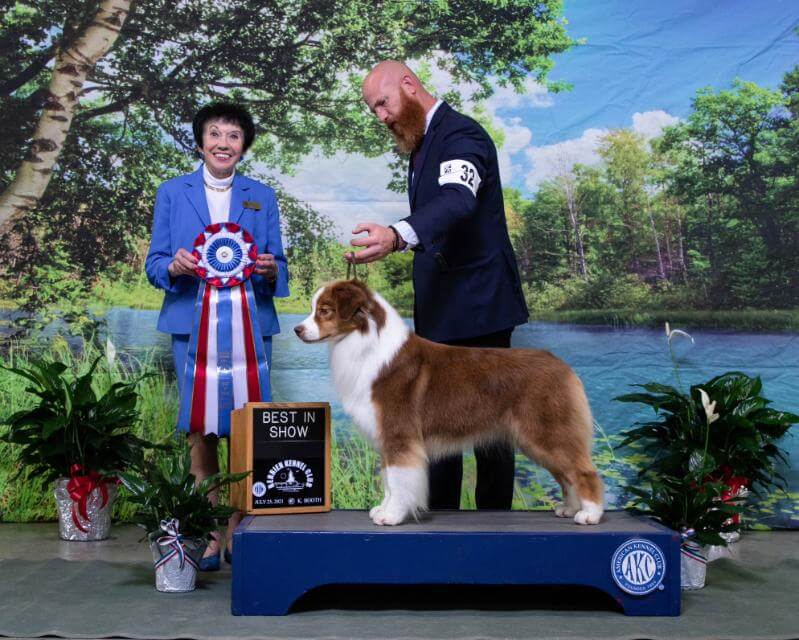
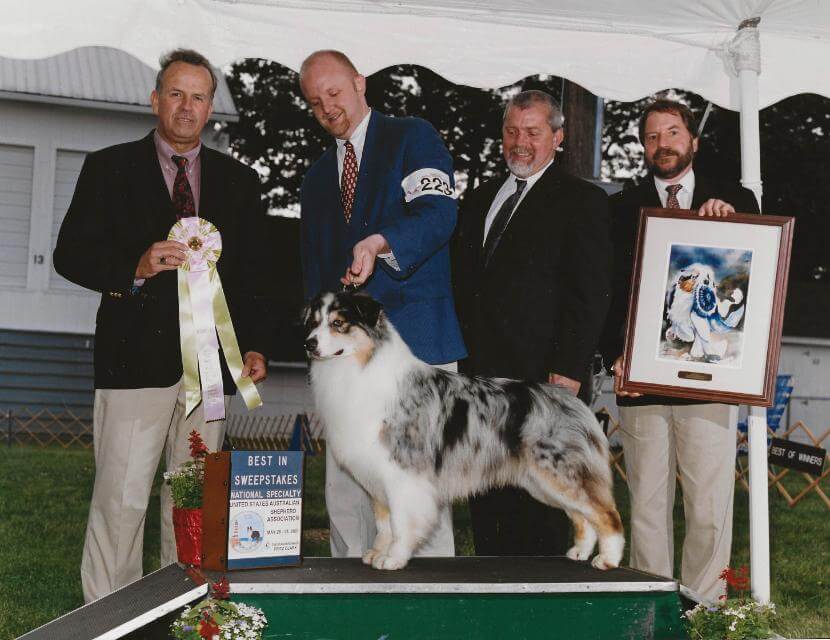
Jeff Margeson: J. Frank Baylis of Bayshore Kennel has without a doubt been the most influential figure in my life in the purebred dog world. When we decided to enter the Conformation ring, Frank took a leap of faith and entrusted us with a promising young dog. I had only owned him for a few weeks before entering him in our first show, the National Specialty.
Incredibly, he won Best in Sweepstakes and was Winners Dog at that event. He went on to become a multiple Group winner and an outstanding sire. From there, Frank and I co-bred most of our Australian Shepherds, and we’ve also collaborated on several other breeds.
In addition, I’ve learned a great deal by observing some of the foundational Australian Shepherd breeders—Alan and Kathy McCorkle (Heatherhill), Leslie Frank (Propwash), Linda Wilson (Briarbrook), Flo McDaniel (McMatt), Alison Smith (Paradox), and others. These are people who established a clear vision and consistency in their breeding programs, and I’ve always admired their ability to stay true to that over time.
Finally, I’ve always made it a point to look outside of the Aussie world and study successful breeders in other breeds. There’s so much to learn about structure, type, and movement by expanding your perspective. That kind of cross-pollination has helped refine my own eye and strengthen my program.
Jeff Margeson: My breeding priorities follow a specific hierarchy: physical and genetic health, breed-appropriate temperament, type, movement, and then aesthetics.
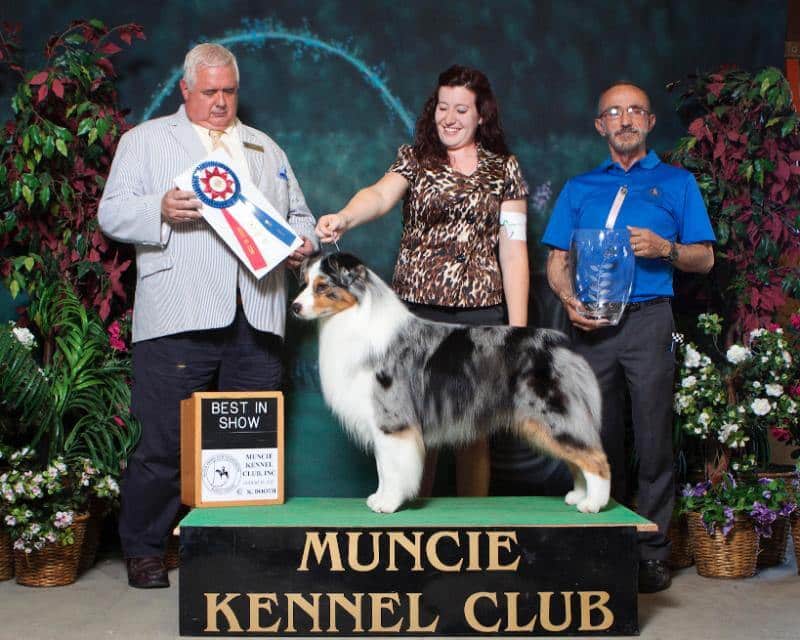
When you’re starting out, it’s easy to get distracted by the flash—dogs that are winning in the ring, the “hot” stud dog of the moment. But I learned early on, especially from showing horses and even raising show rabbits, that the most valuable animals in a breeding program aren’t always the ones winning ribbons. Sometimes, they never set foot in a show ring.
Some of the most successful outcrosses have been to dogs that weren’t well known, but who brought important attributes to the table—traits that complemented my dogs and helped move the breed forward. For me, success is about the longevity of impact. I’m always thinking about what each breeding will contribute to the next generation, and whether it aligns with the breed’s intended function and versatility.
Jeff Margeson: When Chris and I lived on our farm for more than 20 years, we had a dedicated kennel and maintained upwards of 25 dogs across breeds at any given time. It was a setup designed with space for training, conditioning, and raising litters in an environment conducive to both physical and mental development.
These days, my setup is more intimate. I typically house six to eight Australian Shepherds—this includes adults and young prospects being evaluated. The dogs are an active part of my home life.
I’ve converted the entire lower level of my home for the dogs. It includes a large play and crate area, a grooming room, washroom, and a whelping space. Outside, there are multiple large paddocks with steep slopes, perfect for building and maintaining muscle tone. I also have a section of fully covered kennel runs that allows the dogs to be outside and active, even in bad weather.
Jeff Margeson: Our introduction to the Xoloitzcuintli came through a co-bred Bayshore litter. I found the breed fascinating—so much intelligence and character in a unique package. My journey into Miniature American Shepherds started when I was offered a bitch whose grandmother was one of my all-time favorite Aussies. It felt like a full-circle moment.
That said, with changing life circumstances and a shift in priorities, I’ve made the decision to focus solely on Australian Shepherds moving forward. While I’ve enjoyed the other breeds and appreciate the contributions we’ve made in them, my heart remains with the Aussies.
Jeff Margeson: My application to become a judge actually sat on my desk for nearly five years. I didn’t feel ready to commit the time needed to honor the appropriately rigorous process. But after encouragement from peers—and from those who emphasized the need for more breeder-judges—I finally moved forward.
I was approved for breeds in which I qualified as a breeder: Australian Shepherds, Xoloitzcuintli, Border Collies, Chinese Cresteds, and Miniature American Shepherds. I also judge All-Breed Junior Showmanship, which I’ve taught through my local kennel club.
Since then, I’ve been fortunate to receive incredible assignments, both nationally and internationally. One of the greatest honors of my judging career so far is being selected by the USASA membership to judge Best of Breed at the 2027 National Specialty. It’s a milestone that I’m truly humbled by. My future goal is to complete judging requirements for the remainder of the Herding Group, the dogs closest to my heart.
Jeff Margeson: Over my three decades in Australian Shepherds, I’ve seen the breed evolve in both encouraging and concerning ways. At a recent large specialty I judged, I was heartened to see many dogs returning to proper proportions—slightly longer than tall, with balance and symmetry. These dogs not only looked the part but also moved with purpose and efficiency, reinforcing that function and type should go hand in hand.
One of the challenges we face is resisting the temptation to push extremes. The Aussie is a breed defined by moderation—medium size, moderate bone, and coat. It’s essential we stay true to those hallmarks. The drive for “more”—more coat, more substance, more flash—can lead us away from what makes the Aussie a capable working dog. I’m encouraged by breeders who are committed to preserving the complete package, and it’s generally those dogs that stand out in a lineup.
Jeff Margeson: When I started, shows weren’t just about the competition—they were about relationships. People stayed after judging, even among fierce competitors, to discuss dogs, share ideas, and build connections. Today, show halls are often empty minutes after judging wraps up. That sense of community is disappearing, and it’s something newcomers miss out on.
The digital age has made information more accessible, but it has also created a need for instant gratification and a sense of instant expertise. There’s no substitute for hands-on learning, long days at ringside, and the lessons that come from real-life mentorship.
At the same time, we longtime breeders need to own our part. Due to past bad experiences, I’ve seen many breeders become wary of newcomers. As a result, mentorship often comes wrapped in restrictive contracts and co-ownerships that leave little room for growth. We need to invest in people, not just protect pedigrees. Let them make mistakes. Let them learn. Let them carve their own path. That’s how the next generation of great breeders is made.
Jeff Margeson: The loss of my husband in 2023 has brought a shift in perspective. While I will always be involved in purebred dogs, I see myself gradually moving into more of a co-breeder and mentorship role. I want to help the next wave of breeders build strong foundations—grounded in knowledge, ethics, and passion. My hope is that through mentorship, the foundations Chris and I built will live on in future generations.
Finally, tell us a little about Jeff outside of dogs… your occupation, your hobbies.
Is there life outside of dogs? (Kidding… sort of.)
My professional career has always been in banking and financial services. I currently serve as an executive at a large credit union, where I focus on leadership and strategic development. It’s a fast-paced field, but one that’s taught me a lot about structure, vision, and values—things that have translated well to breeding.
Outside of work and dogs, you’ll find me spending time with those I care about or out in nature. I love hiking, kayaking, photography, and exploring new places. I’ve developed a passion for travel, and I’m looking forward to some big, upcoming overseas adventures.
The last year reminded me how precious time is. When someone recently asked me what my life goals are, they weren’t about titles or accomplishments. My answer was simple: to make an impact and leave behind a legacy of kindness.

Meet the Breeders