



Home » Kelsey Keefe | Gestalt Eurasiers
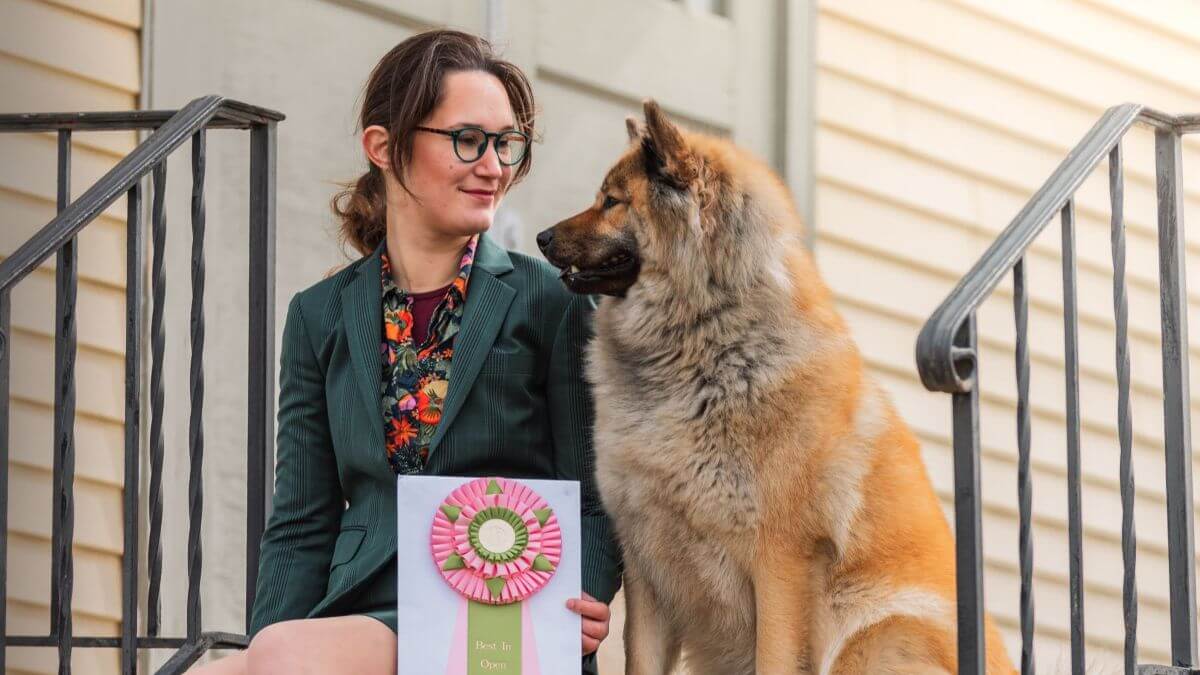
Kelsey Keefe: My name is Kelsey Keefe and I breed under the kennel name Gestalt Eurasiers. We’re based out of Massachusetts, and I’m relatively new to dog sports in general; my oldest Eurasier is six, and my first litter will be turning two years old at the end of December.
Kelsey Keefe: The Eurasier is interesting because our Breed Standard emphasizes moderation in all things: not too much coat, not too big, not too small. We’re a medium-sized spitz-type breed without any disqualifying faults for size. The word “medium” itself appears thirteen times in the FCI Standard; that isn’t to say that we are without certain hallmarks, but just that to maintain breed type, one should aim to avoid excesses such as eyes and ears that are too large or too small, or a coat that is too profuse and hangs, disguising the body. Although these qualities can make for a cute, generic dog, it is in these subtleties that the dogs begin to lose that spark that makes the breed what it is.
Kelsey Keefe: This year was interesting. Although at a breed club level we produced a number of large litters with nine or ten puppies, the first half of the year was difficult and there was a time when our club’s breeders who are mentoring newer breeders really did work hard to connect applicants to breeders, as for the first year we had puppies that were not spoken for by the time when our born. Typically, our breeders don’t breed unless they have a waitlist, but these are interesting times with economic challenges, alongside some large litters which made it unusual. I personally didn’t breed this year as my younger dog isn’t yet two years old, but it’s worth looking at before making any decisions.
As an FSS Breed, we are obliged to produce a minimum of 20 litters within a three-year period prior to requesting full recognition—we are not yet in the Miscellaneous Class and this rule is a retroactive look at the last three years prior to full recognition. But when it comes to balancing the population and encouraging new breeders, it’s a delicate balancing act. We’re very fortunate that Eurasiers are, by and large, a lovely breed with a lot of enthusiasts behind us, but first-time breeders don’t often have the benefit of a wait list, and that certainly is something to think about.
Kelsey Keefe: I’m a big proponent of using everything we’ve got. Whether it’s nomographs, DNA tests, sharing and contributing to longitudinal and cross-sectional studies when and where appropriate… there is a lot to keep up with. We have a responsibility to test our own dogs for acute health issues and take care of the dogs in front of us, but also share that knowledge with one another as well as with our puppy buyers. Personally, as I’m rather new at the game, I just cannot fathom not having access to online databases for pedigrees, and I’ve all the respect in the world for those who not only have the patience for data entry but also maintain the integrity and reliability of these resources.
On the communications side, Eurasiers as a breed are still relatively unknown in the US, it’s important to meet people where they are, using clear, modern communication to demystify responsible breeding and highlight the Eurasier’s unique charms.
Kelsey Keefe: I can’t say that the public’s attitude toward purebred dogs has changed drastically, but I have seen a shift toward higher expectations of what a breeder ought to do. Even among people who deliberately produce mixed-breed dogs, there’s now an expectation that they health test and socialize their dogs. The rhetoric is evolving, and the conversation about how to meet a puppy’s needs and how to choose the right breed is being discussed more clearly among those who are “just” looking for a pet.
In turn, because I have dogs that are therapy dogs, show dogs, and—most critically—members of their community and little local celebrities in their own right, folks have been more receptive to learning about what it takes to really breed. I’ve made it a personal goal to recommend not just my own breed but also to connect people with friends and breeders in other breeds so that, when I meet someone who’s interested in a dog, I can honestly describe some rarer breeds and offer to put them in touch with either a breeder or the appropriate parent club.
There is a sort of intangibility and inaccessibility around purebred dogs when the only ones a person sees are those televised at Thanksgiving. But dogs, like all things, are fundamentally a community. Being able to introduce people to “real” show dogs, and seeing how open they are to learning about well-bred dogs, is genuinely lovely. I’m not sure if this shift comes from people witnessing, either firsthand or through friends, the challenges of socializing a puppy, or if it’s a lingering effect of the pandemic on young dogs’ development, but it has been interesting to watch my conversations shift toward helping people find a dog, a breed, or a breeder who truly suits them.
Kelsey Keefe: Trends are always a little slippery to talk about, and my perspective is inevitably shaped by what I see within my own breed and the communities around the FSS and Miscellaneous Class. That said, one thing that has stood out is how dramatically entries have grown for Miscellaneous breeds. Morris & Essex was packed, and the AKC National Championship has had a genuinely impressive turnout in both the Open Shows and the Miscellaneous Class at the all-breed events. For breeds that are still “new” to the AKC system, that visibility matters.
I still hesitate to make sweeping statements about the sport as a whole; it varies so much from breed to breed, but compared to when I started just a few years ago, I’ve noticed more judges, all-breed club reps, and exhibitors genuinely taking the time to understand what the recognition process looks like for developing breeds. There’s a lot more curiosity, a lot more willingness to talk, and honestly, a lot more grace extended to people showing dogs that are often the first or second generation in the US, many of them direct imports or just barely beyond that.
As for concerns: the CDC’s current regulations on importing dogs under six months worry me. For small-population breeds like ours, international cooperation isn’t a luxury; it’s the backbone of our long-term viability. Restrictions like these can really slow down thoughtful breed development. But in a strange way, because every breed is impacted, it’s opened the door to bigger, more collaborative conversations about how these policies affect all of us and how we can collectively advocate for workable solutions.
Kelsey Keefe: There’s always so much talk about how the sport is dying or how sportsmanship is disappearing, and I don’t entirely disagree—there are fewer breeders than ever, and the economy doesn’t exactly make it easy for the average person to dabble in a hobby that requires travel, time off work, and juggling family responsibilities just to “make it work.” But I’m also not so pessimistic that I can’t look around and see who I’m actually exhibiting with.
While there are bad seeds everywhere, I feel genuinely lucky to be surrounded by young handlers, more LGBTQ+ handlers, more diverse faces in the ring, and an overall shift toward supporting new hobbyists rather than gatekeeping them out. I can’t say everything is magically fixed, but I see so many people within each breed, each little corner of the community, who are showing their dogs and investing in them, and young breeders who, in a few short years, will hopefully seed a new generation of dogs for puppy buyers and future exhibitors. Watching that level of commitment to preserving our breeds, in spite of everything that is going on in the world, is honestly heartening.
As I’ve mentioned already, there’s also been a noticeable rise in enrichment-based puppy raising, thoughtful temperament evaluations, and structured socialization protocols. It’s not that these things never existed before, but the way they’ve been codified, taught, and made accessible is new, and the long-term success we’re seeing in the dogs themselves makes the value of these early interventions impossible to ignore.
When you read books from even 2010 or 2015 about dog husbandry, or when you “come back” to puppy raising after realizing your youngest is suddenly a veteran, the difference in knowledge is stark. The advancements in behavioral science that have trickled down into everyday, practical skills speak volumes about how committed we all are to improving our dogs and elevating the sport as a whole.