Members
Exploring the perils of hyperlocal social apps and online negativity, and the value of real-world community action.

The Weekly Brief
The best of SHOWSIGHT editorials, weekly wins, and breeder commentary — delivered to your inbox every Sunday morning.
A few years ago, I joined an online service which I thought was going to allow me to stay connected with my neighbors in the small New Jersey borough I call home. By providing my legal name and street address, I’d expected to receive periodic notifications about yard sales, leaf collections, and services at the local church. Instead, the digital company that operates as a “hyperlocal social networking service” delivers daily news from communities far and wide. On a typical day, reports come in from nearby towns and from cities located several counties away. Information is delivered from the adjacent state too, mostly from the big city where falling leaves are of little to no concern to most residents. Instead, news arrives about suspicious-looking pedestrians, nighttime car break-ins, and people who allow their dogs to relieve themselves on someone else’s lawn. Though these encounters can certainly be alarming to the people affected by them, the doorbell camera images that often accompany the messages have little value to viewers living in another state, me included. But what is curious (to this observer, at least) are the comments posted in response to the grainy videos that seem to accompany every post. Most folks talk about rising crime rates and the fall of Western civilization, but few offer solutions that might actually prove helpful. Comments rarely suggest installing motion sensor lights, locking car doors and removing all valuables, or getting a quote on a good fence that’s taller than a Chihuahua.
Some readers might argue that instead of having to install lights, lock doors, and build fences, people should simply behave better… and that would definitely be a reasonable assertion. But people are only human, and specific human behaviors are often the result of exacerbating circumstances such as poverty, homelessness, and addiction—or insomnia. Sleeplessness, in fact, is often noted in many of the posts as the reason a person had decided to check the app on their phone at 3 a.m. “I couldn’t sleep, so I decided to reward myself by viewing images that make me afraid to fall asleep. Just wanted to share those with you. Have a good night!” I guess reading a book or drinking a glass of milk was out of the question.
Perhaps some insomniacs assume that by posting images of a burglary in progress (or not), the perpetrators will be identified and captured, thus allowing every neighbor to finally experience a good night’s sleep. This, no doubt, happens periodically, but more than likely, the onslaught of continuous BOLO blasts after midnight only increases everyone’s paranoia and sense of doom and gloom. Certainly, the barrage of comments exclaiming “the end is near” that typically follows in the wake of most video posts supports this point of view. But wouldn’t it be reasonable to stop and consider the side effects of consuming a late-night video diet of theft, robbery, and canine malfeasance? How can we all be expected to function reasonably well in a world where cameras capture every day- and night-time infraction, whether real or imagined?
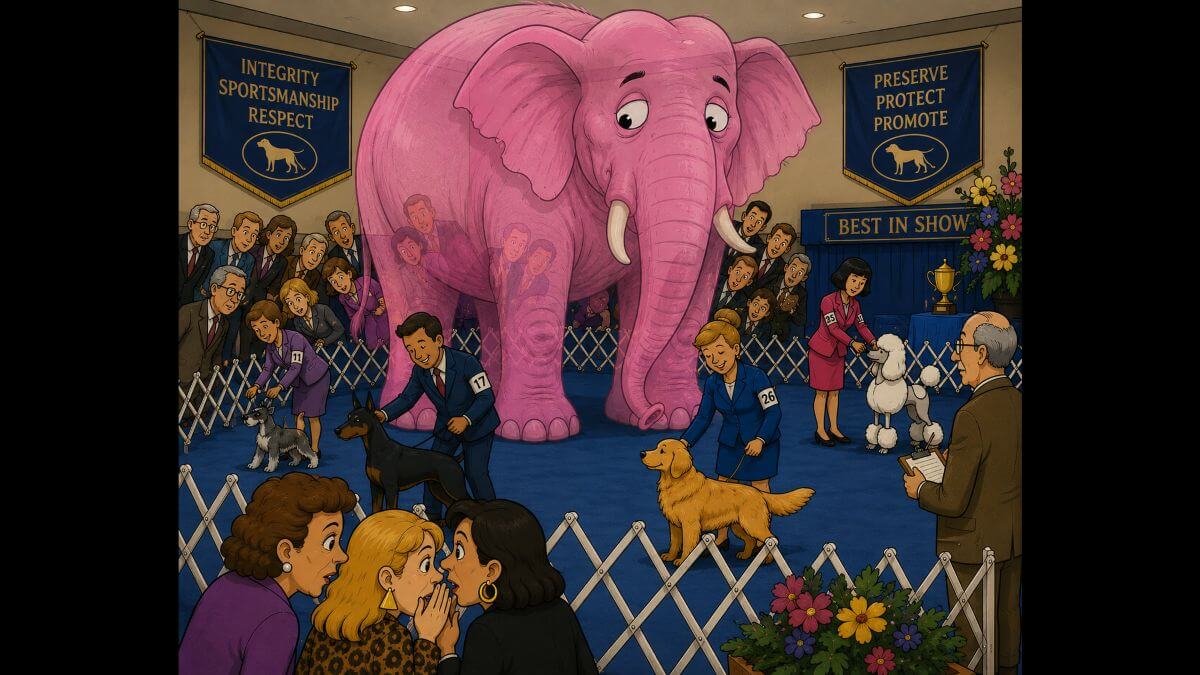
Videos uploaded by self-appointed neighborhood watchpersons, of course, aren’t the only disturbing pieces of content that are delivered to our inboxes—yours and mine. As participants in the sport of dogs, each of us likely has several email addresses and social media accounts that routinely receive messages that are excessively critical of the American Kennel Club and the many judges, ring stewards, professional handlers, breeders, superintendents, show chairs, and exhibitors who willingly choose to participate in thousands of dog-related events annually. If the comments posted online are to be believed, the consensus of opinion would be that all judges are crooked, every ring steward is rude, pro handlers win everything, breeders can’t be trusted, superintendents have lousy websites, show chairs don’t care about exhibitors, and exhibitors only care about ribbons. Ribbons and titles. Ribbons and titles and winning. And, of course, the AKC only cares about one thing. Never mind all the good work that’s done each and every day by individuals who represent each of these essential players. On social media, it seems that only the offenses, oversights, and infractions go viral.
On any given day, a Facebook post (or two) appears that perfectly demonstrates the social media phenomenon of posting with a negative bias. A topic will usually reference a specific incident, complete with a photo of the offense, or it can be a vague comment that only alludes to something specific, presented in big, bold letters on a brightly colored, attention-grabbing background. IYKYK. In either case, the post can all but guarantee a cavalcade of comments from FB friends who show their support with words that are often quick to condemn. Before you know it, stories are shared about similar incidences that have occurred—only the new tales reference experiences that were far, far worse. The “conversation” that ensues ultimately devolves into a rehashing of personal grievances offered by individuals who, I imagine, simply have nothing nice to say. I also imagine they routinely check their doorbell cameras.
One recent post described an unfortunate incident that took place at a recent dog show. No surprise there. The details of the event are not really important, but the hundreds of comments posted in response revealed a considerable degree of negativity directed at dog shows in general. Some commenters even hurled accusations into the digital universe with great fanfare. I didn’t read them all, only the first dozen or so, but it was clear that a lot of people had an opinion that they’d decided to share, or at least a need to show their support for the “victim.” One such supporter listed a series of complaints about everything that’s wrong with the sport of dogs today and then remarked, “I don’t have the solutions…” And I thought, well, there it is: problems identified, but the solutions are someone else’s problem.
If social media is any barometer, a great many people who show dogs have the uncanny ability to identify problems without offering solutions, just as neighbors increasingly provide evidence of figures passing by their front gates at four in the morning without ever considering the fact that some people get up pretty early to go to work each day. (And that some people walk their dog and forget to bring a poop bag.) In the show ring and in neighborhoods, problems like poor sportsmanship and vagrancy—or errant dog walkers—are real, and they would be better addressed thoughtfully without resorting to accusations and innuendo.
Workable solutions to real problems require careful consideration and reason, not fear mongering and virtual shaming. Which isn’t to say that problems don’t exist. They do, and many are very big and terribly worrying. But even the biggest of problems (like declining registrations and late-night burglaries) are not unsolvable—and simply identifying them does little for the greater good. Action is needed instead, and the first order of business is to take a break from technology and step back into the real world. By getting to know the neighbors, watch groups can be formed. And by breeding a litter of puppies, placing them in show homes, and entering them in shows where other competitors do the same, thus building majors that create legitimate champions while supporting local dog clubs, some of the problems that are so easily identified won’t seem insurmountable after all.

Dog Show Community