Members
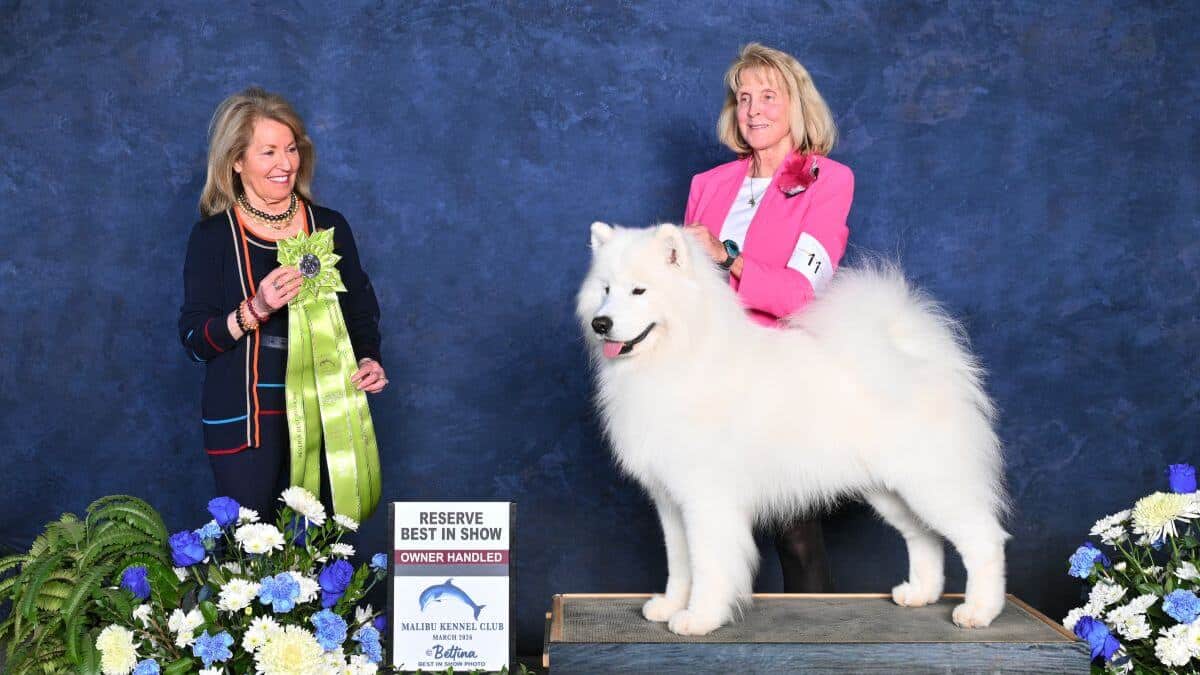
Nancy Rathgeber reflects on her life in Samoyeds, sharing her journey as a Breeder/Owner Handler and the passion behind her Bruin dogs.
The Weekly Brief
The best of SHOWSIGHT editorials, weekly wins, and breeder commentary — delivered to your inbox every Sunday morning.
Nancy Rathgeber: As a very young kid I was always drawn to dogs, though we did not have one of our own. My mom preferred cats. I remember a photo taken of me at about four years of age holding a relative’s Toy Poodle closely in my arms. The look on my face was adoring!
My dad recognized my love for dogs. He was a contractor, working in peoples’ homes. When I was about 14, out of the blue one day, he brought home an adult Samoyed, Blizzard, who had been given up by one of his customers. What an amazing dog! There could not have been a better family dog. I remember dressing Blizzard up in a baseball uniform… kids, you know. He had the biggest Samoyed grin on his face and could not have been happier.
My dad introduced me to a boarding kennel run by Bruce and Nancy Schultz in Santa Ana Heights in Orange County, where he did some work. The neighborhood had several boarding kennels. Though the Schultz’s did not have an open kennel position, Nancy recommended I apply at the boarding kennel across the street from them. Celestial Kennels hired me as a kennel worker. They also raised Boxers. Grace and Scott Lamoreaux took me to my first puppy match, where I showed one of their Boxer puppies. I was hooked!
At 17, I talked my parents into letting me get a Samoyed puppy that I could show. Grace from Celestial Kennels introduced me to Dave and Connie Richardson, who occasionally boarded at their kennel. The Richardsons had Kondako Samoyeds. They did not have a puppy, but referred me instead to Ruth Mary Heckeroth of Asgard Samoyeds. From Asgard, I bought my first show Samoyed, a six-month old, already named Theodore Bruin Of Asgard. I cut my teeth on showing Teddy, eventually obtaining both his AKC and Federación Canofila Mexicana Championships. My kennel name, Bruin Samoyeds, comes from my very first show Samoyed.
Nancy Rathgeber: I bought Teddy in 1978. I suppose that was the start of my Owner Handler career, LOL. Considering that to be my start in dfogs, I’ve been showing Samoyeds for more than 45 years.
I leased a champion bitch from Sansaska Samoyeds and bred her to AM/MEX CH Theodore Bruin Of Asgard just a few weeks before his 11th birthday in 1989. Abigail had three puppies. One of them, CH Bruin’s Sophisticated Lady, “Sophie,” was my first home-bred champion from my very first litter. So, I’ve been breeding Samoyeds since 1989, for more than 35 years.
Thinking back over the years and dogs that I’ve bred and raised, I have personally handled and finished the AKC Championships on at least 37 Samoyeds. These are primarily Bruin-bred dogs, with a few additional that I’ve shown and finished for friends. In the past 10 years or so, I’ve finished and competed with 10 Grand Champions. It was the thrill of my show career to win Best in Show at the 2024 Samoyed Club of America (SCA) National Specialty as a Breeder/Owner Handler!
Nancy Rathgeber: Early on in showing Teddy, it was pretty clear that I had next to no idea what I was doing. I had gotten a few tips from folks and watched others, in an attempt to learn how to show effectively. Ultimately, Dave and Connie Richardson took pity on me and started a handling class. We had a number of people participate. I drove from Carlsbad, California, to Fullerton once a week, about 130 miles round trip, for handling class. Over the years, I’ve participated in handling classes offered by various kennel clubs and obedience clubs.
Carole Cheesman was one of my handling mentors. She was a professional handler who also has Sassillie Samoyeds. She was tough, not hesitating to critique me and point out my flaws. All to the good, though, as her experience helped shape mine and I became a better handler.
One of the biggest things, I think, that helped me really visualize my handling was judging Sweepstakes for three different Samoyed Specialties. It was very eye opening for me to view the dogs from a judge’s perspective, and to see the effects of good and not-so-good things done by those handling the puppies and veterans I judged.
Nancy Rathgeber: I have not used virtual learning tools.
Nancy Rathgeber: I started competing in the National Owner-Handled Series with my current Special, NOHS-Gold GCH-S Bruin’s State Of The Art. He is doing great! He has completed his Gold level and is well on the way to achieving Platinum with two NOHS RBIS wins so far this year. I didn’t think I would, but I’ve found that I really enjoy the NOHS competition. As an Owner Handler, there is a camaraderie in the Owner-Handled ring that I don’t find in the regular Group competition.
Rankings are important to me. They are a reflection of my efforts… both as a Breeder and as an Owner Handler. The NOHS opportunity has opened up an additional avenue of competition, and additional opportunities to win and excel.
Nancy Rathgeber: When I first started showing, I didn’t really understand the significance of the Bred-By-Exhibitor class and entered my dogs in more age-focused classes. However, as a breeder, I became very conscious of the special quality of this class competition. For the past many years, I’ve shown and finished my Bruin dogs solely from the Bred-By-Exhibitor class. It can be a very competitive class, especially at Specialties, and it is very cool to win.
I’ve been fortunate enough to win two Best Bred-By-Exhibitor in Show competitions. This is a great feeling of accomplishment!
I love competing in Samoyed Specialties. It’s a great opportunity to visit with fellow Samoyed exhibitors and breeders, to see their dogs, and to learn from one another. Winning at a Specialty is truly “special.” I’ve had many Best in Specialty Show wins with several different Bruin dogs, as well as earned many Championship and Grand Championship points on my dogs at Specialties. Plus… the trophies are usually extra nice and often unique, which adds a great quality to the experience.
Nancy Rathgeber: In the early 2000s, I had an amazing Special, Bruin’s Black Tie And Tails, “Tuxedo,” who went on to become a top-winning Samoyed and a Grand Champion at the age of 12. He was a natural showman, a true professional, and a high-quality Samoyed. He was very special! Tuxedo won Best in Sweepstakes and Reserve Winners Dog at the SCA National Specialty in 2001, eight Specialties, and had many Group Wins and Placements. As nice as he was, I had a tough time placing with him in the Working Group. I worked full-time and showed him whenever I could, but I was not well known to many judges and this, I believe, impacted his ability to win. Realizing that I was a limitation for him, I hired Amy Rodrigues, a well-known professional handler, to show him for a time. With her assistance, Tuxedo became the No. 1 Samoyed in the Eukanuba 2005 Breed rankings, and the No. 1 male Samoyed in the AKC 2005 Breed rankings.
I retired from the Marine Corps, having served as both a uniformed and civilian Marine, at the end of December 2023. As luck would have it, I had an up-and-coming very special young dog, Bruin’s State Of The Art, “Tekkie,” who I was, and am, very excited about. This is the dog that won BIS at the 2024 SCA National Specialty. Tekkie is a great-grandson of Tuxedo. He has generations of Bruin champions behind him, and also brings together several nice lines and many very nice dogs. Tekkie isn’t quite the natural showman that Tuxedo was, but in some ways I believe he is a better dog. With more time to show, I am hopeful that I will become more known to judges and will be a true asset to Tekkie, rather than a limitation. I really love this dog!
Nancy Rathgeber: Early on, as a new Owner Handler, I give credit to the established Breeder/Owner Handlers like Dave and Connie Richardson, and Ruth Mary Heckeroth, who took the time to help me along my show journey. I will always remember their support. As well, Carole Cheesman became a true friend and mentor over time, sharing her experience and knowledge with me. As a professional handler, her expertise was invaluable. As a fellow breeder, her knowledge was enlightening.
I partnered with Teena Schulz of Crizta Samoyeds in a couple of early breedings, co-owning CH Bruin’s Touchdown At Crizta, “Touche,” who I consider to be my foundation bitch. Teena’s interest in, and knowledge of, genetics provided me with additional insight as I considered possible breedings. Touche produced a dog who won both Best in Sweepstakes and Grand Futurity at the 1995 SCA National Specialty, CH Oakbrook’s Panning For Gold, “Digger,” who contributed significantly to the breed. As well, Digger was grandfather to Tuxedo.
Finally, the time and experiences shared with several Samoyed breeder-friends continues to add to my knowledge and understanding of the Samoyed breed, as we’ve evaluated one another’s litters and grown together.
Nancy Rathgeber: I believe the Breeder/Owner Handler is the Heart and Soul of purebred dog show competitions, and of each and every breed’s development. Their dogs represent the spirit of the competition. These folks have a true personal stake in the accomplishments and successes of their dogs, which makes their commitment to the sport crucial.
Nancy Rathgeber: Breeding your dog, becoming a breeder, is a commitment and a responsibility. Will the puppies you produce be first and foremost healthy, sound, and emotionally stable? The puppies you don’t hold on to will go on to become members of other folks’ families. Will they enhance the lives of these people? Are you prepared to hold on to the very best from your litter in order to positively evolve your breed? Know your goals, objectives, and level of commitment in breeding before you jump in.
Nancy Rathgeber: I have had the personal pleasure of breeding and handling many wonderful Bruin Samoyeds, completing Conformation titles, executing big wins, and producing and raising top-winning dogs. My dogs are my kids. They have greatly enhanced my life, grounding me and helping me stay in good physical shape as a bonus!
I have had so many folks tell me how amazing their Bruin dogs have been for them and their families. I’m excited to see what Tekkie sires and how competitive his get are. So far, he has been bred to several nice bitches, producing very nice litters… all of which are still young dogs. I kept a beautiful bitch from his first litter who has started her show career with a bang, winning three majors at Specialties as her very first wins. I do have personal goals for my next litter or two. We’ll see how that goes!
There is a win that has eluded me to date… an All-Breed Best in Show.
Nancy Rathgeber: I don’t have a funny story that comes to mind, but I do have a story that warms my heart and deepens my love for Samoyeds. I had a beautiful bitch, GCH Bruin’s Simply Irresistible, “Dove,” She was lovely inside and out. One evening, my husband threw out his back very badly. Unfortunately, as he was lifting one of my dogs into the elevated bath tub, that dog struggled in his arms. My husband screamed and fell to the floor in agony. He could not get up. Dove watched this happen, very concerned. She had recently lost an entire litter pre-birth and was carrying around a baby-ball… a squeaky ball that sounded just like a puppy cry when squeaked. With the baby-ball in her mouth, she followed us to our bedroom as we helped my husband get to the bed. As we laid him on the bed, Dove jumped up, laid down next to him, and rested her muzzle on his chest, baby-ball by her side as she comforted my husband. For two solid weeks, until he was healed well enough to move around on his own, Dove stayed with him on the bed. She would only leave to eat and potty, then right back on the bed—day and night. She nursed him with her presence, keeping an eye on him as she also comforted herself with the constant presence of her baby-ball.

Meet the Breeders