


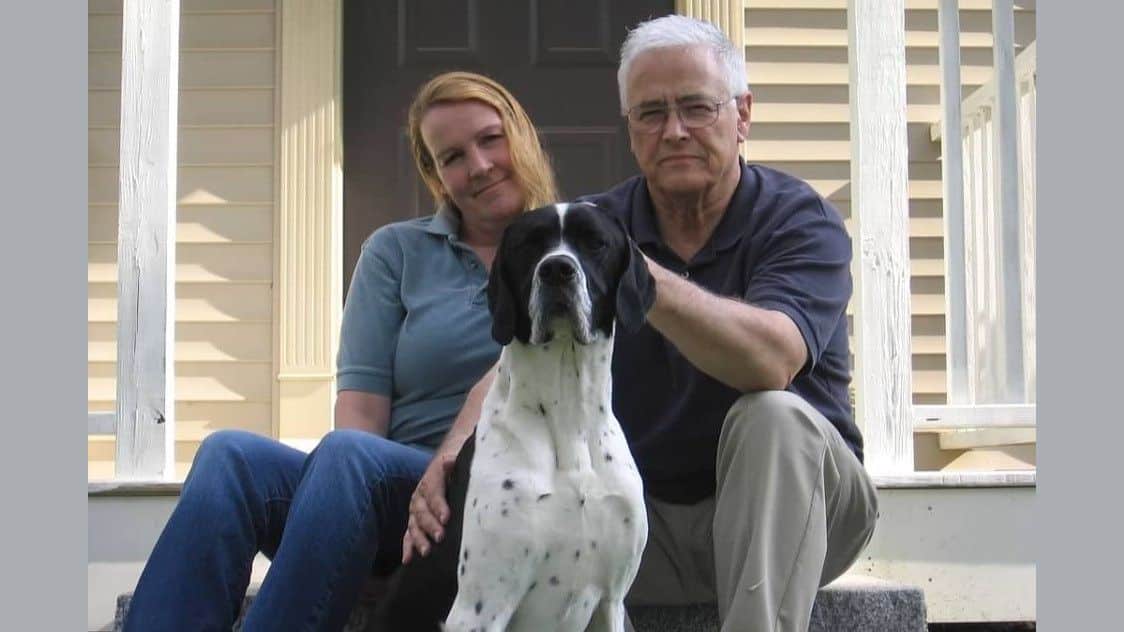
Nancy Tuthill: There are so many parallels in our lives, it could almost be an episode of “Stranger Than Life.” Henri was born in Chicago and moved west to Point Loma (San Diego), California, at age five. By design or coincidence, I was born in a hospital in Point Loma 19 years later, less than three miles from where Henri grew up.
Nancy Tuthill: Neither Henri nor I grew up in “dog families,” but we have always loved dogs, and would bring home a stray puppy or kitten at every opportunity. As a child, my goal was to have a kennel, which I would carefully draw with all the breeds represented. Henri did exactly the same thing.
Nancy Tuthill: Henri first became involved in purebred dogs with English and Irish Setters in the late 1950s and early ‘60s, with close association to Roy and Nedra Jerome of Innisfail Irish Setters. Nedra was a wonderful artist, and their knowledge of structure and function in Irish Setters, and Sporting dogs in general, was a huge influence on Henri. Tom Tobin (Heritage Irish Setters) was the model of what a handler and true sportsman should be.
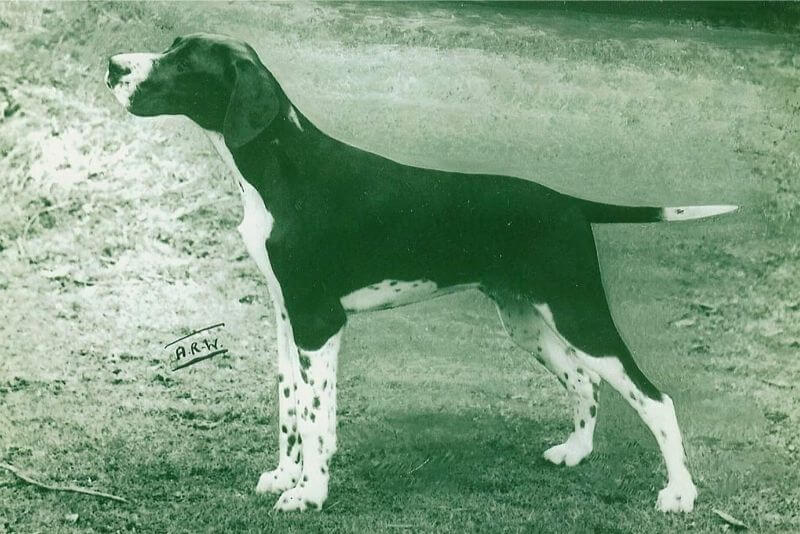
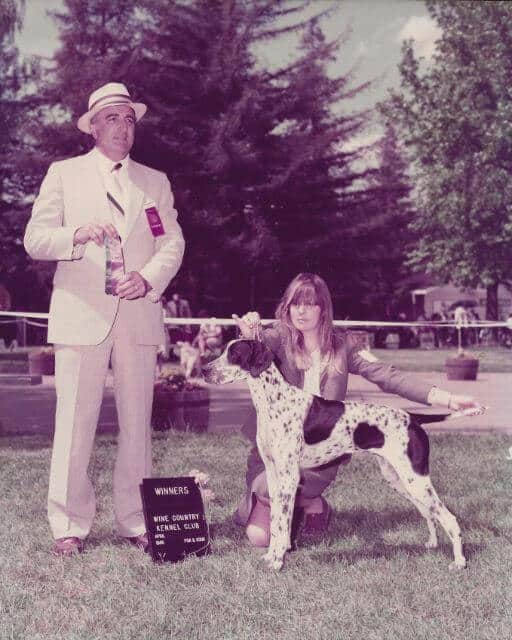
Henri gradually shifted his focus to Pointers, and in the late 1960s he met Mrs. Floyd B. Evans of Tyler Showfield kennel who had recently traveled to England. She showed Henri a Super 8 film she had taken at Crufts, and on that reel was a Mr. George Holliday showing his Pointer Cumbrian Crusader. Henri wrote to him, and over a span of three years imported seven Cumbrian Pointers, and eventually was gifted with the Cumbrian kennel name.
In 1980, I bought a field Pointer puppy advertised in the paper in San Diego. I had no idea that there was a split between field- and show-type Pointers. I entered my field Pointer at the Cabrillo Kennel Club show in 1981. The other exhibitors that day were not kind to us and I left with my “wrong kind” of Pointer. Instead of giving up, I decided to find a show Pointer puppy. It happened that Henri Tuthill, now living in Anaheim, California, had a litter, and I purchased my show puppy. One year later, Henri invited me to accompany him to a circuit in Northern California at the Cow Palace. I never returned to San Diego. That “wrong kind” of Pointer eventually went to a wonderful family and became a titled AKC Amateur Field Champion.
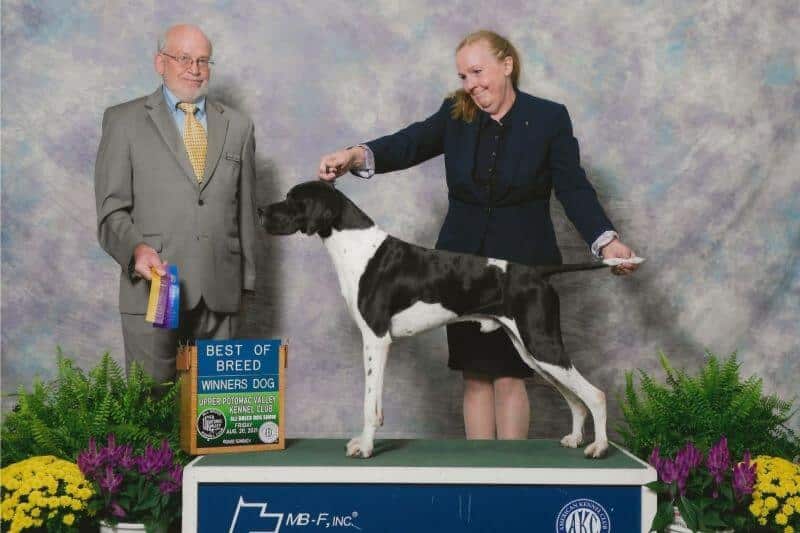
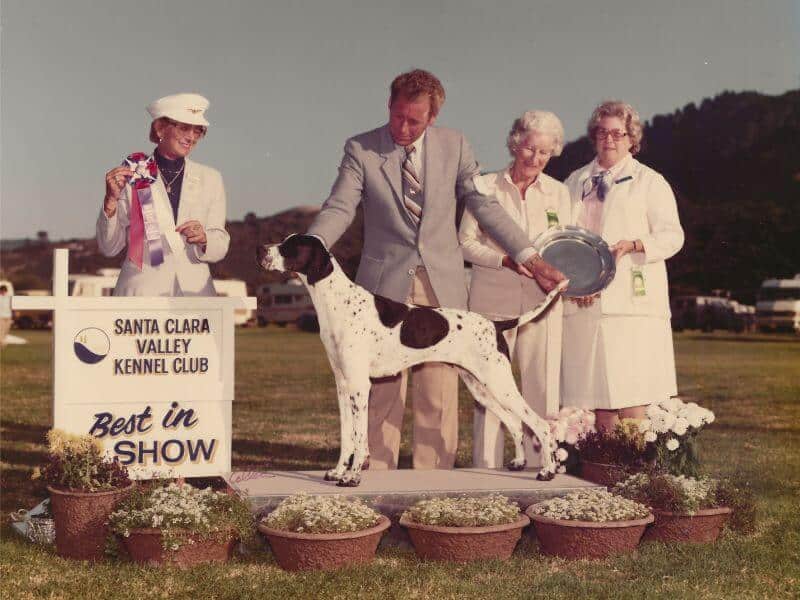
To date, we have bred 151 AKC Pointer champions, as well as more than 50 that we owned and finished. Add to those, champions and CC winners from other countries. We have owned and bred champion Whippets, English and Irish Setters, and bred some top-winning Smooth Fox Terriers in the past. Cumbrian has had many “firsts” to our credit. We had the first black-and-white Pointers imported and exhibited in the show ring in the 1960s, an era when Pointers were liver-and-white. Ch. Cumbrian Sea Breeze was the first orange-and-white Pointer to win a National Specialty. Henri bred Ch. Cumbrian Black Pearl, the No. 1 Sporting Dog, piloted by Corky Vroom and backed by Nathan and Gloria Reese. Black Pearl broke the all-time BIS record for Pointers that had stood since the 1920s with Mrs. Geraldine Rockefeller Dodge’s Ch. Nancolleth Beryl Of Giralda. The journey leading us to where we are today has been a privilege.
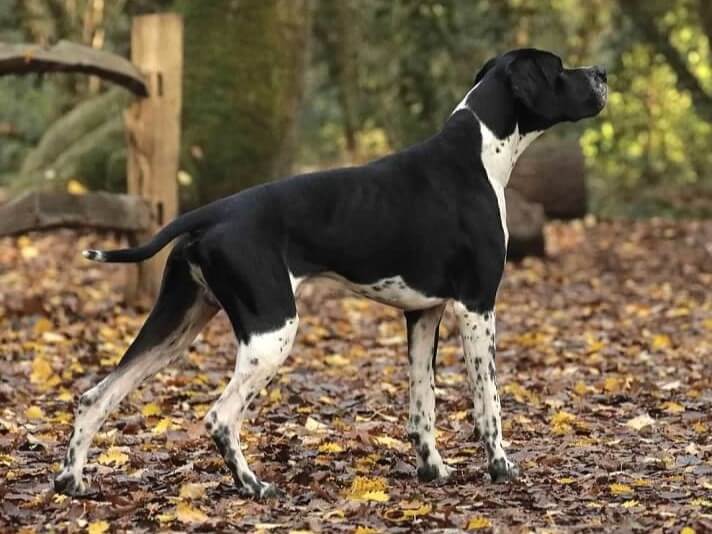
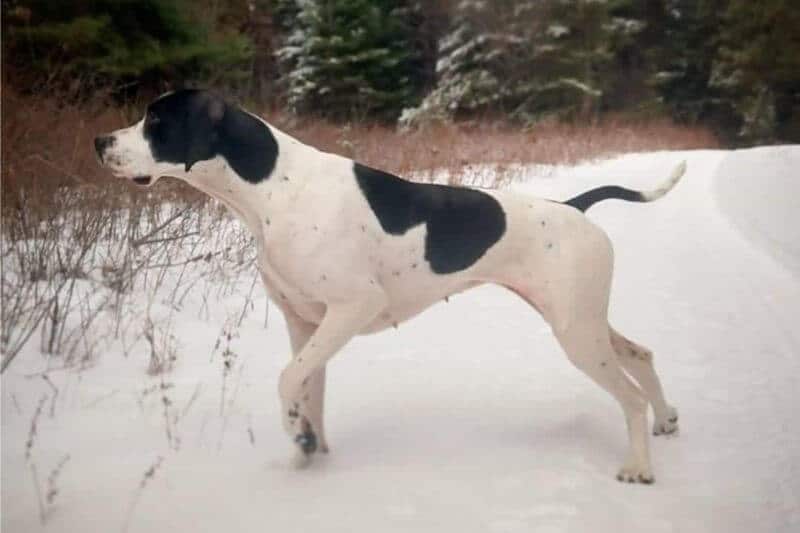
Nancy Tuthill: Goals change, and at some point, we changed our focus from chasing the numbers game to the preservation of our unique gene pool. Our line of Pointers, Cumbrian, was founded in the late 1950s in England by George Holliday, and passed to Henri. Maintaining that type has been our lifelong goal. Our main philosophy in breeding is that, above all else, the Pointer is a Sporting dog and must be able to do what it has been bred to do. You must have correct structure and balance. When breeding Sporting dogs, you should always adhere to the philosophy that you have to breed an animal that can fulfill its purpose.

Nancy Tuthill: Our private kennel is licensed for 25 dogs. We have a facility that is ideal for dogs, with an indoor, temperature-controlled environment; bathing, laundry, and kitchen areas; a whelping room, camera monitored with a separate entrance so that whelping mothers are comfortable in a stress-free environment; as well as indoor “apartments” for the dogs, with comfort in mind. We have covered, outdoor Mason brand kennels on block with a dog yard and an adjoining 450 x 75-foot, double-fenced paddock. Our entire property is fenced as well.

Exercise is the most important part of our day. It is a wonderful sight to see our entire kennel of Pointers in a full-out run! In addition, we have an indoor Jog-a-Dog for exercise in bad weather. We have “Puppy Town,” which is posted daily on Facebook when we have a litter. The scope of our socialization is an entertaining legend on our media page! We breed one litter a year, on average, because we want to enjoy the experience as much as possible. We plan, breed, and are the primary exhibitors and owners of Team Cumbrian Pointers with Darrell and Amy Crate, whom we are partnered with. Puppies that leave here go to lifetime family homes who have been with us for several decades.

Nancy Tuthill: We are fortunate in our breed to have many younger, dedicated breeders who have well-developed breeding programs and are successful year after year, with good, consistent, correct type and structure. They are the ones who will carry the torch forward.


Nancy Tuthill: I wish that newer exhibitors had more access to information about the breed and its history. Unfortunately, there is insufficient access to this knowledge, with few breed books, most of which are out of print and difficult to find. We have a comprehensive historical Pointer archive and we provide information to anyone who asks. Our breed is a wonderful example of both function and beauty. Its history can be traced to antiquity, and the history is worth sharing.
On a local level, we participate in many venues at our kennel club, with Conformation classes and Performance events, in an effort to bring new people into the world of purebred dogs. Dog clubs are also suffering from the fact that their membership is aging, but that is a subject for another time!


Nancy Tuthill: Time grows short for us. The simple truth is it’s very costly to operate a private kennel and maintain a breeding program when you have generations in your care, from baby puppies to elders. We have no family members who will carry our life’s work forward and we don’t breed outside our Cumbrian lines, so most likely, when we are no longer able to maintain our breeding program, it will slip beneath the waves. It will always live on in the history of the breed, but I don’t see any avenue for the actual breeding aspect to continue.

Nancy Tuthill: When we are not doing dog-related chores, we are compiling our archive of breed history. We are huge movie fans, and that love of films passed on to our son Michael who is a successful filmmaker with several award-winning movies to his credit, and a couple streaming on Amazon. Our entire life was formed around the love of the Pointer breed, and I am fortunate enough to be able to spend every day with the Pointers. Henri works in the data science field of cancer research.
Thank you for the opportunity to share our story.