Members
Exploring the Fox Terrier’s form, function, and historic comparison to the hunter horse – strength, stride, and purpose in motion
The Weekly Brief
The best of SHOWSIGHT editorials, weekly wins, and breeder commentary — delivered to your inbox every Sunday morning.
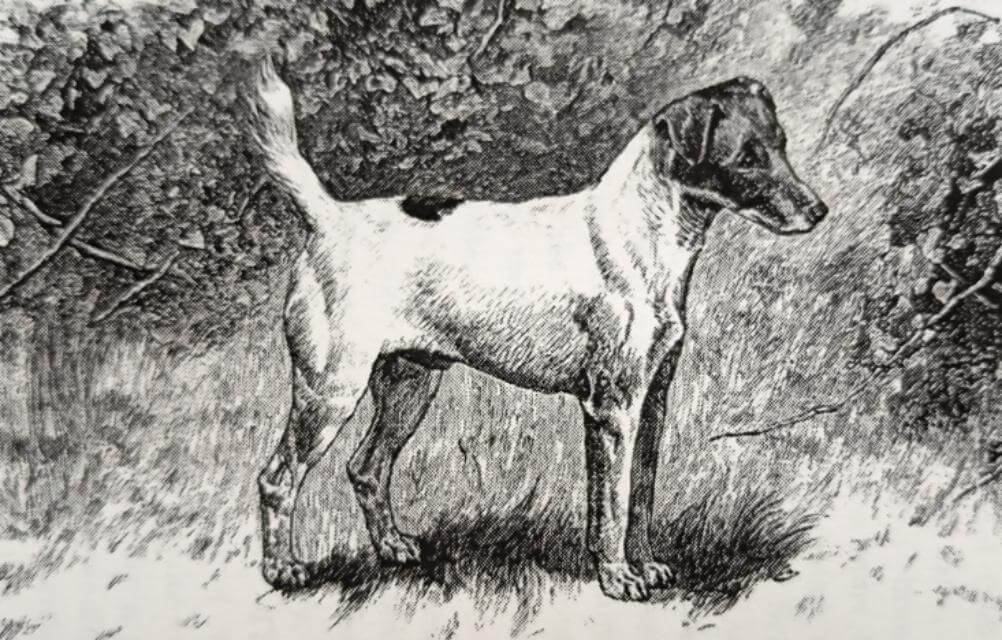
GENERAL APPEARANCE: Active and lively, bone and strength in small compass, never cloddy or coarse. Neither leggy nor too short in the leg, standing like a well made, short-backed hunter, covering a lot of ground.
GENERAL APPEARANCE: Active and lively, bone and strength in small compass, never cloddy or coarse. Conformation to show perfect balance; in particular this applies to the relative proportions of skull and foreface, and similarly height at withers and length of body from shoulder point to buttocks appear approximately equal. Standing like a short-backed hunter covering a lot of ground.
The Fox Terrier was first recognized among the original 40 breeds entered in Vol. 1 of the Stud Book managed by Sewallis Shirley’s spanking-new Kennel Club in 1874. Standards were not part of this archive or even within the sphere of activities of the Kennel Club. They were drafted by the breed clubs (the first Fox Terrier Club formed in 1876) and collected in the successive editions of Vero Shaw’s The Illustrated Book of the Dog.
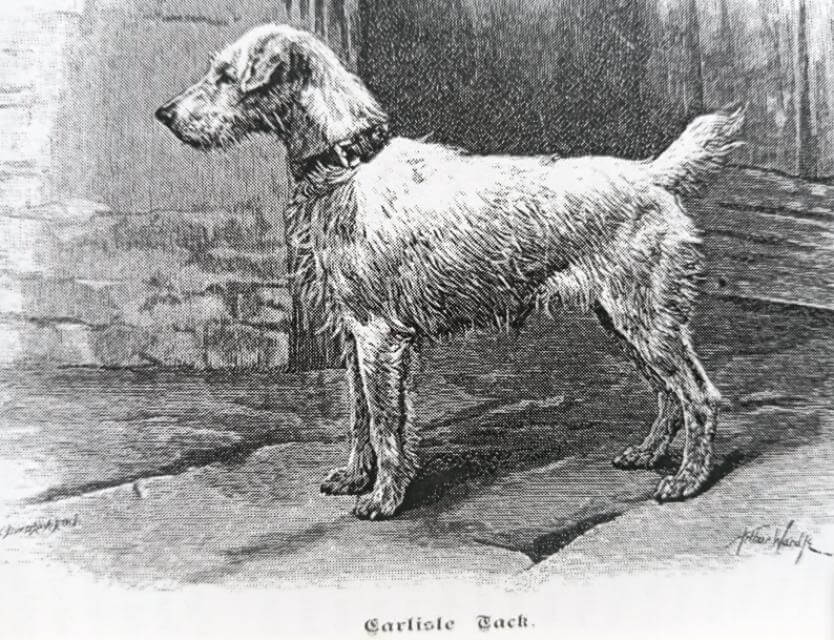
The curious comparison between the Fox Terrier and a hunter (horse) in today’s Standard is often cited but rarely analyzed. It appeared for the first time in Dalziel’s comments on the breed in 1879.2
“Symmetry, Size and Character—The dog must present a generally gay, lively, and active appearance. Bone and strength in a small compass are essentials; but this must not be taken to mean that a fox terrier should be cloggy or in any way coarse. Speed and endurance must be looked to as well as power, and the symmetry of the foxhound taken as a model. The terrier, like the hound, must on no account be leggy; neither must he be too short in the leg. He should stand like a cleverly made hunter—covering a lot of ground, yet with a short back as before stated. He will thus attain the highest degree of propelling power, together with the greatest length of stride that is compatible with the length of body. Weight is not a certain criterion of a terrier’s fitness for his work. General shape, size, and contour are the main points; and if a dog can gallop and stay and follow his fox, it matters little what his weight is to a pound or so, though, roughly speaking, it may be said he should not scale over 20lb in show condition.”
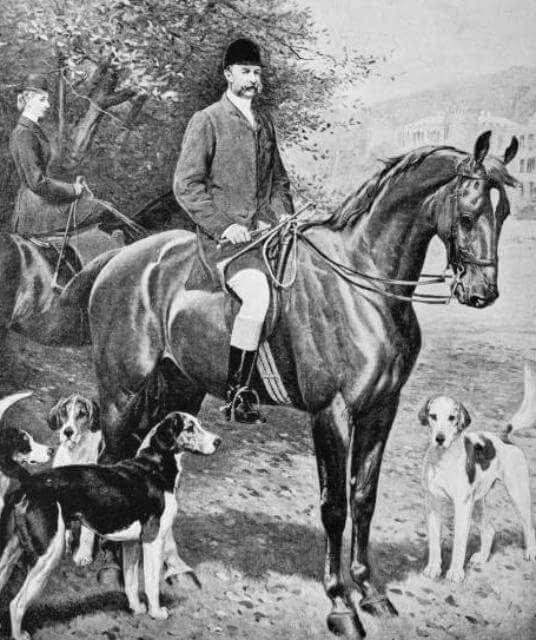
Different authors have attempted to show how the Fox Terrier is like a hunter in anatomy, so let’s explore this view of the analogy beginning with a fundamental question: “How should a good hunter be built?”
Mind you, we are not talking about a breed of horse. In the early days of fox hunting, both horse and dog were types rather than breeds. Just as the Fox Terrier was any dog that could worry the fox enough to bolt him, any horse that could successfully follow the hounds was a hunter. Different strains were considered best, especially when mixed.3
“The best hunting horse needs to be bred for the job, ideally three-quarter bred with the rest Irish Draught with plenty of bone and heart room, a good shoulder, a short back and legs, a large engine behind and enough of a front to make you feel safe. And, of course, good feet. No hoof, no horse is absolutely true.”
Though some racing thoroughbreds and event show jumpers moved on in their career to hunting, they are not ideally constructed for the job. A small, strong, sturdy horse was much more suited to rural terrain and awkward jumps than the leggy, racy, and high-strung racing types.
“…the best hunting horse needs not to be overly big or particularly fast and very long-striding horses are not the answer. To be able to canter downhill into a 5ft hedge and the horse to be able to back off by himself is the ultimate… horses that are overly competitive may not settle in the field or queue. They are better off becoming eventers.
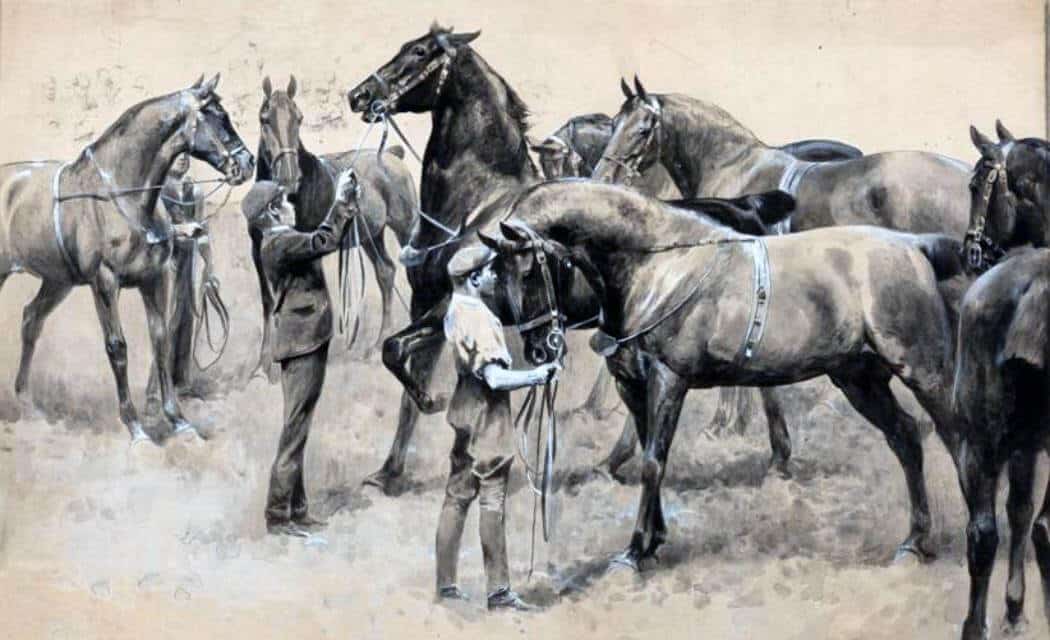
“The best hunting horse is valuable in itself, needing to be brave and calm. They need to be able to do everything… an equine all-terrain vehicle – hardy, handy, economical, and suited to its job.” 4
How about the dog? What was the ideal type that could be useful in the fox hunt? Versatility and speed emerge as the primary qualities required of a Fox Terrier.
“It must not be thought for a moment that this chapter advocates large terriers. On the contrary, there can be no doubt that the ideal dog is one who can follow his fox anywhere, and yet has size and speed enough to enable him to get over the ground.”
In the texts by Dalziel, his observations decidedly emphasize the ability of the dog to cover ground (at the gallop). His comparison to the hunter is inserted between comments on length of leg and what today would be termed reach (length of stride) and drive (propelling power). The reference therefore seems linked to speed and efficiency rather than any aspect of morphology.
This point is borne out today when our knowledge of anatomy is far greater than that of the 19th century, and now we know exactly why dogs and horses serve different purposes and have different morphologies. (Please see the exerpt from Zink)
“With increasing numbers of dogs competing in sports competitions, it is critical for veterinarians to thoroughly understand canine locomotion and gait. While equine gait is taught in veterinary school, few curricula include information about canine gait, which has both similarities and differences to horses. Dogs are built very differently from horses and that is reflected in their use of different gaits. In fact, dogs use some gaits that would be considered completely abnormal in horses. There are three structural features that make dogs different from horses:
What, then, can be considered the similarities between the Fox Terrier and the hunter if we exclude topline, head, neck, and other aspects of conformation? We find in the Fox Terrier Standard that, like the hunter described in The Field, this dog must have good bone, space in the chest for organs (thoracic length and depth), a short back (not longer than the total length of head and neck), a powerful rear assembly (well-muscled with springy angles), some development in the breast (prosternum development), and especially, a well-placed shoulder (lying as parallel to the ribs as possible and oblique enough to leave only a finger or two between the cranial angles). The feet (small, compact, and arching) are also important.
We cannot really get any more specific than this because, as we have seen, the nature of the two animals is profoundly different, starting from the simple fact that horses are weight-bearing animals and dogs are not. When the final and determining phrase “covers a lot of ground” sums up the description of the Fox Terrier from Dalziel’s day to ours, we must allow that the dog and the horse, especially in their biomechanical aspects, will cover ground each in their own way.
In our evaluation, therefore, the free-standing Fox Terrier must show above all “strength in small compass,” hardiness, fitness and versatility, courage and intelligence, and he must possess all the necessary points of anatomy that guarantee his ability to “cover a lot of ground,” showing “plenty of liberty and galloping power.” 6
With the passing decades of the 19th century, speed, both for horse and dog, became increasingly desirable. At the end of the century, fox hunting was less about ridding tenants of pesky vermin and more about fashion for the young gentry who wanted to be seen at the right house parties and cut a dashing figure on horseback in their smart apparel. The hunts no longer had time to fetch the terrier from a cottage, and carrying them was tiresome; the new fashionable dogs had to keep up with the pack, and often enough the whole party would prefer to find a new fox rather than wait for the dog to bolt the quarry.
By the time Vero Shaw published the first Breed Standard, Fox Terriers were already used more on the show bench than in the field. A handsome Fox Terrier as a companion was a status symbol representing the estate and stables of the landed nobility. He was well on his way to becoming the “dog show darling” he still is today.
1 FCI (Fédération Cynologique Internationale) Standards for the Smooth and Wire Fox Terrier.
2 Dalziel H., British Dogs: Their Varieties, History, Characteristics, Breeding, Management and Exhibition, 1879 p 298.
3 The Fox Terrier was widely reported by authors of the times to have been mixed with the Beagle and the Bull Terrier (as it was then, not as it has evolved today).
4 The Field, with an interview with Helen Connors, Feb. 15, 2023.
5 Zink, C. M. (2013). Canine Locomotion: Similarities and Differences to Horses. Tratto da chrome
6 Vero Shaw, The Illustrated Book of the Dog, 1881, p295.
Canine Health