Members
Explore the science of canine coat color—starting with the Agouti gene—and learn how genetics shapes every dog’s hue.

The Weekly Brief
The best of SHOWSIGHT editorials, weekly wins, and breeder commentary — delivered to your inbox every Sunday morning.
When my dear friend and colleague Charlie left us, he also left behind a bit of wisdom that stuck: “George, keep educating. Don’t just test dogs—help breeders understand what those results really mean.”
So, in Charlie’s honor, I’m launching a new series, The Science of Canine Coat Color from A to Z—a guided tour through the genes that paint the coats of our canine companions. My goal? To help breeders, owners, and enthusiasts see that genetics isn’t just a jumble of letters; it’s the story of color, pattern, and sometimes even personality written in DNA.
And where better to begin than with A—for Agouti.
The A locus, also known as Agouti, controls how black and red pigments are distributed across a dog’s coat. It’s responsible for some of the most beloved and instantly recognizable patterns—fawn, sable, agouti (wolf sable), tan points, and recessive black.
But here’s the twist: what you see on the outside isn’t always what’s hidden in the genes. A dog can carry “silent” Agouti alleles that don’t appear until the right partner comes along. That’s why two fawns can surprise everyone by producing a tan-point or agouti puppy.
Now, my Griffon, Mary, is convinced she’s a “limited-edition shade”—a mix of mystery, mischief, and glamour. She’s not wrong. The Agouti Signaling Protein (ASIP) gene behind her coat acts like a clever switchboard, turning pigment on and off within each growing hair shaft. The result? Those dazzling black-and-tan contrasts, shimmering sables, and rich fawns we see trotting proudly through the show ring.
For decades, scientists wrestled with the Agouti puzzle. It wasn’t simply “black or gold”—other genes kept crashing the party. The Dominant Black (K locus) and the Melanocortin 1 Receptor (MC1R) gene often override or mask Agouti patterns entirely, making visual predictions as unpredictable as Mary’s attitude toward bath time.
Until recently, genetic testing recognized just four main ASIP variants:
But these didn’t tell the whole story. Breeders kept seeing unexplained shades and patterns that didn’t quite fit into those four boxes.
Enter Dr. Danika Bannasch and her research team, who decided to look deeper—not at the colors, but at how the gene turns them on and off. Their breakthrough uncovered two “promoter” regions in the ASIP gene that act as conductors of this color orchestra:
Different combinations of these promoters produce five main Agouti-based coat patterns: Dominant Yellow, Shaded Yellow, Agouti, Black Saddle, and Black Back.
And for those who like to color outside the lines, a sixth pattern—Recessive Black—results from a variant elsewhere in the gene.
The A Locus Alleles (from most to least dominant)
The dominance hierarchy (ay > aw > at > a) is straightforward—until other genes get involved. The K locus (Dominant Black), E locus (mask, cream, or red), and S locus (white spotting) can all modify or mask what Agouti is trying to show.
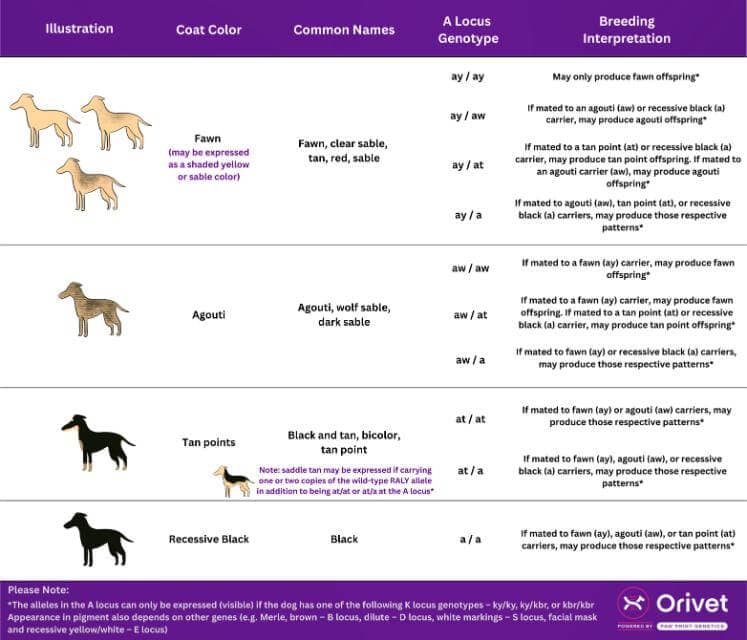
Understanding the A locus is vital for breeding plans and color prediction. Using the A Locus Coat Color Graphic (developed by our talented geneticist and AKC Breeder Samantha Van Buren, who also breeds Mudis), breeders can see how these alleles combine:
Because coat color isn’t governed by one gene—it’s a genetic conversation. The A locus interacts with others like the K and E loci, meaning two puppies from the same litter can look entirely different. One might express the classic black-and-tan pattern, while another, carrying a dominant black allele, looks solid black.
That’s why understanding genetic interactions matters; it brings transparency to breeding, helps to manage expectations, and gives breeders the power to predict outcomes more accurately.
The A locus is the perfect starting point for our coat color journey. It reminds us that what we see in a dog’s coat is just the surface—beneath lies an elegant dance of genes, switches, and interactions shaping each unique pattern.
As Charlie would remind us, “Genetics isn’t here to confuse us; it’s here to guide us.”
By decoding these patterns, we can breed with confidence, educate with purpose, and celebrate the diversity of color that makes every dog a masterpiece—Mary included.
We’ll explore how the B locus adds depth, richness, and chocolatey goodness to the canine color palette.
To celebrate the launch of this series, the first five readers who email me at: george@orivet.com with your breed and the coat color or hereditary issue you most want to understand will receive a complimentary Full Breed Profile (valued at $130).
Let’s keep learning, questioning, and celebrating genetics—together, just as Charlie would have wanted.
Canine Health