Members
Humans and dogs mirror yawns – a sign of empathy. Discover how contagion yawning reveals the emotional bond across species.

The Weekly Brief
The best of SHOWSIGHT editorials, weekly wins, and breeder commentary — delivered to your inbox every Sunday morning.
Picture this: you are riding in a car with a friend, and she yawns. A few seconds later, you yawn too, even though you’re not tired or bored. Your friend yawns again, and this time you decide you are going to resist yawning. But you can feel the darn yawn building in your throat until you just have to let it out! In fact, you might actually be stifling a yawn just from reading this! Congratulations—you’re human!
Contagious yawning affects about 45 to 60 percent of healthy adult humans. It is thought to be associated with our capacity for empathy, so pat yourself on the back if you just yawned. When people yawn contagiously, neural networks responsible for empathy and social skills are activated. In addition, people who score higher on self-recognition, theory of mind, and empathy are more susceptible to yawn contagiously. Further, the contagious effect of yawning is impaired in subjects suffering from empathy disorders such as autism.
Well, it turns out that dogs also yawn contagiously.
The first study to show contagious yawning in dogs demonstrated that a whopping 72 percent of the dogs yawned after observing a human experimenter yawn. Interestingly, in both humans and dogs, just the sound of a yawn can elicit a yawning response. But yawning in dogs can also indicate mild to moderate stress, and up until now, none of the studies showing contagious yawning in dogs hard ruled this out as a possible reason for the dogs yawning.
The authors of a recent study therefore set two goals:
Twenty-five adult dogs of a variety of breeds and mixed breeds were used in this study, with equal numbers of males and females. Dogs were exposed to the owner or an unfamiliar human either yawning or making a control open-mouth movement. At the same time, the dogs’ heart rates were measured by telemetry (remote measurement) to evaluate stress.
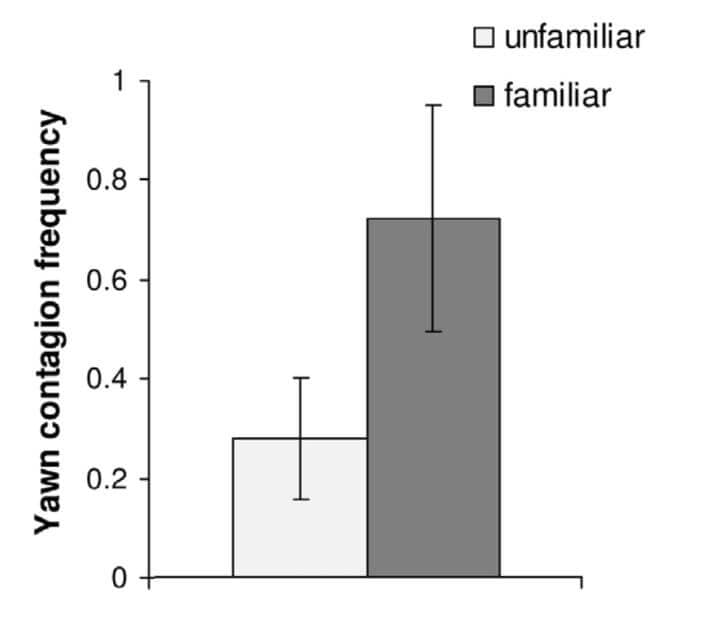
The study confirmed that dogs do yawn contagiously in response to humans, and that, as in humans, it most likely is an empathetic response. Dogs yawned in response to the true yawn significantly more often than to the control mouth movement, and they yawned significantly more often in response to their owners yawning than to an unfamiliar person (Figure 1). Apparently, contagious yawning was not related to stress as the dogs’ heart rates did not vary during any of the conditions.
Many species experience contagious yawning with others of their own species. For example, many different species of primates other than humans (chimpanzees, bonobos, gelada baboons, and stump-tailed macaques) demonstrate contagious yawning. Budgerigars (or parakeets) also experience contagious yawning with other budgies. I never even realized budgies could yawn!
But interestingly, dogs do not experience contagious yawning with each other, only when exposed to a yawning human. The authors suggest that contagious yawning of dogs in response to humans might have evolved as an adaptation for communicating with humans. I see it as a contribution to the scientific basis for the therapeutic effect of dogs and as further evidence of the ability of these incredible creatures with which we share our lives to deeply empathize with us. How lucky we are!

Canine Health