


JUDGING DOGS REQUIRES MORE THAN A GENERAL KNOWLEDGE of the structure of dogs, their movement characterstics, or even the main points of each breed’s standard of perfection. Instead, it requires some knowledge of the history and traditional work of each breed. Breed standards seek to describe dogs whose conformation and temperament are perfectly adapted to the work for which they were originally bred. With this in mind, it is critical we use historical records to accurately describe the past and the present, and to plot the future of the breed.
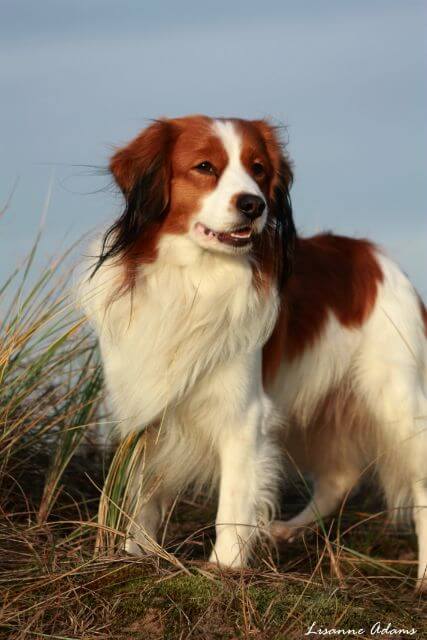
The Nederlandse Kooikerhondje, often called “Kooiker” for short, the breed is a lovely orange-red and white parti-colored spaniel with sable ear tips called “earrings.” Well-known and established in the Netherlands by the 1500s, the Kooiker appears in the paintings of numerous Dutch masters of the age, Jan Steen being especially fond of the cheerful appearance of the striking little dog.
The Kooiker’s long history is intertwined with its unique method of capturing ducks for the table. Prior to the development of accurate fowling guns, elaborate man-made duck decoy trapping systems were built, called Eendenkooi. The Eendenkooi is a Dutch invention consisting of a pond with multiple catching arms or “pipes” that extend from the pond, terminating in hidden cages. The literal translation of the Kooiker’s name is “The Dutch Duck Trapper’s Little Dog,” and the Kooiker worked in partnership with his handler to lure ducks from the pond into the pipes for capture. Sir Ralph Payne-Gallwey, in his 1886 work, The Book of Duck Decoys, notes, “The sprightlier the dog works, the better, so long as he is absolutely mute and obedient.”
The modern development of the Kooikerhondje is thanks to the Baroness Van Hardenbroek Van Ammerstol, who rescued the breed from the brink of extinction. As part of her silent resistance to the Occupation during the Second World War, she undertook the recovery of the breed. She sent peddlers out from her estate with a photograph of the dog and a snippet of cloth to help identify dogs of the correct orange-red color. In this way, she found Tommie, a bitch from Friesland, who became the foundation of the breed. The breed was recognized by the Raadvan Beheer, the Dutch Kennel Club, in 1971. In the United States, the Kooiker was added to the Foundation Stock Service in 2004, the Miscellaneous Class in 2015, and was fully recognized by the American Kennel Club on January 1, 2018.
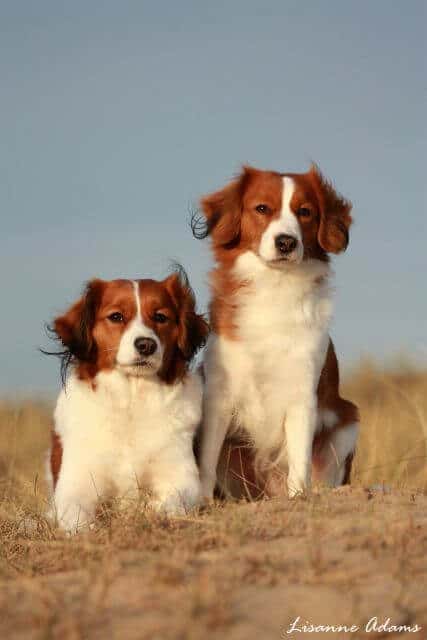
Dutch breeders and judges will tell you, first of all, that the Dutch are practical people, not fancy and not given to display. While the Nederlandse Kooikerhondje is striking in that it is a parti-colored orange-red dog with dark eyes and pigment, it is still a working spaniel with moderation being its hallmark in all ways. For this reason, the breed should be seen and evaluated in a natural, untrimmed coat. This is how they are supposed to look. The only allowed trimming is on the feet for tidiness.
The breed is slightly off-square, measured from the point of the shoulder to the point of the buttock. The elbow should be at the midpoint between the withers and the ground. Bone is strong, but not coarse, and the males are distinctly masculine and the bitches feminine. Size is strict—the “hond-JE” part of its name means “small dog.” Exhibitors know the importance of keeping the breed at the correct size lest a tendency toward “bigger, heavier, and hairier” overtake the breed. The Kooiker is always examined on the table in the United States.
The eyes of a Kooiker can melt the hardest of hearts! Oval, dark, shining with intelligence, they are a striking feature of the breed. They should be neither round nor protruding, but softly set in the middle of the face with nice distance between. Dark eyes and pigment makes for a striking face in this breed. Few other red-patched dogs have this depth of color. It is all because, in reality, this is a sable dog as is attested by the presence of black feathering on the ears and, occasionally, a black tail ring where the color changes from orange-red to white. Sometimes, black hair can be intermingled within the red patches as well. Small amounts are permitted, too much is a fault.
The standard calls for the chest, belly, and the majority of the legs and tail to be white. Color should predominate in patches on the torso only. Patches are more important than the amount of coverage, according to the Dutch breed experts. Kooikers with solid red backs—called mantles—are acceptable, but are less desirable. Eye and head patches must fully cover the eyes and ears, with the color ideally ending at the corner of the mouth with coloring on the cheeks. Our breed standard describes the color of the dog precisely and then closes with this statement: “Color should be a consideration only when all else between two dogs is equal.” The markings are of less importance than the structure beneath.
The earrings are highly desirable, but not mandatory. They can be profuse or sparse, long or the same length as the rest of the ear. Young dogs, especially, will just be growing their earrings. No dog should be penalized for lack of earrings. Ears are set on a line from nose through the eye, but never above the top of the head. Tufts of hair that stick up above the ear are another characteristic of the breed and should never be trimmed away, as are the whiskers adorning the muzzle. The ear leather itself should easily cover the eye on the same side of the head. This gives correct ear size and prevents small or overly large ears from creeping in.
Coat is an area that is a pride of the Kooikerhondje. This weather-resistant coat, with its functional undercoat, has no tendency towards matting or snarling, thanks to the texture. This texture is apparent even in young dogs. Most bitches carry far less coat than the males, and may have sparse coats after a season. Males tend to have full, dense ruffs, longer tail and leg feathering, and more hair in general.
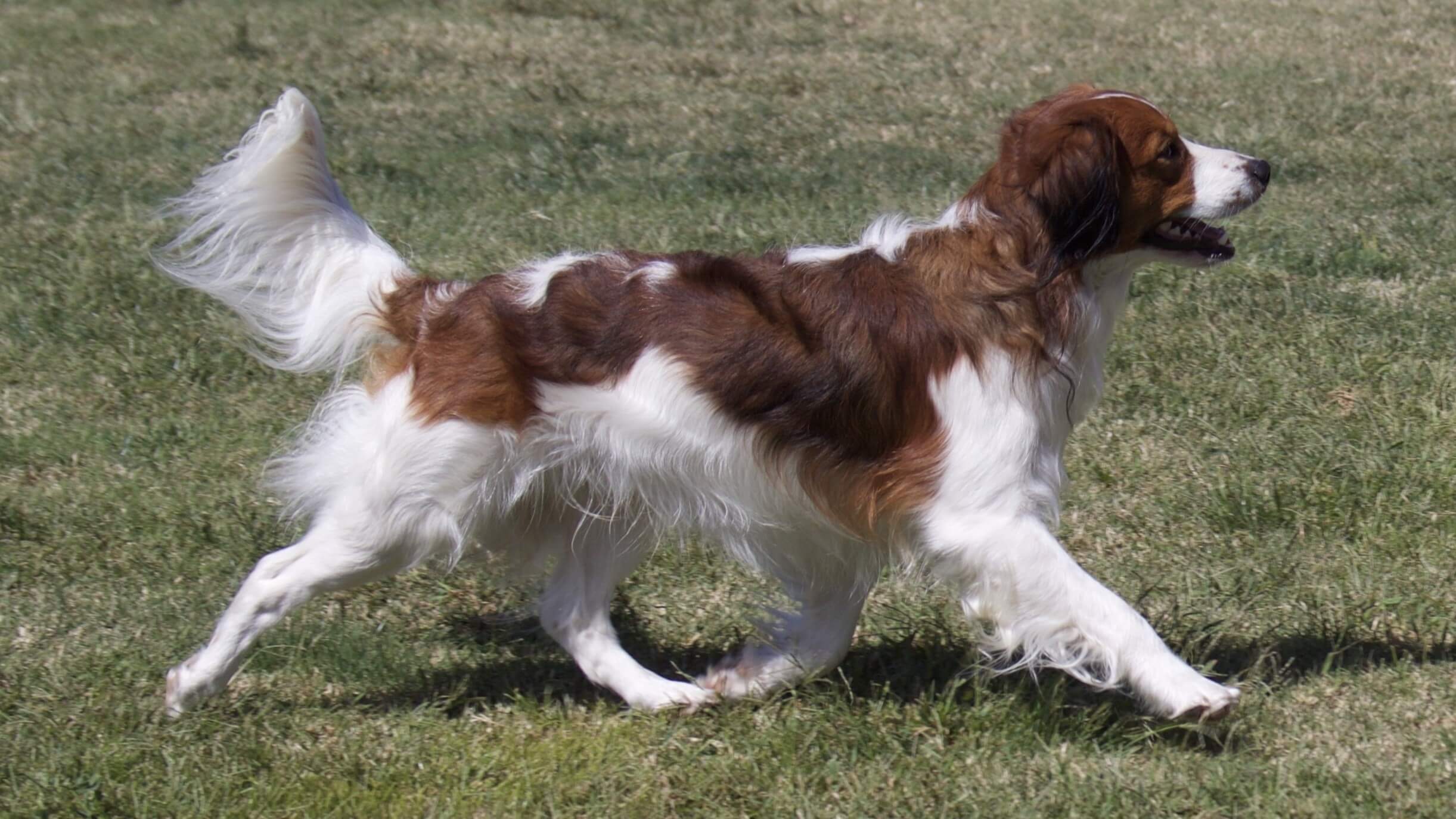
An important working feature of the breed is the tail. The tail vertebrae should reach at least to the hock joint. Short tails are less visible to the ducks following the dog in the traps and are considered a severe fault. The Kooiker in motion carries that white-plumed tail above the level of the back, but never forward over the back or tightly curled.
In keeping with the dog’s sprightly work in the Eendenkooi, the movement of the Kooikerhondje should be light, effortless, and flowing. Think of a bubbling brook as it wends its way across a meadow. So too should the Kooikerhondje move about the ring—with ease and joy in every step.