Members
Legacy breeder Gretchen Hofheins-Wackerfuss shares 40 years of Miniature Pinscher insights, wins, and wisdom in this interview.
Joanne Wilds, Vice President/Delegate Miniature Pinscher Club of America, Inc.
The Weekly Brief
The best of SHOWSIGHT editorials, weekly wins, and breeder commentary — delivered to your inbox every Sunday morning.
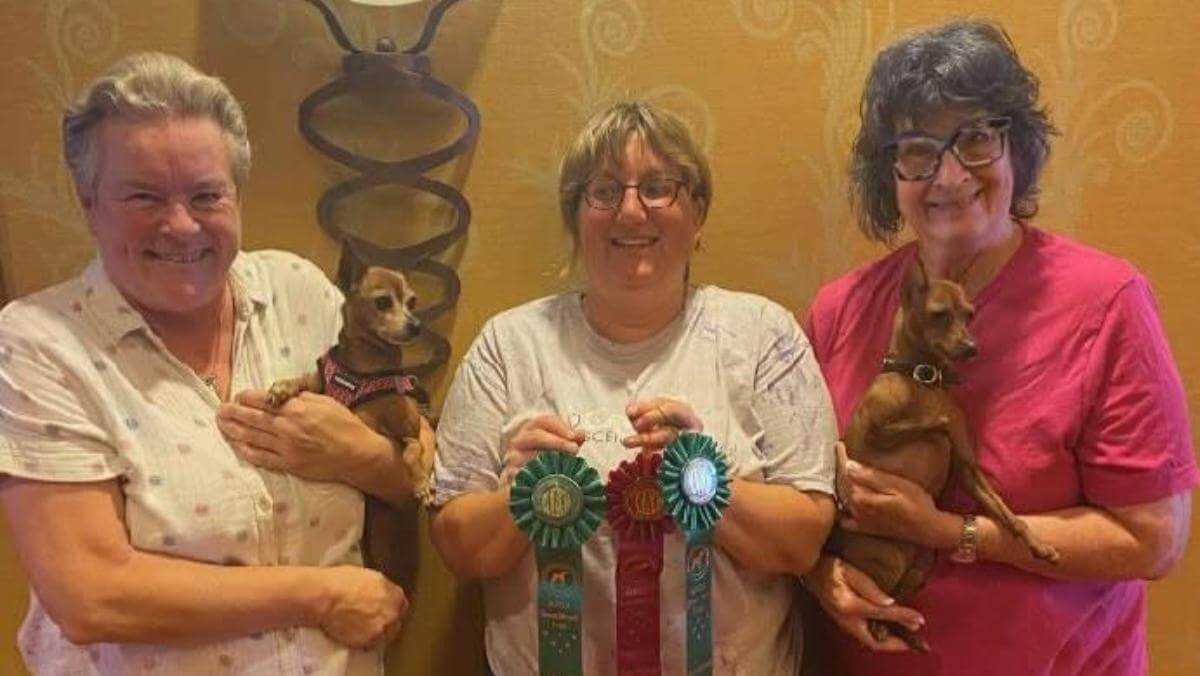
Using the question bank provided by the AKC (American Kennel Club) Parent Club Committee, I have been working to collect interviews with our Legacy Breeders. This is my first interview of the series. Our interviewee is Gretchen Hofheins-Wackerfuss. Gretchen has been breeding/showing/competing with her Sultans Miniature Pinschers for nearly 40 years.
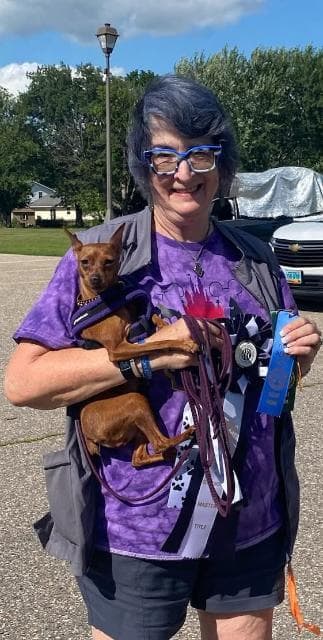
Gretchen Hofheins-Wackerfuss: I have been involved in Miniature Pinschers since 1987. I bred my first litter in 1992.
Gretchen Hofheins-Wackerfuss: I bred and showed the first-ever MPCA (Miniature Pinscher Club of America) Futurity winner, CH SULTANS SULTRY TEMPTRESS, in 1995. She was the dam of the 2001 Futurity winner, CH SULTANS SUSPECT. She was a multiple Group winner, multiple winner at our National Specialty, including Best of Opposite Sex, Award of Merit (AOM); and as a Veteran, multiple Veteran Sweeps winner, National Veteran class winner, and two AOMs from the Veteran class. She is in the Hall of Fame of Dams. I bred the Winners Bitch from the 1996 National Specialty, and numerous National Award winners. I bred, trained, and showed a multiple National Specialty High in Trial (HIT) dog, SULTANS LOVIN’ SIREN UDX, along with numerous other Champions, Grand Champions, and title holders.
Gretchen Hofheins-Wackerfuss: In 1995, I won Best of Breed and Junior Sweepstakes with my dog CH HACKBERRY SYRUS, Futurity with CH SULTANS SULTRY TEMPTRESS, and High in Trial with SULTANS LOVIN’ SIREN UDX. To date, I have heard of no other person winning all of these at one single National Specialty in any breed. I also owned and trained the first Min Pin to achieve the AKC overall Master Scent Work title, GCH MARLEX SUNSPRITE MARTINI SWM CGC TKN FCAT ACT ACTJ. I bred and trained the third dog to achieve the same title, CH SULTANS SHOCKADELICA SWM CGCA TKN FCAT ACT ACTJ.
Gretchen Hofheins-Wackerfuss: Fearless, animated, and very busy. Think of a flea on a leash.
Gretchen Hofheins-Wackerfuss: They really can get enough exercise in a home or condo, so a large house or yard is not a deal breaker. Small children are okay as long as they are taught this is a living animal, not a toy. They must be aware how fast a Min Pin is and can climb a fence as fast as you can blink, and can run like the wind. You need to be quick owning a Min Pin.
Gretchen Hofheins-Wackerfuss: My main goal now is to enjoy my dogs and do fun things with them; life is short. I would still like to win the Puppy Sweepstakes at the National, something I have not won.
Gretchen Hofheins-Wackerfuss: I grew up showing American Saddlebred Horses, and they have always reminded me of them with their hackney-like gait.
Gretchen Hofheins-Wackerfuss: The greatest challenge has been at the Group level; a lot of judges seem to prefer the “fluffy” dogs. A Min Pin is in its underwear. Also, the politics of the professional handler versus breeder/owner-handler. Come on, this exists.
Gretchen Hofheins-Wackerfuss: John MacNamara, Ann Dutton (my mentor), Dave and Sherrie Krogh, Tom Baldwin, Marcia Tucker, Armando Angelbello, Vera Bistrum, Carol Garrison, Pam Ruggie, Dr. Burris Boshell, and E. W. Tipton, Jr.
Gretchen Hofheins-Wackerfuss: Ann Dutton, Sanbrook Kennels. I learned so much about pedigrees, dominant features in the dogs, and breeding colors. There are many others in Min Pins and other breeds I have learned from.
Gretchen Hofheins-Wackerfuss: Number one is fearless and outgoing. Coming from a horse background, it is very important for a dog to be sound coming and going. So many dogs are not, converging or throwing legs outward. They need this for longevity, and for being successful in doing other dog sports.
Gretchen Hofheins-Wackerfuss: Soundness. So many will take the high-stepping hackney, without any consideration for where the feet fall on the ground. Too many breeders get hung up on one feature of a breed; it is the complete package.
Gretchen Hofheins-Wackerfuss: MARLEX CLASSIC RED GLARE, she was THE “complete package” of EVERYTHING a Miniature Pinscher should be. SANBROOK SILK ELECTRIC, sound, stunning, and could move like the wind. PEVENSEY CASH DIVIDEND, he could command a room.
Gretchen Hofheins-Wackerfuss: The stud dog would depend on the bitch you were looking to breed. I prefer dogs (and bitches) with tighter pedigrees (ones with common ancestors). Then I look for a dog that would complement my bitch, or possibly make one improvement on something she is lacking. You cannot expect a male to “fix” your bitch.
Gretchen Hofheins-Wackerfuss: More dogs have the hackney-like gait, but many of those come with other faults; soundness is the major one. We are getting better with toplines and tail sets.
Gretchen Hofheins-Wackerfuss: There are many good Miniature Pinschers, very few “great” ones. It pains me to see a class of finished Champions, wondering how in the heck some of them finished. Mediocrity seems to be very common. A great dog not only carries the attributes of the breed, but stands up and says hey look at me, and marches around the ring.
Gretchen Hofheins-Wackerfuss: Find someone to mentor you and LISTEN to them. They have the experience and know a heck of a lot more than you. I see more new people who have gotten into dogs, and they are out as fast as they are in. They will not listen or take advice from anyone, as they have learned everything they should know on the Internet or somewhere and know more than you. I guess it is the way our society has gone.
Gretchen Hofheins-Wackerfuss: No, our Standard is fine. I would like to stress to people to BREED TO THE STANDARD, not change it to fit the breed. Judges need to take note also. I see too many inferior dogs finishing.
Gretchen Hofheins-Wackerfuss: I look for a “pretty” puppy; they don’t all of a sudden become beautiful. What you see when they are young does not change dramatically as adults. They should be outgoing and exposed to all sorts of sounds and surfaces. They are the puppy that says, “Pick me, pick me!!!”
Gretchen Hofheins-Wackerfuss: Getting new people involved. The animal rights groups have done a fine job convincing people to adopt rescue and shelter dogs. The rise of the breed mixes is another. Our breed has aging members/breeders. If we don’t get newer, younger people interested, our breed, as well as many, is in certain danger of becoming a breed that used to exist. One choice for dog ownership today may be a mongrel shipped here from overseas. People need to be more in tune with legislative issues in their state and speak up before it becomes illegal to not only breed dogs, but even own them.

Meet the Breeders