


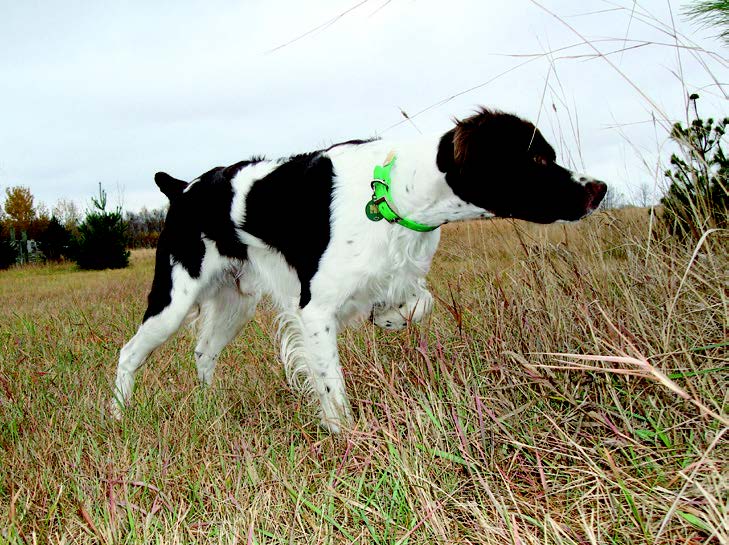
Brittany Judging Simplified | I am the Judge’s Education Coordinator for the American Brittany Club. One of the comments I hear routinely is that the Brittany is a hard breed to judge. When I ask why they think it’s hard, usually they start by listing the differences between Brittanys and the other Sporting breeds:
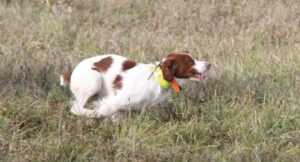 Of the three differences stated above, movement gives judges the most trouble. First, a Brittany should never be judged standing. Judge’s mouths drop open when I say this or they disagree right away. I had a judge recently take up 15 minutes of a hands-on class telling me what he liked about each dog standing. I finally looked at him and said, “OK, now let’s have them move.” When the dogs began to move, his jaw dropped, and he looked at me and said, “I see what you mean. The dogs I liked standing fell apart when they moved.” Now this isn’t always the case, some dogs that look good standing, look good moving too—but that is the point. Many dogs’ toplines change the moment they start to move. Some dogs have a short upper arm that causes them to “flip” their front, and others lose their “balance” when they move; balance being the overall balance of the dog’s conformation.
 I tell judges about what I call the “3Ms”—Movement, Moderate, and Medium. Add balance to these three things and you have a true Brittany type. Everything about the Brittany standard is written so that the dog can perform in the field. The American Brittany Club’s mission statement includes the phrase: “To keep the Brittany forever a dual dog.” We have more dual champions than all the other Sporting breeds combined. I believe that at last count (in 2013) it was 608, and later (in 2020) it was 686!
All through our standard you see the words “moderate” and “medium,” describing various aspects of the breed’s conformation. As I stated above, if you add movement and balance, you have the essence of a Brittany.
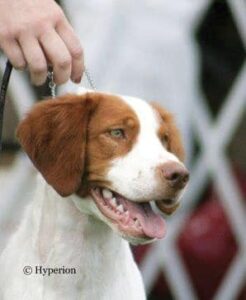
 When judges ask us what percentage the head makes up in our standard, we smile and say that we took that out of our standard because this is NOT a head breed. While we like them to have beautiful heads, it’s more important that they have a prominent brow that protects their eyes in cover, that their nostrils are full and open so they can smell birds, and that they have a good bite so they can pick up the birds for a retrieve. The most important thing is their movement, because if they do not move correctly, they will wear out quickly in heavy brush. When they have that short upper arm, they can actually injure their front legs while moving through the brush. Although coming and going is important, most important is the side movement, because this is where you can see our breed’s beautiful, ground-covering stride.
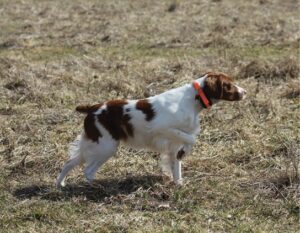
 I would be remiss if I didn’t point out the other problem that judges sometimes have with our breed: Square is in the eye of the beholder. A dog can look long in body, but when you have a chance to measure from the top of the withers to the ground and then measure from the forechest to the rear of the dog, it should be the same length. Measuring from the top of the withers to the elbow should equal the measurement from the elbow to the ground. The length of a Brittany is in the chest, which allows it to have adequate room for an athlete’s heart and lungs. If you think a dog is long, be sure to look at both sides of the dog because, many times, they have markings that further that illusion of length. A dog that is overly square will crab or sidewind because they can’t get out of their own way. I encourage students of the breed to make the opportunity to try this measuring experiment as it will help you to develop your “eye” for the correct look of a square Brittany.
The Brittany still functions in the field, and—while an individual may never get the opportunity of a field experience—if he was turned loose in a field, could he function without injury and in an athletic fashion?
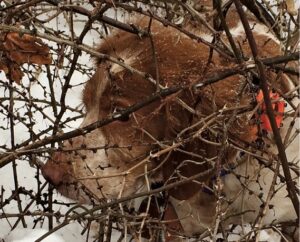
That brings me to the final point I’d like to make… coat. The Brittany’s coat should protect it in all types of cover. Our standard points out, “…too little is preferable to too much.” It says this because if you’ve ever seen a heavily-coated dog after running in the briars for an hour, you just have to wonder how long it’s going to take to get all those pesky little briars out! The Brittany still functions in the field, and—while an individual may never get the opportunity of a field experience—if he was turned loose in a field, could he function without injury and in an athletic fashion? That is a judge’s responsibility to determine when judging this wonderful, energetic, intelligent, and athletic breed with “the soft expression of a bird dog.”
I’m so glad that as I look at the Top 20 Brittanys, I can honestly say that judge’s education has made a difference. Brittanys are now being groomed and judged to our standard, and that’s a huge change from when I started showing dogs 40 years ago. Brittanys winning Breed then were dripping in coat like most of the other Sporting dogs, but today’s competitors have realized that they must groom to our standard in order to win. I congratulate all the handlers, breeders, and owners for helping to keep our breed “forever a dual dog!” Thank you, judges, for listening to our presentations and for trying your best to help protect that which we cherish in our breed—the DUAL!
by Diana Kubitz